
What Hb level is normal? Your easy-to-understand guide
There is no one-size-fits-all answer to the question, “So, what Hb level is normal?” Your optimal level depends heavily on your age and sex. As a general guide, remember: adult women have a healthy hemoglobin level between 12 and 16 g/dl, while adult men have a level between 14 and 18 g/dl.
This value is far more than just a number in a lab report—it is a direct reflection of your energy and well-being. Taking a look at it can help you better understand your body and take charge of your health.
What your Hb level reveals about your energy
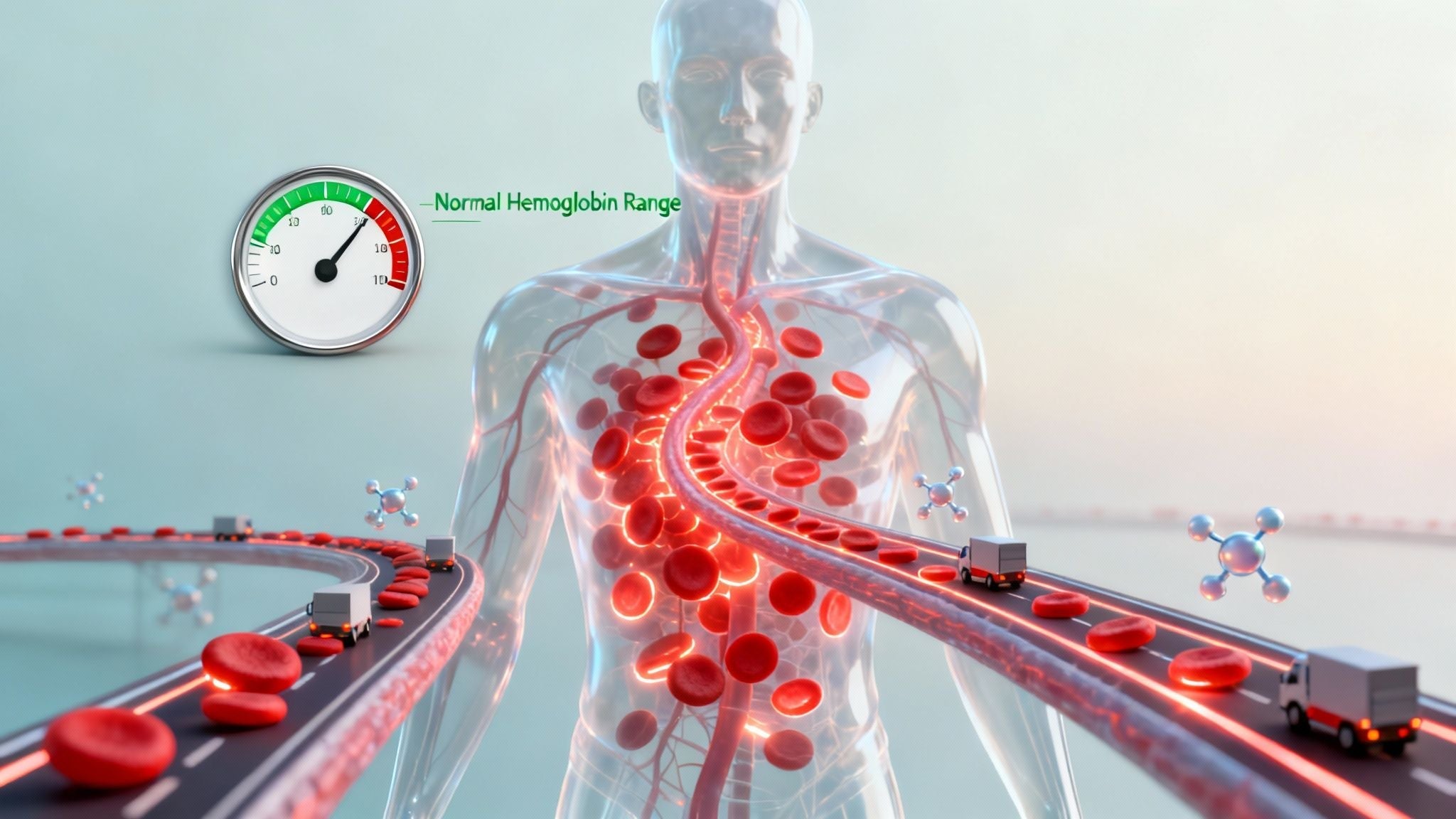
Imagine your body as a huge, pulsating city. Your red blood cells are the tireless delivery services that bring oxygen—the fuel for absolutely everything—to every single cell. From the smallest muscle to the furthest corner of your brain.
Hemoglobin is the crucial transporter in this delivery fleet. It is an iron-containing protein in red blood cells that essentially carries oxygen “piggyback” and safely delivers it to its destination. The hemoglobin level, or Hb level for short, measures how densely your delivery fleet is equipped with these transporters. It tells you how well your body is supplied with vital oxygen.
An optimal Hb level is therefore the foundation for:
- Your everyday energy: Enough oxygen means that your cells can produce the energy you need for work, exercise, and leisure.
- Your mental fitness: Your brain is a real oxygen junkie. An adequate supply is essential for your concentration, memory, and balanced mood.
- Your overall well-being: Efficient oxygen transport strengthens your immune system and helps your body regenerate.
Your personal health window
Do you often feel tired, drained, or notice that your concentration quickly wanes? Before immediately considering complex causes, checking your Hb level is often the first and most logical step. It is a central component of a blood count, one of the most basic medical examinations of all. If you want to take a deeper dive, read our article about what is examined in a complete blood count and the role the Hb level plays in it.
A deviating Hb value is not a verdict but a valuable indication. It shows you that your body may need support—whether through an adjusted diet or targeted nutrients.
This is exactly where personal responsibility begins. Instead of waiting for symptoms to worsen, you can proactively monitor your levels. A simple at-home blood test, such as the one offered by mybody®x, gives you the clarity to interpret your body’s signals correctly and take targeted control of your health. This way, you take control and ensure that your internal delivery fleet is always fully equipped.
What “normal” really means for women, men, and children
When it comes to Hb levels, there is no universal “normal.” Your ideal hemoglobin level is as individual as you are and depends on your sex, age, and even special stages of life such as pregnancy. These differences are by no means arbitrary but have solid biological reasons.
A decisive factor is hormonal makeup. Men naturally produce more testosterone, which significantly stimulates the production of red blood cells. More red blood cells automatically mean more hemoglobin, optimizing oxygen transport to supply, for example, a greater muscle mass.
For women, the situation is different. They regularly lose blood through monthly menstruation, which naturally lowers their Hb level somewhat. Their reference range is therefore set lower from the outset.
Hb values in women and men
In Germany, there are clear differences between the normal hemoglobin values (Hb values) for men and women. In adult women, the reference range is usually between 12 and 16 g/dl (grams per deciliter) or 120 to 160 g/l (grams per liter). Men have higher average values of 14 to 18 g/dl (140 to 180 g/l).
The World Health Organization (WHO) has also defined clear thresholds: Anemia is diagnosed in women at values below 12 g/dl and in men below 13 g/dl. If you would like to delve deeper into the world of laboratory values, you can find additional insights in the further information about hemoglobin on fernarzt.com.
The following graphic clearly shows the differences at a glance and presents the typical normal Hb values for men and women in direct comparison.
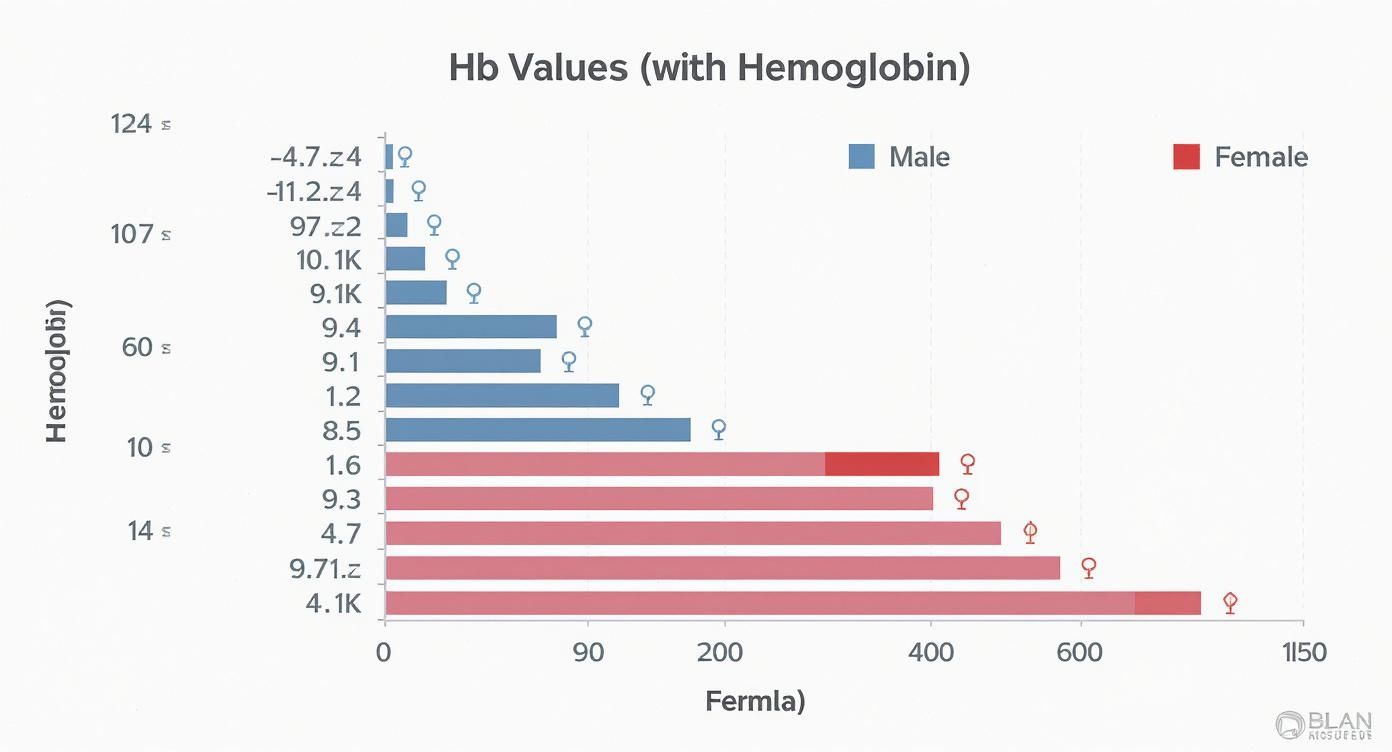
You can see it immediately: the lower limit for men is already at the level of the middle range for women. This impressively underscores the biological differences.
Your personal Hb level is more than just a number. Always consider it in the context of your sex, age, and lifestyle to gain a complete picture of your health.
Special requirements during different stages of life
It is not only sex; exceptional life circumstances also have a major influence. During pregnancy in particular, the female body undergoes a complete transformation.
-
Pregnancy: Did you know that blood volume increases by up to 50 % during pregnancy? However, this increase consists mainly of blood plasma. The number of red blood cells cannot keep pace, leading to a kind of “dilution effect.” That is why Hb levels naturally decrease—values between 10.5 and 12 g/dl are often still considered completely normal here.
-
Children and adolescents: In children, levels develop alongside growth. Newborns start with very high Hb levels, which then fall during the first few months of life. Throughout childhood and adolescence, the levels gradually rise again until they eventually reach the normal ranges for adults.
This knowledge of the specific reference ranges is invaluable for correctly interpreting your own laboratory results—such as those from a mybody®x blood test. A single value is rarely meaningful on its own. Rather, it is one piece of the puzzle whose true significance only becomes clear when viewed in the overall context of your individual situation.
Recognizing symptoms of low Hb levels and anemia
Do you often feel tired, pale, and unable to concentrate, even though you actually get enough sleep? These could be the first signs of a hemoglobin level that is too low—better known as anemia or, colloquially, “low blood count.” If your body cannot produce enough hemoglobin, the vital transport of oxygen becomes impaired.
Think of your body as a high-performance engine. Without enough oxygen as fuel, it simply cannot get up to speed. The result: a noticeable decline in performance that affects your entire body.

When the body operates in energy-saving mode
A lack of oxygen in the cells forces your body to operate in energy-saving mode. This can manifest through a whole range of symptoms that often develop gradually and can therefore easily be overlooked.
The most common signs of a low Hb level are:
- Persistent fatigue and exhaustion: You constantly feel weak and drained, even after a long night's sleep.
- Pale skin and mucous membranes: A glance in the mirror or at the inside of your eyelids can be revealing—your healthy, rosy color is often missing.
- Problems concentrating and dizziness: Your brain is particularly affected by the lack of oxygen, which can lead to memory lapses and lightheadedness.
- Shortness of breath during exertion: You become breathless even when climbing stairs because your muscles do not receive enough oxygen.
- Rapid heartbeat or palpitations: Your heart tries to compensate for the deficiency by pumping faster, sending the oxygen-poor blood through your circulatory system more quickly.
The signs on your skin, hair, and nails
However, chronic oxygen deficiency does not leave its mark only internally. Its effects often also show externally, as the body reduces the supply to less vital areas such as the skin and hair in order to protect the organs.
A low Hb level is more than just fatigue. It is a signal that your body's basic supply is impaired and that you should take a closer look.
Look out for these lesser-known but equally important warning signs:
- Brittle nails and ridges: Your fingernails become brittle, split easily, or develop vertical ridges.
- Dry, cracked skin: The skin loses elasticity and moisture.
- Hair loss: The hair roots are no longer adequately supplied, which can lead to increased hair loss.
- Cracked corners of the mouth (angular cheilitis): These painful cracks can indicate a nutrient deficiency, which is often associated with anemia.
By far the most common cause of a low Hb level is iron deficiency. Iron is the key building block for hemoglobin production. Without enough iron, your body simply cannot produce enough oxygen carriers. Learn more about the background in our detailed article What is iron deficiency.
This issue is widespread. Studies from Germany show that around 10-15 % of adults have a hemoglobin level below the normal range. Women of childbearing age are particularly affected: Approximately 20-30 % of them suffer from iron deficiency, which can directly lead to low Hb levels. In addition to iron, deficiencies in vitamin B12 or folic acid can also disrupt blood formation.
Recognizing the symptoms is the first crucial step toward taking action and giving your body back what it needs. A mybody®x self-test can quickly provide clarity.
What a high Hb level means for you
While most people immediately think of fatigue when hemoglobin is too low, the opposite is also an important signal from your body. A persistently elevated Hb level, known medically as polycythemia, is not a sign of superhuman endurance. Instead, it means that your blood contains more red blood cells than normal.
Imagine your blood becoming thicker and more viscous—similar to honey, which flows much more slowly than water. This changed consistency makes it harder for the heart to pump blood through the fine blood vessels and can disrupt circulation. Unfortunately, this can also increase the risk of blood clots (thrombosis).
Harmless triggers and serious causes
But don't worry: Not every high level is immediately a cause for panic. Often, it is due to everyday, easily treatable reasons. The important thing is not to assume the worst right away, but to consider the overall context.
Common reasons for an elevated Hb level include:
- Fluid deficiency (dehydration): This is one of the most common causes. If you haven't drunk enough or have sweated heavily during exercise, the liquid portion of your blood decreases. As a result, the red blood cells appear more concentrated, and the level seems elevated. Once you drink enough, it quickly returns to normal.
- Spending time at high altitudes: Your body is remarkably adaptable. In the mountains, where the air is thinner, it increases the production of red blood cells to ensure oxygen transport despite the reduced supply.
- Heavy smoking: Nicotine reduces the blood's ability to absorb oxygen. To compensate for this deficiency, the body responds by producing more red blood cells.
An elevated Hb level can be a silent warning sign. Watch for symptoms such as noticeable facial flushing, frequent headaches, or dizziness. They could indicate that you should investigate the matter further.
In rarer cases, however, serious diseases of the heart, lungs, or bone marrow may also be behind the elevated level. So if your Hb level remains persistently high even when you drink enough, seeing a doctor is the right step. This will help determine the exact cause and allow you to protect your health.
Check your Hb level and iron status easily from home
You don't have to wait for a doctor's appointment to get clarity about your Hb level or a possible nutrient deficiency. With the mybody®x nutrient tests, you can easily take control yourself and take proactive steps to support your health.
Instead of living with uncertainty, you can measure your values conveniently and reliably from home. This kind of analysis gives you the chance to identify early on whether your body is lacking something. You can take targeted action, often long before symptoms such as constant fatigue or concentration problems become noticeable.
More than just the Hb value: Why the combined view matters
A single Hb value is often only half the story. An incipient iron deficiency can remain hidden behind an apparently normal hemoglobin value for quite some time. Your body is pretty clever: It first empties its iron stores (known as ferritin) to keep hemoglobin production going for as long as possible.
Only when these stores are critically depleted does the Hb value also drop, making anemia visible in the blood count. The problem is that by this point, the deficiency is often already quite advanced. This is exactly where a comprehensive at-home test comes in, giving you a much more accurate picture of your actual iron status.
A normal Hb value does not automatically mean that your iron stores are fully replenished. Measuring ferritin as well is the key to detecting a deficiency at an early stage and taking preventive action.
How the at-home self-test works
Modern health tests are designed so that you can perform them yourself easily and completely safely. The process is truly straightforward, as you can see from the example of the mybody®x Iron Deficiency Self-Test:
- Simple sample collection: Using a small, low-pain lancet, you collect a few drops of blood from your fingertip. Don’t worry—you’ll find everything you need in the test kit.
- Free return shipping: Simply place your sample in the enclosed return envelope and send it to a certified German specialist laboratory.
- Professional analysis: In the laboratory, your values—including hemoglobin and, above all, the important ferritin—are analyzed precisely.
- Easy-to-understand report: After just a few days, a detailed and easy-to-understand report arrives directly on your smartphone. There, you can see at a glance where your values fall compared with the normal range.
So this test not only gives you a snapshot of your hemoglobin level, but also reveals the condition of your important iron stores. With this knowledge in hand, you have a sound basis and receive specific recommendations for action to support your body in a targeted way and maintain your energy over the long term. This is how you take full responsibility for your well-being.
How to bring your Hb level back into balance
An Hb level that is out of balance is not a fate you simply have to accept. Instead, see it as a clear signal from your body that it could use a little support. The good news is that once you know where you stand—for example, through a mybody®x test—you can take targeted action and bring your hemoglobin level back into balance.
A low Hb level in particular is often rooted in your diet. One nutrient clearly takes center stage here: iron. No iron, no hemoglobin—it is as simple as that. Replenishing your iron stores is therefore the first and most important step, and the best way to do this is by making conscious food choices.
Optimizing your diet when your Hb level is low
To really boost hemoglobin production, you should choose iron-rich foods. Fortunately, nature has plenty to offer:
- Animal-based powerhouses: Red meat, liver, and egg yolks are true iron powerhouses and are particularly easy for the body to absorb.
- Plant-based powerhouses: Legumes such as lentils and chickpeas, whole-grain products, nuts, seeds, and dark green leafy vegetables such as spinach are excellent sources.
The vitamin C trick: Always combine your iron-rich meals with vitamin C. A squeeze of lemon over lentils, bell peppers in a salad, or a glass of orange juice with your meal can improve the absorption of plant-based iron many times over. A simple trick with a big impact!
At the same time, there are also a few “iron blockers” you should watch out for. Coffee, black tea, and dairy products can literally block iron absorption in the intestines. That does not mean you have to give them up, but it is best to enjoy them some time away from your main meals.
If you want to delve deeper into the topic, our guide has plenty of tips on what to eat if you have an iron deficiency.
What to do if your Hb level is too high
If your Hb level is too high, however, and a serious illness has already been ruled out, the countermeasures are often surprisingly simple. In most cases, it is simply caused by a lack of fluids.
So make sure you drink enough throughout the day. Water or unsweetened teas are ideal—aim for at least 1.5 to 2 liters. Regular exercise also gets your circulation moving and helps your body keep everything flowing.
By the way, the importance of a balanced Hb value is also evident when donating blood. In Germany, it is a key screening value because it directly indicates your blood’s ability to transport oxygen. You can read more about the importance of hemoglobin levels at blutspendedienst-west.de.
What else you should know about Hb values
You probably still have one or two questions on your mind. No problem! Here we answer the most frequently asked questions so that you can gain an even better understanding of this important blood value.
Can my Hb value fluctuate from day to day?
Yes, absolutely—and that is not initially a cause for concern. Slight fluctuations are perfectly normal. Your Hb value is not a fixed number; it responds to various factors such as your fluid intake, the time of day, or whether you have just exercised.
For example, if you have not drunk enough, your blood is somewhat “thicker,” which can artificially raise your Hb value. For a reliable measurement, it is therefore very important to keep the conditions as consistent as possible.
At what point does an Hb value become critical in anemia?
Anemia is generally diagnosed in women with values below 12 g/dl and in men below 13 g/dl. It often becomes serious or critical when the value falls below 8 g/dl.
Severe symptoms such as significant shortness of breath or a racing heart may also occur, and these must be assessed by a doctor immediately. It is best not to let it get that far. As soon as you notice that your values are falling below the normal range, you should take action.
Your diet is the biggest lever you can control yourself. A conscious, nutrient-rich diet is essential for keeping your hemoglobin level balanced or bringing it back into balance.
Does my diet really have a direct impact?
Absolutely! Especially when a deficiency in certain nutrients is the cause of low values, nutrition plays the leading role. If your body lacks important building blocks such as iron, vitamin B12, or folate, it simply cannot produce enough hemoglobin.
This is exactly where you can make the greatest difference yourself. A mybody®x blood test is the ideal starting point: It specifically reveals where the problem lies. This way, you know exactly which lever to adjust to bring your values back into the normal range.
Do you want to gain clarity about your values and take your health into your own hands? Discover the self-tests from mybody®x and gain reliable insights into your body. Visit us at https://mybody-x.com and start your journey toward greater well-being.


Share now:
Your blood HbA1c level: Understanding and optimizing it made easy
Estrogen deficiency and weight gain: understand the causes, find solutions