


Sleep disorders during menopause: which causes are genuinely possible
ca. 28 Minuten
The essentials
Sleep disorders during menopause rarely have just one cause. Hormonal changes are one factor, and the best-known one. Other factors include night sweats, mood changes, breathing pauses during sleep, restless legs, thyroid problems, medications, and age itself. No single number can tell you which factor is affecting you.
This article lays out the range of possible causes rather than reducing them to two hormones. Every figure is accompanied by the institution and year. Where a figure is unavailable, that is stated too. The article does not assess treatments or make its own recommendations about hormone therapy, melatonin, or sleep medication; it summarizes what professional associations have published on the subject.
First, you’ll learn what the term actually means, how common poor sleep is in Germany, and what sleep medicine says about it. Then come the individual contributing factors, a comparison table, signs that warrant medical assessment, and an honest answer to the question of what a hormone level can tell us in this context.
What to expect in this article
1. What exactly is meant by sleep disorders during menopause
2. How common poor sleep is in Germany
3. What sleep medicine says about treatment
4. What hormones explain and what they do not
5. Fact-checking three common assumptions
6. Night sweats and the question of what comes first
7. Mood changes, rumination, and tension as a separate factor
8. Comparing six possible causes
9. When persistent insomnia should be assessed by a doctor
10. Thyroid, iron, and medications: the quiet contributors
11. What a hormone level can tell us about this question
12. What you can have measured at home for this issue
13. What two weeks of tracking can reveal
14. Limitations: what this article and this test cannot determine
15. What matters in the end
Frequently asked questions
Sources
What exactly is meant by sleep disorders during menopause
The search term already implies a connection. It links a symptom to a stage of life, suggesting that the stage is the cause. This is exactly where the article needs to be careful.
Menopause is a period, not a diagnosis. Poor sleep is common during this period. But that does not mean that every bad night during this period has a hormonal cause.
Sleep medicine sets a time threshold. The Institute for Quality and Efficiency in Health Care states in its information on sleep problems: “Experts speak of a sleep disorder when problems last longer than a month” (IQWiG, 2024). So two restless nights after a stressful day are not a diagnosis.
Key point
Menopause is the period during which symptoms occur. It is not automatically their cause.
Difficulty falling asleep and staying asleep are two different complaints
Someone who lies awake for an hour in the evening has a different problem from someone who wakes up at three o’clock and cannot fall asleep again. Both fall under the same search term and lead to different questions in a doctor’s office.
Population research figures also distinguish between the two forms. The Robert Koch Institute measures them separately because they occur at different rates and have different causes.
For you, this means: note which of the two forms is more prevalent for you before reading on. That one detail will help orient you to the following chapters.
Why women are more often affected in this respect
In 2024, IQWiG noted that sleep disorders are more common in women than in men. This applies across all age groups, not just from the fifth decade of life onward.
This is an important qualification to the obvious explanation. If a difference between the sexes exists even before menopause, hormonal changes alone cannot explain it.
How common poor sleep is in Germany
Figures help here because they dispel the feeling of being alone. But they are only helpful when it is clear who collected them and when.
In the “Health in Germany” panel, 16.3 percent of respondents reported difficulty falling asleep and 31.7 percent reported difficulty staying asleep, referring to the four weeks before the survey (Robert Koch Institute, 2024 survey, published 2026). A total of 27,038 people took part in the survey.
Difficulty staying asleep is therefore almost twice as common as difficulty falling asleep. In the same publication, the Robert Koch Institute notes that there are differences by sex, age, and education level, and that women are more often affected.
The IQWiG arrives at a similar estimate by a different route: “About one third of people have difficulty falling or staying asleep” (IQWiG, 2024). The same source distinguishes this from the form requiring treatment: according to the source, about 6 in 100 people in Germany have a sleep disorder in the narrower sense.
What these figures do not tell us
None of these surveys reports what proportion of the symptoms is attributable to hormonal changes. They count symptoms; they do not assign causes.
If you see percentage figures online that claim just that—for example, a fixed proportion of hormone-related sleep problems after menopause—look for the institution and year. The sources reviewed here provide no reliable figure for such a breakdown.
This gap is not filled with an estimate here. An invented figure would be the worse mistake.
What sleep medicine says about treatment
Germany has its own guideline for persistent difficulty falling and staying asleep. It was issued by the German Society for Sleep Research and Sleep Medicine and treats insomnia in adults as a distinct clinical condition, regardless of life stage.
This matters more for this topic than it might seem at first. When a professional society recommends a treatment for all ages, stage of life is not the deciding factor.
Documented reference
“Cognitive behavioral therapy for insomnia should be provided to adults of all ages as the first treatment option for insomnia (A).”
German Society for Sleep Research and Sleep Medicine (DGSM)
S3 Guideline on Non-Restorative Sleep/Sleep Disorders, chapter “Insomnia in Adults,” AWMF registration number 063-003, published in Somnologie 2017
This sentence is a treatment recommendation from a professional society, not a recommendation from this article. Whether and in what form such treatment is suitable for you is a decision for a medical or psychotherapeutic practice.
The second statement in the same guideline is noteworthy. For diagnosis, it states that a sleep laboratory examination should be used when there is reasonable suspicion, to rule out organic sleep disorders; periodic limb movements during sleep and sleep-related breathing disorders are mentioned (DGSM, 2017).
The guideline itself therefore states what this article explores in the following chapters: Before a cause is established, other causes are ruled out. A blood test is not among the methods listed for this purpose.
What the gynecological guideline adds
The S3 guideline on peri- and postmenopause addresses sleep disorders as a separate topic. In the summary, dated June 2026 and listed under AWMF registration number 015-062, there is a recommendation that menopausal hormone therapy may be used for newly occurring sleep disorders - and it is preceded by a condition: “after ruling out other causes.”
These four words are at the heart of this article. They appear in a guideline one might most suspect of favoring the hormonal explanation.
The same summary also mentions cognitive behavioral therapy as an option for treating sleep disorders during this stage of life. Both approaches are presented side by side, both as recommendations that something can be done, and both as decisions for a doctor. This text does not evaluate them.
What hormones explain and what they don’t
Hormonal changes are a real factor, and they are not being downplayed here. IQWiG puts it simply: Hormonal changes can lead to problems falling or staying asleep (IQWiG, 2023).
The verb in this sentence carries all the caution. It says “can,” not “causes.” A possibility is not an attribution in an individual case.
Estradiol and temperature regulation
Estradiol is the most important estrogen during the reproductive years. Its levels fluctuate more during perimenopause before declining, and these fluctuations have been linked to the regulation of body temperature.
This gives rise to the best-known connection with sleep: hot flashes and sweating. IQWiG calls them the most common symptoms of this phase and notes that they can also disrupt sleep at night (IQWiG, 2023).
What doesn’t follow from this is that every episode of night sweating is a hot flash. Chapters 6 and 8 examine this distinction because it determines the right kind of investigation.
Progesterone and the question of calming down
Progesterone is produced after ovulation. If ovulation doesn’t occur in some cycles, which is more common during perimenopause, less progesterone is produced in that cycle.
A fixed explanation circulates online: progesterone is the relaxation hormone, and its decline explains why you can’t switch off in the evening. It’s a catchy phrase, but it isn’t supported as an explanation for an individual case.
The gynecological guideline takes the opposite approach. It discusses progesterone in the context of treatment, not as an explanation for a symptom—and even then, only after other causes have been ruled out (AWMF register number 015-062, short version as of June 2026).
Why a hormone level can’t explain your night
A blood test measures a concentration at the time the sample is taken. Sleep unfolds over six to eight hours. There’s a gap between the two that no measurement can bridge.
Then there’s the variation. As long as you’re still having menstrual cycles, estradiol, progesterone, FSH, and LH fluctuate so much over the course of a month that the same level can mean two different things on two different days.
What a level can tell you is covered in Chapter 11. What it can’t tell you is covered right here: it doesn’t answer why you were awake last night.
Three widespread assumptions fact-checked
The following three statements appear, in these or similar words, in many advice articles. They’re not stupid, just oversimplified—and that oversimplification leads to the wrong kind of investigation.
Assumptions and evidence
Widespread
“Night sweats at this age are a hot flash.”
Supported
Night sweats are also included in the list of signs of obstructive sleep apnea, along with loud snoring, pauses in breathing, morning headaches, and severe daytime sleepiness (IQWiG, as of 2026).
Widespread
“The hot flash wakes you up.”
Supported
The US National Institute on Aging, part of the National Institutes of Health, notes that research now suggests waking up itself could trigger a hot flash, rather than the other way around (NIA/NIH, as of 2021).
Widespread
“A hormone test shows whether menopause is to blame.”
Supported
The S3 guideline on peri- and postmenopause uses FSH and AMH levels to determine the phase only in women without a usable bleeding pattern, not to explain individual symptoms (AWMF 015-062, short version as of June 2026).
The third line is the most expensive of the three. Following it means paying for a test that answers a different question from the one you came in with.
Night sweats and the question of which comes first
The usual story is simple: the hot flash comes, you wake up, and your sleep is ruined. The sequence sounds so plausible that it is rarely questioned.
In 2021, the National Institute on Aging described it differently. Its information on sleep problems and menopause says that research now suggests waking up could trigger the hot flash, not the other way around.
The usual story is simple: the hot flash comes, you wake up, and your sleep is ruined.
In practice, this reversal changes more than it might seem. If waking comes first, the hot flash is an accompanying symptom, not the trigger - and the question of why you wake remains open.
The same institute also names mood changes, specifically depression, as contributing to poor sleep during this phase (NIA/NIH, 2021). That puts two factors side by side, not just one.
This is not meant as reassurance. Night sweats are distressing, and in 2023 IQWiG listed them as the most common complaint during this phase. The point is different: distress does not establish a cause.
Mood, rumination, and tension as a factor in their own right
The second factor in the NIA information is the more uncomfortable one. According to this source, mood changes, specifically depression, contribute to poor sleep (NIA/NIH, 2021).
This factor is often skipped in advice articles because it is harder to translate into a measurement. That is exactly what makes it important.
The direction is not fixed here either
Poor sleep lowers your mood, and a low mood disrupts sleep. The National Institute on Aging explicitly describes the first direction: lack of sleep can make you irritable or depressed and increase forgetfulness (NIA/NIH, 2021).
If you read only the other way around, you end up treating mood, even though the night was the starting point. If you read only the first direction, you end up with the opposite. Both approaches are guesswork without further assessment.
Why life circumstances play a role at this age
The years around the fiftieth birthday often bring a particular concentration of responsibilities: children becoming independent, parents with increasing support needs, and a career in its most demanding phase.
This situation cannot be measured, and it does not disappear just because a hormone level is within the normal range. It still belongs on the list of explanations, because otherwise it gets lumped in with the hormone-related factors.
In its 2026 fact sheet, the Robert Koch Institute notes educational differences in difficulty falling asleep and staying asleep. This, too, is a sign that life circumstances play a role in this matter.
Comparing six causes
The following table compares six strands using the same four questions. It does not replace an evaluation; it simply clarifies which question calls for which procedure.
The last column is the most honest one in the entire article. For each strand, it explains what a hormone level from capillary blood can tell you.
| Cause | Typical nighttime sign | How it is evaluated | What a hormone level tells you |
|---|---|---|---|
| Hormonal changes | Difficulty falling or staying asleep associated in time with changes in bleeding (IQWiG, 2023) | Pattern of bleeding and symptoms, medical consultation | Describes the stage of the phase, not the cause of the night |
| Nighttime hot flashes | Feeling hot and breaking out in a sweat, the most common symptom of this phase (IQWiG, 2023) | Description of symptoms, recording over several nights | Nothing about the frequency or severity of episodes |
| Mood and tension | Racing thoughts when falling asleep, early awakening, low mood during the day (NIA/NIH, 2021) | Medical or psychotherapeutic consultation, questionnaires | Nothing. This strand is not measured through blood values |
| Obstructive sleep apnea | Loud snoring with pauses in breathing, night sweats, daytime sleepiness (IQWiG, 2026) | Medical examination; sleep lab if suspected (DGSM, 2017) | Nothing. Breathing is not measured through blood values |
| Restless legs syndrome | Urge to move and unpleasant sensations in the legs at rest in the evening and at night (IQWiG, 2024) | Medical evaluation; sleep lab if suspected (DGSM, 2017) | Nothing from the cycle hormones; iron levels require medical evaluation |
| Thyroid | Restlessness or exhaustion that does not match the length of the night, often with other signs | Medical evaluation, lab results interpreted in context | TSH is the only value in this table covered by an at-home hormone test |
Five of the six rows end with a qualification in the last column. This is not a mistake in the table, but the result of the research.
There are documented figures on the prevalence of both organic strands. According to estimates cited by IQWiG in 2026, around 10 percent of adults have obstructive sleep apnea; it is more common in men than in women, and the likelihood rises steadily from age 45 onward.
For restless legs syndrome, the same institute reports that it affects 3 to 10 percent of people in Europe and North America; in around 1.3 percent of all adults in Germany, the symptoms are severe enough to interfere with daily life (IQWiG, 2024). Women are affected about twice as often as men, and prevalence increases with age.
So both strands become more common during the same decade of life as menopause. Assigning the cause based on timing alone is wrong.
When persistent insomnia should be medically evaluated
Before considering any measurements, check the following list. If any item applies, the next step is an appointment with a doctor, not ordering a test.
These signs warrant a visit to a doctor’s office
The problems last longer than a month
experts consider it a sleep disorder when it lasts this long (IQWiG, 2024)
Loud snoring with observed pauses in breathing
Pauses lasting more than ten seconds, often noticed by a bed partner, are among the signs of obstructive sleep apnea (IQWiG, 2026)
Severe daytime sleepiness despite spending enough time in bed
especially while driving or doing simple daytime activities
An urge to move the legs in the evening and at rest
with pulling sensations, tingling, or pain that improves with movement (IQWiG, 2024)
Low mood, lack of motivation, or anxiety lasting for weeks
Mood changes contribute to poor sleep and should also be evaluated in their own right (NIA/NIH, 2021)
Waking at night with a racing heart or shortness of breath
is among the signs IQWiG lists for obstructive sleep apnea in 2026
Nothing in this article qualifies this list. There is no situation in which a test based on a self-collected sample replaces any of these points.
IQWiG puts it plainly: “A visit to a doctor’s office can help identify the causes of sleep problems and disorders” (IQWiG, 2024).
Thyroid, iron, and medications: the hidden contributors
Three other factors do not appear as separate rows in the table because they cannot be captured by a typical nighttime sign. That does not mean they are overlooked.
The thyroid causes similar symptoms
An overactive or underactive thyroid can affect restlessness, palpitations, fatigue, and temperature perception. In several ways, these symptoms overlap with what is commonly attributed to menopause.
The product page for the test presented below explicitly notes this overlap and therefore includes TSH in its marker panel. This is the only point in this article at which an at-home test touches on one of the causes mentioned.
The limit described in Chapter 4 applies here too: a single lab value is a starting point for a conversation. An abnormal TSH result should be evaluated in a medical practice, where other values and the clinical context can also be considered.
Iron is part of the assessment for restless legs
For restless legs syndrome, iron status is part of the medical assessment. This value is not included in the marker panel of a menopause hormone test, and it is not presented here as one of its features.
Anyone who suspects they have restless legs will reach their goal faster with a doctor’s appointment than with self-measurement. In this case, describing the symptoms is more informative than any number.
Medications and habits are at the start of every assessment
The DGSM guideline begins the diagnostic process with a comprehensive medical history, including evaluation for physical and mental health conditions, as well as a physical examination, sleep questionnaires, and sleep diaries (DGSM, 2017).
This assessment covers things no lab test can capture: supplements or medications you take, alcohol in the evening, caffeine in the afternoon, shift work, pain, and the need to urinate at night. They don’t come at the end of the list, but at the beginning.
This article does not make its own recommendation on this. It simply notes the sequence recommended by the professional society.
What a hormone level can tell you in this context
Now for the honest answer to the question that brings many people to this page. A hormone level does not answer why you lie awake at night.
The S3 guideline on perimenopause and postmenopause uses FSH and AMH levels to determine the stage only when there is no longer a usable bleeding pattern and typical symptoms are present; in uncertain cases, measuring estradiol may be useful (AWMF 015-062, short version as of June 2026). This is a statement about identifying the stage of life, not about the cause of a symptom.
The IQWiG takes the same position. For practical questions about this stage of life, it does not consider measuring hormone levels useful; the pattern of bleeding and the symptoms themselves are what matter (paraphrased from IQWiG, 2023).
That leaves a narrow but genuine benefit for a hormone level in this specific context: it describes your status if you need it for a conversation. It describes neither a cause nor a night.
It may be right for you if …
your bleeding has changed and you’d like to bring a documented baseline result to your next appointment.
none of the signs in Chapter 9 apply to you, and you want to consider the hormonal phase as one of several open questions.
you’re prepared to record your cycle day, the time of day, and any supplements or medications you take, because the result is difficult to interpret without these three details.
Probably not, if …
you’re looking for an explanation for your sleepless nights. No hormone level can answer that question, and this test is the wrong tool for it.
Snoring, observed pauses in breathing, daytime sleepiness, or an urge to move your legs are concerns. These should be evaluated by a doctor.
the symptoms last longer than a month. Then evaluation comes first, regardless of whether a test result is available.
The right-hand column is longer than any provider would like. It is still correct, and that is why it appears before the product chapter rather than after it.
What you can have measured at home for this topic
mybody®x (MYBODY Lab GmbH) offers a capillary blood test for the hormonal phase. Here, it answers a narrow sub-question, not the question addressed in the article.
This limitation is stated openly here because otherwise it gets lost among the list of markers and the price. The test does not measure sleep, breathing, or leg movements.
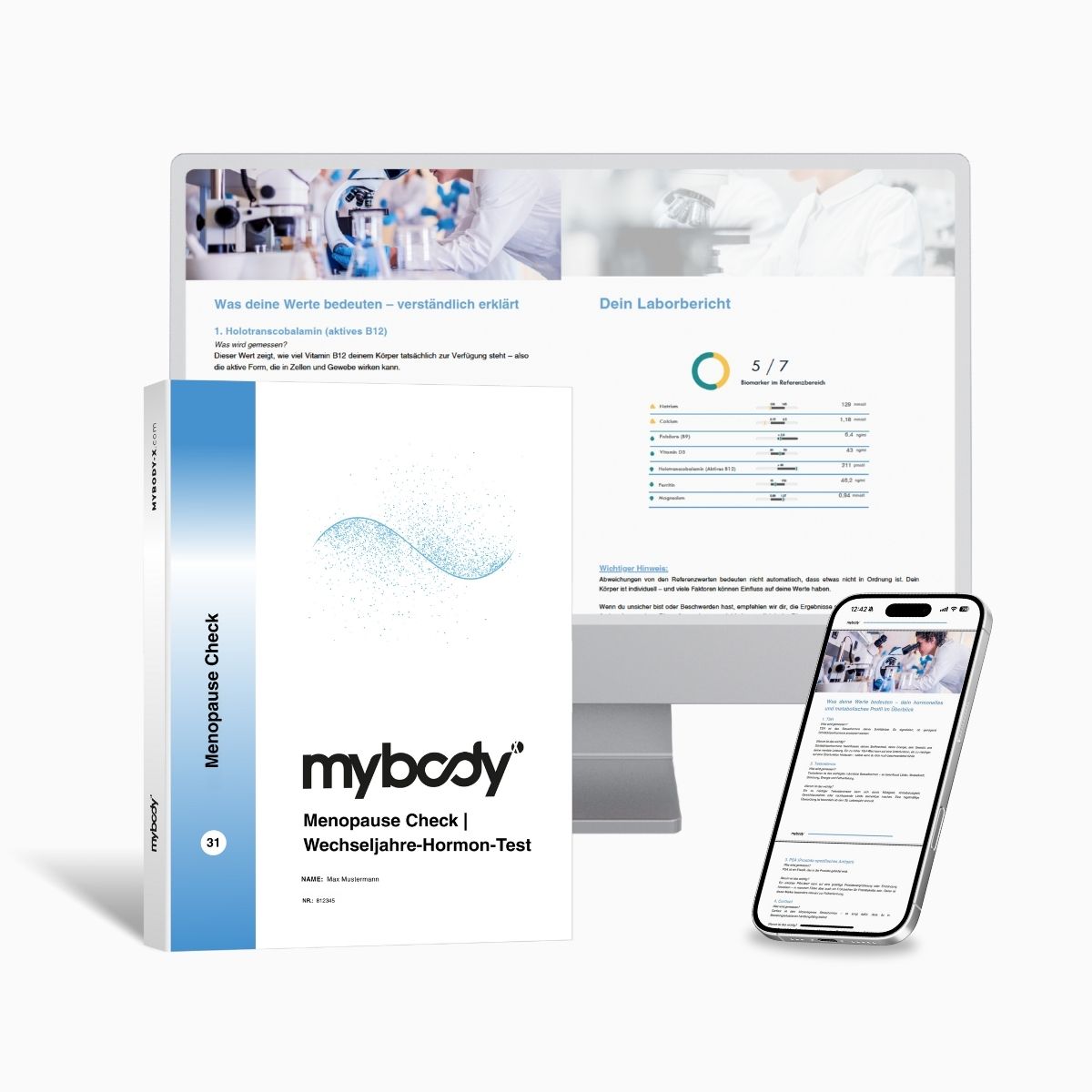
Capillary blood test
Menopause check | Menopause hormone test
Eight values from one blood sample: progesterone, estradiol, FSH, LH, testosterone, DHEA-S, SHBG, and TSH. What the test does not do for the question addressed in this article: it measures neither sleep, breathing, nor leg movements, and it does not assess iron status or cortisol. Of the six groups of causes in Chapter 8, it touches exactly one—the thyroid—through the TSH value. The product page itself points out that estradiol, progesterone, FSH, and LH fluctuate significantly throughout the cycle, and that the cycle day must be noted as long as a cycle continues. An abnormal result should be interpreted by a doctor.
Laboratory analysis 3–5 business days after sample receipt
Information from the product page, accessed 27.08.2026
The product page itself states the limitation more clearly than most informational articles. It notes that the test does not answer how you feel, but where your body is right now (mybody®x product page, accessed 27.08.2026).
The article At-Home Hormone Test addresses the question of test categories itself—test types, sample types, reference ranges, and the assessment of the endocrinology professional society. This text here focuses on the symptom.
The laboratory complies with the GDPR, results are transmitted securely, and samples are processed pseudonymously. The product page does not state the laboratory’s location, so it is not shown on the card above.
What two weeks of record-keeping can reveal
The DGSM guideline lists sleep diaries as part of the diagnostic process (DGSM, 2017). They are therefore not a substitute for assessment, but a preparation for it.
Four details are enough. After recording them for two weeks, you can bring concrete information to your appointment instead of just a feeling.
Record the times
When you went to bed, when you fell asleep, and when you got up. Estimates are fine.
Note why you woke up
Feeling hot, needing to urinate, racing thoughts, pain, restless legs, or no apparent reason. This is exactly the distinction that will otherwise be missing from the conversation later.
Add daytime details
Supplements with dosage and time taken, alcohol, caffeine after midday, shift work. Also bleeding, as long as it continues.
Ask the person sleeping beside you
You may not notice your own snoring or pauses in breathing. A single question to the person beside you can change the direction of the assessment.
Step 4 is the least obvious and often the most useful. Some of the signs of obstructive sleep apnea cited by IQWiG in 2026 can only be observed by someone else.
After two weeks, a pattern will emerge—or it won’t. Both outcomes provide information, and both are more useful than remembering one particularly bad night.
Chapter at a glance
A sleep diary kept for two weeks records four things: times, reasons for waking, supplements and observations from the person sleeping beside you. In 2017, the German Society for Sleep Research and Sleep Medicine listed sleep diaries as part of the diagnostic process. Keeping a record does not replace medical assessment; it prepares you for it. Its greatest value lies in distinguishing the reasons for waking, because that distinction determines what happens next.
Limitations: what this text and this test cannot clarify
This article organizes the contributing factors. It does not make a diagnosis or draw conclusions about your individual case.
It does not name any treatment as its own recommendation. Wherever a treatment is mentioned, it is attributed to a professional association and dated; the decision is made in a clinical setting.
There is no reliable figure for how the causes are distributed. The reviewed source material does not state what proportion of sleep complaints during this stage of life is attributable to each factor. This gap remains open and is not estimated.
The test presented has a firm limit: it measures eight hormone levels in the blood. It does not assess sleep, breathing, leg movements, iron status, or mood, and none of these five factors can be inferred from its results.
The timeline is also a limit. A value describes the moment the sample was taken; it says nothing about the course of a night or a week.
What matters in the end
The most important sentence in this article comes from a gynecological guideline and is four words long: after ruling out other causes. It appears before a recommendation for hormonal treatment, and it applies just as much before a hormonal explanation.
This leads to an order of steps that differs from the usual one. Don’t measure and then interpret—instead, observe, get checked, and only then decide whether a number would add anything.
For the next two weeks, this means four details each night, one question for the person sleeping beside you, and an appointment as soon as the problems last longer than a month or any of the points in Chapter 9 apply.
It began with the question of whether menopause is robbing you of sleep. It may be a factor. Whether it is in your case is not determined by the stage of life you are currently in.
Frequently asked questions
How can I tell whether menopause is causing my sleep problems?
No single symptom can tell you. In 2023, IQWiG noted that hormonal changes can cause problems falling or staying asleep; that does not establish the cause in any individual case. The context is more informative: changes in bleeding, hot flashes at night, and a timeline that fits with these changes. Observed pauses in breathing, pronounced daytime sleepiness, or an urge to move your legs point away from a hormonal explanation. The S3 Guideline on Peri- and Postmenopause explicitly recommends ruling out other causes before hormonal treatment for these symptoms (AWMF 015-062, short version, status June 2026).
When should I have my sleep problems checked by a doctor?
If the problems last longer than a month, it is time to seek help—experts define sleep disorders as problems lasting this long (IQWiG, 2024). Make an appointment sooner if someone has observed you snoring with pauses in your breathing, if severe daytime sleepiness affects your daily life or driving, if you feel an urge to move your legs in the evening, or if your mood and motivation have been low for weeks. IQWiG puts the next step plainly: A visit to your doctor’s office can help identify the causes. Nothing in this article changes that recommendation.
Can an at-home hormone test explain my sleep problems?
No. A hormone test measures blood levels at the time the sample is taken, not how they change over the course of a night. Of the six cause categories in Chapter 8, the Menopause Check covers exactly one: the thyroid, through the TSH value. Breathing, leg movements, mood, iron status, and sleep itself are not included in its marker range. For the practical questions of this stage of life, IQWiG does not consider hormone level testing useful anyway (paraphrased from IQWiG, 2023). What the test provides is a documented baseline for a conversation.
I wake up drenched in sweat at night—is it always a hot flash?
No, and this distinction is the most important point in the article. Night sweats are also a sign of obstructive sleep apnea, which IQWiG lists in 2026 alongside loud snoring with pauses in breathing, morning headaches, dry mouth, and severe daytime sleepiness. According to estimates cited by the same institute, about 10 percent of adults have obstructive sleep apnea, and the likelihood increases after age 45. If any of these other signs are present, the concern should be brought to a doctor, not addressed with a blood test.
How long do sleep problems during menopause last?
The sources reviewed here do not provide a reliable time estimate, so none is given here. Another figure is reliable: if problems persist for more than a month, experts consider them a sleep disorder (IQWiG, 2024). This threshold is more useful in practice than a figure in years because it marks the point for taking the next step. What happens next depends on which possible cause is confirmed during the assessment.
Next step
First the recording, then the question of a number
If none of the signs in Chapter 9 apply to you and you want to consider the hormonal phase as one of several open questions, the Menopause Check covers the eight values related to menopause. The linked article explains what else may cause night sweats.
View the Menopause Check Causes of night sweatsRead more
You might also be interested in
The thread from Chapter 6, explored in detail and beyond menopause.
In case the symptoms persist even though the phase has long passed.
Sources
- German Society for Sleep Research and Sleep Medicine (DGSM): S3 Guideline on Non-Restorative Sleep/Sleep Disorders, chapter “Insomnia in Adults,” AWMF register number 063-003, in: Somnologie 2017, 21:2–44 – dgsm.de
- Institute for Quality and Efficiency in Health Care (IQWiG): Sleep Problems and Sleep Disorders (Insomnia), as of 2024 – gesundheitsinformation.de
- German Society for Gynecology and Obstetrics et al.: S3 Guideline on Peri- and Postmenopause – Diagnosis and Interventions, short version, AWMF register number 015-062, as of June 2026 – register.awmf.org
- Robert Koch Institute: Difficulty Falling and Staying Asleep in Adults, Fact Sheet from the “Health in Germany” panel, Journal of Health Monitoring, 2024 survey, published 2026 – rki.de
The verbatim quote about cognitive behavioral therapy, the information on diagnostics, and the note about sleep diaries come from source [1]. The one-month cutoff, the statement that one third of people have difficulty falling or staying asleep, the figure of around 6 in 100 people with a sleep disorder, and the sentence about visiting a doctor’s office are based on [2]. The statements about measuring hormones using FSH and AMH, as well as the condition “after ruling out other causes,” come from [3]. The percentages 16.3 and 31.7 and the participant count of 27,038 come from [4]. Information on obstructive sleep apnea (as of 2026), restless legs syndrome (as of 2024), and menopausal symptoms (as of 2023) comes from three other publications by the same institute; these are attributed to the institution and year in the main text and therefore do not appear in this list. The same applies to information from the National Institute on Aging of the US National Institutes of Health (as of 2021). Information on price, markers, sample type, and laboratory comes from the mybody®x product page, accessed on 27.08.2026; processing times follow the central requirements for blood tests. All sources were accessed and reviewed on 27.08.2026.

mybody®x Editorial & Specialist Team
Women’s health Hormone diagnostics Laboratory diagnostics Blood test interpretation
This article was created by the editorial and specialist team at mybody®x. The team combines laboratory diagnostics, the interpretation of blood tests, and nutritional science. Find out who contributes on the authors page.
Published on 04.01.2026 · Last updated on 27.08.2026
The content is intended for general information and does not replace medical advice, diagnosis, or treatment. Reference ranges depend on the laboratory, method, and age; the information on your test results is always authoritative.


