

Magnesium deficiency despite normal blood values: what the serum value shows
The essentials at a glance
A magnesium value within the reference range does not rule out inadequate magnesium status. The reason is a figure: only one to two percent of total magnesium is found in the blood (IQWiG, 2025). The rest is stored in bones, muscles, and other tissues, beyond the reach of a blood sample.
This article explains what a serum value can show and where it reaches its limits, without disparaging the test. The alternatives are not better, but limited in different ways. Whenever an institution cites a figure, its name and year are provided here.
You will first read how much magnesium actually reaches the blood. Next comes a comparison of the three measurement methods, its distribution in the body, the figures for requirements and intake, the documented symptoms, four common statements in a fact check, and the actual routes of loss. The limitations are discussed at the end.
What to expect in this article
1. Why a normal value does not answer the question
2. What reaches the blood at all
3. Serum, whole blood, challenge test: what each method can do
4. Where your magnesium actually is
5. Requirements and intake in numbers
6. Why the blood value remains stable for so long
7. Which symptoms have been conclusively linked
8. Four statements about magnesium deficiency fact-checked
9. Where magnesium losses actually come from
10. How to determine your magnesium value at home
11. Limitations: what the serum value does not answer
12. What matters about this value
Frequently asked questions
Sources
Why a normal value does not answer the question
According to the Institute for Quality and Efficiency in Health Care, the reference range for magnesium in the blood is 0.70 to 1.05 mmol/l for adults (2025). Anyone within this range receives no indication on their test report, and for most people, that is the end of the matter.
For some people, it is not. They have symptoms, an unremarkable value, and a gap between the two that no one fills. That gap is the subject of this article, and it has a factual basis.
Key message
A magnesium value within the reference range describes the small proportion found in the blood. It says little about tissue stores, and that is precisely what makes interpretation difficult.
What the value tells you
It reliably indicates a clear shift. If the value is well below the reference range, it is a significant finding that should be medically evaluated. According to the MSD Manual, a medical reference guide maintained for decades, hypomagnesemia begins below 0.70 mmol/l (professional edition, James L. Lewis III, 2025).
It also shows a trend. Anyone who remains at the same position in the lower range for months has a different starting point from someone in the middle. However, this observation requires multiple measurements from the same laboratory.
What it does not establish
It does not prove adequate intake. The German Nutrition Society states this unequivocally in its questions and answers about magnesium: “There is currently also no suitable biomarker for determining magnesium status” (2025).
This is a remarkable statement because it does not criticize the blood test, but the entire measurement situation. No method provides a definitive picture of magnesium status. Anyone claiming otherwise goes beyond the evidence.
Who this article is written for
For people with an unremarkable result and an uneasy feeling. They have often already visited a medical practice, received a number, and gotten no explanation. The phrase “everything is in the normal range” ends a conversation without answering a question.
This article does not provide a counterdiagnosis. It explains why the figure says less than it appears to, and what follows from that for the next steps. That is less than an answer and more than a shrug.
What actually reaches the blood
The crucial figure appears in a single sentence from IQWiG. It explains why this article had to be written in the first place.
Documented source
“Only 1 to 2% of total magnesium is found in the blood.”
Institute for Quality and Efficiency in Health Care (IQWiG)
Laboratory value: magnesium, as of 2025
Everything that follows is based on this one number. A blood sample captures one to two percent of total body stores. Anything inferred from this about the remaining ninety-eight percent is an inference, not a measurement.
However, the converse is also true, and it is rarely mentioned: A low blood level is a strong signal. If the body can no longer maintain this small proportion consistently, that is not a coincidence.
Serum, whole blood, loading test: what each method can do
Guidebooks often claim that measuring magnesium in whole blood is superior to measuring it in serum. We found no evidence of this in the sources reviewed. Instead, Arnaud’s review in the British Journal of Nutrition (2008) describes the specific limitations of all methods.
| Criterion | Serum magnesium | Magnesium in red blood cells | Loading test |
|---|---|---|---|
| What is measured | The proportion in the blood plasma, around one to two percent of total body stores | The proportion within the red blood cells | How much magnesium the body retains after a dose |
| Evidence base | Established and standardized, but not a representation of total body stores | Controversial. Arnaud (2008) reports an unresolved professional debate, not a consensus | Arnaud (2008) considers it the reference method |
| Practical for everyday use | Yes, one blood sample is sufficient | More complex and not standard in every laboratory | No. Unsuitable in cases of impaired kidney or bowel function |
| Provides a diagnosis | No, a value interpreted by a doctor | No | Only under medical supervision |
The table does not identify a winner. It shows that the question of the best method is wrongly framed. The reference method cannot be used in everyday practice, and the two applicable methods each measure only part of the picture.
For another variant, the evidence is clear. Arnaud notes that, compared with measuring total magnesium, ionized magnesium shows no demonstrable advantage (2008).
Where your magnesium actually is
IQWiG describes the distribution as follows: “In the body, it is found mostly in tendons, teeth, and bones—about two-thirds is bound in the bones alone” (2025).
The bone is therefore not just a storage site but also a buffer. When magnesium becomes scarce in the blood, the body can draw on this reserve. For the measured value, this means it remains stable while the reserve shrinks.
A buffer that masks the measurement
That is precisely what Arnaud (2008) means: Values within the normal range do not rule out a total-body deficiency that is compensated for by release from bone stores. The buffer works, and that is why the measurement detects nothing.
This statement comes from a specialist journal and is not a marketing claim. It describes a physiological characteristic that applies in much the same way to potassium and calcium.
Why this is not an argument against measurement
Because there is no better alternative. If no method can clearly reflect status, a practical measurement with a known limitation is more reasonable than no measurement based on an unverified assumption.
The difference lies in expectations. Anyone who reads the serum value as proof will be disappointed. Anyone who reads it as one of several indicators gets useful information.
Why the same question looks different for potassium
The vast majority of potassium is also found in cells, yet the blood value is still considered informative. The difference lies in the storage system: potassium has no bone buffer, so a shift is reflected more quickly.
Magnesium has this buffer, and it works over weeks. So when someone sees the two values side by side on a test report, they interpret them with different degrees of scrutiny. A borderline potassium value is an event; a borderline magnesium value is a snapshot.
This is one of the reasons why electrolytes are rarely measured individually. Only when considered together can we tell whether one value deviates from the others or whether several point in the same direction.
Requirements and intake in figures
In addition to the blood value, there is a second way to approach the question: intake. The following three figures come from the German Nutrition Society and describe the same quantity in the same unit.
Magnesium in numbers
350 mg
per day is the estimated value for an adequate intake for men aged 19 and over
300 mg
per day is the estimated value for women aged 19 and over, including during pregnancy and breastfeeding
284 mg
per day is the average intake for women in Germany; for men, it is 345 mg
Source: German Nutrition Society (DGE), Reference Values for Magnesium (derived 2021) and Questions and Answers about Magnesium (as of 2025); intake data from the German National Nutrition Survey II
The gap is smaller than expected
Women reach an average of 95 percent of the estimated value, and men 99 percent. That is not a supply gap, but a bullseye. Anyone who infers widespread deficiency from these figures is contradicting the source itself.
The DGE says the same thing plainly: “Magnesium deficiency is relatively rare among metabolically healthy people with a balanced diet” (2025). Both halves of the sentence matter because they specify the conditions.
What an average conceals
An average says nothing about the distribution. We did not find verified evidence in the sources we examined showing how many people in Germany fall below the estimated value. That is why this article gives no such percentage.
For you personally, the average is merely a reference point anyway. Your intake depends on what is on your plate, while your losses depend on entirely different factors. Chapter 9 adds another aspect.
Why the blood value remains stable for so long
The DGE quantifies how sluggishly the system responds. According to its information, the serum magnesium concentration decreases only after a prolonged period of inadequate intake, specifically after more than eighty days (2025).
The blood value does not respond to the past week, but to the past several months.
The blood value does not respond to the past week, but to the past several months. In practice, this has two consequences, and both are useful.
A measurement after two weeks is pointless
If you change your diet or take a supplement and measure two weeks later, you are measuring the old state. A follow-up measurement only becomes meaningful after several months, and even then only in the same laboratory using the same material.
This is inconvenient, but it saves money. Two measurements four weeks apart do not make a time series, but two random values with laboratory noise in between.
A low value carries weight
Conversely, if a serum value declines despite this sluggishness, something substantial has happened. Such a finding is not a borderline case, but a reason to speak with a doctor.
That is the real strength of the value. It rarely changes, but when it does, it is worth taking a closer look.
Which complaints are reliably associated
The list is shorter than the search results suggest. The DGE names loss of appetite, nausea, vomiting, fatigue, and general weakness as the first signs (2025). IQWiG adds that too little magnesium can impair muscle function and thereby cause muscle cramps, and that severe deficiency can also cause cardiac arrhythmias (2025).
A cramp is not the same as a sign of deficiency
The direction of the statement matters. It is documented that a confirmed deficiency can promote cramps. What is not documented is the reverse conclusion—that a cramp indicates a deficiency.
The Federal Centre for Nutrition sums it up: “Magnesium plays an important role in muscle contraction. But that does not mean it helps with cramps” (2026). A Cochrane review of eleven studies reaches the same conclusion; more on this in the article on nighttime leg cramps.
What is not on the list
Migraine, sleep disorders, inner restlessness, and restless legs do not appear in the reviewed institutional sources as documented signs of magnesium deficiency. They are therefore not imagined complaints, but magnesium is not a documented explanation for them.
The longer the list, the easier it is to sell and the less often it is right. The short list is more honest, even if it appeals to fewer people.
Why the documented signs are so nonspecific
Loss of appetite, nausea, fatigue, and weakness can have dozens of causes. That is precisely what makes them useless as search criteria and valuable as warning signs: They indicate that something is wrong, but not what.
That is why starting with the causes is quicker. Anyone who recognizes one of the situations mentioned in Chapter 9 has a concrete indication. Anyone who only compares their symptoms with the list ends up considering almost every nutrient.
The objection is justified: So the symptom list is no use at all. More precisely, it is useful for something other than what one might expect. It is not suitable for classification, but it is useful for ruling things out, because what is not on it is very unlikely to be relevant.
Four statements about magnesium deficiency: a fact check
When researching, you almost inevitably come across the following four statements. All four sound plausible, and none stands up to the evidence.
Checked against the evidence
Widespread
“Whole-blood magnesium is more informative than serum magnesium.”
Supported by evidence
None of the sources reviewed says that. Arnaud (2008) reports an unresolved expert debate about magnesium in red blood cells and finds no advantage for ionized magnesium.
Widespread
“A large proportion of Germans have a magnesium deficiency.”
Supported by evidence
The DGE describes deficiency with a balanced diet and healthy metabolism as “relatively rare” (2025). Average intake is 95% and 99% of the estimated value, respectively.
Widespread
“A deficiency is already present below 0.85 mmol/L.”
Supported by evidence
According to IQWiG, the reference range begins at 0.70 mmol/l (2025), and the MSD Manual sets the threshold at the same level (2025). There is no evidence for a higher deficiency threshold.
Widespread
“Magnesium helps with nighttime leg cramps.”
Supported by evidence
A Cochrane review of eleven studies concludes that magnesium probably does not reduce the frequency or severity of nocturnal leg cramps in older adults (2020). The BZfE also explicitly contradicts this (2026).
The third statement needs a qualification. Arnaud describes the range between 0.75 and 0.85 mmol/l as a gray area in which further investigation may be appropriate (2008). That is different from a deficiency threshold, and the distinction is regularly lost in consumer health articles.
Where magnesium losses actually come from
The DGE describes the causes as follows: “Causes include gastrointestinal disorders such as acute or chronic diarrhea, vomiting, malabsorption, or small-intestinal resections/bypass” (2025). It also lists kidney disease, chronic alcohol consumption, and the long-term use of certain medications, including diuretics, antibiotics, and oral contraceptives.
Medications taken over long periods
The MSD Manual is more specific, citing chronic use of a proton pump inhibitor for more than a year and the concurrent use of diuretics as examples (2025). Both are long-term medications that no one typically considers as a cause of a muscle complaint.
Alongside treatment with diuretics, IQWiG mentions diabetes, an underactive thyroid, and persistent diarrhea or vomiting (2025). Four of these appear in a medical record, not on a meal plan.
Why the order matters
Anyone with one of these causes will not get far by increasing their intake. A larger supply provides only limited help against an ongoing loss because the same route remains open.
That is why every meaningful assessment should begin not with an analysis of the diet, but with a review of medications, digestion, and known conditions. A measurement comes afterward.
Where intake still plays a role
Alongside routes of loss, IQWiG explicitly mentions a magnesium-poor diet and an increased need, for example due to vigorous exercise (2025). Both are real possibilities, but they affect different people from those experiencing the loss mechanisms described above.
People who sweat heavily lose minerals through their sweat. Those who eat an unbalanced diet take in less. Both shift the balance, but rarely enough for a blood value to reflect it. The DGE classifies a deficiency as relatively rare in people with a balanced diet and healthy metabolism (2025).
In practical terms: The question of diet is justified, but it comes second. Anyone who looks there first and skips the medication list is likely to miss the more probable cause.
Chapter at a glance
Magnesiumverluste entstehen laut DGE vor allem über den Magen-Darm-Trakt, über die Nieren, durch chronischen Alkoholkonsum und durch Dauermedikation mit Diuretika, Antibiotika oder oralen Kontrazeptiva (2025). Das MSD Manual nennt zusätzlich Protonenpumpenhemmer über mehr als ein Jahr (2025). Gegen einen laufenden Verlust wirkt mehr Zufuhr nur begrenzt. Die Klärung beginnt deshalb bei Medikamenten und Verdauung, nicht beim Speiseplan.
According to the DGE, magnesium losses occur primarily through the gastrointestinal tract and kidneys, as well as through chronic alcohol consumption and long-term use of diuretics, antibiotics, or oral contraceptives (2025). The MSD Manual also lists proton pump inhibitors used for more than a year (2025). Increasing intake has only a limited effect while ongoing loss continues. Clarification should therefore start with medications and digestion, not the meal plan.
How to determine your magnesium level at home
Two tests from mybody®x (MYBODY Lab GmbH) measure magnesium from capillary blood, each embedded in a broader panel of values. You collect the sample at home with a finger prick, and it is analyzed by a certified medical laboratory.
Both measure blood and are therefore subject to the limitation described in this article. They provide an indication, not proof of status, and that is exactly how they should be interpreted.
Step 1
Check for causes of loss
Step 2
Record the date and laboratory
Check the sample type and reference range
Does the report state serum or plasma? The reference range next to it is the relevant one.
Repeat no earlier than after several months
The serum level does not respond until after more than eighty days. Measuring earlier costs money without providing any insight.
Step one deliberately comes before the measurement. It is the only one of the four that can identify a cause, and it costs nothing but five minutes of reflection.
Capillary blood test
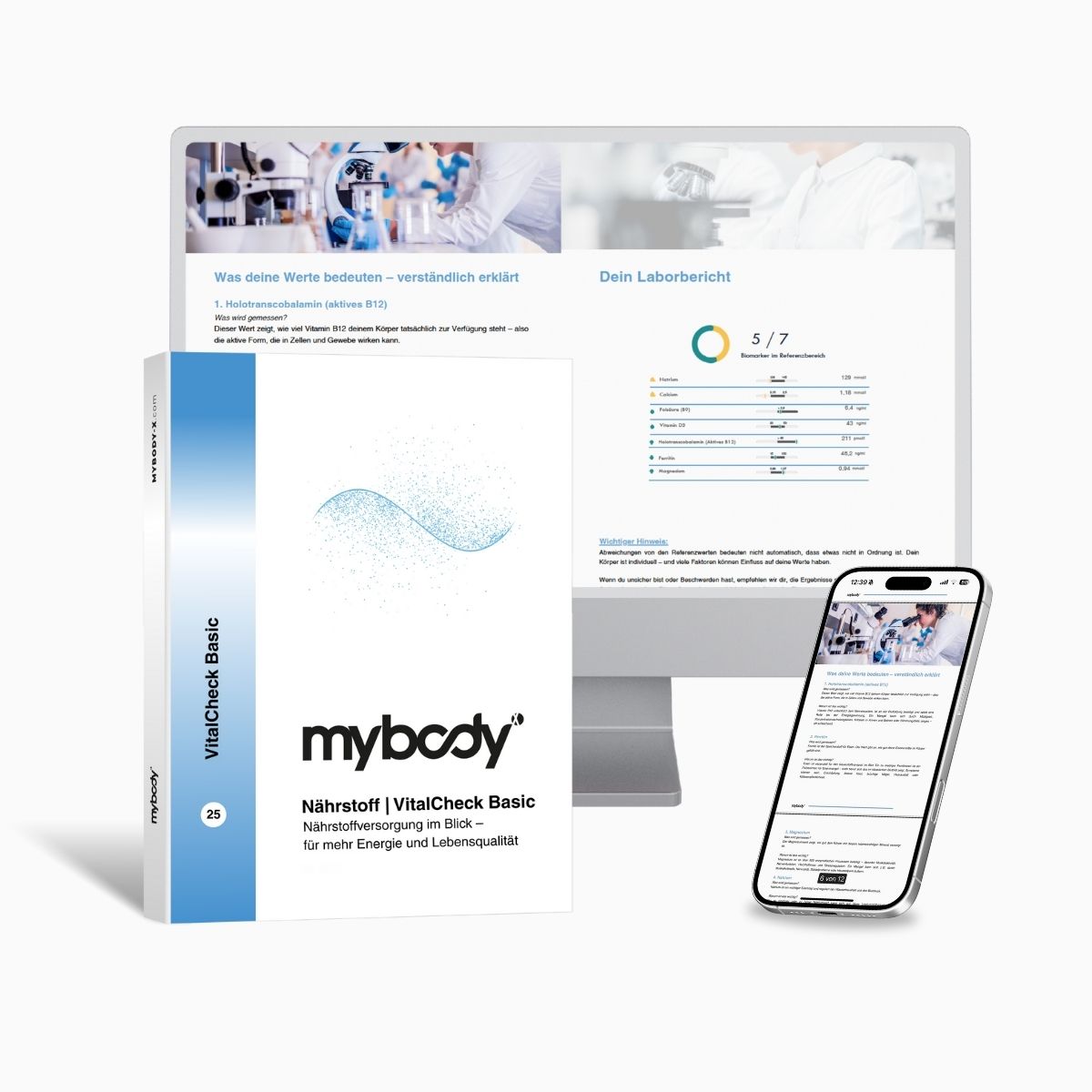
BalanceCheck | Electrolytes & Minerals Test
15 elements from one blood sample: magnesium together with potassium, sodium, calcium, and phosphorus, plus six trace elements and four heavy metals. What the test does not provide: it measures the amount in the blood, not the total amount stored in the tissue. It does not establish a diagnosis, and chloride is not included in the profile.
Laboratory analysis: 3–5 working days after receipt of the sample
Information from the product page, accessed 10 August 2026
Capillary blood test
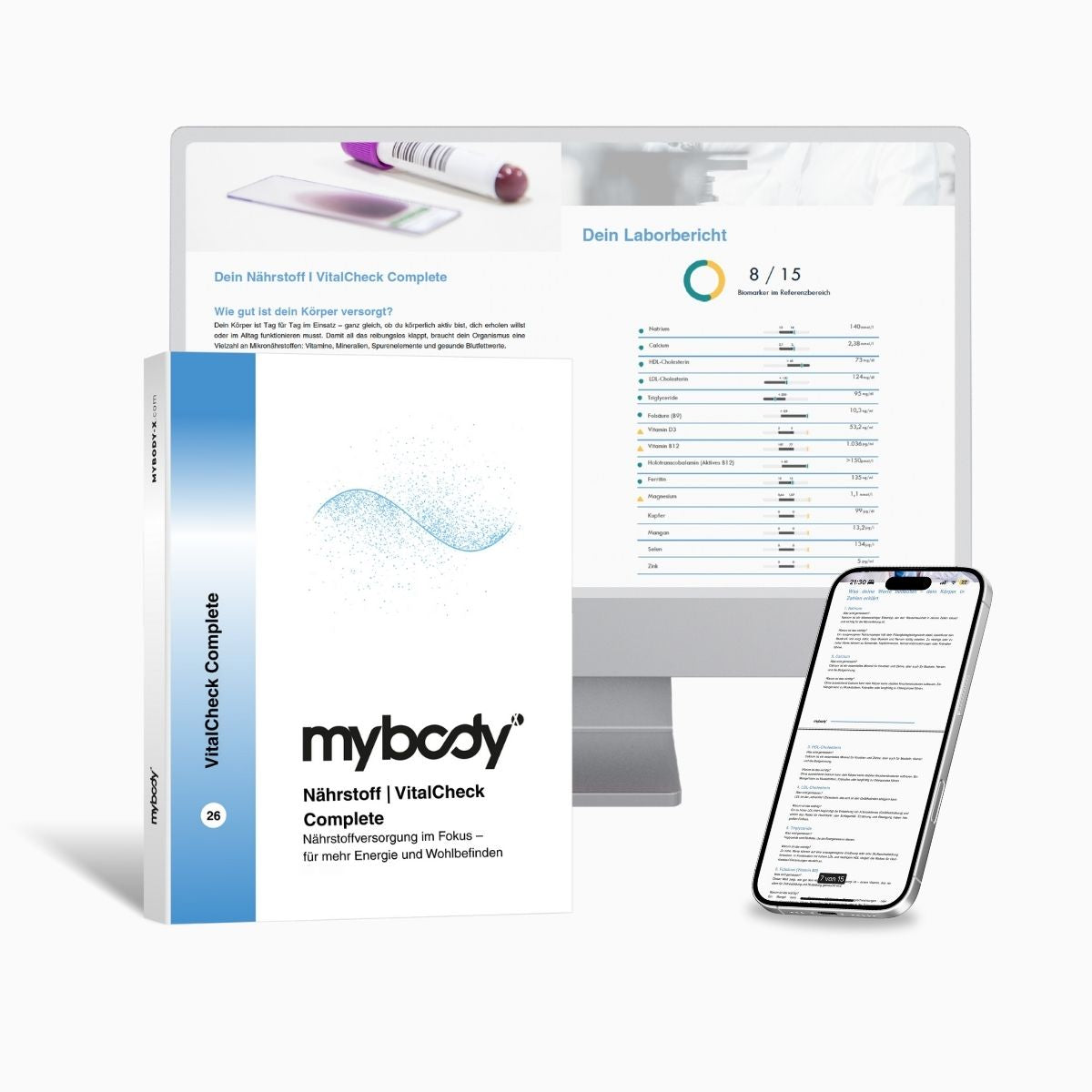
VitalCheck | Complete Nutrient & Mineral Test
Magnesium combined with vitamin D3, vitamin B12, folic acid, ferritin, transcobalamin, blood lipids, and calcium, sodium, selenium, zinc, copper, and manganese. Useful if you want to assess magnesium alongside your vitamin and iron status. What the test does not provide: potassium and phosphorus are not included, and it does not establish a diagnosis.
Laboratory analysis: 3–5 working days after receipt of the sample
Information from the product page, accessed 10 August 2026
Limitations: what the serum level does not answer
A blood test does not establish a diagnosis. Hypomagnesemia is diagnosed and treated by a doctor, usually in conjunction with other values and the medical history.
It also does not prove adequate intake. One to two percent of the total stores are in the blood, the bones buffer the level, and the DGE notes that no suitable biomarker for magnesium status currently exists (2025). This applies to every blood test, regardless of the provider.
The data also have limitations. German figures are available for the reference range, the estimated value, and average intake. We were unable to substantiate how many people in Germany fall below the estimated value, so no percentage is given here.
One final limitation concerns what you expect from a number. A lab result does not explain why you feel tired. It indicates where a single substance currently stands. No test alone can determine whether sleep, strain, a medication, or something entirely different is behind it.
This is not an argument against testing. It is an argument against expecting a number to replace a decision. The result is a data point, and a data point is a starting point.
What matters about this value
If you take away just one action from this article, let it be this: write down the date of your test and the name of the laboratory. If you test again in a few months, use the same laboratory and the same sample material.
The reason is explained in Chapter 6. The serum level does not respond until more than eighty days of inadequate intake have passed (DGE, 2025). Two measurements four weeks apart show you laboratory variability; two measurements six months apart show you a trend.
The initial question was whether a magnesium deficiency is possible despite normal blood levels. The most honest answer is: yes, and no one can prove it with certainty. Anyone who promises you otherwise is selling you a certainty that does not exist.
Frequently asked questions
Can I have a magnesium deficiency even though my blood level is normal?
Yes, this is possible. Only one to two percent of total magnesium is found in the blood (IQWiG, 2025); around two-thirds is bound in the bones. The body can draw on this reserve to replenish magnesium and keep blood levels stable. The DGE notes that no suitable biomarker for determining magnesium status currently exists (2025). A normal result is therefore a good finding, but not proof.
Is whole-blood measurement better than serum measurement?
The reviewed sources contain no evidence for this. Arnaud’s review in the British Journal of Nutrition (2008) reports an unresolved debate among experts regarding magnesium in red blood cells and explicitly finds no advantage of measuring ionized magnesium over total magnesium. The reference method is the loading test, but it is unsuitable in cases of impaired kidney or intestinal function.
At what level is magnesium deficiency diagnosed?
IQWiG gives the reference range for adults as 0.70 to 1.05 mmol/l (2025). The MSD Manual likewise sets the threshold for hypomagnesemia below 0.70 mmol/l (2025). We found no evidence for the widespread claim that a deficiency is already present below 0.85 mmol/l. The reference range on your own test report is always decisive.
When should I measure again after making a change?
Not after two weeks. The DGE states that serum concentrations do not decrease until more than eighty days of inadequate intake have passed (2025). A follow-up measurement therefore becomes meaningful only after several months, and even then only in the same laboratory using the same specimen material. Two measurements taken close together are more likely to reflect measurement variation than a change.
Which symptoms of magnesium deficiency are proven?
The DGE lists loss of appetite, nausea, vomiting, fatigue, and general weakness as early signs (2025). IQWiG adds muscle cramps and, in cases of severe deficiency, cardiac arrhythmias (2025). None of the reviewed institute sources identifies migraine, sleep disorders, or restless legs as proven signs. Conversely, a cramp does not indicate a deficiency; only the reverse relationship has been established.
Next step
A baseline value with a known threshold
If you want to view your magnesium level in relation to the other electrolytes and trace elements, the BalanceCheck provides a starting point. It does not replace medical evaluation and does not prove adequate intake.
Go to BalanceCheck Go to VitalCheck CompleteRead more
You might also be interested in
How to read laboratory values for electrolytes, value by value.
The symptoms page for this topic, if you are more interested in the signs than in the measurement.
Sources
- Institute for Quality and Efficiency in Health Care (IQWiG): Magnesium (as of 2025) – gesundheitsinformation.de
- German Nutrition Society (DGE): Selected questions and answers about magnesium (as of 2025) – dge.de
- Arnaud MJ: Update on the assessment of magnesium status. British Journal of Nutrition 99, Supplement 3, 2008 – cambridge.org
- MSD Manual, Professional Edition: Hypomagnesemia, James L. Lewis III (as of 2025) – msdmanuals.com
The verbatim quotation about the proportion of magnesium in the blood, the reference range, its distribution in the body, and the symptoms and causes come from source [1]. The statement about the missing biomarker, the figure of more than eighty days, the rarity of a deficiency, the list of causes, and the intake figures from the National Consumption Study II are based on [2]. The statements about measurement methods, bone stores, and the gray area come from [3], as do the threshold for hypomagnesemia and the information about proton pump inhibitors from [4]. The estimated intake values come from the DGE reference values (2021 derivation), the quotation about muscle contraction from the Federal Centre for Nutrition (as of 2026), and the Cochrane review on magnesium for muscle cramps is attributed in the text with its year. Information on price, biomarkers, sample type, and laboratory comes from the mybody®x product pages, accessed on 10.08.2026; processing times follow the central specification for blood tests. All sources were accessed and checked on 10.08.2026.

mybody®x Editorial & Expert Team
Laboratory diagnostics Nutritional science Blood analysis interpretation Nutrigenetics
This article was created by the mybody®x editorial and expert team. The team combines laboratory diagnostics, nutritional science, and the interpretation of blood analyses. Anyone involved can be found on the authors page.
Published on 10.08.2026 · Last updated on 10.08.2026
The content is intended for general information and does not replace medical advice, diagnosis, or treatment. Reference ranges depend on the laboratory, method, and age—what always matters is the information on your test report.




Share now:
Potassium deficiency symptoms: how to recognize them and what not to mistake for them
Blood phosphate level: what the number means—and what it doesn’t