

Potassium deficiency symptoms: how to recognize them—and how not to
The essentials at a glance
Three signs are proven in potassium deficiency: muscle weakness, paralysis, and cardiac arrhythmias. The German Nutrition Society (2016) lists these signs. Fatigue is not one of them, although it regularly appears in advice articles. According to the same source, deficiency caused by too little potassium in the diet is rare.
This article separates proven signs from claimed ones and explains why a single potassium value from a blood test says less than the number on the report may suggest. Whenever an institution provides a number, it is given here with its name and year. Where none is available, that is stated as well.
You will first read where potassium is found in the body. Next come the signs that belong in a doctor's office, the reference ranges with their numbers, four common statements fact-checked, the actual causes, and the question of how to obtain a value you can interpret. The limitations come at the end.
What to expect in this article
1. What potassium does—and why only a fraction of it is found in the blood
2. When your symptoms are no longer a matter of your diet
3. The numbers used to assess a potassium value
4. Four statements about potassium deficiency and what remains of them
5. Which signs are proven and which are not
6. What actually causes potassium deficiency
7. How to obtain a value you can interpret
8. Which method answers which question
9. Which mybody®x tests measure potassium at all
10. What shipping does to your potassium value
11. Limitations: what a single potassium value cannot answer
12. What matters about this value
Frequently asked questions
Sources
What potassium does—and why only a fraction of it is found in the blood
Potassium is involved in regulating blood pressure and maintaining water, electrolyte, and acid–base balance, and it is important for muscle and heart function. This is how the German Nutrition Society describes it in its reference values (derived in 2016).
The crucial point for everything that follows comes from the Institute for Quality and Efficiency in Health Care: “In the body, potassium is found primarily inside the body's cells—outside the cells, sodium predominates” (IQWiG, 2025).
Key takeaway
A blood potassium test measures the small amount outside the cells. That is precisely why it is sensitive: even a slight shift there represents a large amount in the body as a whole.
Two percent outside, the rest inside
A review by Kardalas and colleagues in the journal Endocrine Connections (2018) quantifies the distribution: Two percent of potassium is in the fluid outside the cells, meaning around 98 percent is inside the cells. A blood test therefore looks through a window behind which the far larger share remains invisible.
This distribution has two consequences, and they point in opposite directions. First: the blood level is highly sensitive. Because so little is present outside the cells, even a small shift significantly changes the measured concentration.
The second consequence is less reassuring. Potassium can move from outside to inside without changing the total amount. The blood level then falls, while the body's stores remain the same. A laboratory value therefore describes a distribution, not automatically an amount.
Why potassium is measured at all
Potassium is one of the values routinely included in basic medical testing when someone reports muscle symptoms or palpitations. The reason is its connection to the transmission of nerve impulses: nerve and muscle cells work with the voltage difference between the inside and outside, and potassium plays a major role in this difference.
However, this does not mean that an abnormal potassium level explains the symptom. It is an indication of where to look next. This sequence runs through the entire article.
The difference between being undersupplied and being ill
Eating too little potassium does not mean you are ill. The German Nutrition Society gives an estimated adequate intake of 4,000 milligrams per day for adults (2016). According to the same figures, actual intake in Germany is around 3,900 milligrams per day for women aged 18 to 79 and around 4,300 milligrams per day for men of the same age.
That is a remarkably small gap. It explains why the professional association describes a deficiency caused by diet as a rare case, not as a widespread problem.
When your symptoms no longer belong in the realm of your meal plan
This chapter deliberately comes first. A text that puts the stopping criteria at the end reaches precisely the reader for whom they are intended.
Documented source
“Potassium deficiency resulting from low potassium intake through the diet is rare.”
German Nutrition Society (DGE)
Selected questions and answers about potassium, as of 2016
This one sentence reverses the usual line of inquiry. People looking for potassium deficiency usually look for a dietary mistake. Instead, the professional association points to losses, and losses have causes other than a meal plan.
These signs require a visit to a doctor's office
Muscle weakness that limits everyday activities
for example, when climbing stairs or raising your arms above your head
Palpitations or a racing heart
newly occurring, recurring, without any apparent cause
Persistent vomiting or diarrhea
over several days, because potassium is actually lost in the process
Regular use of laxatives
over several weeks and without medical supervision
Diuretic medication as long-term therapy
this is where potassium monitoring belongs under medical supervision anyway
This list is not a diagnostic framework. It identifies the point at which a self-test would be the wrong answer to the right question.
A single point means little on its own. Heart palpitations after a sleepless night usually have nothing to do with potassium. The picture becomes noteworthy when several points come together or when one of them persists for weeks.
Many people researching this topic have already visited a medical practice. They are not distrustful but dissatisfied: they are missing a data point, not a promise. For them, this chapter is a reminder that a second appointment with a specific question often provides more benefit than the first one without one.
The figures used to assess a potassium value
Potassium is one of the few values where one decimal place makes a difference. The following three figures come from IQWiG’s laboratory values section and describe the same substance in the same unit.
Potassium in figures
3,7–5,1
mmol/l of potassium in blood serum is the reference range for women and men over 18
3,5–4,6
mmol/l applies to blood plasma. The same blood, a different sample material, a different range
0,4
mmol/l difference exists between the two lower limits alone
Source: German Institute for Quality and Efficiency in Health Care (IQWiG), Laboratory Value: Potassium, as of 2025
Why serum and plasma are not the same
Serum is the liquid component of blood after clotting, while plasma is the liquid component before clotting. When blood clots, platelets release potassium, which is why the serum value is systematically slightly higher. A value of 3.6 mmol/l is unremarkable in plasma but already below the reference range in serum.
That is why anyone comparing two results should first check the sample material. Without this information, two potassium values are not a time series but two different measurements placed side by side.
The reference range on your report applies
The German Institute for Quality and Efficiency in Health Care (IQWiG) states: “Reference ranges can differ from one laboratory to another because different testing methods are used” (2025). The figures above are therefore a guide, not a benchmark against which to assess your own result.
In practice, this means that the range shown next to the result on your lab report is the relevant one. It comes from the laboratory that performed the measurement and is matched to its method.
Below the reference range does not immediately mean that you are ill
A reference range is set so that most healthy people fall within it. As a result, a small number of healthy people will inevitably fall below or above it, without anything being wrong.
The MSD Manual, a medical reference maintained for decades, sets the threshold for hypokalemia at below 3.5 mmol/L in serum and describes a mild level between 3.0 and 3.4 mmol/L as rarely symptomatic (professional edition, 2025). Between this threshold and the IQWiG lower limit of 3.7 mmol/L lies a range in which a value is abnormal without this leading to a diagnosis.
Four statements about potassium deficiency and what remains of them
The following four sentences appear in many advice articles on the subject. All four sound plausible, and none fully withstands the available evidence.
Checked against the available evidence
Commonly stated
“Potassium deficiency is widespread in Germany.”
Substantiated
The DGE explicitly describes deficiency due to low intake as rare (2016). Average intake in Germany is close to the estimated value of 4,000 milligrams per day.
Commonly stated
“Constant fatigue is a typical sign of potassium deficiency.”
Substantiated
Neither the DGE, IQWiG, nor the MSD Manual lists fatigue as a sign of hypokalemia. They mention muscle weakness, paralysis, and cardiac arrhythmias.
Commonly stated
“Eating more bananas makes up for a potassium deficiency.”
Substantiated
The DGE lists losses through vomiting, laxatives, diuretic medication, or chronic diarrhea as common causes (2016). Increasing intake does not counteract an ongoing loss.
Commonly stated
“A value within the normal range proves that there is enough potassium.”
Substantiated
Around 98 percent of potassium is located inside cells (Kardalas et al., Endocrine Connections, 2018). The blood level reflects the small amount outside the cells, not the total stores.
The fourth sentence deserves an addition so that the contradiction does not become a new promise. There is no established method for detecting a potassium deficiency in the cells when the blood level is unremarkable. Anyone offering this is going beyond the available evidence.
Which signs are substantiated and which are not
The shortest substantiated answer to the question about symptoms comes from the German Nutrition Society (2016). It names three consequences of potassium deficiency: muscle weakness, paralysis, and cardiac arrhythmias in the form of an accelerated heartbeat.
Muscle weakness is different from muscle soreness.
This refers to a loss of strength, not a feeling of heaviness after exercise. It is first noticeable during movements against gravity: climbing stairs, standing up from a low armchair, or putting laundry away in an upper cupboard.
The review article in Endocrine Connections (2018) states that symptoms generally occur only below 3.0 mmol/L in serum, unless the level falls rapidly or an additional factor is present. According to the MSD Manual (2025), levels between 3.0 and 3.4 mmol/L are usually asymptomatic.
Cardiac arrhythmias are the serious end
The heart muscle works with the same voltage difference as every other muscle, but reacts more sensitively to deviations. That is why pronounced shifts call not for nutritional advice, but for medical evaluation with an electrocardiogram.
This applies in both directions. A significantly elevated potassium level can also disrupt the heart rhythm, and this direction is almost never mentioned in advice texts about deficiency.
What is not on the list
Fatigue, concentration problems, hair loss, and mood swings do not appear in the sources on potassium deficiency that were reviewed. This does not mean these symptoms are imaginary. It means that potassium is not an evidence-based explanation for them.
Those who extend the list nevertheless sell more easily and miss less often. We consider the shorter list the more honest approach, even if it appeals to fewer people.
Chapter at a glance
Established signs of potassium deficiency are muscle weakness, paralysis, and cardiac arrhythmias (DGE, 2016). Symptoms usually occur only below 3.0 mmol/l in serum; between 3.0 and 3.4 mmol/l, there are often no symptoms. Fatigue, concentration problems, and hair loss are not listed as signs of potassium deficiency in any of the institute sources reviewed. A single item from the list is not a finding, but a reason to ask questions.
What actually causes potassium deficiency
The DGE identifies the causes unambiguously: “A common cause of potassium deficiency (hypokalemia) is severe potassium loss due to, for example, vomiting, the use of laxatives, taking diuretic medications, or chronic diarrhea” (2016). Four causes, and none of them belongs on a meal plan.
Diuretics are right at the top
The review in Endocrine Connections (2018) quantifies how strong this association is: Around 80 percent of people receiving diuretics develop hypokalemia. This is not a marginal side effect, but the norm with this therapy.
That is why potassium monitoring is part of medical care during long-term diuretic therapy. People who take these medications do not need a self-test to draw attention to the issue. They need the monitoring that is already routinely planned.
Losses through the gastrointestinal tract
Vomiting and diarrhea deprive the body of fluids and, with them, electrolytes. In a single infection, this usually balances out on its own. It becomes critical when the condition persists for days or keeps recurring.
Regular laxative use works in the same direction, only more slowly and less noticeably. That is precisely what makes it a common and often overlooked cause.
How common abnormal results actually are
There is a figure about the frequency that is often passed on incorrectly. The 2018 review states that mild hypokalemia occurs in almost 14 percent—but among outpatients who had already undergone laboratory testing. This is not a statement about the general population.
We did not find a reliable figure for how many people in Germany have a low potassium level in the sources we reviewed. That is why there is no figure in this article.
Why the list of causes changes the direction of the search
Anyone looking for potassium deficiency almost automatically ends up looking at food. Bananas, potatoes, dried fruit, legumes. These lists are not wrong; they simply answer a question that is rarely the right one.
The four causes identified by the DGE have one thing in common: in all of them, the body loses potassium faster than it takes it in. A meal plan changes intake. It does not change the amount lost through urine or the intestines.
This leads to a practical order for investigating the cause. Start by asking about medications and persistent gastrointestinal symptoms. Only then is it worth looking at the plate—and usually not as the cause, but as a contributing factor.
How to obtain a result you can interpret
A potassium level without context is just a number on a sheet of paper. The following four steps turn it into information you can work with.
List your medications
Diuretics, laxatives, blood pressure medication. This list explains more than any dietary analysis.
Return the sample promptly
Put it in the mailbox on the same day. Why this is particularly important for the potassium level is explained in Chapter 10.
Check the sample type and range
Does the report say serum or plasma? The reference range next to it is the relevant one.
Discussing the findings
Bring the medication list and test results with you. This noticeably shortens the medical history.
Why the medication list comes first
Because it is the only one of the four pieces of information that can identify a cause. A measurement describes a condition. A medication list describes a possible reason.
In around 80 percent of people taking diuretics, the connection has already been established (Endocrine Connections, 2018). Bringing this list saves both you and the practice a complete detour.
Which approach answers which question
There are three ways to obtain a potassium measurement or have it interpreted. They are not mutually exclusive, but they answer different questions. The table compares them according to the same four criteria.
| Criterion | Medical assessment | BalanceCheck for home use | VitalCheck Complete |
|---|---|---|---|
| Potassium included | Yes, standard parameters in a basic laboratory panel | Yes, together with sodium, calcium, magnesium, and phosphorus | No. Potassium and phosphorus are not included in the profile |
| Question answered | Could an illness or medication effect be behind it? | What are my electrolyte and trace element levels right now? | How well supplied am I with vitamins and iron? |
| Provides a diagnosis | Yes, that is its purpose | No, explicitly not | No, explicitly not |
| Time required | Appointment, waiting time, and possibly a follow-up measurement | Kit shipping: 1–3 business days; laboratory analysis: 3–5 business days | Kit shipping: 1–3 business days; laboratory analysis: 3–5 business days |
The first line is the actual difference between the two tests. If you are looking for potassium, the broader nutrient test will not meet your needs, even though it measures more values.
Which mybody®x tests measure potassium at all
Among mybody®x (MYBODY Lab GmbH) products, exactly one test measures potassium: BalanceCheck. You collect the sample at home with a finger prick, and it is analyzed in a certified medical laboratory.
The second test is shown here for comparison, not as an alternative. It covers vitamins and iron status, so it is designed to answer a different question.
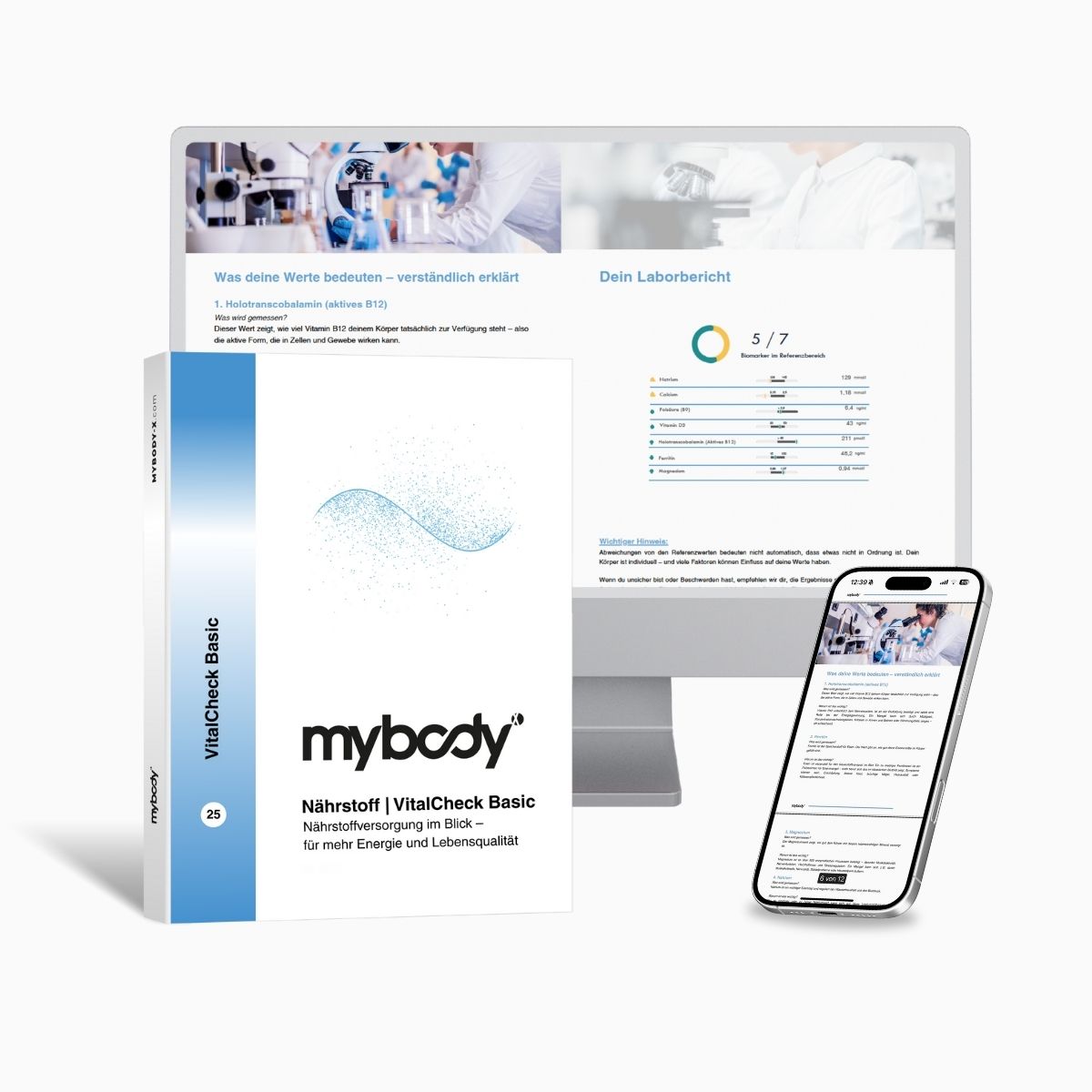
Capillary blood test
BalanceCheck | Electrolytes & Minerals Test
15 elements from one blood sample: the electrolytes potassium, sodium, calcium, magnesium, and phosphorus, plus six trace elements and four heavy metals. What the test does not provide: it does not provide a diagnosis, it measures a single point in time, and chloride is not included in the profile. An abnormal result should be assessed by a doctor.
Laboratory analysis 3–5 business days after sample receipt
Information from the product page, accessed 10 August 2026
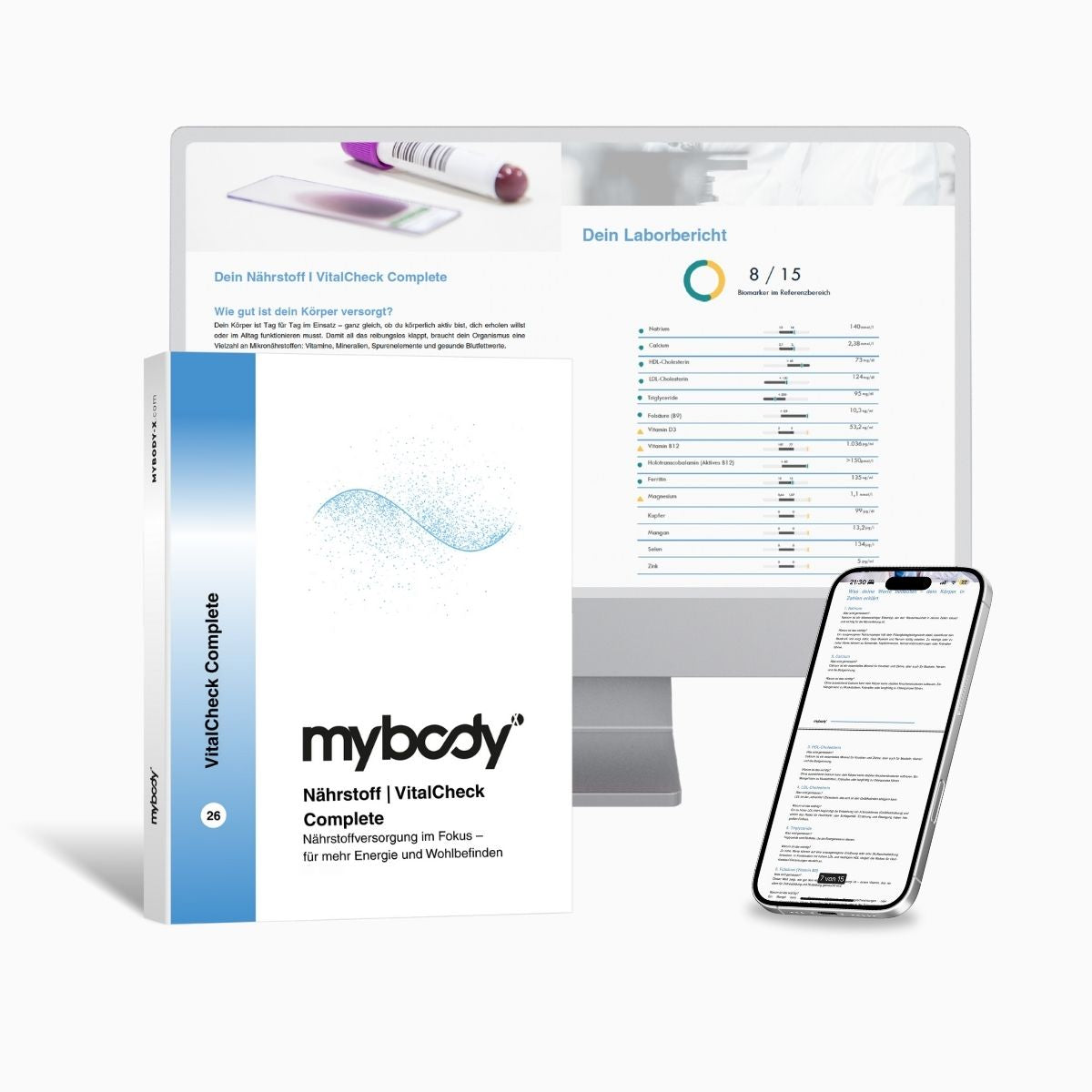
Capillary blood test
VitalCheck | Complete Nutrient & Mineral Test
The broader nutrient test with vitamin D3, vitamin B12, folic acid, ferritin, transcobalamin, blood lipids, as well as calcium, magnesium, sodium, selenium, zinc, copper, and manganese. What the test does not provide: potassium and phosphorus are not included, nor are heavy metals, and it does not provide a diagnosis.
Laboratory analysis 3–5 business days after sample receipt
Information from the product page, accessed 10 August 2026
What the mail-in process does to your potassium reading
Among blood values, potassium is the one most sensitive to how the sample is handled. This is not unique to self-tests; it applies in every laboratory. Nevertheless, for a test returned by mail, it is the most important sentence in the article.
The Institute of Clinical Chemistry and Laboratory Medicine at Freiburg University Medical Center describes two effects. First, hemolysis, meaning the bursting of red blood cells, releases potassium from the cells and causes the measured value to rise. Second: “An interval that is too long (> 1 hour) between blood collection and separation of the cellular components leads to an increase in potassium and a decrease in glucose” (as of 2025).
A potassium reading from a sample that has been left for a long time is more likely to be too high than too low.
A potassium reading from a sample that has been left for a long time is more likely to be too high than too low. For you, this means two things, and both are easy to put into practice.
Return it to the mailbox the same day
Plan the sample collection for a day when the return shipment can still be sent, rather than Friday evening. The laboratory will then receive the sample sooner, and the result will more closely reflect what was in your blood.
Storage also plays a role. According to the same information from Freiburg, storing whole blood in the refrigerator causes hemolysis and an increase in potassium. So the tube should not go in the refrigerator, but in the return envelope.
Why we are writing this at all
Because a slightly elevated potassium reading from a mail-in test may be a measurement effect rather than a statement about you. Anyone who does not know this may be alarmed by a number that would have been different at the local lab.
The objection is justified: This weakens the result. More precisely, it does not weaken the result itself, but the expectations placed on it. A result you can interpret correctly is more valuable than one you trust blindly.
Limitations: what a single potassium reading cannot answer
A blood test does not establish a diagnosis. Hypokalemia is diagnosed by a doctor, usually together with an electrocardiogram and other values, and it is treated by a doctor.
It also measures only the portion outside the cells. Around 98 percent of potassium remains invisible (Endocrine Connections, 2018). An unremarkable result is therefore a good finding, but not proof of the total stores.
The available data also have limitations. German information from IQWiG and DGE is available on reference ranges and intake. We did not find a reliable figure for the frequency of low potassium levels in the German population, so none is given here.
Another limitation concerns interpretation. A laboratory value tells you where something stands, not why. Whether the cause is a medication, an infection, or kidney function cannot be determined by a test alone, but requires a conversation with the results in hand.
And finally, a limitation concerning our own product: the BalanceCheck measures potassium, sodium, calcium, magnesium, and phosphorus, but not chloride. It would therefore be incorrect to call it a complete electrolyte profile, and we do not.
This list may read like an argument against testing. It is not. It is an argument against expecting a single number to replace a decision. A value is a data point, and a data point is a beginning.
A test is particularly useful when you bring a specific question with you. For example, if you want to see your electrolytes and trace elements side by side instead of collecting individual values scattered over several years. It is less useful if you notice one of the signs from Chapter 2, because then you need an appointment, not an order.
What matters about this value
If you take away just one action from this article, let it be this: Write down which medications you take regularly, and mark everything that is diuretic or laxative. It takes five minutes.
The reason is unremarkable. Of all the causes mentioned in this text, this is the only one with a documented magnitude: around 80 percent of people taking diuretics develop hypokalemia (Endocrine Connections, 2018). No dietary change comes close to that figure.
It all began with the question of how to recognize potassium deficiency. The most honest answer is: by very few of the signs mentioned online. Three are supported by evidence, and the most reliable indication is not in your body but on your medication list.
Frequently asked questions
What are the real symptoms of potassium deficiency?
The German Nutrition Society identifies three consequences: muscle weakness, paralysis, and cardiac arrhythmias in the form of an accelerated heartbeat (2016). Symptoms usually occur only when serum levels fall below 3.0 mmol/L; between 3.0 and 3.4 mmol/L, people often remain symptom-free. Fatigue, concentration problems, and hair loss are not listed as signs of potassium deficiency in the institute sources reviewed.
At what level is potassium deficiency diagnosed?
The IQWiG gives the reference range for adults as 3.7 to 5.1 mmol/l in blood serum and 3.5 to 4.6 mmol/l in blood plasma (2025). The MSD Manual sets the threshold for hypokalemia at below 3.5 mmol/l in serum (2025). The decisive factor is always the reference range shown on your own report, as it belongs to the measuring laboratory's procedure.
When should I seek medical evaluation instead of testing?
In cases of muscle weakness that limits daily activities, newly developed palpitations or a racing heart, persistent vomiting or diarrhea lasting several days, or regular use of laxatives or diuretic medication. In these cases, scheduling a medical appointment is the right order of action, not taking a self-test. A test provides a number, but not an interpretation of these signs.
Can I correct a potassium deficiency through my diet?
The DGE notes that potassium deficiency resulting from low dietary intake is rare (2016). It identifies losses due to vomiting, laxatives, diuretic medication, or chronic diarrhea as common causes. Increasing intake does not counteract an ongoing loss. The estimated value for adults is 4,000 milligrams per day, while average intake in Germany is approximately 3,900 milligrams for women and 4,300 milligrams for men.
Which mybody®x test measures potassium?
The BalanceCheck measures 15 elements in capillary blood, including potassium, sodium, calcium, magnesium, and phosphorus, as well as six trace elements and four heavy metals. The VitalCheck Complete does not include potassium; instead, it measures vitamins, ferritin, and blood lipids. Neither test provides a diagnosis or replaces medical evaluation.
Next step
A starting point instead of a guess
If you want to know where your potassium level stands in relation to the other electrolytes and trace elements, the BalanceCheck provides a starting point for personal monitoring. It does not replace medical evaluation.
To the BalanceCheck To the VitalCheck CompleteRead more
You may also be interested in
An overview of all electrolytes if you are not focusing only on potassium.
How to read electrolyte laboratory values, value by value.
Sources
- German Nutrition Society (DGE): Selected Questions and Answers about Potassium (as of 2016) – dge.de
- Institute for Quality and Efficiency in Health Care (IQWiG): Potassium (as of 2025) – gesundheitsinformation.de
- Kardalas E, Paschou SA, Anagnostis P et al.: Hypokalemia: a clinical update. Endocrine Connections 7(4), 2018 – ec.bioscientifica.com
- MSD Manual, Professional Edition: Hypokalemia, James L. Lewis III (as of 2025) – msdmanuals.com
The verbatim quotation concerning the rarity of diet-related potassium deficiency, along with the information on consequences, causes, estimated value, and actual intake, comes from source [1]. Reference ranges, the note on laboratory dependence, and the distribution of potassium in the body are based on [2]. The figure of two percent outside the cells, the symptom threshold of 3.0 mmol/l, and the information on diuretics and frequency come from [3]; the threshold of 3.5 mmol/l and the severity levels come from [4]. The description of potassium’s functions comes from the DGE reference values (derived in 2016); the information on hemolysis, holding time, and storage comes from the preanalytical information provided by the Institute of Clinical Chemistry and Laboratory Medicine at Freiburg University Medical Center (as of 2025); both are attributed in the text with the institution and year. Information on price, biomarkers, sample type, and laboratory comes from mybody®x product pages, accessed on 10.08.2026; processing times follow the central specification for blood tests. All sources were accessed and reviewed on 10.08.2026.

mybody®x Editorial & Expert Team
Laboratory diagnostics Nutritional science Blood analysis interpretation Nutrigenetics
This article was created by the mybody®x editorial and expert team. The team combines laboratory diagnostics, nutritional science, and the interpretation of blood analyses. The contributors are listed on the authors page.
Published on 10.08.2026 · Last updated on 10.08.2026
The content is for general information and does not replace medical advice, diagnosis, or treatment. Reference ranges depend on the laboratory, method, and age—the information on your test report is always authoritative.




Share now:
Your weight isn’t going down: which values you should check
Magnesium deficiency despite normal blood levels: what the serum level shows