

Blood values in plant-based diets: five that matter
The essentials
Five values are regularly mentioned in connection with plant-based diets. The sources are clear about two, cautious about two, and say something surprising about one.
The situation is clearest for vitamin B12. The MSD Manual, professional edition, makes a statement about this that also exonerates all other dietary patterns (as of August 2024).
You will first read why selecting the values is a question in the first place. This is followed by a comparison of the five values, the evidence-based core statement, three common statements fact-checked, and the figures from the authoritative sources.
What to expect in this article
1. Why selecting the values is a question
2. What criteria we used for selection
3. The five values compared
4. Vitamin B12: the clearest case
5. The statement that underpins the selection
6. Ferritin rather than iron
7. Three statements fact-checked
8. Two values with gaps in the evidence
9. Why folate belongs on the list
10. The figures from the authoritative sources
11. Why the five belong together
12. Who can benefit from testing
13. What a capillary blood test can show here
14. Limitations: what five values leave unanswered
15. What matters when making the selection
Frequently asked questions
Sources
Why selecting the values is a question
A blood test can include many different values. The practical question is therefore never whether something can be measured, but which values provide useful information in your own context.
Lists of varying lengths circulate in connection with plant-based diets. Some mention three values, others fifteen, and the reasons rarely match.
This article takes a different approach. It examines five values that are regularly mentioned and checks individually what the professional literature actually says about each one.
The result is mixed, and that is precisely what makes it useful. The sources are clear about two values, cautious about two, and say something about one that you should know in advance.
What criteria we used for selection
A value is included in this list if the reviewed sources establish a connection with the dietary pattern or if its interpretation has a particular feature one needs to know.
A value is not included simply because it is frequently mentioned. Popularity is not evidence, and a list that includes everything does not help with any decision.
What this article does not do: It does not assess any dietary pattern, provide dietary advice, or recommend a supplement. It describes laboratory values and what they can tell us.
The five values compared
The table compares the five values using the same three questions. It provides context and is not a diagnosis.
| Value | What the sources say about its connection to diet | What makes its interpretation more difficult | Evidence |
|---|---|---|---|
| Vitamin B12 | Inadequate intake is possible in vegans but otherwise unlikely | A broad gray area between 200 and 350 pg/ml | MSD Manual, Professional Edition, as of August 2024 |
| Ferritin | Non-heme iron from plants and grains is absorbed significantly less efficiently than heme iron | Iron levels alone have little significance; they should be interpreted together with ferritin and transferrin | MSD Manual, as of May 2025; IQWiG, as of March 20, 2025 |
| Zinc | The sources reviewed contain no statement about dietary pattern | Laboratory diagnosis is difficult; low albumin makes serum measurement more challenging | MSD Manual, Professional Edition, as of May 2025 |
| Selenium | IQWiG lists fish, meat, grains, and nuts among the sources | According to the MSD Manual, blood tests to detect selenium deficiency are currently unavailable | MSD Manual, Consumer Edition, as of July 2025; IQWiG glossary |
| Folate | No statement about dietary pattern, but it does help distinguish it from B12 deficiency | Homocysteine can be elevated in both vitamin B12 and folate deficiency; methylmalonic acid remains normal in folate deficiency | MSD Manual, Professional Edition, as of August 2024 |
The third column is the real message of this table. Each of the five values presents its own difficulty, and none of them appears on a test result.
Vitamin B12: the clearest case
For this value, the evidence is clearer than for all the others on this list.
The MSD Manual, Professional Edition, notes that dietary vitamin B12 deficiency develops with inadequate absorption, but that it can also affect vegans (as of August 2024).
One distinctive feature of this value is the time frame. The same source states that the liver’s vitamin B12 stores meet physiological needs for three to five years when intake is absent (as of August 2024).
Three to five years is a long period. It explains why this value cannot be inferred from how you feel and why a dated measurement makes the difference.
What this value specifically describes and which additional values the medical literature mentions is covered in the companion article Vitamin B12 in a Vegan Diet.
The sentence that supports the selection
A sentence from the medical literature explains why this particular value appears on every list while most others do not.
Documented source
“Inadequate intake of vitamin B12 is possible in vegans but otherwise unlikely.”
Larry E. Johnson, MD, PhD
MSD Manual, Professional Edition, Vitamin B12 Deficiency, as of August 2024
This sentence says two things at once, and both are crucial for choosing the values.
It says that inadequate intake is possible with a vegan diet. And it says that otherwise it is unlikely, meaning it is not the norm with other dietary patterns.
This makes it the only one of the five for which the scientific literature establishes a direct connection with dietary pattern. For the other four, the reasoning is different and less conclusive.
Ferritin instead of iron
For the second value on this list, the key difference lies not in intake but in absorption.
The MSD Manual, professional edition, states: Heme iron is found mainly in animal products and is absorbed significantly better than non-heme iron, which occurs in plants and grains (as of May 2025).
This is a statement about absorption, not content. It explains why looking at iron stores makes sense in this context.
Why the iron level alone is of little help
The IQWiG is unusually clear on this point: The level has little significance on its own because iron levels fluctuate considerably over the course of a day (as of 20 March 2025).
The same source gives the reason: The iron level temporarily rises after eating something and falls when you have not eaten for a longer period. And: A low iron level alone is not meaningful (as of 20 March 2025).
The interpretation is based on the same source together with other laboratory values, namely ferritin, transferrin, and transferrin saturation. That is why this list includes ferritin rather than iron.
The sister article Plant-Based Iron and Its Absorption discusses in detail how the absorption of iron from plant sources differs.
Three statements fact-checked
These three statements come up regularly when it comes to blood levels and plant-based diets.
Checked against the evidence
Commonly cited
“A plant-based diet lacks all kinds of things.”
Documented
For many levels, we found no connection to diet at all in the sources reviewed. The situation is clear for vitamin B12 (MSD Manual, professional edition, as of August 2024); for zinc and selenium, the sources cite other causes and other difficulties.
Commonly cited
“The iron level shows whether there is enough iron.”
Documented
The IQWiG states: The level has little significance on its own because iron levels fluctuate considerably over the course of a day. And: A low iron level alone is not meaningful (as of 20 March 2025). It should be interpreted together with ferritin, transferrin, and transferrin saturation.
Commonly cited
“A selenium level shows whether there is a selenium deficiency.”
Documented
The MSD Manual, Consumer Version, states: Blood tests to detect this deficiency are currently unavailable (as of July 2025). A selenium level can be measured; the source says that it does not establish a deficiency.
Two values with gaps
This is where the uncomfortable result of the research belongs in the text.
Two of the five values can be measured and are nevertheless difficult to interpret. That belongs on the test report, not in a footnote.
For zinc, the MSD Manual, Professional Edition, states: Laboratory diagnosis is also difficult and requires special collection techniques. It also states: Low albumin levels, which commonly occur with zinc deficiency, make determining the serum zinc level difficult (as of May 2025).
For selenium, the statement is even more fundamental. The MSD Manual, Consumer Version, states: Suspected selenium deficiency is based on the affected person’s circumstances and symptoms. Blood tests to detect this deficiency are currently unavailable (as of July 2025).
Both values are nevertheless included in this list for one reason only: Anyone who finds them on a test report should know how to interpret them. A number without this context is misleading.
Why folate is included
The fifth value is included in the list for a different reason than the other four. It is not useful on its own, but helps when interpreting another value.
The MSD Manual, Professional Edition, describes two additional values used when investigating vitamin B12 deficiency. One is methylmalonic acid: An elevated serum methylmalonic acid level supports a diagnosis of vitamin B12 deficiency (as of August 2024).
And the same source draws a distinction: Methylmalonic acid levels remain normal in folate deficiency, whereas homocysteine levels can be elevated in both vitamin B12 deficiency and folate deficiency (as of August 2024).
That means the two values are diagnostically related. Anyone considering one should know the other, because otherwise two different situations can feel the same.
The figures from the key sources
Three figures, each with a source and date. They provide context and do not constitute a diagnosis.
Documented information
under 200
pg/mL, corresponding to less than 145 pmol/L: A vitamin B12 level below this indicates a deficiency (MSD Manual, Professional Edition, as of August 2024)
3–5 years
the liver’s vitamin B12 stores cover physiological needs when intake is absent (as of August 2024)
over 85%
of the iron in the average diet is non-heme iron, which is absorbed less effectively than heme iron (MSD Manual, as of May 2025)
The third figure surprises many people. It refers to the average diet overall, not to a specific dietary pattern.
And as with every laboratory value, the decisive factor is the reference range stated on your own report, because reference ranges can vary from one laboratory to another (IQWiG, as of 02.04.2025).
Why the five belong together
The previous chapters do not present a uniform picture, and that is the point.
One of the five has a documented connection to dietary pattern. One has a documented connection to absorption. Two present measurement difficulties. And one is included because it makes another easier to interpret.
The practical benefit still exists, and it lies in the shared sample. Values from the same day, from the same laboratory, and under the same conditions can be related to one another.
The example of zinc and albumin illustrates this most clearly. According to the cited source, a zinc value on its own is harder to interpret than one accompanied by an albumin value.
Who may benefit from testing
The comparison concerns the joint measurement of several values from one sample.
Useful for you if …
You have changed your diet and want to establish a dated baseline value.
So far, you have only individual values from different years.
You are missing the albumin value for your zinc result, which is needed to interpret it.
You want to bring several figures from one sample to a consultation at a medical practice.
Probably not, if …
You expect an assessment of your diet. Laboratory values cannot provide that.
You want to use it to make a decision about supplements. That belongs in a medical practice.
You hope the selenium value will provide proof. The cited source explicitly says otherwise.
You expect a diagnosis. That is provided by a medical practice, not a self-test.
What a capillary blood test can show here
A capillary blood self-test does not provide a diagnosis or assess any dietary pattern. What it can do is provide several values from the same sample, together with the date and reference range.
VitalCheck by mybody®x (MYBODY Lab GmbH) measures four of the five values discussed here—vitamin B12, ferritin, zinc, and selenium—along with folate and albumin, which plays a role in interpreting the zinc value.
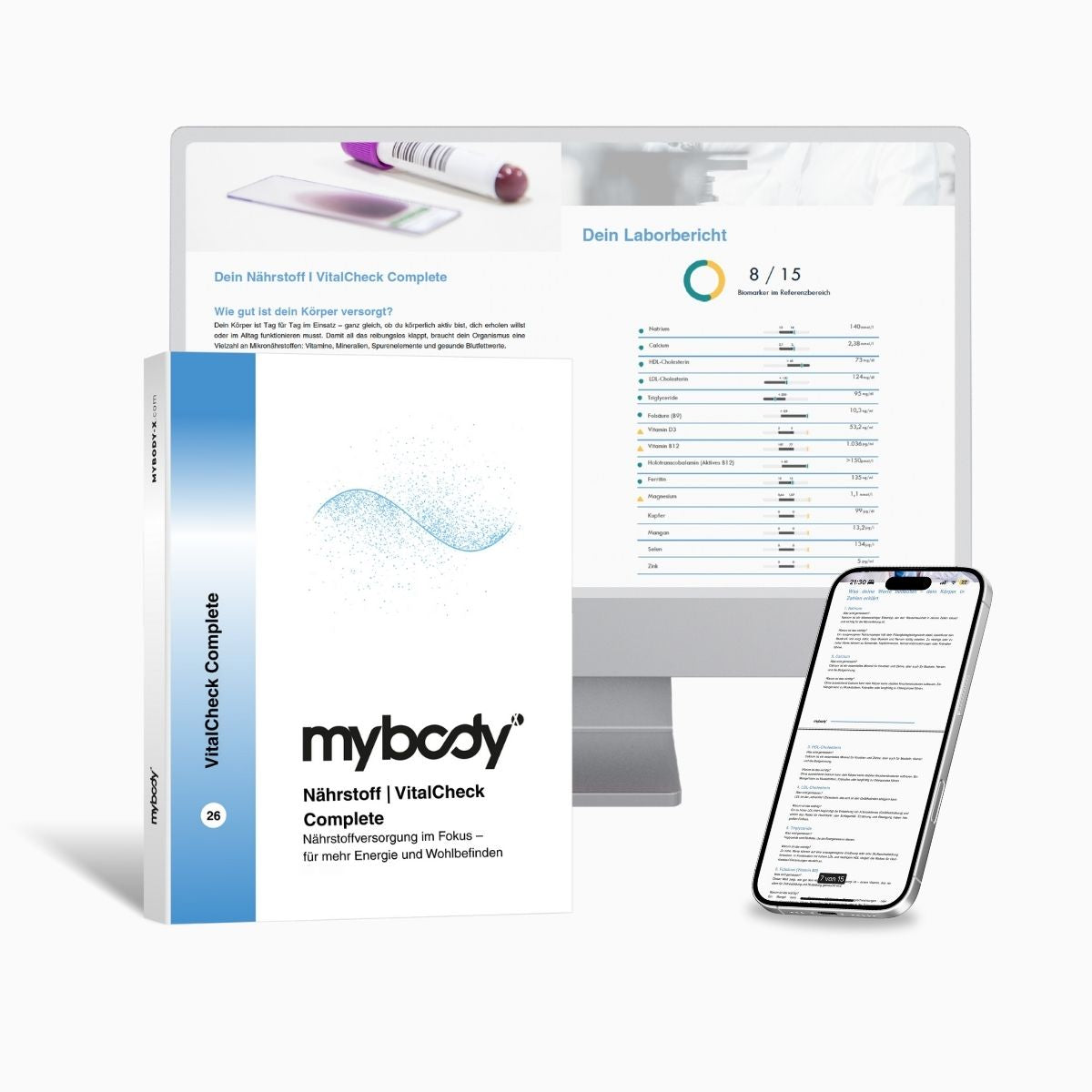
Capillary blood test
VitalCheck | Complete Nutrient & Mineral Test
Measures 18 values from the same sample, including vitamin B12, folate, ferritin, iron, transferrin, zinc, selenium, and albumin. It also measures vitamin D, calcium, magnesium, phosphate, long-term blood glucose, CRP, and the cholesterol profile. What the test does not do: It measures neither methylmalonic acid nor homocysteine, and the caveat from the cited specialist literature applies to selenium. It does not assess any dietary pattern, provide a diagnosis, or replace a medical examination.
Laboratory results available 3–5 business days after sample receipt
Product page information, accessed 08/15/2026
Four points determine whether several values can provide useful information.
Storage rather than a snapshot
For iron, the storage value matters because the iron level fluctuates significantly throughout the day.
Read albumin alongside it
Low albumin makes determining the serum zinc level more difficult.
Know the caveat
The specialist literature states that blood tests cannot detect a selenium deficiency.
Discuss the interpretation
What follows from a result is determined by a medical practice.
Chapter at a glance
A capillary blood self-test provides several of the values discussed from the same sample and does not constitute a diagnosis. Its benefit is that the values come from the same day and can be related to one another. Four points are decisive: storage rather than a snapshot, reading albumin alongside it, knowing the caveat, and discussing the interpretation.
Limitations: what five values leave open
The first limitation is the selenium level. The MSD Manual, consumer edition, states that blood tests to detect selenium deficiency are currently unavailable (as of July 2025). A measured value remains a number accompanied by this caveat.
The second limitation concerns zinc. According to the same body of sources, laboratory diagnosis is difficult and requires special collection techniques (MSD Manual, professional edition, as of May 2025).
The third limitation is the gray area for vitamin B12. According to the specialist literature, values between 200 and 350 pg/ml are within or only slightly below the normal range (as of August 2024), and it recommends additional tests for this range.
The fourth limitation is diagnosis. All classifications in this article provide context and are not diagnoses. A diagnosis is made in a medical practice based on several components, and no self-test can anticipate it.
What matters when making the selection
If you take away just one thing from this article, let it be this: A list of values is only useful when each value is accompanied by an explanation.
Of the five values discussed here, one has a documented connection to dietary intake, one to absorption, two involve measurement difficulties, and one makes another interpretable.
It began with the question of which values are worth testing. The honest answer is: these five, for very different reasons, with two caveats that do not appear on any report.
Frequently asked questions
Which blood values are particularly relevant for a vegan diet?
The evidence is clearest for vitamin B12. The MSD Manual, Professional Edition, states: Inadequate vitamin B12 intake is possible in vegans but otherwise unlikely (as of August 2024). Ferritin is relevant because non-heme iron from plants and grains is absorbed much less efficiently than heme iron (as of May 2025). Zinc, selenium, and folate are included for their own respective reasons.
Why ferritin rather than the iron level?
Because the iron level alone provides little information. IQWiG states: The value has little significance on its own because iron levels fluctuate considerably over the course of a day. It rises temporarily after eating something and falls when someone has not eaten for a longer period (as of March 20, 2025). It is interpreted together with ferritin, transferrin, and transferrin saturation.
How long do B12 stores last without intake?
The MSD Manual, Professional Edition, states: The liver’s vitamin B12 stores meet physiological needs for three to five years when vitamin B12 intake is absent (as of August 2024). Therefore, current well-being says little about this value.
Can selenium deficiency be detected in the blood?
The MSD Manual, Consumer Version, states: Suspected selenium deficiency is based on the person’s circumstances and symptoms. Blood tests to detect this deficiency are currently unavailable (as of July 2025). A selenium level can be measured; the source says that it does not establish a deficiency.
Why is folate included in this list?
Because of the distinction from vitamin B12. The MSD Manual, Professional Edition, states that homocysteine levels can be elevated in both vitamin B12 deficiency and folate deficiency, whereas methylmalonic acid levels remain normal in folate deficiency (as of August 2024). The two values are diagnostically related.
Next step
The values from the same day have
Values from the same sample can be related to one another; individual reports from different years cannot. The VitalCheck measures vitamin B12, folate, ferritin, zinc, selenium, and albumin together with twelve other values from capillary blood. It does not assess any particular diet, provide a diagnosis, or replace medical evaluation.
To the VitalCheckRead more
You might also be interested in
What the serum level describes and which two values the specialist literature also mentions.
Why iron absorption matters more than iron content.
Sources
- MSD Manual, Professional Version: Vitamin B12 Deficiency, Johnson LE (full review August 2024) – msdmanuals.com
- MSD Manual, Professional Version: Iron Deficiency, Johnson LE (full review May 2025) – msdmanuals.com
- MSD Manual, Professional Version: Zinc Deficiency, Johnson LE (full review May 2025) – msdmanuals.com
- MSD Manual, Patient Version: Selenium Deficiency, Johnson LE (full review May 2025, last updated July 2025) – msdmanuals.com
- Institute for Quality and Efficiency in Health Care (IQWiG): Iron, as of 20.03.2025 – gesundheitsinformation.de
- IQWiG: Glossary entry: Selenium – gesundheitsinformation.de
- IQWiG: Understanding laboratory values correctly, as of 02.04.2025 – gesundheitsinformation.de
The verbatim quotation regarding inadequate intake among vegans, the threshold below 200 pg/ml, the gray area from 200 to 350 pg/ml, the storage period of three to five years, and the information on methylmalonic acid and homocysteine are taken from source [1]. The statements about heme and non-heme iron and the figure of more than 85 percent are taken from [2]. The statements about the difficulty of diagnosing zinc deficiency in the laboratory and about albumin levels are taken from [3]. The statement that blood tests for detecting selenium deficiency are currently unavailable is taken from [4]. The statements about the limited significance of the iron level alone, its daily fluctuations, and its joint interpretation with ferritin and transferrin are taken from [5]. The mention of selenium sources is taken from [6]. The explanation of the reference range is taken from [7]. Information on price, values, sample type, and laboratory comes from the mybody®x product page, accessed on 15.08.2026; processing times follow the central specifications for blood tests. All sources were accessed and reviewed on 15.08.2026.

mybody®x Editorial & Specialist Team
Laboratory diagnostics Blood analysis interpretation Nutritional science Nutrigenetics
This article was created by the mybody®x editorial and specialist team. The team combines laboratory diagnostics, nutritional science, and the interpretation of blood analyses. Those who contribute to it are listed on the authors’ page.
Published on 15.08.2026 · Last updated on 15.08.2026
The content is intended for general information and does not replace medical advice, diagnosis, or treatment. Reference ranges depend on the laboratory, method, and age; the information on your test report is always authoritative.




Share now:
Normal TSH level but still experiencing symptoms
Copper and zinc: why the ratio matters