

Transferrin completes the picture of iron status
The key points at a glance
Transferrin appears on many test reports below iron and ferritin and is read least often. This is also because it has to be interpreted in the opposite way from what one would expect.
According to the cited source, a high level indicates a significant iron deficiency. A low level, by contrast, often points to too much iron in the body or to inflammation.
You will read a fact-check of three common statements, the cited source in its original wording, three documented facts, a comparison of the three values, and the role of transferrin saturation.
What to expect in this article
1. The value that hardly anyone reads
2. Three statements in a fact-check
3. What transferrin is
4. The documented source
5. Why high points to low here
6. Three documented facts
7. The key point in one sentence
8. Transferrin saturation as a derived value
9. The three values compared
10. What happens during inflammation
11. Who benefits from the third value
12. What a capillary blood test can show here
13. Limitations: what even three values leave unanswered
14. What matters about this value
Frequently asked questions
Sources
The value that hardly anyone reads
On a test report showing iron values, the eye usually goes to two lines: iron, because the name is familiar, and ferritin, because the word is associated with storage.
The third line is labeled transferrin and often goes unnoticed. The reason is not a lack of interest but a trap in the way the value is structured.
Anyone who reads this level like the other two will misunderstand it—in reverse, so to speak. Here, high does not mean a lot; according to the cited source, it points in the opposite direction.
This article explains what the level reflects, why it has to be interpreted in reverse, and what it adds to the test report. It builds on the article Ferritin shows the stores, iron shows the moment.
Three statements in a fact-check
These three statements come up as soon as transferrin appears on a test report.
Checked against the available evidence
Common
“A high transferrin level is a good sign.”
Documented
The IQWiG writes: Elevated transferrin levels usually occur with a significant iron deficiency (as of March 20, 2025). The interpretation here is reversed.
Common
“Then a low level is simply bad.”
Documented
That is also too simplistic. The same source notes: When the transferrin level is low, there is often too much iron in the body—in other words, iron overload (as of March 20, 2025). Low levels can also occur with inflammation.
Common
“This value is superfluous; ferritin is enough.”
Documented
The MSD Manual explicitly lists transferrin saturation alongside the complete blood count and serum ferritin for diagnosis (Johnson, as of May 2025). It cannot be calculated without the transferrin value.
What transferrin is
As with ferritin, the name refers not to iron, but to a protein that interacts with it.
The IQWiG writes: “Transferrin is a protein produced in the liver. Its function is to transport iron in the blood to the organs” (as of March 20, 2025).
This means that an iron panel contains three different things: the element itself, its storage form, and its transport medium. Each of them responds to a different situation.
For the reference ranges, the same source gives 200 to 360 mg/dl for both women and men over 18 (as of March 20, 2025). Unlike iron and ferritin, the figures do not differ between the sexes here.
The fact that the liver produces this protein is a second important point for interpretation. A value that originates in an organ also depends on the condition of that organ, and not solely on the iron status.
This means that an iron panel contains two proteins that are both produced or processed in the liver, and an elemental value that fluctuates over the course of the day. None of the three is a direct reading of a reserve.
The same applies to each of these values: A single laboratory value usually cannot be used to infer a disease; only in conjunction with other values, symptoms, and examinations does a clear picture emerge (IQWiG, as of March 20, 2025).
The documented source
The sentence that establishes the reading direction is short and nevertheless regularly overlooked.
Documented source
“Elevated transferrin levels usually occur in cases of significant iron deficiency.”
Institute for Quality and Efficiency in Health Care
IQWiG, gesundheitsinformation.de, Transferrin, as of March 20, 2025
This sentence contradicts the intuitive expectation, which is precisely why it appears here as a quotation rather than a summary.
The word “significant” is part of the statement. The source does not refer to every deficiency, but to a significant one, thereby also indicating the value’s sensitivity.
For the opposite direction, the same source states: “In cases of a low transferrin level, however, there is often too much iron in the body, meaning iron overload” (as of March 20, 2025).
Why high here indicates little
The reversed reading direction seems arbitrary until you realize what the value actually measures.
According to the quoted source, transferrin is the means of transport for iron in the blood. A transferrin value therefore describes how much transport capacity is available, not how much of it is loaded.
One way to picture this: Twenty empty railway cars are standing at a station. This number says nothing about how much goods are in circulation. It says something about how much goods could be transported.
Therefore, a high transferrin value is not a sign of abundance. According to the quoted source, it usually occurs in cases of significant iron deficiency, while a low value is often associated with too much iron in the body (IQWiG, as of March 20, 2025).
Where the image reaches its limit
Every image has a point beyond which it no longer applies, and that needs to be stated as well.
At a real railway station, no one adds railway cars because goods are missing. In the body, things are different: transferrin is produced in the liver, and its amount responds to the state of supply. That is precisely why the value provides any information at all.
The comparison therefore helps readers remember the direction of reading; it does not explain the underlying mechanism. The direction of reading is sufficient for interpreting a report, while explaining it is the responsibility of a medical professional.
The word “usually” in the quoted sentence is also important. It indicates that this is a typical case, not a calculation rule. A single value outside the range therefore does not permit any conclusion, and the same source generally states: A disease usually cannot be inferred from a single laboratory value alone (IQWiG, as of March 20, 2025).
Three documented pieces of information
Three pieces of information from the reviewed sources. They provide context and do not constitute a diagnosis.
Documented information
200–360
mg/dl is the stated transferrin reference range, applying equally to women and men over 18 (IQWiG, as of March 20, 2025).
< 20 %
In cases of deficiency, transferrin saturation is often; ferritin levels are then generally low, below 50 mcg/l (MSD Manual, professional edition, Johnson, as of May 2025).
3
The same source lists the following tests for diagnosis: complete blood count, serum ferritin, and transferrin saturation (as of May 2025).
The first piece of information is revealing in itself. The fact that the same range applies to both sexes distinguishes transferrin from iron and ferritin, where the values differ significantly.
And as with every laboratory value, the decisive factor is the reference range stated on your own report, because reference values can vary from one laboratory to another (IQWiG, as of April 2, 2025).
The key point in one sentence
This is where the topic can be brought together.
This value does not count goods, but railway cars. Therefore, a high value does not mean abundance, but rather demand.
Once you grasp this one idea, you read the line in the right direction. Everything else in this article is an elaboration of it.
And it explains why a new value is calculated from transferrin and iron together. If you count the wagons and the goods, you can calculate how full the wagons are.
Transferrin saturation as a derived value
This exact calculation appears as a separate value on many test reports and in the medical literature.
The MSD Manual lists transferrin saturation alongside a complete blood count and serum ferritin measurement as one of three tests used for diagnosis (Johnson, as of May 2025).
Regarding the order of magnitude, it states: In deficiency states, ferritin levels are generally low, below 50 mcg/l, and transferrin saturation is often below 20 percent (as of May 2025).
Saturation is therefore a derived value, and it inherits the properties of its components. Because the iron value fluctuates considerably over the course of the day according to IQWiG (as of March 20, 2025), a saturation calculated from it fluctuates as well.
This is not an argument against this value, but a condition for interpreting it. A saturation without the time of sample collection is harder to put into context than one that includes it.
What is noteworthy is what the medical literature does not do here. It does not replace the individual values with the saturation; instead, it lists serum ferritin and transferrin saturation side by side. The derived value is therefore added and does not take the place of the others.
For a test result, this means that when a saturation is reported, the values from which it was calculated still belong with it. A single percentage without its two components beside it loses the information about which of the two drove it.
You will find the same idea in this blog in the discussions of cholesterol and the copper-to-zinc ratio. A quotient is convenient and conceals its components, and that is precisely why the components belong alongside it.
The three values compared
The table places the three values side by side and shows the direction in which each should be interpreted. It provides context and does not constitute a diagnosis.
| Value | What it measures | What a high value suggests | What a low value suggests |
|---|---|---|---|
| Serum iron | The amount in the blood at the time the sample was taken | Low on its own—the value has little significance by itself because it fluctuates considerably over the course of the day (IQWiG, as of March 20, 2025) | Also low, for the same reason |
| Ferritin | The storage protein—the protein that can bind iron | Iron overload or inflammation (IQWiG, as of March 20, 2025) | In deficiency states, the levels are generally low, below 50 mcg/l (MSD Manual, as of May 2025) |
| Transferrin | The transport capacity – the protein that carries iron to the organs | Usually indicates a significant iron deficiency (IQWiG, as of March 20, 2025) | Often too much iron in the body, meaning iron overload; inflammation is also possible (IQWiG, as of March 20, 2025) |
| Transferrin saturation | How full the transport capacity is – a derived value | Used by a practice for assessment; the value inherits fluctuations from the iron level | Often below 20% in deficiency states (MSD Manual, as of May 2025) |
The second and third lines move in opposite directions. This is precisely what creates the additional information provided by the third value.
Low ferritin and high transferrin point in the same direction, even though the numbers appear to move in opposite directions. Anyone who reads only one of the two lines cannot recognize this parallel.
And when the two lines contradict each other, this is not an error in the test report but information in itself. It raises the question of whether another condition is involved, and the most common one is discussed in the next chapter.
What happens during inflammation
This shows why a third value is more than a repetition.
For ferritin, IQWiG states that more ferritin is present in the blood during inflammation to inhibit bacterial growth, and that elevated levels can indicate both iron overload and inflammation (as of March 20, 2025).
For transferrin, the same source lists inflammation alongside iron overload as a cause of low levels (as of March 20, 2025). Under this condition, both values therefore change, but in opposite directions.
The MSD Manual describes the consequence plainly: Chronic inflammation increases serum iron by reducing the use of iron to make red blood cells, thereby making it harder to assess iron status (Johnson, as of May 2025).
This leads to a simple consequence for interpreting a test result: An inflammation marker should be included alongside it. On many test reports, this is the CRP level, and the article CRP level in the blood: what it indicates explains what it can tell you.
Who can benefit from the third value
The comparison addresses the question of whether a transferrin level can help you in addition to iron and ferritin.
Useful for you if …
you have so far only known iron and ferritin, and the two values seem to contradict each other.
you want to bring a more complete picture to a conversation at the doctor's office.
you have a ferritin level that may be distorted by inflammation.
You want to establish a baseline before changing something in your diet.
Probably not if …
You expect a third value to settle the question. It does not.
You need a complete blood count. This test does not include one.
You are already undergoing evaluation. In that case, the practice that started it will guide the process.
You expect a diagnosis. That is provided by a medical practice, not a self-test.
What a capillary blood test can show here
A capillary blood self-test does not provide a diagnosis. What it can do is provide all three values from the same sample and on the same date.
VitalCheck by mybody®x (MYBODY Lab GmbH) measures iron, ferritin, and transferrin, as well as the CRP value. This puts the three iron values and the inflammation caveat from Chapter 10 on the same report.
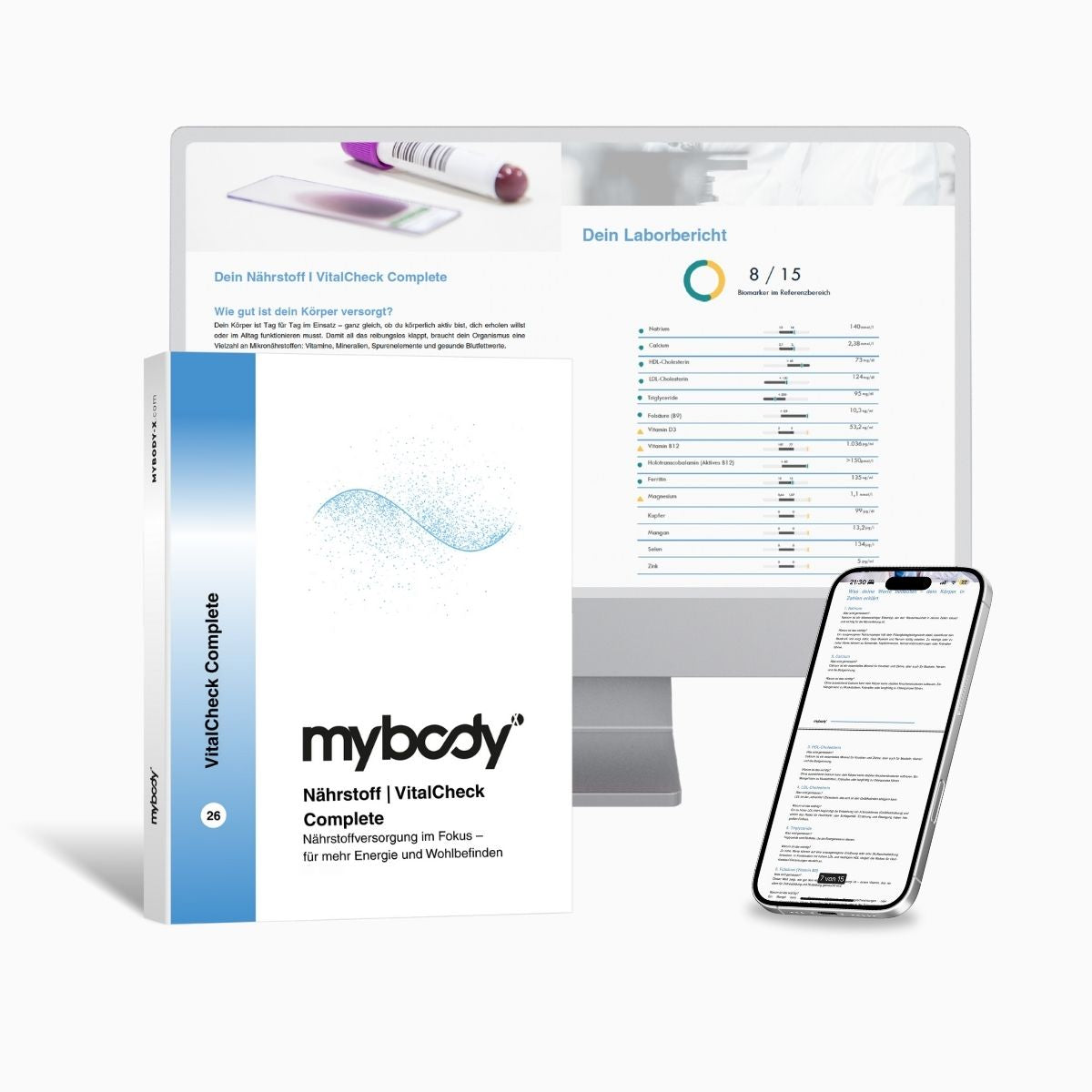
Capillary blood test
VitalCheck | Complete Nutrient & Mineral Test
Measures 18 values from the same sample, including iron, ferritin, transferrin, and CRP, as well as 25-OH vitamin D3, vitamin B12, folic acid, calcium, magnesium, phosphate, albumin, selenium, zinc, long-term blood sugar, and the cholesterol profile. What the test does not provide: no complete blood count, no diagnosis, no recommendation for a supplement, no dosage, and no substitute for a medical examination.
Laboratory results 3–5 business days after sample receipt
Product page information, accessed 18/08/2026
Chapter at a glance
A capillary blood test measures iron, ferritin, transferrin, and CRP from the same sample. This puts the three iron values and the inflammation caveat on the same report at the same time. A complete blood count is not included, and the overall assessment belongs in a medical practice.
Limitations: what even three values leave unanswered
The first limitation is cause. The three values describe a situation, not its underlying reason. Why a picture looks the way it does is something a medical practice can determine.
The second limitation is inflammation. It moves ferritin and transferrin in opposite directions and, according to the MSD Manual, makes assessing iron status overall more difficult (Johnson, as of May 2025).
The third limitation is scope. The MSD Manual lists a complete blood count as one of the three tests, and a nutrient panel does not include it. In rare cases, according to the same source, an examination of the bone marrow for iron may even be necessary.
The fourth boundary is diagnosis. All the interpretations in this article provide context but do not constitute a diagnosis. A diagnosis is made in a medical practice based on several components, and no self-test can anticipate it.
What matters for this value
If you take away just one thing from this article, let it be this: Transferrin reads in reverse.
IQWiG writes that elevated transferrin levels usually occur in cases of significant iron deficiency, while a low level often indicates that there is too much iron in the body (as of March 20, 2025). The reason lies in what the value measures: transport capacity, not the amount being transported.
What it adds to the test result is a third perspective on the same question. Together with the iron level, it forms transferrin saturation, which the MSD Manual lists alongside a blood count and serum ferritin for diagnosis. Assessing these values together is a medical task.
Frequently asked questions
What does a high transferrin level mean?
IQWiG writes: Elevated transferrin levels usually occur in cases of significant iron deficiency (as of March 20, 2025). So this value is interpreted in the opposite way to what one might expect. Interpreting a specific finding belongs in a medical practice.
And what does a low level mean?
The same source notes: However, a low transferrin level often indicates that there is too much iron in the body—in other words, iron overload (as of March 20, 2025). Inflammation is also a possible reason for low levels.
What exactly is transferrin?
IQWiG writes: Transferrin is a protein produced in the liver. Its function is to transport iron in the blood to the organs (as of March 20, 2025). The same source gives a reference range of 200 to 360 mg/dl for both women and men over 18.
What is transferrin saturation?
A derived value that the MSD Manual lists alongside a complete blood count and serum ferritin measurement for diagnosis (Johnson, as of May 2025). It states that, in deficiency states, this value is often below 20 percent and ferritin levels are generally low, below 50 mcg/l.
Why include an inflammation marker?
Because inflammation affects both protein levels. With ferritin, more of it is present in the blood during inflammation; for transferrin, the same source lists inflammation as a reason for reduced levels (IQWiG, as of March 20, 2025). The MSD Manual states that chronic inflammation makes it more difficult to assess iron status (Johnson, as of May 2025).
Next step
All three values on one sheet
VitalCheck measures 18 values from capillary blood, including iron, ferritin, transferrin, and CRP from the same sample. It does not include a complete blood count, does not provide a diagnosis, and does not replace medical evaluation.
Go to VitalCheckRead more
You might also be interested in
The introductory article on the other two values.
Why the level says little about absorption.
Sources
- Institute for Quality and Efficiency in Health Care (IQWiG): Transferrin, as of 20 March 2025 – gesundheitsinformation.de
- MSD Manual, Professional Edition: Iron deficiency, Johnson LE (last full review May 2025) – msdmanuals.com
- IQWiG: Ferritin, as of 20 March 2025 – gesundheitsinformation.de
- IQWiG: Iron, as of 20 March 2025 – gesundheitsinformation.de
- IQWiG: Understanding laboratory values correctly, as of 2 April 2025 – gesundheitsinformation.de
The verbatim quotation about elevated transferrin levels, the description of the protein and its function, the reference range of 200 to 360 mg/dl, and the statements about low levels come from source [1]. The three tests mentioned, the figures below 50 mcg/l and below 20 percent, the sentence about chronic inflammation, and the reference to bone marrow examination come from [2]. The statements about ferritin during inflammation come from [3]. The statement about fluctuations in iron levels over the course of the day comes from [4]. The explanation of the reference range comes from [5]. Information on price, values, sample type, and laboratory comes from the mybody®x product page, accessed on 18 August 2026; processing times follow the central requirements for blood tests. All sources were accessed and reviewed on 18 August 2026.

mybody®x Editorial & Specialist Team
Laboratory diagnostics Blood analysis interpretation Nutritional science Nutrigenetics
This article was created by the mybody®x editorial and specialist team. The team combines laboratory diagnostics, nutritional science, and the interpretation of blood analyses. Everyone involved can be found on the authors page.
Published on 18 August 2026 · Last updated on 18 August 2026
The content is intended for general information and does not replace medical advice, diagnosis, or treatment. Reference ranges depend on the laboratory, method, and age; the information on your report is always authoritative.




Share now:
Copper and zinc: why the ratio matters
Men’s health is reflected in seventeen values