

Normal TSH level but symptoms nonetheless
The essentials at a glance
A TSH within the reference range is reliable information, and it is narrower than it sounds. The MSD Manual, Professional Edition, states it with an exception in the same sentence (as of February 2024).
What the value answers is the question of thyroid function. What it does not answer is where your symptoms come from. IQWiG notes that many symptoms of an underactive thyroid can also have other causes (as of April 24, 2024).
You will first learn what TSH describes. This is followed by a fact check of three common statements, three age-specific reference ranges, the circumstances in which the value itself can lead you astray, and what subclinical means.
What to expect in this article
1. What TSH describes
2. The sentence with the exception
3. Why TSH is measured first
4. Three statements fact-checked
5. There is more than one reference range
6. The figures from the authoritative sources
7. What a normal value leaves unanswered
8. When TSH itself leads you astray
9. Four situations compared
10. What subclinical means
11. Who may benefit from testing
12. What a capillary blood test can show here
13. Limitations: what a laboratory value cannot tell you
14. What matters about TSH
Frequently asked questions
Sources
What TSH describes
TSH is a value with a peculiarity that surprises many people: it does not actually come from the thyroid.
IQWiG describes it as follows: TSH, also called thyrotropin, is a hormone produced by the pituitary gland and released into the blood (as of March 20, 2025). It stimulates the thyroid to produce thyroid hormones.
TSH therefore does not measure the thyroid itself, but the signal sent to it. It describes regulation, not a reserve.
Why the direction is reversed
This regulatory system leads to a logic that seems backward at first glance.
IQWiG puts it succinctly: Elevated TSH levels in the blood generally indicate an underactive thyroid, while low TSH levels indicate an overactive thyroid (as of March 20, 2025).
The reason lies in the feedback system. When the thyroid produces too little, the pituitary gland calls louder, and that very call is what TSH measures.
The sentence with the exception
The medical literature answers this article’s title question in a single sentence, and that sentence contains its own limitation.
Documented source
“Normal TSH levels rule out hyperthyroidism or hypothyroidism, except in patients with central hypothyroidism due to a disorder of the hypothalamus or pituitary gland”
Laura Boucai, MD
MSD Manual, Professional Edition, Description of thyroid function, as of February 2024
This statement is stronger than many guidebooks claim. It says that a normal TSH rules out the two common thyroid disorders.
And it also indicates where this information ends: with central hypothyroidism, meaning a disorder of the hypothalamus or pituitary gland. In that case, the site that sends the signal is itself not regulating things properly.
Both points belong together. Anyone who cites only the exception turns a reliable value into an unreliable one. Anyone who cites only the rule conceals a documented limitation.
Why TSH is measured first
The fact that diagnostic testing begins with TSH is neither accidental nor a cost-cutting measure.
The MSD Manual, professional edition, states: TSH is the most sensitive parameter for evaluating thyroid function (as of February 2024). It continues: In patients with risk factors, serum TSH should be measured; it is the best test for detecting both hyperthyroidism and hypothyroidism.
IQWiG describes the same sequence based on clinical practice: Thyroid dysfunction can be detected particularly early through a change in the TSH level, so often only TSH is measured initially; if this value is abnormal, the thyroid hormones T3 and T4 are also measured (as of April 24, 2024).
What the two hormone values add and when they are useful is covered in the companion article Free T3 and free T4 alongside TSH.
Three statements in a fact check
These three statements regularly come up when a TSH result is unremarkable.
Checked against the evidence
Widespread
“A normal TSH says nothing at all.”
Substantiated
It tells us quite a bit. Normal TSH levels rule out hyperthyroidism or hypothyroidism, except for central hypothyroidism caused by a disorder of the hypothalamus or pituitary gland (MSD Manual, professional edition, as of February 2024). IQWiG puts it this way: If TSH levels are within the reference range, the thyroid is also functioning normally (as of March 20, 2025).
Widespread
“The reference range is the same for everyone.”
Substantiated
IQWiG lists three age-based ranges: 0.51 to 4.3 mU/l up to age 20, 0.3 to 3.5 mU/l for adults, and 0.3 to 4.5 mU/l from age 50 onward (as of March 20, 2025). The same number can fall within or outside the range depending on age.
Widespread
“Fatigue and weight gain point to the thyroid.”
Substantiated
IQWiG writes: Because many symptoms of an underactive thyroid can also have other causes, blood tests are performed to establish a clear diagnosis (as of April 24, 2024). So the direction is from the test to the diagnosis, not from the symptom to the suspicion.
There is not just one reference range
This point often determines whether a finding is interpreted as unremarkable or not.
IQWiG lists three TSH ranges by age. The adult range is the narrowest, while the range for people aged 50 and over extends considerably higher (as of March 20, 2025).
A value of 4.0 mU/l is above the stated adult range for a 35-year-old person and within the stated range for people aged 50 and over for a 60-year-old person. The same number, two interpretations.
And the value fluctuates during the day
There is also a daily rhythm. IQWiG notes: The values may fluctuate as well; at night, for example, they are highest, and in the afternoon, lowest (as of March 20, 2025).
For comparing two test reports, this means that the time of the sample is part of the picture. Two values from different times of day are not readily comparable.
And as with every laboratory value, the decisive factor is the reference range shown on your own report, because reference values may vary from one laboratory to another (IQWiG, as of April 2, 2025).
The figures from the authoritative sources
Three reference ranges from the same source, all in milliunits per liter. They provide context and do not constitute a diagnosis.
Established TSH reference ranges
0,51–4,3
mU/l for adolescents and young adults up to age 20 (IQWiG, as of March 20, 2025)
0,3–3,5
mU/l for adults – the narrowest of the three ranges (IQWiG, as of March 20, 2025)
0,3–4,5
mU/l from age 50 onward (IQWiG, as of March 20, 2025)
The upper limit stands out. There is a full milliunit between 3.5 and 4.5, and whether a number in this range falls inside or outside depends solely on age.
Regarding frequency, IQWiG gives an approximate figure: In countries such as Germany, about 5 in 100 people have an underactive thyroid, with women and older people being particularly frequently affected (as of April 24, 2024).
What a normal value leaves open
At this point, the core message of this article can be summed up in one sentence.
A normal TSH answers the question of the thyroid. It does not answer the question of what is causing your symptoms.
That is the real point, and it is misunderstood in both directions. One side infers from a normal value that the symptoms are imaginary. The other concludes that the value is worthless.
Neither conclusion follows. The value answered one question, and the next question is a different one.
IQWiG states the general principle: A single laboratory value usually cannot be used to infer a disease (as of March 20, 2025). This statement applies in both directions, to abnormal as well as unremarkable values.
When TSH itself leads you astray
In addition to central hypothyroidism, the medical literature identifies other circumstances in which the value does not indicate what it normally indicates.
The MSD Manual, professional edition, states: Serum TSH may be falsely low in very ill people, particularly in patients receiving glucocorticoids or dopamine (as of February 2024).
The same source also lists euthyroid sick syndrome, also called low-T3/low-T4 syndrome, in which TSH may be normal, low, or high (as of February 2024).
What this means in practice
These circumstances are not everyday cases. They predominantly affect people who are already receiving treatment for other reasons.
That is precisely why they belong in a discussion, not in a self-assessment. Ongoing medication and an existing condition change the interpretation of a TSH level, and only the practice familiar with both can assess this.
Only the prescribing medical practice decides on ongoing medication. This article mentions it as a circumstance that affects interpretation, not as something to be called into question.
Four situations compared
The table compares four situations in which TSH is within the reference range. It provides context and does not constitute a diagnosis.
| Situation | What a normal TSH tells you | What it leaves open | Evidence |
|---|---|---|---|
| Symptoms, TSH within the reference range | Hyperthyroidism or hypothyroidism is therefore ruled out | What is causing the symptoms—many symptoms also have other causes | MSD Manual, as of February 2024; IQWiG, as of April 24, 2024 |
| Afternoon sample | The same, with a caveat regarding the comparison | Whether a later value was measured at a different time of day—levels are highest at night and lowest in the afternoon | IQWiG, as of March 20, 2025 |
| Severe illness, glucocorticoids, or dopamine | Less than usual—the value may be falsely low | The actual functional status; the classification belongs with the treating medical practice | MSD Manual, as of February 2024 |
| Disease of the hypothalamus or pituitary gland | Nothing reliable—the exception in the quoted sentence | Whether central hypothyroidism is present; this is determined by a medical practice | MSD Manual, as of February 2024 |
The first line is the most common case and the one discussed in this article. The other three are less common but nevertheless documented.
What “latent” means
One term regularly comes up in this context and is rarely explained.
IQWiG defines it as follows: If the TSH level is elevated, but sufficient thyroid hormones are produced and no symptoms occur, this is referred to as latent hypothyroidism (as of April 24, 2024).
What is noteworthy is that this condition is explicitly defined as occurring without symptoms. It is therefore almost the opposite of the article’s starting question.
What it leads to, and what remains open
Regarding further progression, IQWiG gives one figure: Each year, 2 to 5 out of 100 people with subclinical hypothyroidism develop hypothyroidism with symptoms (as of April 24, 2024).
The same source cites an observational study over two to three years in which the risk increased with the level of the result: at 5 to 10 mU/l, 2 percent of participants per year; at 10 to 15 mU/l, 20 percent per year; and above 15 mU/l, 73 percent per year (as of April 24, 2024).
It also clearly leaves two things open. Slightly elevated TSH levels often return to normal, sometimes only after a longer period. Whether treating subclinical hypothyroidism has benefits is unclear (as of April 24, 2024).
This also means that the treatment question cannot be determined from a laboratory value. It belongs in a medical practice, and this article makes no recommendation on it.
Who may benefit from testing
The comparison concerns measuring the thyroid values from one sample.
It may be useful for you if …
You have never had your TSH measured and want a baseline value with the date.
You only know one TSH result and are missing the two corresponding hormone values.
You want to bring dated and timed results to a discussion at your doctor’s office.
You want to see the thyroid values together with other values from the same sample.
Probably not if …
You hope the result will explain your symptoms. It cannot answer that question.
You want to monitor existing thyroid treatment. That belongs with the practice managing it.
You are seriously ill or taking certain medications. Interpretation is then limited.
You expect a diagnosis. That is provided by a medical practice, not a self-test.
What a capillary blood test can show in this context
A capillary blood self-test does not provide a diagnosis or explain symptoms. What it can do is provide all three thyroid values from the same sample instead of just one.
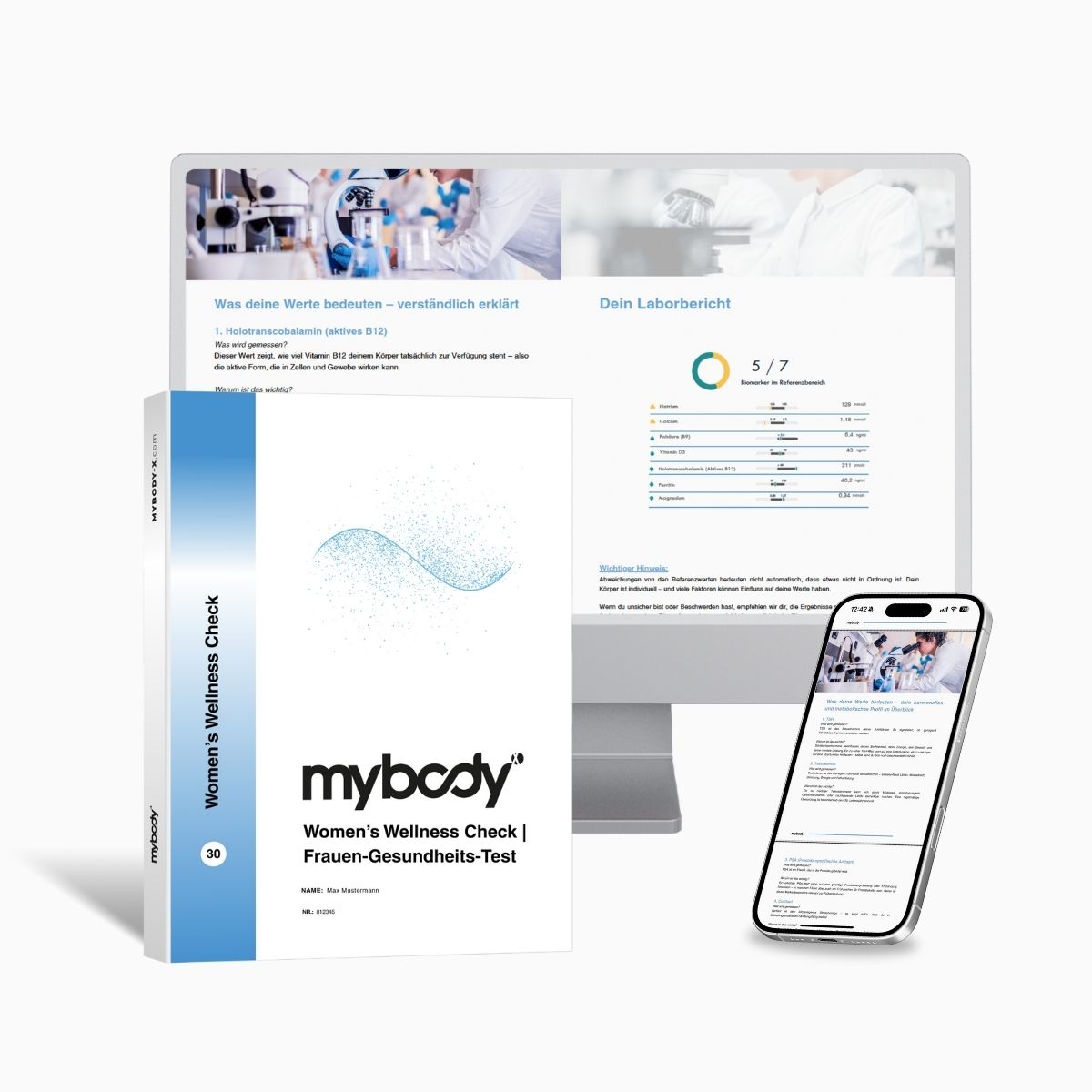
The Women's Wellness Check by mybody®x (MYBODY Lab GmbH) measures TSH, fT3, and fT4 together. This provides the regulatory value and both hormone values from the same day.
Capillary blood test
Women’s Wellness Check | Women’s Health Test
Measures 18 values, including the complete thyroid profile of TSH, fT3, and fT4. It also measures cortisol, prolactin, SHBG, ferritin, vitamin B12, vitamin D, gamma-GT, GPT, cystatin C, long-term blood sugar, CRP, total cholesterol, HDL, LDL, and triglycerides. What the test does not do: It does not explain symptoms, check for a central disorder of the hypothalamus or pituitary gland, provide a diagnosis, or replace a medical examination.
Laboratory analysis 3–5 business days after sample receipt
Product page information, accessed 08/15/2026
Four points determine whether a TSH value becomes useful information.
Consider age
IQWiG lists three reference ranges by age.
Note the time
Values are highest at night and lowest in the afternoon.
State the circumstances
Serious illness and certain medications change the interpretation.
Keep the question separate
The question about the thyroid is not the same as the question about the symptoms.
Chapter at a glance
A capillary blood self-test provides TSH, fT3, and fT4 from the same sample and does not constitute a diagnosis. Its benefit is that the regulatory value and hormone levels are from the same day. Four points are decisive: consider age, note the time, state the circumstances, and keep the question separate.
Limitations: what a laboratory value cannot tell you
The first limitation is central hypothyroidism. It is stated as an exception in the quoted sentence from the MSD Manual (as of February 2024) and cannot be clarified using TSH alone.
The second limitation is the range found in healthy people. IQWiG notes that healthy people sometimes also have values outside the reference range (as of 03/20/2025).
The third limitation is the unresolved treatment question. According to IQWiG, it is unclear whether treating subclinical hypothyroidism has benefits (as of 04/24/2024). This article therefore makes no recommendation on the matter.
The fourth limitation is diagnosis. All the classifications in this article provide context and do not constitute a diagnosis. A diagnosis is made in a medical practice based on several factors, and no self-test can anticipate it.
What matters about TSH
If you take away just one thing from this article, let it be this: A normal TSH is a real piece of information—and a limited one.
According to the specialist literature, it rules out hyperthyroidism or hypothyroidism, with the exception mentioned. It does not say where fatigue, weight changes, or concentration problems come from, because many such symptoms also have other causes.
At the beginning was the question of what a normal value means when symptoms are already present. The honest answer is: It closes one chapter and opens the next. A medical practice determines what that next chapter is.
Frequently asked questions
Can I have thyroid disease despite a normal TSH?
The MSD Manual, professional edition, states: Normal TSH levels rule out hyperthyroidism or hypothyroidism, except in patients with central hypothyroidism due to a disorder of the hypothalamus or pituitary gland (as of February 2024). This exception is documented and is clarified in a medical practice, not through a self-test.
What TSH level is considered normal?
That depends on age. The IQWiG gives a range of 0.51 to 4.3 mU/L up to age 20, 0.3 to 3.5 mU/L for adults, and 0.3 to 4.5 mU/L from age 50 onward (as of March 20, 2025). The reference range on your own test result remains decisive, because reference values may vary from one laboratory to another.
Does the time of blood collection matter?
Yes, when comparing two values. The IQWiG notes that the levels can also fluctuate; for example, they are highest at night and lowest in the afternoon (as of March 20, 2025). Anyone comparing two results should therefore also know the time at which each sample was taken.
What is subclinical hypothyroidism?
The IQWiG defines it as follows: The TSH level is elevated, but sufficient thyroid hormones are produced and no symptoms occur (as of April 24, 2024). Each year, 2 to 5 out of 100 affected people develop hypothyroidism with symptoms. Slightly elevated TSH levels also often return to normal, and according to the same source, it is unclear whether treatment offers any benefits.
When can the TSH level be misleading?
The MSD Manual cites two circumstances: TSH serum levels may be falsely low in very ill people, particularly in patients receiving glucocorticoids or dopamine. And in euthyroid sick syndrome, TSH may be normal, low, or high (as of February 2024). Both circumstances primarily affect people receiving ongoing treatment and should be discussed with the treating medical practice.
Next step
All three values from the same day
TSH alone answers one question. The two hormone levels alongside it show what the thyroid actually produces. The Women’s Wellness Check measures TSH, fT3, and fT4 together with 15 other values from capillary blood. It does not provide a diagnosis and does not replace medical evaluation.
Go to the Women’s Wellness CheckRead more
You may also be interested in
What the two hormone levels add and when they are measured.
What the sources say about the link to weight—and what they leave unanswered.
Sources
- MSD Manual, Professional Edition: Overview of thyroid function, Boucai L (complete review February 2024) – msdmanuals.com
- Institute for Quality and Efficiency in Health Care (IQWiG): Thyroid-stimulating hormone (TSH), as of 20.03.2025 – gesundheitsinformation.de
- IQWiG: Hypothyroidism, as of 24.04.2024 – gesundheitsinformation.de
- IQWiG: Understanding thyroid examinations, as of 24.04.2024 – gesundheitsinformation.de
- IQWiG: Are there benefits to treating subclinical hypothyroidism?, as of 24.04.2024 – gesundheitsinformation.de
- IQWiG: Free thyroxine (fT4), as of 20.03.2025 – gesundheitsinformation.de
- IQWiG: Understanding laboratory values correctly, as of 02.04.2025 – gesundheitsinformation.de
The verbatim quotation about normal TSH levels and central hypothyroidism, the statements about the most sensitive parameter, the best test, falsely low TSH in very ill people taking glucocorticoids or dopamine, and euthyroid sick syndrome are taken from source [1]. The definition of TSH, the three age-specific reference ranges, the daily rhythm, the indication of elevated and reduced levels, and the sentence about the normal reference range are taken from [2]. The definition of subclinical hypothyroidism, the figure of 2 to 5 out of 100 per year, the frequency of approximately 5 out of 100 people, the statement about mildly elevated levels returning to normal, and the note about the other causes of many symptoms are taken from [3]. The sequence of TSH first, followed by T3 and T4, is taken from [4]. The percentages from the observational study over two to three years and the statement about the uncertainty surrounding treatment are taken from [5]. The note that healthy people can also sometimes have values outside the reference range is taken from [6]. The explanation of the reference range is taken from [7]. Information about the price, values, sample type, and laboratory comes from the mybody®x product page, accessed on 15.08.2026; processing times follow the central specifications for blood tests. All sources were accessed and reviewed on 15.08.2026.

mybody®x Editorial & Expert Team
Laboratory diagnostics Blood analysis interpretation Nutritional science Nutrigenetics
This article was created by the mybody®x editorial and expert team. The team combines laboratory diagnostics, nutritional science, and the interpretation of blood analyses. Everyone who contributes to it is listed on the authors’ page.
Published on 15.08.2026 · Last updated on 15.08.2026
The content is intended for general information and does not replace medical advice, diagnosis, or treatment. Reference ranges depend on the laboratory, method, and age; the information on your report is always decisive.




Share now:
CRP over time: why a single value has no direction
Blood Values on a Plant-Based Diet: Five That Matter