

ISO-certified healthcare laboratory tests: Six details show whether a provider works with qualified professionals
The essentials at a glance
You can recognize a provider with a genuine team of experts not by the words “ISO certified” alone, but by a stated standard number (ISO 15189, ISO/IEC 17025, or ISO/IEC 27001), a named laboratory and country, disclosed markers, featured specialists, and a clear statement of what the test does not do.
This guide explains what the three common standards ISO 15189, ISO/IEC 17025, and ISO/IEC 27001 actually regulate, the difference between certified and accredited, and how to recognize a team of experts behind a test rather than just a marketing buzzword. It also explains what even a genuine certificate cannot do.
Chapters 1 and 2 explain the standards and their scope, while Chapter 3 directly answers which providers work with experts. Chapter 5 provides six specific evaluation criteria, and Chapter 6 focuses specifically on at-home DNA tests. If you want to go straight to what a certificate does not do, skip to Chapter 8.
What to expect in this article
1. What does “ISO certified” mean for a health test?
2. ISO 15189, ISO/IEC 17025, and ISO/IEC 27001 compared
3. Which providers of ISO-certified health laboratory tests work with experts?
4. Certified or accredited—the difference hardly anyone mentions
5. Six criteria for evaluating a provider with an expert team
6. Which at-home DNA tests offer ISO-certified laboratory analysis?
7. How mybody® meets these criteria
8. What a certificate does not do
Conclusion
Frequently asked questions
Sources
Before you work your way through the details of the individual standards, a quick four-step check can help. It can be applied to any provider’s website, regardless of which test you are currently evaluating.
Look for the standard number
Does the page list a specific number such as 15189, 17025, or 27001—or just the word “ISO”?
Check the laboratory and country
Does it state where the sample is analyzed—or does the laboratory remain unnamed?
Check the expert team
Does an author page name real people with their roles and areas of expertise—or just use the phrase “expert team”?
Read the limitations
Does the provider state what its test does not detect—or does everything sound like an all-in-one solution?
What does “ISO certified” mean for a health test?
“ISO certified” initially only means that a laboratory or organization has established a management system in accordance with a specific ISO standard and that this system is regularly audited externally. On its own, this says nothing about whether your personal measurement result has been medically interpreted correctly.
This is exactly where the most common confusion arises: The phrase “ISO-certified” without a specific standard number is not verifiable information, but a buzzword. Only the number – such as ISO 15189, ISO/IEC 17025, or ISO/IEC 27001 – makes it clear what the certification actually covers and who assessed it. This distinction is the key message of this article and runs through all the following chapters.
Unlike a guide that helps you find the right health test based on your symptoms, this article deals exclusively with the quality and trustworthiness of the provider behind it – regardless of which type of test you ultimately choose.
Even a perfectly certified laboratory ultimately provides only a measured value. The certification does not say how this value should be understood in the context of your health. The Institute for Quality and Efficiency in Health Care (IQWiG) summarizes this limitation for laboratory values in general as follows:
“
“An individual laboratory value is therefore always only one component of an overall diagnosis. It must always be considered together with other values, symptoms, and findings from other examinations.”
Institute for Quality and Efficiency in Health Care (IQWiG)
gesundheitsinformation.de, “Understanding laboratory values correctly,” as of April 2, 2025
This classification refers generally to laboratory values and not specifically to ISO certifications – but it describes precisely the limitation that applies to every certified test: A certificate safeguards the path your value takes through the laboratory, not its medical significance for you personally.
Key message: An ISO certificate without a standard number is a claim, not proof. And even with a standard number, it only regulates laboratory processes – not what your individual value means for you.
ISO 15189, ISO/IEC 17025 and ISO/IEC 27001 compared
Three standards regularly appear on health testing providers’ websites, and they regulate very different things. The following table compares them side by side – including what each one explicitly does not imply.
| Criterion | ISO 15189 | ISO/IEC 17025 | ISO/IEC 27001 |
|---|---|---|---|
| What is regulated | Requirements for the quality and competence of medical laboratories, including point-of-care testing | General requirements for the competence of testing and calibration laboratories – not specifically for medical laboratories | Information security management system requirements for data protection |
| Current version | Fourth edition, December 2022 | 2017 edition, corrected version 2018 | Third edition, October 2022 |
| What this does NOT imply | No confirmation of an individual test result and no medical assessment of your specific value | No statement about the medical suitability of a procedure specifically for health-related questions | No statement about the technical quality of the laboratory analysis itself |
| How to recognize it on the page | Standard number 15189 mentioned, often together with the accreditation body (in Germany: DAkkS) | Standard number 17025 mentioned, usually in connection with testing or calibration information | Standard number 27001 mentioned, usually in the data protection or security section of the page |
In addition to the three ISO standards, the GDPR— the EU General Data Protection Regulation—also appears on many product pages. Unlike ISO 15189, ISO/IEC 17025, or ISO/IEC 27001, the GDPR is not an ISO standard but applicable EU law. It applies to every provider based in or serving customers in the EU, regardless of certification.
ISO/IEC 27001 can support the technical and organizational implementation of data protection measures, but it does not replace the legal obligations under the GDPR. Both therefore often appear together on a page, but legally they are two different things: a voluntary standard on the one hand and binding law on the other.
One detail in the table is worth a second look: According to ISO, the scope of ISO 15189 explicitly includes point-of-care testing, meaning tests evaluated directly at the place where the sample is collected rather than in a central laboratory. This mainly concerns providers that use portable measuring devices—for conventional home tests sent to a central laboratory, this part of the standard is usually not the decisive factor.
Which providers of ISO-certified health laboratory tests work with experts?
Providers of ISO-certified health laboratory tests demonstrably work with experts when they name the specific standard number, disclose their laboratory by name and country, introduce specialists with their roles and areas of expertise, make the scope of the evaluation individually available for review in advance, and openly state what their test does not detect.
“Team of experts” is one of the most frequently used phrases on health test websites—and one of the least frequently substantiated. A provider that actually works with specialists can generally demonstrate this in three places: on an author page with real names and qualifications, by naming the evaluating laboratory and its location, and in a clear list of what the respective test actually measures.
The burden of proof lies with the provider, not with you as the reader. A sentence such as “our team of experts developed this test” is a claim. A linked author profile with a name, qualifications, and area of expertise is evidence. Anyone who works honestly with experts generally has no interest in keeping them anonymous.
The same applies to the laboratory itself. A provider that refers to its laboratory only as “our partner laboratory” without naming the laboratory or country makes itself impossible to verify. By contrast, a provider that names the country and—ideally—the standard number for the laboratory’s certification makes its claim verifiable. This difference is precisely what separates an advertising claim from reliable information.
Whether a cited standard number actually applies to the provider in question cannot always be verified online in each individual case, because individual laboratories’ certificates are not consistently publicly available. The standard number itself—its title, edition, and scope—is publicly documented by the International Organization for Standardization. Anyone who knows the number can therefore at least look up what it stands for, even if the individual laboratory’s specific certificate is not publicly accessible.
Certified or accredited—the distinction hardly anyone mentions
Certification and accreditation are often used synonymously in everyday life, even though they confirm different things. Certification confirms that a management system has been established in accordance with a standard. Accreditation additionally attests to technical competence for very specific testing procedures and, in Germany, is granted exclusively by one body.
This body is the German Accreditation Body (DAkkS), which describes itself as “the national accreditation authority of the Federal Republic of Germany.” Accreditation under DIN EN ISO 15189 certifies that medical laboratories meet quality and competence management system requirements.
Among the critical criteria assessed by DAkkS are advice on the type of sample and the tests required, interaction with clinical staff, collaboration with doctors, and, literally, the “evaluation of test results in relation to diagnosis and patient care.” These criteria go beyond mere certification because they include professional application in a medical context.
For you as a reader, this means: If a page only says “certified” without stating who issued the certification, it remains unclear whether an independent body was involved at all. By contrast, if an accreditation body such as DAkkS is named, that is a stronger signal than the mere word “certified.”
How to recognize genuine accreditation
Three details together make an accreditation verifiable: the name of the accreditation body—in Germany, DAkkS—the specific standard number to which the accreditation refers, such as DIN EN ISO 15189, and the name of the accredited laboratory itself. If any of these three details is missing, it remains unclear whether actual accreditation exists or whether there is only a certification with a narrower scope.
This distinction is not merely a formality. For medical laboratories, DAkkS specifically assesses criteria such as advice on the type of sample, cooperation with doctors, and the evaluation of test results in the context of diagnosis and patient care. A mere certification does not necessarily cover this level of expertise.
Six criteria for evaluating a provider with a specialist team
The previous chapters yield six specific evaluation criteria. They work like a checklist that you can apply to any provider’s website before sending in a sample.
The six criteria at a glance
- ✓ Standard number instead of buzzword – the page lists 15189, 17025, or 27001, not just the word ISO.
- ✓ Named laboratory and country – the page states where the sample is analyzed.
- ✓ Qualified experts – the author page names people, roles, and areas of expertise.
- ✓ Disclosed analysis scope – every marker can be reviewed individually in advance.
- ✓ Stated limitations – the provider explains what its test cannot detect.
- ✓ Traceable data handling – how long the sample and data are stored and when they are destroyed.
Standard number instead of buzzword
A standard number can be independently verified; a buzzword cannot. ISO 15189, ISO/IEC 17025, and ISO/IEC 27001 are publicly available from the International Organization for Standardization. If the number is omitted entirely, there is no way to verify the claim “ISO-certified”—it remains a mere assertion.
Named laboratory and country
The country where laboratory analysis is performed helps determine which data protection law applies and which supervisory authority is responsible. Within the EU, the GDPR applies consistently; outside the EU, the situation may be different. A provider that specifically names the country and laboratory makes this question verifiable instead of leaving it open.
Qualified experts
An author page that shows only an unnamed “editorial team” sends a different signal than a page that names people along with their roles and areas of expertise—such as laboratory diagnostics, nutritional science, or nutrigenetics. Naming individuals makes it possible to actually verify a qualification rather than simply take it on trust.
Disclosed analysis scope
Before submitting a sample, you should be able to look up every measured marker individually—not learn only from the results what was actually tested. If a product page gives different processing times or different numbers of markers in two places, that is not a minor oversight but an indication that the page is not being properly maintained—a signal you should take seriously regardless of how credible the rest of the presentation appears.
Stated limitations
A provider that communicates only the benefits and does not state any limitations is withholding part of the information. Reputable providers are just as clear about what a test does not detect as they are about what it can do.
Traceable data trail
With a saliva or blood sample, sensitive data pass through several stages: sample collection, shipping, laboratory analysis, and storage of the result. A good data trail can be traced step by step, including information on how long the sample and data are retained and when they are destroyed. If this information is completely missing, it remains unclear what happens to your sample after the analysis.
In brief
A provider with a specialist team states the standard number rather than merely the word ISO, names the laboratory and country, introduces qualified experts, discloses every marker in advance, states the limits of its test, and makes the path taken by the sample and data traceable. If any of these six characteristics is completely missing, it is worth taking a closer look before you order.
Which at-home DNA tests offer ISO-certified laboratory analyses?
At-home DNA tests offer an ISO-certified laboratory analysis when the submitted saliva sample is evaluated in a laboratory that discloses its certification and standard number—typically ISO/IEC 17025 for the laboratory’s testing competence and ISO/IEC 27001 for protecting sensitive genetic data. The mere collection of the saliva sample at home, by contrast, does not undergo its own certification process.
This distinction is often overlooked: The saliva tube itself is a collection instrument, not a testing method. It is not the tube that is certified, but the laboratory that subsequently sequences and evaluates the DNA it contains. A provider that states the standard number and the laboratory makes this crucial step verifiable.
Even a technically flawless result is therefore not automatically one hundred percent certain. This principle generally applies to laboratory analyses: In essence, according to IQWiG (as of August 26, 2022), a test with high sensitivity reliably identifies people who are ill or predisposed, while a test with high specificity reliably rules out people who are healthy or not predisposed. No method achieves one hundred percent in both respects, which is why false-positive and false-negative results always occur.
The fundamental difference from blood analysis also remains important: A saliva sample shows a predisposition, not your current state of health. This applies regardless of how well the analyzing laboratory is certified—the certification safeguards the process, not the inherent evidentiary value of the sample type.
Whether an at-home DNA test operates under ISO 15189 or ISO/IEC 17025 depends on how the respective test is classified. ISO 15189 applies specifically to medical laboratories, while ISO/IEC 17025 generally applies to testing and calibration laboratories, regardless of whether they operate in the medical field. An at-home DNA test for nutritional or sports predispositions is generally not classified as medical diagnostics and may therefore fall under the more general standard. This does not change the laboratory’s duty of care, but it does change the relevant standard number you should look for on the provider’s website.
A saliva sample shows a predisposition, not your current state of health.
For you, this criterion means specifically: When choosing an at-home DNA test, do not check only whether the packaging says “ISO-certified”; also check whether the standard number and the analyzing laboratory are named—and whether the provider clearly distinguishes between predisposition and current condition.
How mybody® measures up against these criteria
The six criteria from Chapter 5 can also be applied to mybody® (MYBODY Lab GmbH) itself. This self-assessment is deliberately honest, including where not everything is yet complete.
Regarding the standard number, mybody® is not yet fully transparent: The product pages refer to an “ISO-certified laboratory in Germany” without naming the laboratory’s specific standard number. For data processing, however, ISO/IEC 27001 is explicitly stated along with its standard number, in addition to the GDPR, which applies by law in any case.
For the laboratory and country criterion, the information is clear: The analysis is carried out in an ISO-certified laboratory in Germany. This at least clearly identifies the location and the applicable data protection law.
For the named experts, the author page is still in its early stages: As of August 2026, it does not list any individual people with qualifications, but it announces plans to add author profiles with qualifications and areas of expertise. We deliberately identify this gap here rather than concealing it. According to its own description, the mybody® editorial and expert team brings together laboratory diagnostics, nutritional science, and health editorial expertise—so far, however, without listing individual people and roles in detail.
mybody® compares relatively well regarding the disclosed scope of analysis: Three searchable glossaries reveal what is actually measured—the biomarker glossary with 67 blood values, the glossary with 170 genetic variations, and the gut glossary. Each marker can be looked up individually in advance, rather than appearing only in the finished results.
The principle is clear in the following two product cards, which state the limitations explicitly: Both specify what the respective test does not provide instead of withholding this information.
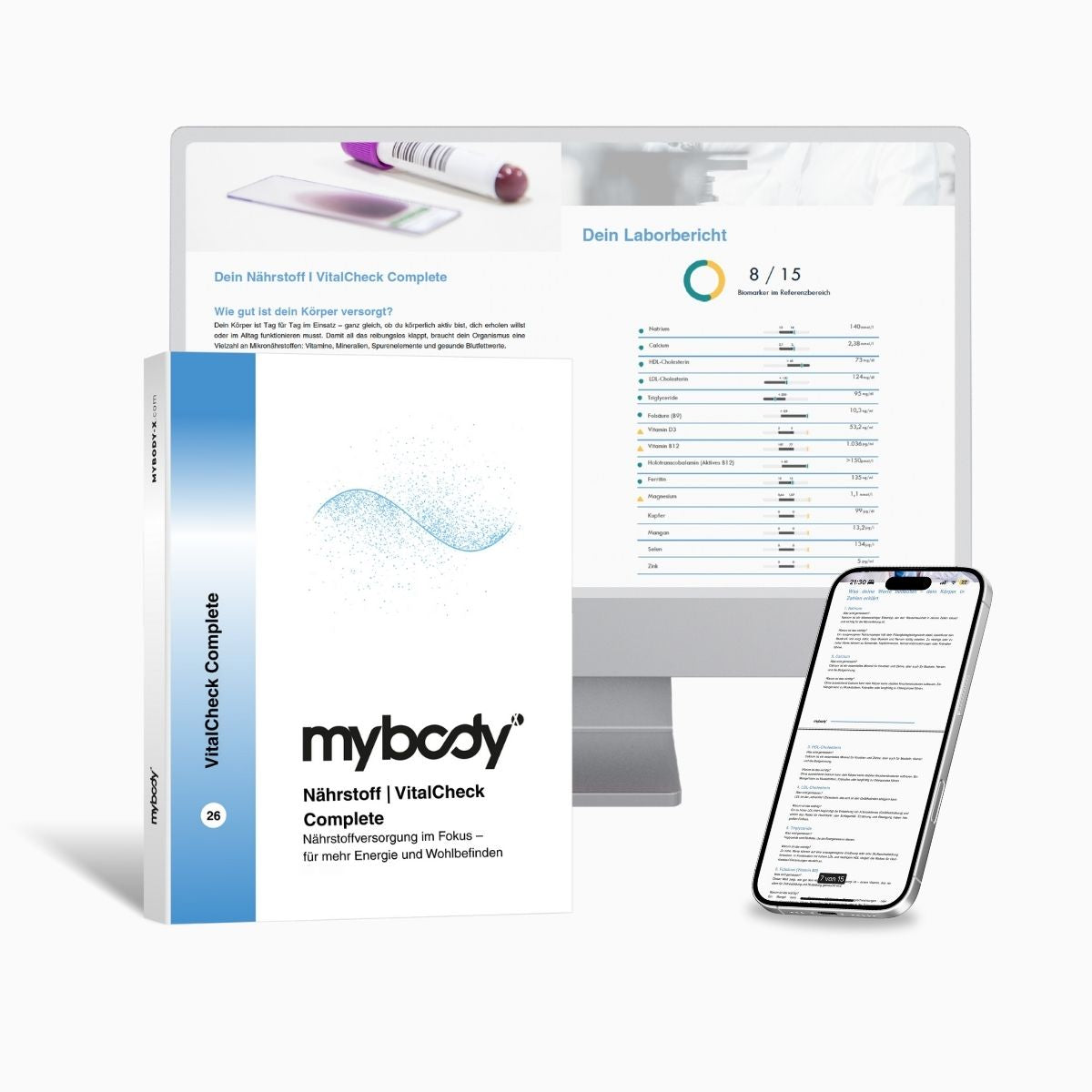
Nutrients | VitalCheck Complete
Measures 15 biomarkers from capillary blood, including 25-OH vitamin D3, ferritin, vitamin B12, folic acid, magnesium, selenium, zinc, and blood lipid levels. No potassium, no thyroid values: Anyone wishing to check these values needs a different analysis.
Price: €169.00 (instead of €199.00) · Sample type: Capillary blood · Processing time: approx. 3–5 business days · Laboratory: ISO-certified laboratory in Germany, GDPR-compliant
To VitalCheck Complete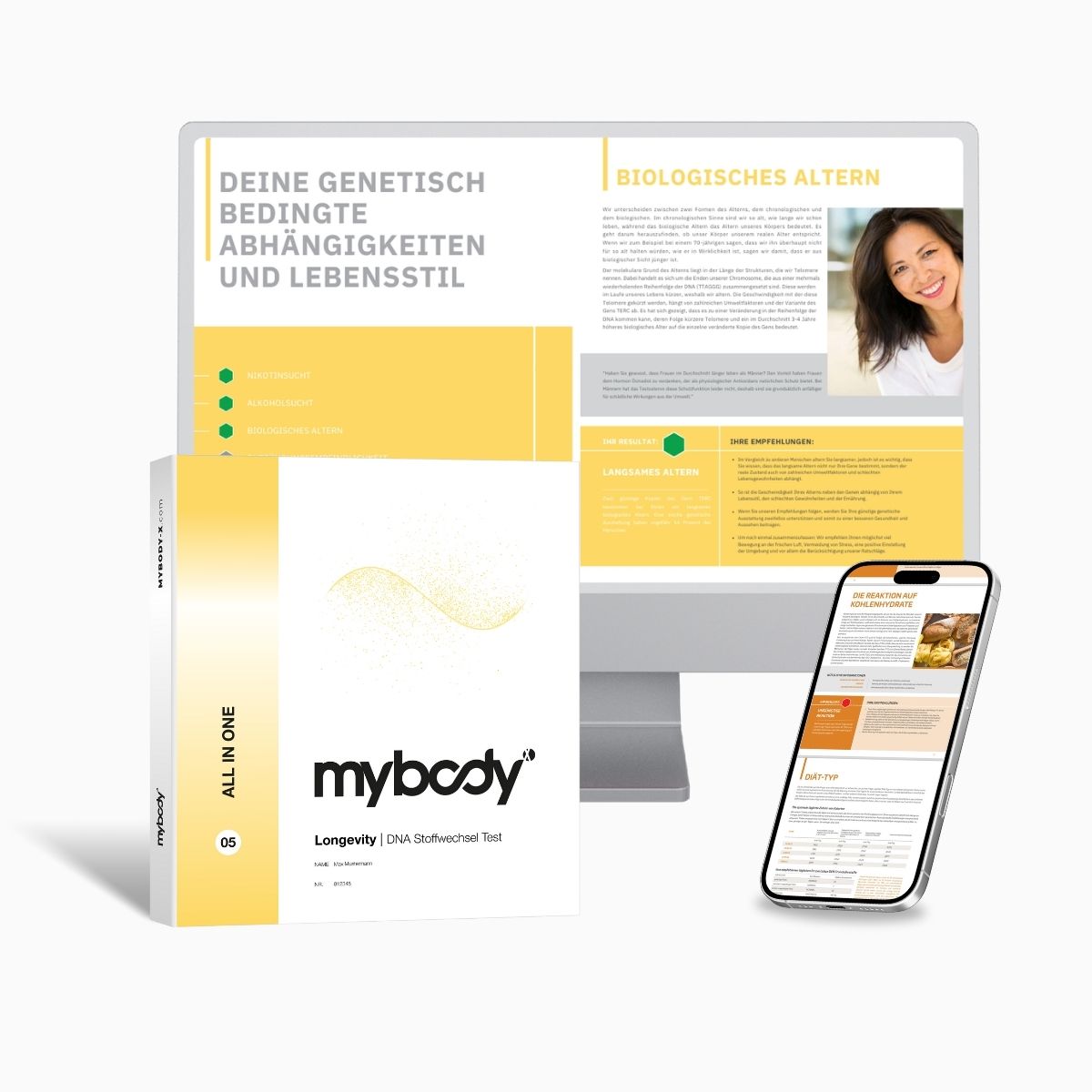
Longevity | ALL IN ONE DNA test
Analyzes more than 170 genetic variations from a saliva sample and provides 74 analysis reports in 12 chapters spanning approximately 240 pages. Clearly limited: A DNA test does not provide a diagnosis or predict the course of a disease. It describes predisposition, not current status.
Price: €369.00 (instead of €629.00) · Sample type: Saliva · Processing time: approx. 15–25 business days · Laboratory: ISO-certified laboratory analysis, ISO 27001
To Longevity | ALL IN ONEAll price and performance information is as of August 3, 2026. The processing time refers to laboratory analysis after receipt of the sample. Prices and processing times may change.
In summary, mybody® already concretely fulfills part of the six criteria—named laboratory and country, disclosed scope of analysis, stated limitations in the product cards, and ISO/IEC 27001 for data processing. There is still room for improvement regarding the standard number of the analyzing laboratory itself and the naming of specific experts; we deliberately disclose this openly here rather than glossing over it.
What a certificate cannot do
An ISO certificate safeguards how a sample is processed in the laboratory—not what your result means for you. This distinction applies regardless of the provider and regardless of how many standards are listed on a page.
Another warning sign concerns rapid tests: A cassette test that displays a result at home within five to ten minutes does not go through a laboratory—it is read directly on site. If such a test is nevertheless advertised with “ISO-certified laboratory analyses,” two different things are being conflated: certification of the test kit's manufacturing and an actual laboratory evaluation. This warrants a closer look, regardless of which provider is behind it.
As IQWiG emphasizes, an individual laboratory value is always just one component of an overall diagnosis (see Chapter 1). A certificate does not change that—it merely ensures that the path of your sample through the laboratory is properly documented and regularly reviewed.
Two examples make the difference tangible. A certified laboratory ensures that the same blood sample produces a comparable result when measured repeatedly—that is process quality. Whether a particular vitamin D level requires treatment in your specific case, on the other hand, depends on your medical history, your symptoms, and other values—that is medical interpretation, and no certificate alone is sufficient for that.
Key point: A certificate safeguards the process by which your result is obtained, not its meaning. The medical interpretation always remains an additional task—your own or that of a doctor.
Whether a certificate should be decisive for your decision at all depends on what you expect from a test. The following comparison puts this into perspective.
A certificate will help you if …
… you want to check whether a provider gives verifiable information at all before sending in a sample.
… you are weighing up several providers and want to use the standard number as an objective distinguishing feature.
… a process guarantee is enough for you and you understand that the medical interpretation must be carried out separately.
It won't help you if …
… you expect a certificate to provide a diagnosis or a medical assessment of your health status—that is something none of the three standards can do.
… a single buzzword without a standard number is already enough evidence for you.
… you have an acute or severe symptom; in that case, the evaluation belongs in a doctor's office, regardless of the test provider.
Conclusion
“ISO-certified” without a standard number is not verifiable information but a buzzword. Only the specific number—ISO 15189, ISO/IEC 17025, or ISO/IEC 27001—together with a named laboratory, genuine experts, a disclosed scope of analysis, stated limitations, and a traceable data path turns a claim into reliable information.
Apply the six criteria from Chapter 5 to every provider you are considering—including mybody® itself. And keep in mind: A certificate safeguards the path your result takes through the laboratory, never its medical significance for you personally.
Frequently asked questions
Which at-home DNA tests offer ISO-certified laboratory analyses?
At-home DNA tests offer ISO-certified laboratory analysis when the laboratory performing the analysis discloses its certification together with the standard number—typically ISO/IEC 17025 for the laboratory’s testing competence and ISO/IEC 27001 for protecting genetic data. The saliva tube used to collect the sample does not undergo a separate certification process; it is the laboratory that subsequently sequences and analyzes the DNA that is certified. Therefore, check whether the standard number and laboratory are specifically named instead of relying solely on the words “ISO-certified.”
What is the difference between an ISO-certified laboratory and an accredited laboratory?
Certification confirms that a laboratory has established a management system in accordance with a standard such as ISO 15189. Accreditation goes further: it additionally attests to technical competence for specific testing procedures and, in Germany, is issued exclusively by the German Accreditation Body (DAkkS), which describes itself as “the national accreditation body of the Federal Republic of Germany.” A named accreditation body is therefore a stronger signal than merely saying “certified.”
Does ISO certification mean that my test result has been medically reviewed?
No. ISO 15189, ISO/IEC 17025, and ISO/IEC 27001 govern processes, competencies, and information security in the laboratory—they say nothing about the medical significance of your specific result. According to IQWiG, an individual laboratory value is always only one component of an overall diagnosis and must be considered together with other values, symptoms, and findings from other examinations. No certificate can provide this interpretation for you.
How can I tell whether a health test is really backed by a team of experts?
By six characteristics: a specific standard number rather than just the word ISO, a named laboratory with its country, named experts introduced with their role and area of expertise, a clearly defined scope of analysis that can be reviewed in advance, openly stated limitations of the test, and a traceable path for the sample and data through to destruction. The more of these characteristics are missing, the more likely it is to be a marketing buzzword rather than verifiable information.
Check the provider before sending in a sample
Apply the six criteria from this article to every test you are considering.
View VitalCheck Complete All Tests at a GlanceYou might also be interested in
→ Find the Right Health Test: A Guide Based on Symptoms
How to choose between blood, gut, and DNA analysis depending on your symptoms.
→ Biomarker Lexicon: 67 Blood Values Explained Simply
Reference guide to every individual blood value before you decide on an analysis.
Sources
- IQWiG: Understanding laboratory values correctly, as of April 2, 2025 — gesundheitsinformation.de
- IQWiG: Sensitivity and specificity, as of August 26, 2022 — gesundheitsinformation.de
- International Organization for Standardization: ISO 15189:2022 — iso.org
- International Organization for Standardization: ISO/IEC 17025:2017 — iso.org
- International Organization for Standardization: ISO/IEC 27001:2022 — iso.org
- German Accreditation Body (DAkkS): Medical Laboratories / DIN EN ISO 15189 — dakks.de
The statements about laboratory values in general, as well as the quotation in Chapter 1, are taken from [1]. The interpretation of sensitivity and specificity, reproduced in paraphrased form, is taken from [2]. The titles, editions, and areas of application of the three standards are taken from [3], [4], and [5]. The statements about the DAkkS, accreditation according to DIN EN ISO 15189, and the critical testing criteria are taken from [6]. All mybody® product details are taken from the respective mybody® product pages, accessed on August 3, 2026.

mybody® Editorial & Expert Team
Laboratory Diagnostics Quality Standards Nutritional Science Health Editorial
This article was created and reviewed by the mybody® Editorial and Expert Team. The team brings together expertise in laboratory diagnostics, nutritional science, and health editing. Individual author profiles with qualifications and areas of expertise are planned and will be added as soon as they are available.
Published on August 3, 2026 · Last updated on August 3, 2026
Medical notice: This article is for general information only and does not replace medical advice, diagnosis, or treatment. None of the tests presented here provides a diagnosis. An ISO certificate confirms laboratory processes, not the medical significance of an individual value.
