


Is spelt gluten-free? What’s really in rice, spelt, and oats
ca. 15 Minuten
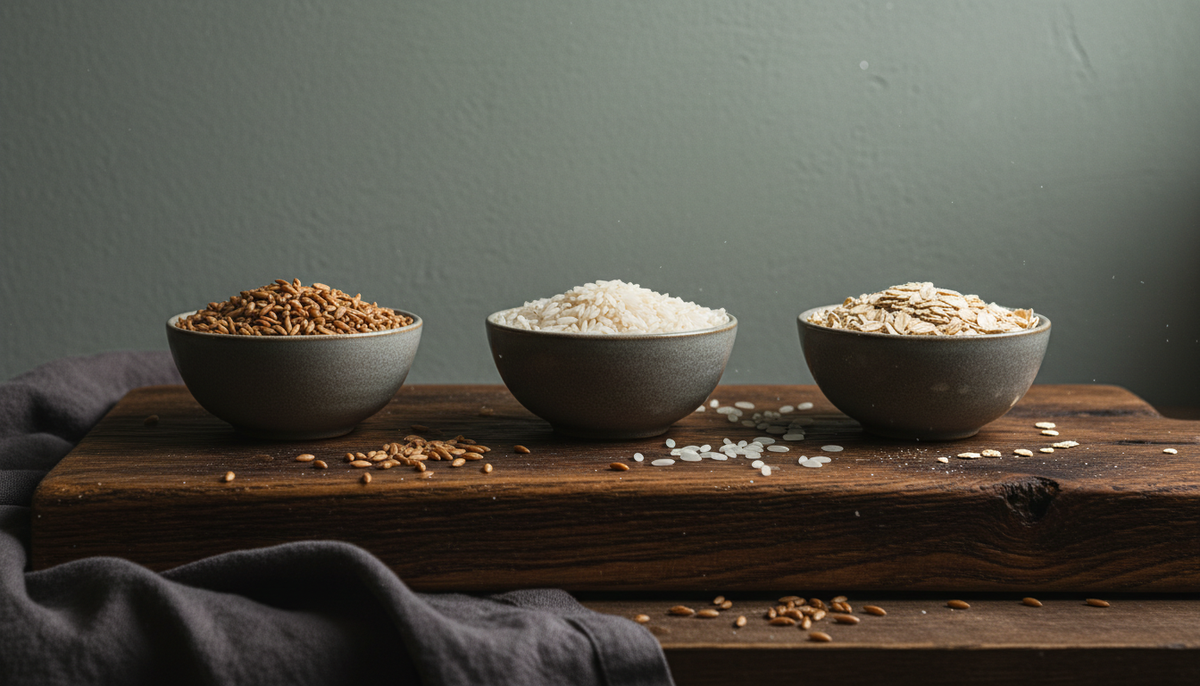
Spelt bread has a reputation for being the gentler choice. A test of 300 grain samples and a blind bread-tasting tell a different story. Rice and oats are put to the test too.
By the mybody x editorial team (MYBODY Lab GmbH) · Format “The Fact Check” · Section: Gut
Perhaps this sounds familiar. After a few weeks of bloating, you stopped eating wheat bread and have been buying spelt bread ever since. You feel better, and you hear the same from people you know. On your next shopping trip, you notice a green sign on the shelf: gluten-free. It hangs above the rice, and a few meters farther along, above the oats. There isn’t one above the spelt.
Behind this scenario is a persistent belief. It goes roughly like this: spelt is the gluten-free, gentler alternative to wheat. If you’re sensitive, choose spelt; if you want to be absolutely sure, choose rice or oats.
This fact-check compares the three grains and tests them against what measurements, studies, and official bodies actually say. It offers an assessment, not a diagnosis. If you have unexplained symptoms, you should discuss them with a doctor. What this article can do is provide a basis for that conversation.
Is spelt gluten-free?
No. Spelt belongs to the wheat genus, and IQWiG explicitly lists it among the grains to avoid in celiac disease (IQWiG, 2022).1 In a test of 300 samples, spelt even had more gluten than common wheat (Geisslitz et al., 2019).2
First, let’s clarify the term. Gluten is a protein that occurs naturally in wheat, and therefore also in spelt, as well as in rye. The Institute for Quality and Efficiency in Health Care, or IQWiG for short, also calls it “glue protein” (IQWiG, 2022).1 More precisely, gluten is not a single substance. It is the main storage protein in the wheat kernel, a mixture of hundreds of related proteins, primarily gliadin and glutenin, the two main groups in this mixture (Biesiekierski, 2017).3
Related storage proteins are also found in other grains. In rye, it is called secalin; in barley, hordein. Even oats have one, avenin, and in technical terminology they are all grouped together under the name gluten (Biesiekierski, 2017).3 Gluten is heat-stable and has binding and stretching properties. That is why it is added to processed foods, Biesiekierski writes in her 2017 review.3
The amount consumed in everyday life is considerable. According to this review, average gluten intake in a Western diet is estimated at 5 to 20 grams a day (Biesiekierski, 2017).3 Alongside this is a figure from a completely different scale: for people with celiac disease, the safe amount is less than 10 milligrams a day according to IQWiG - no more than a few bread crumbs (IQWiG, 2022).1
Celiac disease is an autoimmune disease in which the immune system attacks the body’s own tissue. According to IQWiG, even the smallest amounts of gluten can trigger inflammation in the small intestine in people with celiac disease (IQWiG, 2022).1 For this group, IQWiG has published a list of grains to avoid. At the top are grains from the wheat genus or wheat hybrids. The list explicitly includes spelt, also called hulled wheat, as well as its grain, green spelt. Emmer and einkorn are in the same group.1
The question remains whether spelt contains less gluten, at least. A research group led by Geisslitz measured exactly that. They examined 300 samples from five wheat species, with 15 varieties of each, including spelt and common wheat. All the plants were grown in the same year at four sites in Germany (Geisslitz et al., 2019).2
The result was clear. At all four sites, spelt had more protein and more gluten than common wheat, as did the ancient varieties emmer and einkorn. Common wheat, on the other hand, contained more glutenin. Its gliadin-to-glutenin ratio was below 3.8, while the ratio for the ancient varieties rose to as much as 12.1 (Geisslitz et al., 2019).2 This study has two limitations. It comes from a single growing season, and it measures the content in the grain. It does not tell us whether bread is well tolerated.
Why, then, is spelt considered easier to digest?
Because people with suspected wheat sensitivity often report tolerating spelt better (Zimmermann et al., 2022).4 In a blinded trial involving 24 adults, there was no difference between wheat and spelt bread.
The reputation has a basis: people’s own experience. A research group led by Zimmermann took this experience seriously and investigated it. In the introduction to their study, the authors write that people with suspected non-celiac wheat sensitivity report that they tolerate spelt baked goods better than wheat baked goods. This experience had not yet been confirmed or explained (Zimmermann et al., 2022).4 This refers to people who attribute their symptoms to wheat even though they do not have celiac disease.
For the study, the researchers recruited 24 adults who said exactly that: wheat doesn't agree with me, but spelt does. Over six weeks, they ate six different study breads, each for four days, 300 grams a day. There was a three-day break between breads (Zimmermann et al., 2022).4 The study was single-blind. That means participants did not know which bread they were eating. Because each person tried all the breads in turn, they were effectively compared with themselves.
The study ended with a finding that contradicts spelt's reputation. There was no difference in tolerability between wheat and spelt bread. Nor did signs of inflammation or markers of the intestinal barrier, the protective function of the intestinal wall, change (Zimmermann et al., 2022).4
“Our data do not objectively confirm the differences in expected symptoms after wheat and spelt products, suggesting a strong nocebo effect for wheat and a placebo effect for spelt.”
Zimmermann et al., Nutrients, 2022 · translated from English4
Two terms are key to this sentence. A placebo effect is an improvement that comes from expecting something to help. The nocebo effect is its counterpart: symptoms that are more severe because they are expected. According to the study's authors, the findings only suggest that expectations about a bread may influence how people feel afterward.
The study has limitations, and they are part of the assessment. With 24 participants, it is small. It was only single-blind. It included only people without celiac disease, so the study says nothing about celiac disease (Zimmermann et al., 2022).4 Read more about the relationship between spelt and gluten intolerance in our article Spelt and gluten intolerance.
Does rice contain gluten?
No. Rice is one of the foods that naturally contain no gluten (DGE, 2024).5 The IQWiG also counts rice and wild rice among gluten-free grains (IQWiG, 2022).1
For rice, the answer is clearer than for any other grain in this article. The German Nutrition Society, or DGE, lists it alongside corn and quinoa as a gluten-free food (DGE, 2024).5 The IQWiG also includes millet and teff on its list of gluten-free foods. Pseudocereals such as buckwheat are included too. Pseudocereals are seeds that can be used like cereals (IQWiG, 2022).1
IQWiG does add a caveat. These foods are safe for people with celiac disease as long as they are not contaminated (IQWiG, 2022).1 Contamination, often also called cross-contamination, means that a naturally gluten-free grain comes into contact with gluten-containing grain during processing. With a limit of less than 10 milligrams a day, every crumb counts for people with celiac disease (IQWiG, 2022).1
If you have ever bought sticky rice, you may have wondered about its name. In English, sticky rice is called “glutinous rice,” which sounds suspiciously like gluten. Sticky rice is rich in amylopectin, a branched form of starch (Guo et al., 2024).6 Its name has nothing to do with gluten. According to IQWiG, rice is one of the gluten-free grains (IQWiG, 2022).1
Gluten-free does not mean free of everything, however. According to IQWiG, rice is highly nutritious, but can contain harmful substances, including heavy metals such as arsenic. The German Federal Institute for Risk Assessment, or BfR, therefore recommends, according to IQWiG, eating products such as rice cakes or rice porridge in moderation (IQWiG, 2022).1 Anyone who eats a lot more rice because of gluten intolerance should keep this in mind. Our article Gluten intolerance and rice explains what this means in everyday life.
Are oats gluten-free?
Naturally, yes; reliably so in stores, no. IQWiG lists oats among gluten-free grains, but advises people with celiac disease against eating commercially available oats unless they are labeled gluten-free (IQWiG, 2022).1
Oats appear on both of IQWiG’s lists, and this is no mistake. They are on the list of gluten-free grains because the grain itself is considered safe as long as it is not contaminated. Commercially available oats are on the list of grains to avoid because they may be contaminated with gluten-containing grains (IQWiG, 2022).1 According to IQWiG, what matters is that they have not come into contact with gluten-containing grains.1
There is also a question of terminology. In her review, Biesiekierski includes oat avenin under the umbrella term gluten because it is a related storage protein (Biesiekierski, 2017).3 By contrast, IQWiG classifies oats according to their safety for people with celiac disease. The two perspectives are not mutually exclusive. One describes the grain’s chemistry, the other what people with celiac disease can eat.
How well pure oats are tolerated by people with celiac disease was examined in a 2017 meta-analysis by a research group led by Pinto-Sánchez. A meta-analysis statistically combines the results of several studies. The group evaluated 28 studies, including controlled studies with 661 patients. All randomized studies used pure, uncontaminated oats (Pinto-Sánchez et al., 2017).7
The researchers found no evidence that oats, as a supplement to a gluten-free diet, affect symptoms or tissue findings in people with celiac disease. However, they note that there were only a few studies for many measures and that the quality of the evidence was low (Pinto-Sánchez et al., 2017).7 IQWiG also points out that some studies included a small group of people who could not tolerate oats. According to IQWiG, the German Celiac Society recommends introducing oats into the diet only once the transition to a gluten-free diet has been successful (IQWiG, 2022).1
The meaning of the word “gluten-free” on a package is precisely regulated. A food is considered gluten-free if it contains no more than 20 milligrams of gluten per kilogram (IQWiG, 2022; DGE, 2024).1, 5 According to IQWiG, products bearing the European crossed grain symbol are the safest, because they fall below this limit and are strictly controlled. Gluten can also be found where you might not expect it, for example in fruit yogurt or chocolate (IQWiG, 2022).1 Our article Are oats healthy? explains whether oatmeal is a good choice for you.
What does less gluten change in the gut of healthy people?
Somewhat, but probably less because of gluten itself. In a study of 60 healthy adults, a low-gluten diet moderately changed the gut microbiome; the authors say that most of the effects were probably due to changes in fiber intake (Hansen et al., 2018).8
So far, we have focused on grains. But the reader introduced at the beginning is mainly interested in what happens in her gut when she eats less wheat. For that, it’s worth taking a look at the microbiome. That’s the name for the community of bacteria and other microorganisms in the gut, commonly called the gut flora. Two studies have examined healthy adults, people with no known bowel disease.
The larger study was conducted in Denmark. Hansen and colleagues had 60 middle-aged adults with no known illnesses go through two phases of eight weeks each. In one, they ate a low-gluten diet, with 2 grams of gluten a day; in the other, a high-gluten diet, with 18 grams. Between the two was a break of at least six weeks, during which they ate their usual diet, with around 12 grams a day (Hansen et al., 2018).8
Compared with the high-gluten phase, the low-gluten phase moderately changed the gut microbiome. Participants exhaled less hydrogen while fasting and after eating. They also reported less bloating (Hansen et al., 2018).8 This is where it pays to read carefully. The researchers write that most effects of a low-gluten diet in adults without celiac disease are probably due to changes in fiber intake (Hansen et al., 2018).8 After all, if you stop eating wheat bread, you also eat different sources of fiber.
The second study was shorter. Bonder and colleagues followed 21 healthy volunteers who ate gluten-free for four weeks (Bonder et al., 2016).9 Differences between individuals remained stable during this period. Each person’s gut microbiome remained recognizably their own. Some bacterial groups nevertheless changed. The Veillonellaceae family declined most markedly, and most of seven other groups that changed play a role in breaking down starch (Bonder et al., 2016).9 The study does not say whether these shifts are good or bad.
Neither study recommends giving up gluten without a reason. They show that the microbiome shifts with diet, and that for healthy people, fiber is probably a more important lever than gluten. The situation is different for people with celiac disease. According to the DGE, celiac disease is an autoimmune disease that can develop at any age and lasts a lifetime. About 1 percent of the population in Germany is affected (DGE, 2024).5
For people affected, the DGE recommends qualified nutritional counseling at the outset and, if necessary, during follow-up (DGE, 2024).5 A medical examination can determine whether someone has celiac disease. If you repeatedly have symptoms after eating bread or pasta, your family doctor’s office is the right first step. Our article Celiac disease test explains how celiac disease is diagnosed.
- The measurement by Geisslitz et al. comes from a single growing season and measures the gluten content of the grain, not how well bread is tolerated.
- The blinded study of 24 adults excluded people with celiac disease. No conclusions about celiac disease can be drawn from it.
- The gut studies examined healthy adults over a few weeks. They do not establish whether the microbiome changes are good or bad.
- None of the studies provides a diagnosis or replaces medical evaluation of symptoms.
Three reader questions
Is spelt flour gluten-free?
No. Spelt belongs to the wheat genus and contains gluten; IQWiG lists it among the grains to avoid if you have celiac disease (IQWiG, 2022).1 In a measurement of 300 samples, spelt had a higher gluten content than common wheat (Geisslitz et al., 2019).2
What does “gluten-free” mean on the package?
A food is considered gluten-free if it contains no more than 20 milligrams of gluten per kilogram (DGE, 2024).5 According to IQWiG, products bearing the crossed grain symbol are the safest choice (IQWiG, 2022).1
Is sticky rice gluten-free?
The English name “glutinous rice” is misleading: sticky rice is rich in amylopectin, a form of starch (Guo et al., 2024).6 According to IQWiG, rice is among the gluten-free grains, provided it is not contaminated (IQWiG, 2022).1
The green seal hangs above the rice, and that’s where it belongs. There was never one above the spelt. It wasn’t missing.
- Institute for Quality and Efficiency in Health Care (IQWiG): Gluten-free diet. gesundheitsinformation.de, 2022. gesundheitsinformation.de
- Geisslitz S., Longin C. F. H., Scherf K. A., Koehler P.: Comparative Study on Gluten Protein Composition of Ancient (Einkorn, Emmer and Spelt) and Modern Wheat Species (Durum and Common Wheat). Foods 8(9), 409, 2019. doi.org/10.3390/foods8090409
- Biesiekierski J. R.: What is gluten? Journal of Gastroenterology and Hepatology 32 Suppl 1, 78–81, 2017. doi.org/10.1111/jgh.13703
- Zimmermann J., Longin F. H., Schweinlin A., Basrai M., Bischoff S. C.: No Difference in Tolerance between Wheat and Spelt Bread in Patients with Suspected Non-Celiac Wheat Sensitivity. Nutrients 14(14), 2800, 2022. doi.org/10.3390/nu14142800
- German Nutrition Society (DGE): Eating and drinking with celiac disease. Press release, 2024. dge.de
- Guo Z. et al.: Comparative Metabolome Profiling for Revealing the Effects of Different Cooking Methods on Glutinous Rice Longjing57 (Oryza sativa L. var. Glutinosa). Foods 13(11), 1617, 2024. doi.org/10.3390/foods13111617
- Pinto-Sánchez M. I. et al.: Safety of Adding Oats to a Gluten-Free Diet for Patients With Celiac Disease: Systematic Review and Meta-analysis of Clinical and Observational Studies. Gastroenterology 153(2), 395–409.e3, 2017. doi.org/10.1053/j.gastro.2017.04.009
- Hansen L. B. S., Roager H. M., Søndertoft N. B. et al.: A low-gluten diet induces changes in the intestinal microbiome of healthy Danish adults. Nature Communications 9, 4630, 2018. doi.org/10.1038/s41467-018-07019-x
- Bonder M. J., Tigchelaar E. F., Cai X. et al.: The influence of a short-term gluten-free diet on the human gut microbiome. Genome Medicine 8, 45, 2016. doi.org/10.1186/s13073-016-0295-y
Learn more about the topic in the mybody pedia: Celiac disease and gluten intolerance
The content is for general information and does not replace medical advice, diagnosis, or treatment.
Our products are not intended to diagnose, treat, cure, or prevent diseases.


