

Spelt and gluten intolerance: A good alternative or a health risk?
Do you believe that spelt is the better, healthier choice than wheat if you have a gluten intolerance? Let’s put this myth to rest right away. The short and clear answer is: No. Many people consider spelt easier to digest, but for people with celiac disease or gluten sensitivity, it is just as problematic as wheat. It often even contains more gluten.
Spelt and gluten intolerance: A fact check
The belief that spelt is a safe alternative to wheat runs deep. But when it comes to genuine gluten intolerance, this idea is not only wrong—it can even be dangerous. To understand why, we need to take a brief look at what gluten actually is and how your body reacts to it.
Imagine gluten as a tiny, sticky protein building block found in grains such as wheat, rye, barley, and spelt. For most of us, this building block is completely harmless. But if you have an intolerance, it triggers an immune response—and that can lead to genuinely unpleasant, often painful symptoms.
The misconception that spelt is easier to tolerate
So why does the myth that spelt is easier to digest persist so stubbornly? Well, spelt is an ancient form of wheat and has a slightly different protein structure. Some people who do not have diagnosed celiac disease do indeed report that they tolerate spelt products better. But this is often not due to the gluten itself.
Other ingredients, such as the so-called FODMAPs (fermentable oligo-, di-, monosaccharides and polyols), could instead be the reason. These short-chain carbohydrates are often more concentrated in wheat and can also trigger digestive problems. For someone with a genuine gluten reaction, however, this subtle difference is unfortunately completely irrelevant.
The decisive point remains the pure gluten content. And analyses make it very clear: spelt not only contains gluten, but often even exceeds wheat in this respect.
For example, type 630 spelt flour contains around 10.3 g of gluten per 100 g, while classic type 405 wheat flour contains approximately 9.8 g. You can find more details about the composition of different types of grain on glutenfreiumdiewelt.de.
This fact alone should really be enough to remove spelt from your diet if you have even the slightest suspicion of gluten intolerance.
Gluten content in direct comparison: spelt vs. wheat
To finally bury the myth that spelt is a low-gluten alternative, it helps to look at the raw figures. The following table shows the average gluten content of common types of flour in a direct comparison.
| Grain and flour type | Average gluten content per 100g | Suitability for celiac disease |
|---|---|---|
| Spelt flour (Type 630) | ~ 10.3 g | ❌ No |
| Wheat flour (Type 405) | ~ 9.8 g | ❌ No |
| Wheat flour (Type 550) | ~ 11.5 g | ❌ No |
| Wholegrain spelt flour | ~ 12.0 g | ❌ No |
As you can see, spelt has not only a comparable gluten content, but in some cases an even higher one than wheat. Spelt is therefore absolutely not an option for a gluten-free diet.
This graphic once again illustrates how common gluten intolerances are and directly compares the ingredients of spelt and wheat.
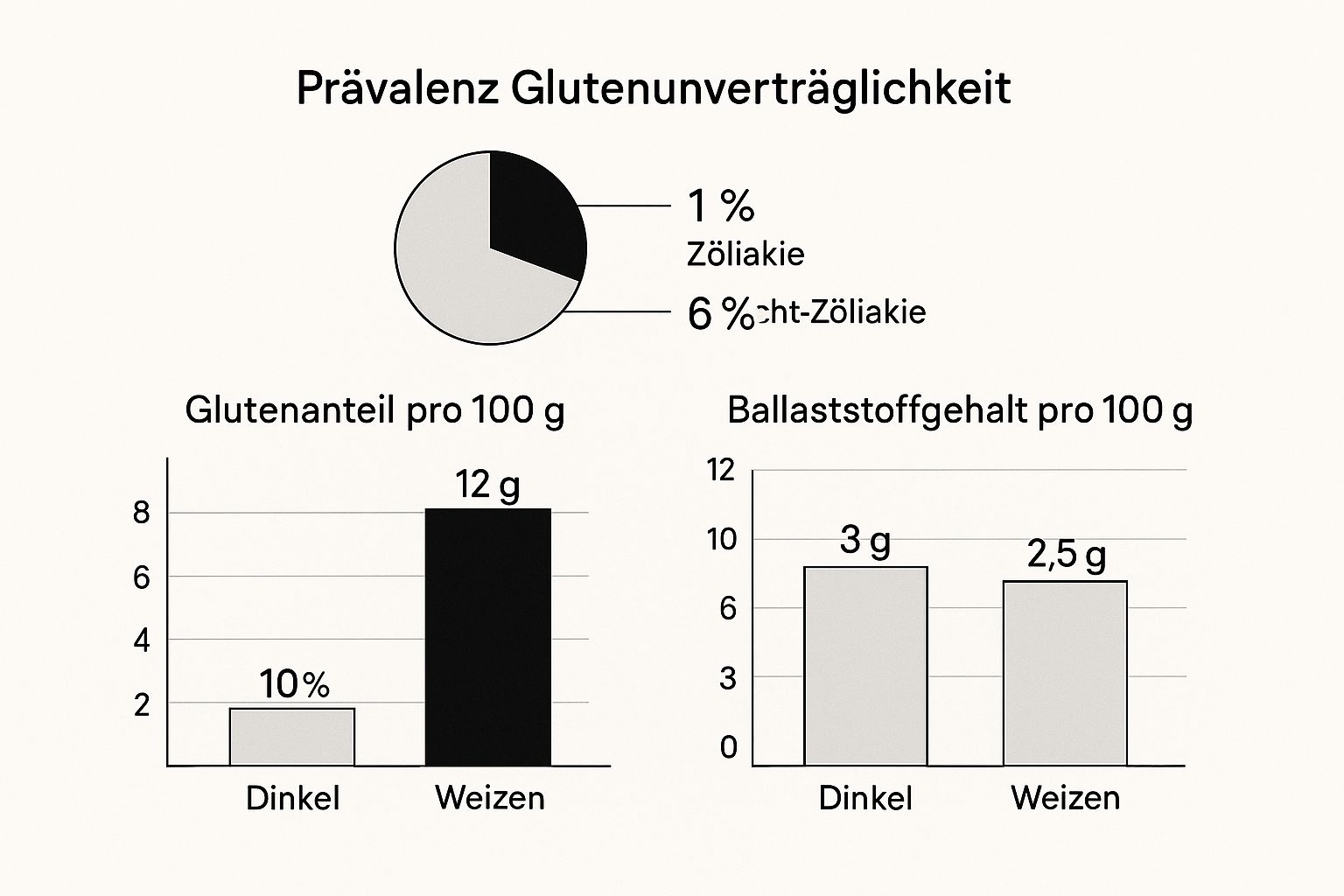
The data clearly show: If you have to avoid gluten, spelt is not a safe choice.
More Than Just a Little Stomachache: The Different Reactions to Gluten
To properly assess your situation, it is important to know that there are different types of reactions to gluten. They are not all the same and require different approaches:
- Celiac disease: This is a serious autoimmune disease. When you consume gluten, your immune system attacks the lining of your small intestine. The result is chronic inflammation and, in the long term, a dangerous nutrient deficiency.
- Non-celiac gluten sensitivity (NCGS): This causes symptoms very similar to those of celiac disease (e.g., bloating, headaches, fatigue). However, the typical antibodies or intestinal damage cannot be detected. The exact causes are still the subject of research.
- Wheat allergy: This is a classic allergic reaction. The immune system reacts to various proteins in wheat, not necessarily just gluten. Symptoms can range from skin rashes to breathing difficulties and usually occur very quickly after eating.
Unclear symptoms and half-knowledge can lead to incorrect and unhealthy decisions. Instead of relying on myths, you need to know the exact cause of your symptoms. Mere suspicion is not enough to change your diet safely and healthily. The first step toward genuine clarity is therefore often a targeted analysis, for example with a home intolerance test.
Understanding Celiac Disease: Why Spelt Is Not a Safe Alternative

Now that we have dispelled the myth that spelt is a gluten-free alternative, let’s take a look at the hard medical facts. With celiac disease, avoiding spelt is not simply a matter of taste, but an absolute necessity for your health.
It is extremely important to understand: celiac disease is not a simple digestive weakness, but a genuine autoimmune disease. This means that your immune system—actually your personal bodyguard—mistakes friend for foe and attacks your own body. The trigger is always gluten, regardless of whether it comes from modern wheat or traditional spelt.
What exactly happens in the body with celiac disease?
Imagine the inner wall of your small intestine as a fluffy carpet. The countless fine hairs on it are the intestinal villi. Their job is to increase the surface area so that all the important nutrients from your food—vitamins, minerals, and trace elements—can be optimally absorbed and enter your bloodstream.
If you have celiac disease and eat gluten, a fatal chain reaction occurs:
- Your immune system mistakenly classifies gluten as a dangerous intruder.
- It triggers a severe immune response that is directed not only against the gluten.
- In this “battle,” the immune cells also attack the sensitive lining of the small intestine and thus the intestinal villi.
This attack triggers chronic inflammation that gradually destroys the delicate villi. The fluffy carpet is, so to speak, flattened and smoothed out. As a result, the surface area available for nutrient absorption shrinks dramatically—with far-reaching consequences for your overall health.
The gradual danger: Long-term effects of untreated celiac disease
The destruction of the intestinal villi is a gradual process that you often do not notice for years. But because your body is no longer properly nourished, serious deficiencies can develop. Untreated celiac disease is so much more than just a little stomachache.
Possible long-term effects include:
- Iron-deficiency anemia: You feel constantly tired, look pale, and are no longer able to perform at your best.
- Osteoporosis: Calcium and vitamin D deficiencies make the bones porous and more likely to break.
- Neurological problems: Concentration problems, migraines, or even nerve damage may occur.
- Infertility and menstrual disorders: In women, fertility can be severely impaired.
- Increased cancer risk: The risk of certain types of cancer, especially lymphomas of the small intestine, increases.
This knowledge makes it clear how important it is to distinguish celiac disease from other intolerances. If you want to learn more, take a look at our article on the differences between celiac disease and gluten sensitivity.
For those affected, there is no tolerance threshold—every single gram of gluten, including gluten from spelt, harms the body. The only effective treatment is a strictly gluten-free diet, for life. An exact diagnosis is therefore essential to avoid these serious health risks.
These symptoms indicate gluten intolerance
Do you often feel inexplicably tired, does your stomach rumble after eating, and do you blame it on stress or simply a “sensitive stomach”? You’re not alone. Many people suffer from vague symptoms for years without finding the true cause.
Gluten intolerance—whether celiac disease or gluten sensitivity—is a true master of disguise. The symptoms are incredibly diverse and often difficult to identify. But your body sends signals. If you learn to interpret them correctly, you’ll be much closer to discovering the cause of your problems. It’s about developing an awareness of how your diet—for example, enjoying spelt products—and your well-being are connected.
The loud warning signals: Classic digestive symptoms
The best-known signs of gluten intolerance occur directly in the gastrointestinal tract. They are usually the first symptoms people notice because they often appear immediately after consuming gluten-containing foods such as spelt bread, pasta, or muesli.
Imagine biting into a delicious spelt roll in the morning and feeling extremely uncomfortable shortly afterward. Your stomach bloats like a balloon, you get cramps, or you suddenly have to rush to the bathroom. These are typical reactions that may indicate inflammation in the small intestine, as occurs with celiac disease.
The classic symptoms include:
- Bloating and abdominal distension: An unpleasant feeling of fullness, often so severe that the abdomen visibly swells.
- Diarrhea: Frequent, watery stools indicating that your intestines cannot properly absorb nutrients and water.
- Constipation: The opposite is also possible, as the inflammation disrupts the entire intestinal process.
- Abdominal pain and cramps: Sharp or pulling pain that may come and go in waves.
- Nausea and vomiting: These symptoms can be particularly severe in children.
These symptoms aren’t merely bothersome. They’re a clear sign that your digestive system is overwhelmed by gluten. If you ignore these signals over time, they can lead to the long-term damage already mentioned.
When symptoms extend beyond the stomach
Now it gets a little trickier. Gluten intolerance doesn’t always stay confined to the stomach. The chronic inflammation and poor nutrient absorption can affect your entire body. These so-called atypical symptoms are often misdiagnosed for years because no one makes the connection to gluten.
Gluten intolerance is a systemic disease. This means that the resulting inflammatory response can affect organs and bodily functions that, at first glance, have absolutely nothing to do with digestion.
Perhaps some of this sounds familiar:
- Skin problems: Itchy rashes, eczema, or a very specific skin condition called dermatitis herpetiformis Duhring can be triggered by gluten.
- Persistent tiredness and exhaustion: Do you constantly feel weak and lacking in energy, even though you actually get enough sleep? Chronic iron deficiency (anemia) caused by impaired nutrient absorption is a common cause.
- “Brain fog” and concentration problems: The feeling of thinking as if through a dense fog. You may find it difficult to concentrate and become forgetful.
- Joint and muscle pain: Unexplained pain in the joints that feels almost like rheumatism can also be a symptom.
- Mood changes: Your mental health can suffer too. Persistent irritability, anxiety, or depressive episodes may be connected to inflammatory processes in the body.
- Neurological symptoms: Recurrent headaches, migraine attacks, or even tingling in your hands and feet can occur.
This list makes it clear how far-reaching the effects can be. If you notice several of these symptoms in yourself and have not yet found an explanation, gluten intolerance could be the missing piece of the puzzle. It is crucial not to dismiss these signs as unrelated individual problems, but to see the bigger picture. This is the only way to substantiate your suspicion and take the next crucial step.
Stop guessing: This is how you can gain certainty with a test

A vague feeling in your stomach and constant fatigue are certainly bothersome, but they are not a concrete diagnosis on which you should base changes to your diet. You need clarity. If the symptoms described sound familiar, the next logical step is to investigate the matter specifically. And this journey often begins not in a doctor's office, but conveniently in your own home.
Many people with unclear symptoms put off visiting the doctor. They worry about not being taken seriously or shy away from the organizational effort. This is exactly where modern at-home self-tests come in: you can take the first, crucial step into your own hands—discreetly, easily, and without stress.
Your blood reveals more than you think
The most reliable initial indication of possible celiac disease can be found in your blood. When your immune system encounters gluten and mistakenly classifies it as an enemy, it produces specific defense substances known as antibodies. These can be detected in the blood and are a strong indication that your body is sounding the alarm when you consume gluten.
The most important value being tested is tissue transglutaminase (tTG-IgA). If these antibodies are elevated in your blood, the likelihood of celiac disease is extremely high. Such a test provides you with a solid factual basis for discussing the matter with your doctor.
Very important: For the test to be meaningful, you must follow your normal diet, including gluten, beforehand. Your body only produces detectable antibodies if it regularly comes into contact with gluten. Anyone who avoids gluten beforehand risks a false-negative result.
This shows why it is so crucial not to simply go gluten-free on a whim, but to first obtain a proper diagnosis.
How the mybody-x gluten intolerance test works
To make this first step as simple as possible, mybody-x developed the gluten intolerance home self-test. Forget appointments and waiting rooms. Simply order the test kit online and collect the sample yourself at home in just a few minutes.
The process is incredibly easy:
- Quick sample collection: Use a small lancet to collect a few drops of blood from your fingertip. It only takes a few seconds and is barely noticeable.
- Free return shipping: Place the sample in the enclosed return envelope and send it to our certified German specialist laboratory.
- Professional laboratory analysis: Your blood is specifically tested for the crucial tTG-IgA antibodies.
- Easy-to-understand report: You will receive your results report after just a few days. At a glance, you can see whether your values are within the normal range or whether action is needed.
This at-home test is your tool for turning a vague suspicion into clear information. It gives you the facts you need for all the next steps to better understand your body.
What your test result really means
A positive result is a very strong indication of celiac disease, but it is not yet a definitive diagnosis. This must always be made by a specialist, usually a gastroenterologist. An endoscopy of the small intestine (biopsy) is often performed for final confirmation. Your mybody-x test result is the ideal preparation for this doctor’s appointment.
Celiac disease is actually more widespread in Germany than many people think. In the past, it was estimated at around one case per 1,000 people. Today, studies show a prevalence of 1:200 to 1:300. This means that more than 840,000 people in Germany could be affected—and the number of unreported cases is probably high because many people do not even know they have the condition.
A test therefore not only gives you personal clarity; it also helps reduce the number of unreported cases. It is your first decisive step toward greater well-being and the right strategy for your health. If you would like to learn more about the different testing options, read our comprehensive guide on how to perform a food intolerance test.
Practical tips for an enjoyable gluten-free everyday life
Being diagnosed with gluten intolerance can initially feel like a blow—a huge restriction. But in reality, it is above all the starting point for a new, better awareness of your body and the chance to discover an entirely new world of food. Living gluten-free doesn’t mean giving things up; it means making conscious choices that are often far more enjoyable.
With the right information and a few clever tricks, making the switch becomes an exciting journey of discovery. You’ll be amazed at how many delicious and healthy alternatives there are to spelt, wheat & co. This guide gives you everything you need to make your everyday life safe, simple, and above all, delicious.
Discover safe grain alternatives
The first and most important step toward a life without the constant worry of spelt gluten intolerance is getting to know the safe alternatives. And believe me, your pantry will be more colorful and diverse than ever before!
These powerhouses are naturally gluten-free and the perfect foundation for your kitchen:
- Rice: Whether as a simple side dish, in creamy risotto, or as fine flour for baking, rice is an incredibly versatile and safe all-rounder.
- Corn: From hearty polenta and cornmeal for wraps to classic cornflakes, corn is a staple of the gluten-free world.
- Quinoa: This pseudocereal from the Andes is a true nutrient powerhouse, packed with protein and perfect for salads, bowls, or as a fluffy side dish.
- Buckwheat: Don’t let the name fool you—buckwheat has absolutely nothing to do with wheat. It tastes fantastic in pancakes, as Japanese soba noodles, or as warming groats.
- Millet: A true ancient grain that is rich in minerals. You can prepare it as porridge, in casseroles, or as a light side dish.
- Amaranth: Like quinoa, amaranth is high in protein and works great in muesli or puffed in homemade bars.
A well-stocked pantry is half the battle. If you always have these gluten-free basics at home, you won’t be tempted and can whip up something delicious at any time.
Spotting Hidden Gluten
The biggest challenge in everyday gluten-free life is often not the obvious things like bread or pasta. It’s the gluten hidden in processed foods. The food industry likes to use it as a binding agent, flavor carrier, or stabilizer. That’s why it’s so important to learn to read ingredient lists like a detective.
Keep a close eye out for these typical hidden sources of gluten:
- Sauces and Dressings: Ready-made sauces, ketchup, many types of mustard, and salad dressings often contain gluten-containing starch or spice blends.
- Sausage and Meat Products: Breaded meat is obvious. But gluten is also used as a binding agent in many types of sausage, meatballs, and marinated meat.
- Spice Blends and Broths: Instant bouillon cubes and ready-made spice blends often contain gluten-containing carriers to make them easy to sprinkle.
- Sweets and Snacks: Chocolate with cookie pieces, licorice, seasoned chips, and some types of ice cream can be surprising sources of gluten.
- Light Products: Fat is often replaced with gluten-containing starch to achieve a creamy consistency.
The official crossed-out grain symbol is your best friend when shopping. Products bearing this symbol are strictly monitored and guaranteed to be safe for you. If you want to explore the topic in greater depth, you’ll find plenty more information in our guide to the differences between celiac disease and gluten intolerance.
Simple Recipe Ideas for Getting Started
Getting started doesn’t have to be difficult. With a few simple and delicious recipes at your fingertips, you can effortlessly begin cooking gluten-free. Here are three ideas that show you how easy and delicious it can be:
- Quinoa Breakfast Bowl: Cook a portion of quinoa and mix it with fresh berries, a few nuts, a spoonful of honey, and a splash of plant-based milk. It will give you energy for the entire morning.
- Lentil Bolognese with Rice Noodles: Who needs ground meat? Cook a classic tomato sauce with red lentils—it’s hearty and healthy. Gluten-free noodles made from rice or corn go perfectly with it.
- Chicken curry with coconut milk: Diced chicken breast, plenty of fresh vegetables, creamy coconut milk, and a good curry paste. That's all you need for a quick, aromatic dish. Fragrant basmati rice is the perfect accompaniment.
As you can see, these dishes are quick to prepare, packed with valuable nutrients, and taste fantastic. They are the best proof that avoiding gluten isn't a restriction, but a real enhancement.
Your path to greater clarity and well-being
Now you have everything you need to better understand the myth surrounding spelt gluten intolerance and finally interpret your body's signals correctly. You may recognize yourself in some of the symptoms described and feel that it's time to make a change. The decisive impetus now lies with you: take action yourself.
When you're not feeling well, waiting won't get you anywhere. Undetected celiac disease is not a minor ailment – it can harm your health in the long term by depriving your body of important nutrients day after day. It's time to take responsibility for your well-being and finally find out what's really behind your symptoms.
Your first step toward greater certainty
The mybody-x gluten intolerance test is your straightforward and reliable starting point for getting the first important answers. Instead of waiting weeks for a doctor's appointment or continuing to feel in the dark, you can easily take the first step from home. Our test specifically analyzes your blood for the antibodies (tTG-IgA) that are considered a strong indicator of celiac disease.
Don't see this test as just a blood analysis. It's your first conscious step toward a better gut feeling, more energy in everyday life, and a life without constant discomfort. This is the moment when you stop guessing and start taking action.
In the end, you won't just receive a dry laboratory result, but a clear and easy-to-understand evaluation. This gives you a solid basis for confidently discussing the results with your doctor if needed. The decision to take your health into your own hands begins right here.
Order your test now and start your personal journey toward greater clarity and a more carefree life. It's easier than you think – and your body will thank you. Find out what you need to feel completely comfortable again.
Spelt and gluten – what you really need to know
To wrap things up, we want to address a few questions that keep coming up in connection with spelt, gluten, and intolerances. Here you'll find the answers presented briefly and clearly, so you can understand the connections even better.
Perhaps you are also wondering whether spelt could be a good alternative for mild sensitivity or how to approach testing correctly. Such questions are completely normal and are the first step toward finally gaining clarity.
Is spelt better tolerated with gluten sensitivity?
Some people with non-celiac gluten sensitivity do report that they tolerate spelt better than modern wheat. One possible reason could be differences in the composition of other components, such as fructans (a type of FODMAP), which are often more prevalent in wheat.
However, scientifically conclusive evidence for this benefit is still lacking. The distinction here is crucial: If you have diagnosed celiac disease, spelt is absolutely off-limits. In this case, the gluten itself triggers the severe autoimmune reaction—regardless of what other compounds are present in the grain.
Do I need to avoid gluten before a blood test?
No, absolutely not—in fact, quite the opposite! For a meaningful result from an antibody test, such as the one offered by mybody-x, it is crucial that you eat gluten-containing products as usual in the weeks before the test. This is an extremely important point.
Your immune system produces the antibodies (such as tTG-IgA) that the laboratory looks for only when it regularly comes into contact with gluten. If you avoided gluten beforehand, the result could be distorted. In the worst-case scenario, the test could be negative even though you actually have an intolerance. If you are unsure about the procedure, you can find everything you need to know about preparation in our guide to the gluten intolerance test.
Is a blood test enough for a complete celiac disease diagnosis?
A positive antibody blood test is a very strong and reliable initial indication of celiac disease. It gives you a solid basis for consulting a medical specialist.
However, a gastroenterologist usually makes the final, formal diagnosis only after an additional small-intestinal biopsy. The home test is the ideal, straightforward first step to initiate this important process and finally get clarity for yourself.
Do you suspect that gluten could be behind your symptoms? Take control and gain clarity. The mybody-x blood test is your reliable first step toward greater well-being. Find out now what your body is trying to tell you. Take the first step now at mybody-x.com



Share now:
Test your hormone levels: Here’s how to gain clarity simply and understandably
Recognize the symptoms of estrogen deficiency – How to correctly interpret your body’s signals