
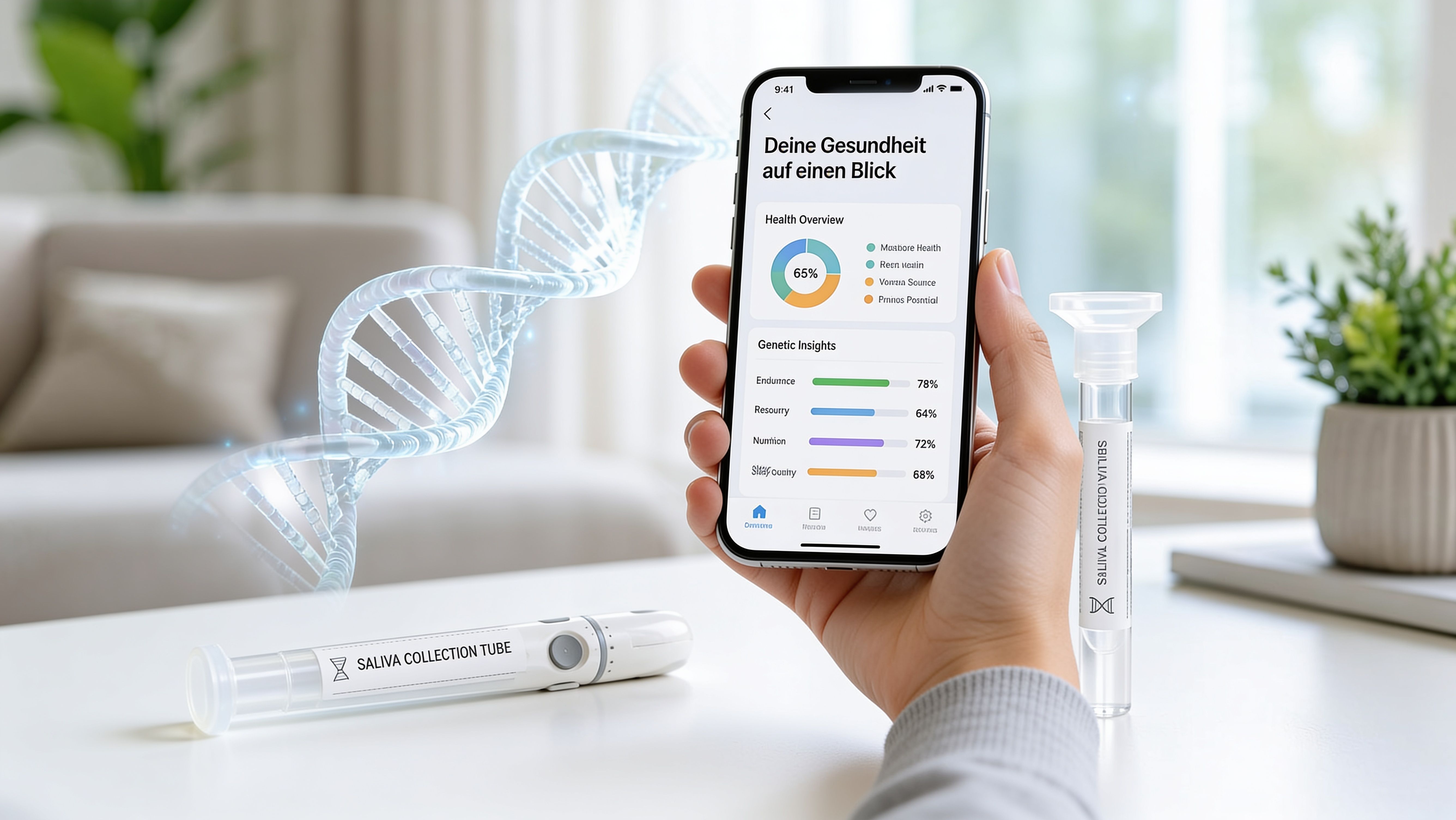
Top health self-tests with digital results reports
You may be sitting there right now with exactly the feeling many people know but find difficult to describe. Not sick enough to make a doctor's appointment out of concern, but not really fit either. Your energy fluctuates, your stomach reacts sensitively, your sleep is restless, or you have been wondering for weeks why your diet and training are not having the effect they should.
In moments like these, the test itself is not the only decisive factor. What matters is what happens after the sample is collected. A health self-test only truly benefits you if you understand the results and can derive clear next steps from them. That is why the top health self-tests with digital results reports focus not only on laboratory values, but also on presenting them in an understandable way.
The path to greater clarity about your body
Many people start with assumptions. Perhaps you are deficient in something. Perhaps you do not tolerate certain foods well. Perhaps hormones play a role. The problem is that mere assumptions rarely bring peace of mind.
A good at-home self-test replaces this guesswork with a structured look at your body. You collect a sample, have it analyzed in a laboratory, and then ideally receive not a dry sheet of difficult-to-read values, but a digital report that explains the results in everyday language.
When symptoms are unclear
A situation like this is typical: You are often tired during the day, even though you get enough sleep. After eating, you feel bloated. Your concentration fluctuates. None of this has to be dramatic. But together, it is often enough to noticeably affect your well-being.
This is especially where self-tests tailored to a specific question can help. Blood-based tests can provide indications of nutrient levels, hormones, or intolerances. Other types of tests look at digestion or genetic predispositions. If you first want to get a general overview, the article on what a self-test is is a good starting point.
A test is not valuable simply because it provides a lot of data. It is valuable when you can use that data to make a meaningful decision for your everyday life.
The digital report is the real turning point
This is often where, from a professional perspective, average results are separated from genuinely helpful support. A laboratory can measure accurately. Nevertheless, the benefit remains limited if you are ultimately left alone with technical terms.
A digital results report turns raw data into a decision-making tool. It not only shows you that something might be unusual, but also helps you understand what this means for your diet, lifestyle, or next steps. For many people, this is the moment when a test first becomes practical health guidance.
That is why it is worth choosing self-tests not only based on the type of test, but also by asking: Will I receive a report after the analysis that I can actually use?
What digital results reports really deliver
A traditional laboratory report seems to many people like the technical manual for a machine: technically accurate, but without any translation into everyday life. A digital results report works more like a good car dashboard. You can immediately see what is important, where you should take a closer look, and which signals you should not ignore.
From raw data to guidance
The way the results are presented is crucial. Instead of merely listing values and reference ranges, a digital report puts the results into context. This is especially helpful if you have no medical background but still want to understand what your test reveals.
These elements are particularly useful:
- Clear visualization: Charts and color coding make it quicker to see where action may be needed.
- Clear language: Technical terms are explained so that you can understand what they mean for your everyday life.
- Interactive features: Users particularly appreciate being able to understand complex values and access additional information when needed.
- Action-oriented recommendations: Abstract laboratory values are translated into specific guidance for nutrition and lifestyle.

What works in practice—and what doesn’t
What works well is simplicity without oversimplification. A report should not overwhelm you with details, but it should not be simplified so much that you only get a basic traffic-light view and lose the context.
Digital reports that look attractive but provide no genuine interpretation are less helpful. In that case, you only have a more modern PDF, not better guidance.
Practical rule: A good report answers three questions: What was measured? What does it mean for you? What can you do next?
This translation is particularly important for genetic analyses. The DNA Metabolism Analysis from mybody®x reveals genetically determined metabolic types, fat and carbohydrate utilization, and individual weight-related risks. However, the real benefit only emerges when this information is presented in the report in a way that allows a customized nutrition and training plan to be derived from it.
The real added value comes after logging in
Collecting the sample often takes only a short time. The report stays with you much longer. That is why the top at-home health tests with digital results reports are not simply convenient home tests. They are tools for assessment, prioritization, and implementation.
A good digital report gives you the feeling that you are no longer merely observing your body, but finally understanding it better.
The most important types of at-home health tests
You collect a sample at home, send it in, and wait for the report. This is precisely the point at which a helpful test differs from one that merely satisfies curiosity. The type of test determines which question the digital results report can ultimately answer.
The choice therefore depends not on what sounds most modern, but on what you really want to find out. In everyday practice, I mainly encounter three categories: blood tests, gut tests, and DNA tests. They provide different types of information and lead to different next steps.
Blood tests for your current condition
Blood tests are suitable if you want to know how your body is doing right now. They are often used to better assess nutrient levels, hormonal indicators, or reactions to specific stresses.
This is useful if you have been feeling exhausted for weeks, your cycle has changed, or you want to understand whether a measurable current factor is behind nonspecific complaints. The sample usually consists of just a few drops of capillary blood from your finger. For many questions, this is the most direct route to a useful report because current values can be translated well into concrete everyday recommendations.
Gut tests for digestion and the microbiome
Gut tests focus specifically on the digestive tract and patterns in the microbiome. They are particularly suitable for recurring bloating, unexplained digestive complaints, or the feeling that certain meals do not agree with you.
The stool sample is somewhat less pleasant than a saliva test, but from a professional perspective it is often closer to the actual question. That is precisely the important difference. If you have abdominal complaints, a gut-focused report often provides more guidance than a general blood value with no clear connection to digestion.
If you would like to explore this topic in more detail, the article about the intolerance test offers useful further information.
DNA tests for genetic predispositions
DNA tests answer a different question. They do not show how your body is reacting today, but rather which genetic factors may play a role in the long term.
This is useful if you want to plan your nutrition, training, or weight management more individually. The sample is usually collected via saliva. The main advantage lies in the report’s long-term value. Genetic results do not change from week to week. The downside is just as clear: They are usually less helpful for acute complaints than a test that measures your current condition.
Health self-tests at a glance
| Test type | What is it suitable for? | Sample type | Typical result turnaround time |
|---|---|---|---|
| Blood test | Nutrients, hormones, intolerances, current health status | Capillary blood | Approx. 3 to 5 business days after the sample arrives at the laboratory |
| Stool test | Digestive complaints, gut flora, microbiome | Stool sample | 5 to 10 business days after the sample arrives at the laboratory |
| DNA test | Genetic predispositions, metabolism, long-term nutrition strategy | Saliva sample | 15 to 25 business days after the sample arrives at the laboratory |
mybody®x gives these time frames in its overview of the testing process. In practical terms, this means that blood tests often provide insights more quickly for short-term decisions, stool tests take a little longer, and DNA tests are more of an investment in a long-term strategy.
Which category is often misjudged
DNA tests are often overestimated when an acute complaint is actually the main concern. A genetic report can show you which patterns in metabolism or weight regulation are more likely. However, it does not replace a current medical assessment if you have symptoms today.
Blood tests, by contrast, are sometimes used too broadly. They show you a snapshot of the present, but not automatically the cause behind every problem. Stool tests are more appropriate when your symptoms are clearly related to digestion.
In the end, one simple question matters: Which report will actually help you afterward? If you answer that carefully before buying, you will usually choose the better test. For more guidance on how your data is handled, it is also worth taking a close look at how providers secure their digital reports.
How to reliably assess quality and data protection
Health self-tests are not just about convenience. They involve sensitive samples, personal results, and data that is no one else’s business. That’s why you should assess a provider not only by its range of tests, but also by its quality assurance and data protection.
How to recognize a reputable provider
Many people look first at the homepage and the insights promised there. What matters more from a professional perspective, however, is what happens behind the scenes. Where is the analysis carried out, how transparent is the process, and how carefully does the provider explain its handling of health data?
Pay attention to these points:
- Laboratory standards: The provider should openly state that the analysis is carried out in qualified laboratory facilities.
- Clear presentation of results: Good providers show even before purchase that results are presented in an understandable way.
- Data protection transparency: You should be able to understand which data are stored, for how long, and for what purpose.
- Secure portal: Protected access is especially important for digital results reports.
- Access to advice: When results raise questions, more than just a download area is needed.

Data protection is not fine print
Many people underestimate what a digital health report reveals about them. Even if individual values seem harmless, the data as a whole forms a highly personal health profile. That is precisely why GDPR compliance is not a nice extra, but a minimum requirement.
If you generally want to better understand what to look out for in digital processes, the article on handling your data is helpful. It explains data protection in a practical way without unnecessary technical jargon.
Genetic information is even more sensitive. If you are currently looking into this area, you can find additional guidance in the article on data protection for genetic tests in Switzerland.
You should only store health data where protection is explained visibly, not hidden away.
What is often overlooked when choosing
Many people check which markers a test covers, but not how results are provided. Yet that is exactly where a real risk lies. A good provider makes it clear that your digital portal is protected and that health data are not treated like ordinary newsletter data.
The language on the website is also a signal. Vague promises and unclear statements about data security are not minor details. They often show that the focus is more on marketing than on the responsible handling of sensitive information.
My professional recommendation for making the choice
If you are choosing between several tests, don’t just ask yourself what the test includes. Ask yourself these three questions too:
- Do I understand who analyzes my sample?
- Do I understand how I receive my result?
- Do I understand how my data is protected?
If one of these answers remains unclear, it is worth exercising restraint. Especially with top health self-tests that provide digital results reports, a trustworthy data concept is part of the actual product.
Choosing the right test for you
The best choice starts with a clear question. People who test without a specific question often receive many values but little guidance in the digital report. That is precisely where a useful self-test differs from mere data collection.
First ask yourself: What do you really want to decide after receiving the results report? Is it about having more energy in everyday life, symptoms after eating, your menstrual cycle and hormones, or a long-term nutritional strategy? A good test matches that decision, not the largest possible list of markers.
When energy is your main concern
For fatigue, dips in performance, or the feeling that you cannot really get going despite healthy habits, a nutrient test is often the most sensible starting point. It shows your current status. For many people, this is more practical than a DNA test, which tends to describe predispositions.
For everyday use, this is an important distinction. A digital results report should not merely show you values, but should clearly explain which markers are abnormal, what they may mean, and which next steps you can discuss with your doctor or incorporate into your routine.
When digestion or reactions to food are the main concern
Symptoms after meals, skin reactions, or a persistent suspicion of certain foods can quickly lead to unnecessarily strict diets. A food intolerance test is more sensible or, depending on the symptoms, a test focusing on the gut.
Here too, the practical value lies in the report. You do not need an isolated number, but an analysis that makes connections easy to understand and helps you make nutritional decisions in an organized way rather than based on gut instinct.

If you want to understand your metabolism and weight in the long term
For questions about weight, training, and nutrition, a snapshot is not always enough. A DNA-based metabolic analysis may be useful if you want to understand how your body generally responds to specific nutritional and training stimuli.
The value here lies primarily in the long-term interpretation. The digital report should therefore be written in a practical, everyday way. In other words, it should not merely list genetic terms, but explain what the results mean for your planning and what they explicitly do not say. Genes provide clues. They do not determine your behavior.
Anyone who wants to personalize their diet over the long term needs different answers from someone who wants to assess acute symptoms.
A simple decision aid
This classification helps in practice:
- You often feel exhausted: A nutrient test is usually the more suitable first step.
- You suspect hormonal fluctuations: A hormone test addresses this question more precisely than a general check.
- You are sensitive to certain foods: An intolerance test is more closely aligned with your everyday life.
- You have recurring digestive issues: A gut test may be more useful than repeatedly trying different things.
- You want to tailor your diet and training more individually: A DNA-based metabolism analysis is often a good fit.
If you are looking for a straightforward option for blood values, mybody x Bluttest is one of the providers offering home self-tests for areas such as nutrients, hormones, and intolerances, complemented by digital results reports. If you mainly want to know how sample collection works in practice, this guide on how to perform a blood test at home can help.
What often goes wrong in practice
A broad test may seem attractive at first glance. But the evaluation often creates a different problem. The report does not answer the question you started with.
That is why my recommendation is: formulate your main concern in one sentence before ordering. For example: “I want to understand whether my fatigue is more likely related to a nutrient issue” or “I want to assess my reactions after eating more precisely.” Then choose the test whose digital report directly supports that decision.
This makes the result not only interesting, but useful.
Your simple path to the result
The hurdle often feels smaller once you have a clear idea of the process. Many people worry less about the result than about whether collecting the sample at home will be complicated or unsafe. In practice, the process is usually much simpler than you initially expect.
From the test kit to the sample
After you place your order, the test kit will be delivered to your home. It contains the materials for collecting the sample and instructions. With a blood test, this usually means a small prick in your finger. With a DNA test, you generally provide a saliva sample. A gut test works with a stool sample.
What matters is not speed, but working cleanly. Read the instructions all the way through before you begin. Then the process will immediately seem more manageable.
For practical preparation, a detailed guide on how to perform a blood test at home is helpful, especially if you are collecting a capillary sample for the first time.

Return shipping and analysis
After collection, the sample is packaged according to the instructions and sent back to the laboratory. This part is important for users because it builds trust. You do not have to arrange the shipment of medical samples yourself. The process is designed for at-home use.
The analysis then takes place in the laboratory. For you, this phase often marks the beginning of the actual added value, because you are not simply waiting for a finding but for a report that you can access digitally.
When the report is ready
As soon as your result is available, you gain access to the digital result report in the secure portal. This is the point at which a small sample becomes a useful insight.
What I appreciate about this process from a professional perspective is that it removes unnecessary obstacles. You neither have to arrange for medical professionals nor deal with an unreadable printout. The process takes you from the test kit to interpretation in one seamless flow.
The simpler the process, the more likely you are to complete the test properly. Good health routines often fail not because of a lack of willpower, but because of unnecessary friction.
More than just a result with mybody®x
A test report alone does not change anything. The benefit only emerges when you translate the results into your everyday life. This is precisely where the difference between merely collecting data and providing genuine support becomes apparent.
mybody®x combines the digital result report with an environment focused on implementation. This includes explaining complex values in an understandable way rather than leaving them as abstract laboratory information. Users particularly appreciate recommendations that are clearly formulated to guide action.
It is also practically important to have the opportunity to put results into context. If a test points to a nutritional issue, a nutrient area, or a hormonal question, a subsequent professional assessment is often more helpful than taking yet another test. This is how analysis becomes guidance.
Ultimately, that is the real strength of the top health self-tests with digital result reports. They provide more than just data about your body. They help you translate this data into meaningful decisions about nutrition, everyday life, and well-being.
If you want to do more than simply observe your body and understand it on a deeper basis, mybody x blood test offers at-home health self-tests with digital result reports that help you better interpret nutrients, hormones, or intolerances.



Share now:
Testosterone Test for Men: The Complete Guide 2026
Find the best at-home tests for weight loss and more energy!