
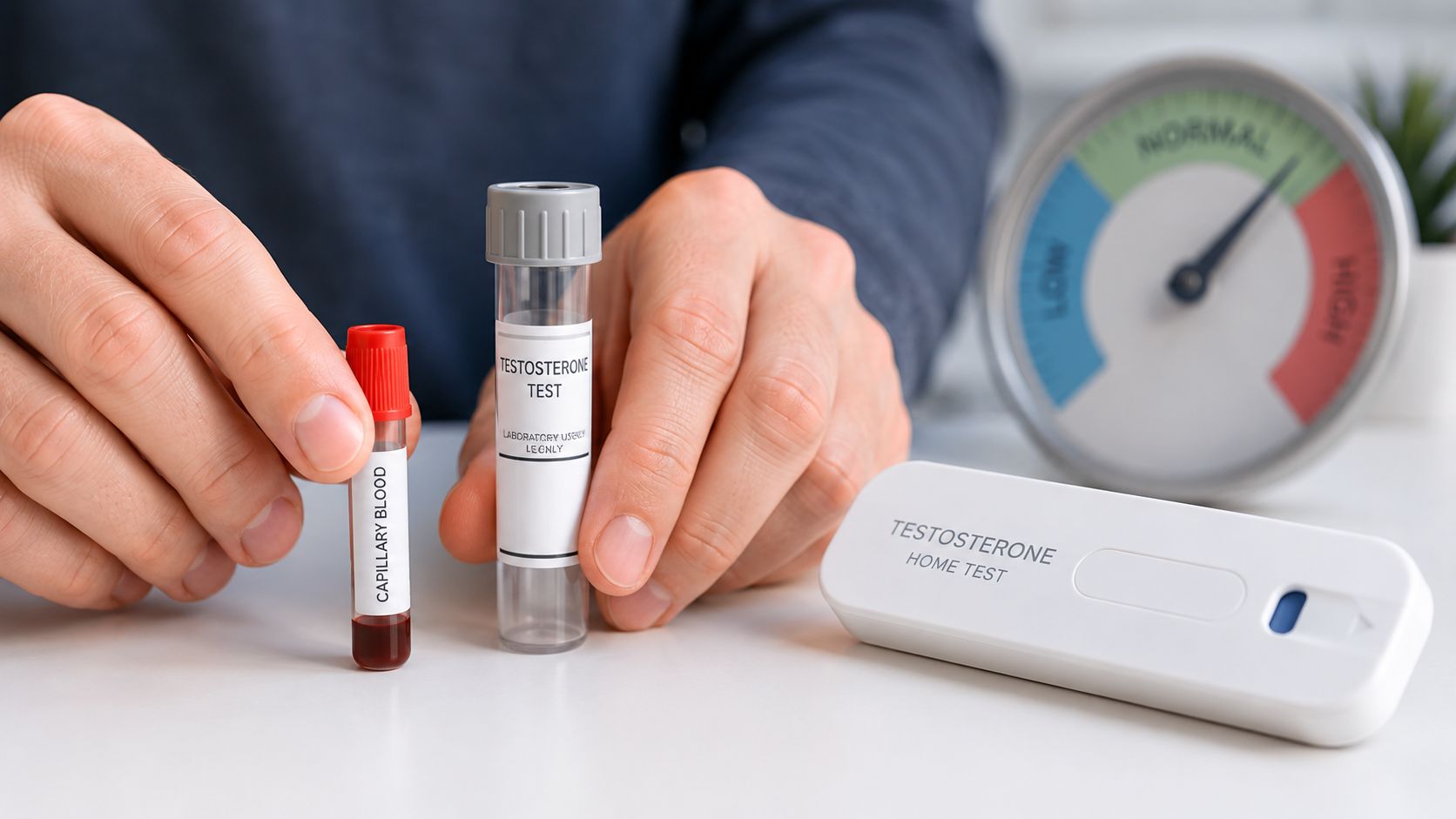
Testosterone Test for Men: The Complete Guide 2026
For weeks, you have noticed that something is not quite right. You get enough sleep and are still tired. Concentrating at work has become more difficult. You lack drive during training, motivation in everyday life, and your libido is no longer what it used to be. Many men initially attribute this to stress, getting older, or “just a difficult phase.”
That is exactly why the topic of testosterone test for men is so important. A properly conducted test can help you put vague symptoms into perspective instead of continuing to guess. And it does not just show you whether your level is unusual, but above all what you can sensibly do next.
Why a testosterone test can be useful for men
A typical example is a man who considers himself healthy. He manages everyday life, but only with lots of coffee, little enjoyment, and the feeling that he is constantly trying to catch up with his own energy. Weight gain, less sexual desire, or a low mood may also occur. These are not definitive signs. That is precisely why they often go unnoticed for a long time.
That is precisely the challenge with testosterone. A deficiency often does not show up as one clear symptom, but rather as a pattern of several small changes. Loss of libido, low motivation, difficulty concentrating, or depressive moods may be part of it. Many men initially think they are simply overworked, but their hormone balance may also play a role.
Important: A test does not replace a medical diagnosis. However, it gives you a concrete basis instead of making judgments based only on how you feel.
When it makes sense to take a closer look
There are phases of life when checking your testosterone levels can be especially useful. This is particularly true when symptoms persist for a longer period and do not fit well with your previous condition.
You should pay particularly close attention if you:
- feeling constantly exhausted and not fully recovering even with sleep
- reduced performance in everyday life or during exercise
- significantly lower libido or sexual problems
- increasing belly fat and feeling physically “sluggish”
- mental changes such as irritability, lack of motivation, or brain fog
Another reason for increased attention is age. From the age of 40 onward, men's testosterone levels decline continuously by about 1 to 2% per year. As a result, around one in four men in their 60s is affected by clinically relevant testosterone deficiency.
Clarity instead of self-doubt
A good test can provide psychological relief. Not because every problem is immediately explained, but because you stop groping around in the dark. If your level is unremarkable, you can look more deliberately in other directions. If it is abnormal, you can approach the next steps in a structured way.
That is often the real benefit. You take your body seriously and make decisions based on data rather than assumptions.
What a testosterone test really measures
Many people think of a testosterone level as a single number. In practice, that is too simplistic. A good test result shows more than just a “high” or “low” value.

Total testosterone is not the whole story
The first important term is total testosterone. This is the complete amount of testosterone measured in your blood. This value is relevant, but it does not automatically explain how much of it is actually available for your body to use.
A simple analogy helps: Imagine that many cars are driving around in a city. Total testosterone is the total number of cars. But if you need a taxi right now, the sheer number is not very useful. What matters is how many vehicles are freely available.
That is precisely what free testosterone refers to. It is the biologically active portion that can act directly in the body.
The role of SHBG
Some testosterone is bound to proteins. SHBG, or sex hormone-binding globulin, is particularly important. When a lot of testosterone is bound to SHBG, your total level may appear normal on paper even though the active portion is too low.
That is why a man may have symptoms even though his total testosterone does not look dramatically low.
According to UroKompetenz’s guide to interpreting testosterone deficiency, clinically relevant testosterone deficiency is often defined as a total testosterone level below 300 ng/dl (10.4 nmol/l). However, free testosterone is also important, because when SHBG is high, the total level may be normal while free, active testosterone is already too low.
A test result without context can be misleading. That is why it is worth looking beyond just one number.
Which values you should pay attention to in your test result
When you look at your report, these three questions will help:
- How high is your total testosterone? This is the basis for the initial assessment.
- What does your free testosterone level look like? This value is often closer to your actual symptoms.
- Are there indications of a high level of bound testosterone? SHBG can then limit its availability.
In practical terms, this means that if you take a test, it should be designed to look at more than just the total amount. Otherwise, you may receive an apparently reassuring result that does not explain your symptoms.
Why interpretation is more important than panic
A single borderline value does not automatically mean that you have a disease. At the same time, a “normal” total value does not always mean there is nothing to worry about. The value of a test therefore lies not in raising the alarm, but in interpreting it together with your symptoms, age, and lifestyle.
Once you understand this, you no longer read your test result like a school grade. You read it as a biological signal that explains why you feel the way you do right now.
Laboratory or at-home test: Choosing the right testosterone test
In practice, most men do not first ask themselves about hormones, but about the effort involved. Arrange a doctor's appointment, show up in the morning, sit in the waiting room. Or test at home instead, discreetly and without much hassle.

What speaks in favor of laboratory testing
The traditional route via a medical practice or laboratory remains the medical reference point. Medical guidelines recommend measuring venous blood as the gold standard. A valid diagnosis also requires two separate measurements several weeks apart to rule out day-to-day fluctuations, as described in the Adon Health article on testosterone measurement.
This is particularly important if you need a medical diagnosis or if treatment is ultimately being considered.
Benefits of seeing a doctor or using a laboratory:
- medical assessment directly on site if the result is abnormal
- venous blood draw as the standard closest to clinical guidelines
- further evaluation possible, such as additional hormone or metabolic markers
- a good choice for more severe symptoms or an unclear overall situation
Why choose a home test
A home test serves a different purpose. It is not a shortcut to treatment, but a very practical starting point. For many men, precisely this low barrier is crucial. You can check without an appointment whether your hormone status warrants a more detailed evaluation at all.
Discretion is especially important for sensitive topics such as libido, energy, or declining performance. Some men only take action once they can collect their first sample comfortably at home.
If you’re interested in how the process works in practice, the article Hormone test at home provides practical guidance on what to expect.
How to recognize a meaningful home test
Not every test provides genuinely useful information. Pay attention to these points:
| Criterion | Why it matters |
|---|---|
| Laboratory integration | The sample should be analyzed in a professional laboratory |
| Clear presentation of results | You must be able to see what was measured |
| Data protection | Health data in particular requires reliable processes |
| Guidance on what to do next | A test is only helpful if you can interpret your result |
Where mybody x Gesundheit fits into the picture
If you first want a straightforward assessment of your current status, a home test may be a suitable solution. mybody x Gesundheit offers at-home health self-tests with laboratory analysis. In this context, this is particularly interesting for men who want to check their hormone status discreetly and then plan their next steps more deliberately.
In the end, the choice is simple. For medical diagnosis, a doctor-supervised blood test is the standard. For an accessible introduction and greater personal responsibility, a reputable home test can be very useful.
The right preparation for reliable results
You’re standing in the bathroom in the morning, slept poorly, trained hard the night before, and want to get the test over with quickly. It’s precisely in moments like these that a result can easily reflect more about the previous day than about your typical hormone status.

For a meaningful test, it is not only the sample itself that matters. The time of day, food, physical exertion, and your general condition also play a role. Testosterone behaves somewhat like blood pressure in this respect. A single measurement is only truly comparable when the conditions are as similar as possible.
What you should keep in mind before the sample collection
It is best to schedule the blood draw for the morning. Testosterone follows a daily rhythm, so values from the early part of the day are more comparable than measurements taken in the afternoon.
Remain fasting before the sample collection. If you are unsure what fasting specifically means, the explanation what fasting means exactly before a blood draw can help.
Avoid intense workouts, alcohol, and a hectic journey shortly before the test. Too little sleep or acute stress can also affect the results. The goal is not to do everything perfectly. Above all, you want to create conditions that reflect your normal state as accurately as possible.
These points will help you prepare:
- Test in the morning: preferably always at a similar time
- Arrive fasting: water is generally fine
- Avoid excess the day before: both alcohol and extreme exercise
- Arrive relaxed for the sample collection: it is better to arrive a few minutes early
- Make a note of medications: especially hormone preparations or other products that could affect the result
Why small deviations can make a big difference
Many men are puzzled by fluctuating results. This does not mean that the body is suddenly behaving unpredictably. Hormones respond to sleep, energy intake, physical exertion, and the natural course of the day.
That is why good preparation is more than a formality. It creates a fair starting point for interpreting later results. This is the only way to assess whether an abnormal finding really matches your symptoms or whether a proper follow-up measurement would be advisable first.
One practical rule almost always helps: Repeat subsequent measurements under conditions that are as similar as possible. The same time of day, similar preparation, and a similar routine. This way, you are not comparing apples and oranges.
If you use a home test, read the instructions in full before collecting the sample. The most common mistake does not occur during evaluation but during preparation at home. Good results therefore begin with calm, proper timing, and a clear routine.
Understanding and correctly interpreting your test result
You open the test report and immediately look for a clear answer. Instead, you see reference ranges, abbreviations, and perhaps a result that is just above or below a threshold. This is precisely where most misinterpretations arise.

A number is a clue, not a final verdict
A testosterone result seems unambiguous at first glance. In practice, it is more like a speedometer without a road map. You see a number, but not yet why it looks that way or what it means for your everyday life.
That is why the context always matters. How old are you? What symptoms do you actually have? Was the test taken in the morning? Does the result fit with fatigue, loss of libido, or reduced performance, or does it remain a laboratory finding without clear symptoms?
A single borderline result should neither reassure nor alarm you. It is a signal to take a closer look.
Why reference ranges are often misunderstood
Many men treat the laboratory range like a school grade: equally good within the range, automatically problematic outside it. It is not that simple.
Reference ranges describe where values commonly fall in a comparison group. But they do not by themselves answer the more important question: Do you feel well with this result, or do your symptoms and findings appear to fit together unusually? That is why a result in the lower end of the normal range may deserve more attention when symptoms are significant than a slightly low result in isolation without symptoms.
If you want to better understand how laboratory ranges and units are connected, the article on normal testosterone levels in men in ng/dl can help.
Age, symptoms, and related test results belong together
Hormone levels change with age. That does not mean, however, that every change is automatically “normal for your age” or that every deviation needs to be treated. What matters is the combination of the result, symptoms, and other laboratory values.
Free testosterone is particularly important to consider when total testosterone appears borderline. The reason is simple. Some of the hormone is bound to transport proteins in the blood. Only the available portion can act on target tissues. This explains why two men with similar total levels can feel completely different.
A typical case from practice
A man in his late 40s has had less drive, poorer recovery, and hardly any interest in sex for several months. His total testosterone is in the borderline range in the laboratory. Only an additional look at free testosterone levels and the clinical context makes the picture clearer.
This is where confusion often arises. Many people read only the first number and immediately draw a major conclusion. A calmer approach is more useful. First, check whether the symptoms, time of measurement, and additional values fit together. Then you can decide whether a repeat measurement, further diagnostic testing, or initial changes in your everyday life make sense.
Your results do not just answer the question “How high is the level?” but above all, “Does this level fit your situation?”
How to read your results step by step
These four questions bring order to the evaluation:
- How significant is the deviation? Clearly normal, borderline, or clearly abnormal.
- Do you have typical symptoms? A number without symptoms is assessed differently from a finding that fits well with your symptoms.
- Was the measurement properly comparable? The time of day, sleep, physical strain, and medications affect how the result is interpreted.
- Are there values that add to the picture? For example, free testosterone or other laboratory parameters that explain why you have symptoms.
This takes the pressure out of the situation. You do not have to immediately classify your level as “good” or “bad.” First, you need a more complete picture.
When you should seek a closer medical evaluation
Medical evaluation makes sense if your level is clearly abnormal, if typical symptoms are present, or if a borderline result repeatedly does not match how you feel. Even an apparently normal level can leave further questions open if symptoms are pronounced.
Many men make an understandable mistake at this point. They look for a quick decision: hormone deficiency, everything fine, or immediate treatment. In reality, interpreting the results is more like putting together a puzzle. Only several pieces together create a reliable picture.
From results to an action plan
An abnormal finding is not a signal to rush into blind action. It is an opportunity to sort out the levers that can be adjusted. And when it comes to testosterone, the most important levers are often not found in the prescription pad first, but in everyday life.
Why lifestyle should come first
There are causes of low testosterone levels that are often overlooked even though they can be influenced. Obesity, vitamin D deficiency, and chronic sleep deprivation are common and often reversible causes of low testosterone levels. Lifestyle changes can often significantly improve levels without medication, according to the medical assessment cited in the background material in the YouTube video about reversible triggers of low testosterone levels.
That is a powerful message. It takes the pressure off and gives you back a sense of responsibility. Not everything is “hormonal destiny.” Much of it can be influenced.
The three most sensible first steps
Get your sleep in order first
If your sleep is consistently short, restless, or interrupted, you start every morning at a disadvantage. Regular sleep times, less late-night light, less alcohol in the evening, and a calmer evening routine are often the underrated basics.
Take body fat and training seriously
Abdominal fat in particular is often associated with hormonal imbalance. At the same time, targeted strength training can be a useful lever. Not as a self-optimization project, but as metabolic maintenance.
Check micronutrients instead of guessing
If a deficiency has been confirmed, it makes sense to take targeted action instead of supplementing indiscriminately. The Vitamin D3 K2 Complex | Shield from mybody®x combines high-dose D3 with K2 for optimal calcium utilization, bone health & immune system support. According to the product information, it is ideal after a DNA or blood test has confirmed a deficiency and is precisely dosed.
When you should see a doctor
There are situations in which self-management alone is not enough. These include:
- Clearly abnormal values together with typical symptoms
- Borderline results that remain unclear despite good preparation
- Severe sexual dysfunction or a pronounced decline in performance
- Uncertainty about accompanying factors that should be investigated further
Then the right step is not Reddit, but an andrological, urological, or endocrinological evaluation.
A sensible process without overreacting
- Review the result and make sure the testing conditions were correct.
- Record your symptoms as specifically as possible and over several weeks.
- Implement lifestyle changes, especially regarding sleep, exercise, weight, and nutrient status.
- Repeat the test or seek medical evaluation if symptoms persist or the result is clearly abnormal.
Proceed in a structured way. Not passively, but not in a panic either.
Frequently asked questions about the testosterone test
Does health insurance cover the test?
Yes, under certain conditions. The cost of a testosterone test at the doctor’s office is covered by health insurance if there is a medical reason, such as clinical symptoms or risk factors. Anonymous online self-tests for an initial assessment must be paid for privately, as explained by the Urological Foundation for Health regarding the process and cost coverage.
How often should I test?
That depends on the reason for testing. For initial guidance, a single properly planned test is sufficient. If a result is borderline or abnormal, further evaluation should be carried out systematically. Repeating the test is particularly useful if your symptoms, daily routine, or lifestyle have changed, or if a doctor recommends a follow-up.
Is an at-home test useful at all?
Yes, an at-home test can be very useful as an initial assessment. However, it does not replace a complete medical diagnosis. Its main value is that it gives you clarity with a low barrier to access, rather than leaving you guessing for months.
Many men only take action when the first step is simple enough. That is exactly where an at-home test can be useful.
What should I look for regarding data protection and quality?
When it comes to sensitive health data, you should make sure that the provider operates transparently. Clear information about laboratory analysis, data protection, and data processing is important. According to the company, mybody®x uses ISO-certified laboratories in Germany, GDPR standards, and ISO 27001 processes as part of its framework. This is particularly relevant if you prefer to have your health data processed in a controlled and discreet manner.
What are the best natural steps for a low level?
The most important levers are often surprisingly down-to-earth: sleep better, reduce abdominal fat, incorporate regular strength training, cut down on alcohol and chronic stress, and address micronutrient deficiencies in a targeted rather than blanket manner. If you implement this consistently, you will have established the foundation before even considering further measures.
If you want to better understand your body and gain initial clarity about your hormone status, mybody x Gesundheit offers at-home self-tests that combine laboratory analysis with practical everyday use. Especially with nonspecific symptoms, this can be a sensible first step toward making data-based decisions instead of relying on intuition.



Share now:
How to Boost Your Metabolism: Top Strategies for 2026
Top health self-tests with digital result reports