

Sweeteners and blood sugar: what has been established
The essentials at a glance
Few nutrition topics generate as many conflicting statements as sweeteners. That is why this article begins not with an answer, but with the state of the evidence.
The German Federal Institute for Risk Assessment summarizes it as follows: The evidence is inconsistent and very limited for some of the population groups considered and for certain health aspects (as of July 15, 2025).
You will first read what distinguishes sweeteners from sugar substitutes. This is followed by a fact check of three common statements, the question of the maximum amount, a comparison of the substance groups, and the value that actually helps answer this question. This article recommends neither for nor against sweeteners.
What to expect in this article
1. The state of the evidence
2. Sweeteners and sugar substitutes are two different things
3. Three statements about sweeteners put to the fact check
4. The maximum amount and what it means
5. Why the evidence is so inconsistent
6. The substance groups compared
7. What can be measured instead of assumed
8. Why a personal experiment is of little value
9. Who could benefit from a measurement
10. What a capillary blood test can show in this context
11. Limitations: what remains unresolved
12. What matters when it comes to sweeteners
Frequently asked questions
Sources
The state of the evidence
Anyone researching this topic will find a counterstatement for every claim. This is rarely due to the people searching and usually due to the subject itself.
Documented source
“The BfR concluded that the evidence is inconsistent and very limited for some of the population groups considered and for certain health aspects.”
German Federal Institute for Risk Assessment
Sweeteners in Food, Selected Questions and Answers, as of July 15, 2025
Inconsistent means that studies arrive at different results. Very limited means that, for some questions and groups, there is too little data to make any judgment at all.
This is the most honest information that can be given on this topic, and it comes from the authority responsible for such assessments in Germany.
This sentence determines the structure of this article. It states what has been established and identifies the points where nothing has been established, instead of filling them with a plausible assumption.
Sweeteners and sugar substitutes are two different things
In everyday language, the two terms are often mixed up. Technically, they describe two different groups of substances under the umbrella term sweeteners.
The German Federal Institute for Risk Assessment describes them as follows: Sugar substitutes are sugar-like substances with generally lower sweetening power and fewer calories than sugar that cause little or no tooth decay. The sweeteners group, by contrast, comprises very different chemical substances that have no caloric value or only a negligible one and taste much sweeter than sugar (as of July 15, 2025).
There are two differences. One concerns caloric value, the other sweetening power and therefore the amount used.
The distinction is crucial when it comes to blood sugar. A statement about one group cannot be transferred to the other, and many contradictory texts online conflate them at this point.
Why sweetening power determines the quantity
The BfR's note that sweeteners taste much sweeter than sugar (as of July 15, 2025) sounds like a matter of taste. It is primarily a matter of quantity.
Anyone wanting to achieve the same sweetness with a very sweet-tasting substance as with sugar needs considerably less of it. The amount used is therefore on a different scale from that of sugar, and the same does not apply to the second group: according to the same source, sugar substitutes generally have lower sweetening power, so more of them tends to be needed.
Taken together, these two statements explain why figures for caloric value and quantity are not comparable between the groups. Anyone transferring a figure from one group to the other is using two different scales in the same line.
Three statements about sweeteners in a fact check
These three statements come up regularly. All three can be checked against the evidence, and for one of them the result is a blank.
Checked against the evidence
Widespread
“Sweeteners raise blood sugar just like sugar.”
Substantiated
We found no reliable statement in the sources reviewed about the effects of sweeteners on blood sugar or insulin. It is substantiated that sweeteners have no caloric value or only a negligible one (BfR, as of July 15, 2025). That is all the source says, and therefore that is all we say here.
Widespread
“Science is in agreement.”
Substantiated
The BfR concluded that the evidence is inconsistent and very limited for some population groups and certain health aspects (as of July 15, 2025). Anyone claiming consensus does not reflect the assessment of the responsible authority.
Widespread
“A sweetener is a sweetener.”
Substantiated
The sweeteners group comprises very different chemical substances (BfR, as of July 15, 2025), alongside the separate group of sugar substitutes. A statement about one substance does not automatically apply to the others.
The first point is the least satisfying and, at the same time, the most honest. A gap in the sources is information, and replacing it with a supposition would be the actual mistake.
The maximum amount and what it means
Approved sweeteners have defined maximum daily amounts. They are referred to as the ADI value, which stands for acceptable daily intake.
For aspartame, the German Federal Institute for Risk Assessment specifies an ADI value of 40 milligrams per kilogram of body weight per day (as of 15 July 2025).
This figure describes an amount that, according to current knowledge, can be consumed daily over a lifetime. It is not a recommendation to use up that amount, nor is it a threshold above which something happens.
Each approved sweetener has its own ADI value. Applying one number to all of them would be the same mistake as conflating the two groups of substances.
Why the ADI value is difficult to apply in everyday life
The figure refers to body weight. For aspartame, with 40 milligrams per kilogram per day (BfR, as of 15 July 2025), the calculated amount is 2,400 milligrams per day at 60 kilograms and 3,200 milligrams at 80 kilograms. The same amount therefore represents a different proportion of each person’s respective value.
The second reason concerns the product. Packaging generally states which sweetener is included, but not how many milligrams of it are in a serving. For most foods, the path from the ingredients list to the milligram amount is therefore not feasible.
This does not amount to either reassurance or a warning. It means that the ADI value is intended as an assessment measure for authorities, not as a calculation tool for shopping.
Why the evidence is so inconsistent
When the evidence is inconsistent, dietary questions almost always have the same reasons, and they are methodological in nature.
A gap in the sources is information. Filling it with a supposition would be the mistake.
The first reason is the diversity of the substances. What applies to one substance does not necessarily apply to the next, and studies rarely examine them all together.
The second reason is the comparison standard. Whether a sweetener is compared with sugar or with water changes the result, and both comparisons appear in the literature.
The third reason concerns the people studied. The BfR explicitly states that the data for some of the population groups considered are very limited (as of 15 July 2025).
This does not imply skepticism toward research, but restraint in interpretation. Anyone who derives a clear recommendation from an inconsistent body of evidence is not doing so on the basis of the data.
The fourth reason: what was measured in each case
Studies on nutritional questions rarely measure the same thing. One records blood sugar over two hours, the next measures a long-term value after three months, and the next measures body weight after one year.
All three appear under the same heading in a headline, even though they answer three different questions. A result covering a two-hour period says nothing about the long-term value, and vice versa.
For you as a reader, this means that whenever you encounter a statement about sweeteners, it is worth asking which period was meant and how it was measured. Without these two details, a statement can neither be properly evaluated nor compared with another.
The substance groups compared
The table compares the two groups and sugar according to the same four criteria.
| Criterion | Sweeteners | Sugar alcohols | Sugar |
|---|---|---|---|
| Caloric value | None or only negligible | Less than sugar | The reference value |
| Sweetening power | Significantly sweeter than sugar | Usually lower than sugar | The reference value |
| Uniformity of the group | Very different chemical substances | Sugar-like substances | Defined substance |
| Effect on blood sugar | No reliable statement in the sources reviewed | No reliable statement in the sources reviewed | Carbohydrates are converted into glucose and cause blood sugar to rise |
The last line contains the same blank space twice, and that is not a mistake. In the sources we reviewed, we found no reliable statement about the effect of sweeteners on blood sugar or insulin, and so there is no statement there.
What can be measured instead of assumed
When a question cannot be answered using sources, the question becomes what can be observed instead.
For blood sugar regulation, there is a value that is not sensitive to individual meals. The MSD Manual, Professional Edition, describes it as follows: HbA1c levels reflect glucose control over the past three months (as of December 2025).
That is not an answer to the question about sweeteners. It is an answer to the question behind it: what blood sugar regulation looks like over a longer period.
How this value is determined and which confounding factors can shift it is discussed in the companion article HbA1c: What period the value reflects.
Why self-experimentation offers little insight
It would seem obvious to test the question itself: measure once with a sweetener, once without, and compare. But this fails for the same methodological reasons as the studies.
How high blood sugar rises after a meal depends on its composition, quantity, the order of the courses, time of day, physical activity before and afterward, and the time since the last meal.
Two measurements taken on two different days therefore differ for many reasons at the same time, and the one you wanted to examine gets lost among them.
What a self-experiment can still show
That does not make personal observation worthless. It simply answers a different question from the one with which it usually began.
What may emerge over several weeks is a pattern: that certain meals regularly turn out differently from others, that taking a walk afterward makes a difference, or that a late evening looks different from an early one. Patterns like these hold up across multiple repetitions.
What cannot be inferred from this is the contribution of a single ingredient. Everything else would have to remain the same, which is not the case on a normal day. Observations of this kind therefore belong in a conversation with your doctor, not in your own conclusion about a food.
What distinguishes normal post-meal spikes from persistently high levels is covered in the companion article How to properly interpret blood sugar after eating.
Who may benefit from testing
The comparison concerns long-term blood sugar. It does not provide information about the sweeteners themselves, because the sources do not support such a conclusion.
Makes sense for you if …
You have changed your diet and want to see in a few months whether your long-term value has changed.
You want to establish a dated baseline for later comparison.
You have never had your long-term blood sugar measured.
You want to bring a number to a medical appointment that describes a period of time.
Probably not, if …
You want to know how a particular sweetener affects you. No laboratory value can answer that question.
You want to base a dietary decision on the result. A single value is not designed for that.
You only changed something two weeks ago. The value then primarily reflects the period before that.
Anemia, a hemoglobinopathy, or pregnancy is present. Interpretation is then limited.
What a capillary blood test can show here
A capillary blood self-test does not answer the question about sweeteners. It provides long-term blood sugar and thus a figure related to the question behind it.
A test by mybody®x (MYBODY Lab GmbH) includes this value. What it does and does not do is shown on the card.
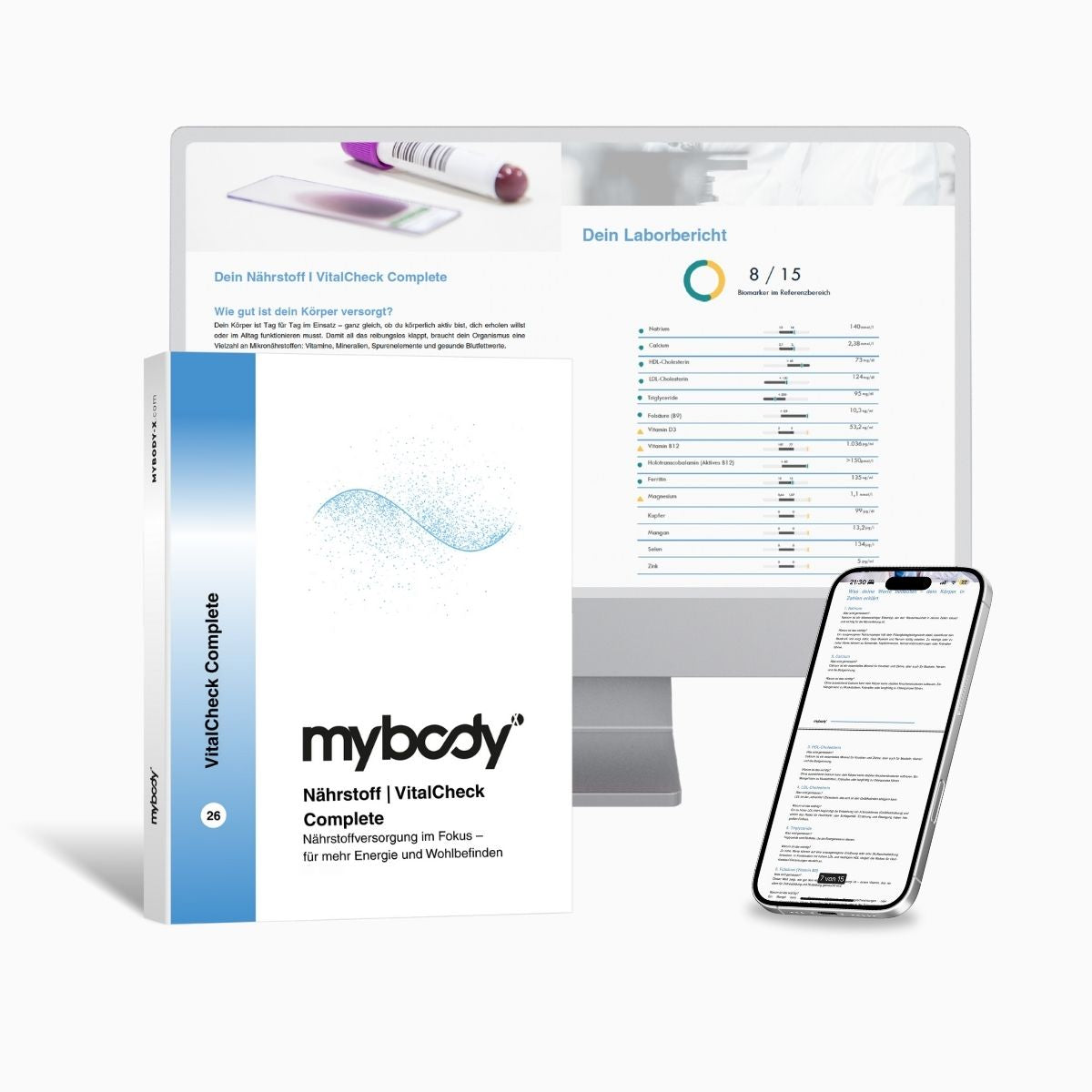
Capillary blood test
VitalCheck | Nutrient & Mineral Test Complete
Includes 18 values, including long-term blood sugar, as well as a cholesterol profile, CRP, ferritin, iron, transferrin, vitamin B12, folic acid, vitamin D, and calcium, magnesium, phosphate, selenium, and zinc. What the test does not do: It says nothing about the effects of individual foods or sweeteners, does not measure values after a meal, and does not answer any nutrition-related question. It does not provide a diagnosis and does not replace a medical examination.
Laboratory analysis 3–5 business days after sample receipt
Product page information, accessed 13 August 2026
Four points determine whether a question becomes useful information.
Distinguish substance groups
Sweeteners and sugar substitutes are two groups with distinct characteristics.
Tolerate gaps in the evidence
Where the evidence is inconsistent, every definitive statement is a claim.
Measure over time
The long-term value is not sensitive to individual meals.
Discuss nutrition-related questions
What is right for you should be discussed with a doctor or nutrition professional.
Chapter at a glance
A capillary blood self-test does not answer the question about sweeteners and provides long-term blood sugar levels. This addresses the question behind the original one: what blood sugar regulation looks like over several months. Four points are crucial: distinguish substance groups, tolerate gaps in the evidence, measure over time, and discuss nutrition-related questions.
Limitations: what remains open
The first limitation is the main message of this article. In the sources we reviewed, we found no reliable evidence regarding the effect of sweeteners on blood sugar or insulin.
The second limitation is identified by the German Federal Institute for Risk Assessment itself. The evidence is inconsistent and very limited for some population groups considered and for certain health aspects (as of 15 July 2025).
The third limitation is transferability. The group of sweeteners comprises very different chemical substances, and a statement about one substance does not apply to all of them.
The objection that a guide with three gaps has little to offer is justified. Even so, its value is clear: once you know that the situation is unresolved, you can recognize an exaggerated claim as soon as you encounter one—and that happens frequently with this topic.
What matters when it comes to sweeteners
If you take away just one thing from this article, let it be this: The responsible authority describes the evidence as inconsistent and, in some areas, very limited.
This provides a standard for assessing everything you encounter on this topic. Anyone who gives a clear answer is not deriving it from this body of evidence.
It began with the question of what is established. The most honest answer is this: the classification of the substance groups, the maximum permitted amounts, and the fact that much remains unresolved. This article therefore makes no recommendation, either for or against sweeteners.
Frequently asked questions
Do sweeteners affect blood sugar?
We found no reliable statement on this question in the sources we reviewed, so there is none here. It is established that sweeteners have no or only negligible caloric value (BfR, as of July 15, 2025). The German Federal Institute for Risk Assessment describes the overall evidence on sweeteners as inconsistent and very limited for certain health aspects.
What is the difference between sweeteners and sugar substitutes?
The BfR describes it this way: Sugar substitutes are sugar-like substances that are generally less sweet and have fewer calories than sugar, and that cause little or no tooth decay. Sweeteners, by contrast, comprise a wide range of chemical substances with no or only negligible caloric value that taste significantly sweeter than sugar (as of July 15, 2025).
What does the ADI mean?
ADI stands for acceptable daily intake. For aspartame, the BfR specifies an ADI of 40 milligrams per kilogram of body weight per day (as of July 15, 2025). This figure describes an amount that, based on current knowledge, can be consumed daily over a lifetime. It is not a recommendation to consume the full amount. Every approved sweetener has its own value.
Can I test this myself?
Hardly conclusive. How much blood sugar rises after a meal depends on its composition, the amount, the order, the time of day, physical activity before and afterward, and the interval since the last meal. Two measurements therefore differ for many reasons at once, and the one you wanted to examine gets lost among them.
Which value helps answer this question?
Long-term blood glucose. HbA1c levels reflect glucose control over the past three months (MSD Manual, Professional Edition, as of December 2025) and are not affected by individual meals. It does not answer the question about a single sweetener, but rather the question of regulation over a longer period.
Next step
Measure the period, not the ingredient
If the question of blood glucose regulation over several months is on your mind, VitalCheck measures long-term blood glucose together with 17 other values from capillary blood. It does not answer a nutrition-related question, provide a diagnosis, or replace medical evaluation.
Go to VitalCheckRead more
You may also be interested in
Why a single measurement after a meal provides so little information.
The value that is not affected by individual meals.
Sources
- German Federal Institute for Risk Assessment (BfR): Sweeteners in food – Selected questions and answers, as of 15/07/2025 – bfr.bund.de
- MSD Manual, Professional Edition: Diabetes mellitus (DM), Brutsaert EF (as of December 2025) – msdmanuals.com
The verbatim quotation regarding the inconsistent body of evidence, the distinction between sweeteners and sugar substitutes, and the ADI value for aspartame of 40 milligrams per kilogram of body weight per day come from source [1]. The quotation about the three-month period for HbA1c comes from [2]. In the sources reviewed, we found no reliable statement about the effects of sweeteners on blood glucose or insulin; therefore, the text contains neither a statement nor a recommendation for or against their use. Information on price, values, sample type, and laboratory comes from the mybody®x product page, accessed on 13/08/2026; processing times follow the central specification for blood tests. All sources were accessed and reviewed on 13/08/2026.

mybody®x Editorial & Expert Team
Laboratory diagnostics Blood analysis interpretation Nutritional science Nutrigenetics
This article was created by the mybody®x editorial and expert team. The team combines laboratory diagnostics, nutritional science, and the interpretation of blood analyses. Those who contribute to it are listed on the authors page.
Published on 13/08/2026 · Last updated on 13/08/2026
The content is for general information only and does not replace medical advice, diagnosis, or treatment. Reference ranges depend on the laboratory, method, and age; the information on your test report is always authoritative.




Share now:
Translate hormonal symptoms into values
The LDL-to-HDL ratio: what it actually indicates