
Low progesterone: which symptoms point to it and which do not
The essentials at a glance
Progesterone is not a level that remains constant. It rises in the second half of the cycle and falls again before bleeding begins. Therefore, a single number without the corresponding cycle day says almost nothing. Anyone who wants to assess symptoms first needs two details: the cycle day and the pattern over several months.
This article distinguishes symptoms that German institutions have written about from claims that have proliferated online. Where a figure is available, it is given here along with the institution and year. Where no figure is available, that is also stated.
You will first read what progesterone actually does in the cycle. Then comes the point that determines how informative the result is: the cycle day. Next, we discuss signs that should be evaluated by a medical practice. This is followed by the symptoms that have been described, possible causes, a comparison of the options, four steps for assessing your own situation, and the limits of what a test can achieve.
What to expect in this article
1. What progesterone does in the cycle and why its level fluctuates
2. Why a progesterone level is of little value without the cycle day
3. What is within the normal range and when symptoms should be evaluated by a medical practice
4. Which symptoms have actually been described
5. Why a progesterone level may be low
6. Which approach answers which question
7. How to know what is behind it in your case
8. How this can appear over three months
9. Menopause: nothing you simply have to endure
10. What you can have measured at home for this question
11. Limitations: what a hormone level cannot clarify
12. Who can benefit from a test and who cannot
13. What matters in the end
Frequently asked questions
Sources
What progesterone does in the cycle and why its level fluctuates
Progesterone is a hormone, meaning a messenger substance that the body produces itself and distributes through the blood. The Federal Institute for Public Health describes its role as follows: Together with estrogen, progesterone regulates the female menstrual cycle and is important for building up the uterine lining as well as for the implantation and further development of the fertilized egg.
The location where it is produced is crucial to everything that follows. Progesterone is initially produced in the corpus luteum, and the corpus luteum only develops after ovulation. Before ovulation, there is therefore little progesterone in the blood, and that is not an abnormal finding but the normal course.
Key message
Progesterone is produced in the corpus luteum, and the corpus luteum only develops after ovulation. A low level in the first half of the cycle therefore describes the normal course, not a deficiency.
The corpus luteum produces and breaks down the hormone
The corpus luteum forms in the ovary after ovulation from cells in the follicle’s outer layer. It develops during the second half of the cycle and produces estrogen and progesterone there. If fertilization does not occur, it regresses and stops producing hormones.
It is precisely this decline that triggers menstrual bleeding. The progesterone level therefore falls at the end of every cycle in which pregnancy has not occurred. That too is normal and not an indication of a problem.
If pregnancy occurs, things work differently. Progesterone continues to be produced, and from about the tenth week of pregnancy, the placenta takes over this task (Federal Institute for Public Health, encyclopedia entry on progesterone). In everyday terms, this means above all one thing: A progesterone level is always a value for a specific state on a specific day.
Why day 3 and day 21 do not mean the same thing
A cycle usually lasts between 25 and 32 days (Federal Institute for Public Health, as of 2026). Within this range, ovulation does not occur on the same day for every woman, nor does it occur on the same day every month in the same woman.
Someone who has blood drawn on the third day of the cycle is measuring a phase in which progesterone is low anyway. Someone who measures on day twenty-one, in a 28-day cycle, is roughly at the midpoint of the second half. In a 32-day cycle, the same day may still be before ovulation.
Two identical numbers can therefore mean two completely different things. This is the most important sentence in this article, and it comes before any list of symptoms.
Why a progesterone level without the cycle day has little value
A progesterone level without the cycle day is not information but a number. The laboratory can measure it, but no one can interpret it because the reference point is missing.
There is a second limitation that goes even further. It concerns not the individual day of measurement, but the question of what hormone testing can actually determine. In its guide to menopausal symptoms, the Institute for Quality and Efficiency in Health Care writes that a woman can have her sex hormones tested in her gynecologist’s office if she wants to know more precisely whether menopause has begun. It goes on to say:
Documented source
“However, measuring hormone levels has no practical value: The result says nothing about whether a woman can still become pregnant and how long she still needs to use contraception—or whether treatment would be useful if she has symptoms.”
Institute for Quality and Efficiency in Health Care (IQWiG)
Menopausal symptoms, as of 2023
This sentence comes from the context of menopause and refers to the question of whether menopause has begun. Nevertheless, it is the most honest way to begin this topic because it dispels a common expectation: A hormone level provides neither a diagnosis nor a prognosis.
What remains, then? A snapshot that becomes meaningful when considered together with the cycle day and your own records. It is not the number itself that conveys the meaning, but the number in context.
How to find the right day to take the measurement
There is one observation that costs nothing and tells you the day. On the day of ovulation or shortly afterward, body temperature rises by at least 0.2 degrees Celsius and remains elevated until the next bleeding begins (Federal Institute for Public Health, 2026 edition).
In practical terms: If you record your temperature every morning for two to three months before getting out of bed, you can see in retrospect when the second half of your cycle began. This pattern indicates the day on which a measurement can provide meaningful information at all.
This record does not replace an examination, and it says nothing about pregnancy. It does something else that is just as important: It makes you the person who determines the timing instead of guessing.
Anyone who no longer has a regular cycle reaches a limit with this approach. At that point, it is no longer a single day’s measurement that matters, but the description of the course over several months—and that belongs in a conversation at a gynecologist’s office.
What falls within the normal range and when symptoms should be assessed at a doctor’s office
Before you read on, it is worth taking stock. Much of what is interpreted as a hormonal problem falls within the described range. And some things that are dismissed as harmless should be investigated.
First, the framework. For most women, menstrual bleeding lasts 3 to 7 days, with a total blood loss of only 20 to 60 milliliters, or about 4 to 12 teaspoons (IQWiG, 2022 edition). The following three figures describe the timing of the hormonal transition.
The timeline of the transition
40 years
Up to about this age, the number of follicles in the ovaries slowly decreases. After that, it drops very rapidly
51 years
At this age, menstrual bleeding stops completely on average. The last menstrual bleeding is called menopause
4–5 years
This is how long it usually takes for hot flashes to subside on their own
Source: Institute for Quality and Efficiency in Health Care (IQWiG); female menstrual cycle, 2022 edition; menopausal symptoms, 2023 edition
These figures are averages, not deadlines. A woman whose bleeding becomes irregular at age 47 is no more unusual than one whose cycle has not yet changed at 54.
And now the other side. The following observations are not a reason to search for the right home remedy, but to make an appointment.
These signs should be assessed at a gynecologist’s office
Bleeding after menopause
when menstrual bleeding had already stopped for more than a year and then occurs again
Significantly heavier or longer bleeding
rather than the 3 to 7 days and 20 to 60 milliliters that the IQWiG (2022) describes as the usual range
Bleeding between periods
repeatedly and outside the expected days, not as a one-time instance of spotting
Severe lower abdominal pain
that limit everyday life or become worse from month to month
Menstruation absent for several months without pregnancy
especially pronounced before the age of forty
Persistently low mood
IQWiG (2023) names depressive moods as a possible consequence of hormonal changes. If it persists, it should be discussed rather than endured.
This list is not a diagnostic framework. It marks the point at which self-observation would be the wrong answer to the right question.
Many people who research this topic have already visited a medical practice and left with the statement that everything was fine. What they lack is not a promise, but a data point. A second appointment with a specific question and written notes often brings more than the first one without either.
Which symptoms are actually described
Long lists of symptoms attributed to low progesterone circulate online. Most of these lists have no source. That is why this section includes only what can be substantiated, alongside what cannot be substantiated.
The cycle changes first
From the beginning of menopause, menstrual periods become irregular in most women (IQWiG, as of 2022). This is the best-described change in this context, and it precedes the end of menstruation by years.
Here, irregular does not merely mean less frequent. Cycles can become shorter, longer, stop, and reappear the following month. For your own observation, the change from your previous pattern is the signal, not comparison with a norm.
Sleep and mood
Hormonal changes can lead to difficulty falling asleep or staying asleep, mood swings, or depressive moods (IQWiG, as of 2023). According to the same source, hot flashes and sweating are particularly typical and can also disrupt nighttime sleep.
This wording is intentionally open-ended, and that is not a shortcoming of the source. It reflects what can be said: an association is described, but no attribution can be made in an individual case.
That is why the order matters for you. Poor sleep has many causes, and hormonal changes are one of them. Anyone who first records which nights they slept poorly and on which day of the cycle those nights occurred has a basis for assessment. Anyone who first blames a hormone has a hypothesis.
What cannot be clearly attributed
Water retention, breast tenderness, weight changes, hair loss, and concentration problems are listed under the heading “progesterone deficiency” in many advice articles. The source material used here contains no frequency data from a German institution for any of these attributions.
That is why there is no number here. An estimate would be the worse error because it would create a false impression of certainty where none exists.
This does not mean that these symptoms are imagined. It means that they cannot be explained by a progesterone level alone, and that tracking over several cycles is more informative here than a single measurement.
Why a progesterone level may be low
A low value on a test result does not automatically have a physical cause. It may also be due to how and when the measurement was taken. The following four explanations differ in what should be done afterward.
The measurement day was wrong
This is the most common and also the easiest explanation to remedy. Anyone who measures before ovulation gets a low value because the corpus luteum does not yet exist.
In a 32-day cycle (Federal Institute for Public Health, as of 2026), the twenty-first day is not necessarily in the second half. Anyone who adopts this day without checking may measure the wrong phase and then misinterpret the result.
A cycle without ovulation
Without ovulation, no corpus luteum forms, and without a corpus luteum, hardly any progesterone is produced. Bleeding can still occur, so such a cycle may appear unremarkable from the outside.
This becomes visible through temperature tracking. If the described rise of at least 0.2 degrees Celsius fails to occur over several months (Federal Institute for Public Health, as of 2026), this observation belongs in a gynecologist’s office, not in another laboratory.
The transition during menopause
Until about the age of 40, the number of follicles in the ovaries gradually decreases; after that, it declines very rapidly until eventually no more follicles mature (IQWiG, as of 2022). Fewer maturing follicles mean fewer ovulations and therefore fewer corpus lutea.
That is why, during this phase, the balance between the hormones changes first, rather than the level of any single value. Anyone who measures only progesterone sees just one part of this process.
What lies outside the ovaries
Hypothyroidism and ongoing stress are associated with menstrual irregularities. The same applies to substantial weight changes. The source material used here does not contain a documented frequency figure from a German institution.
In practical terms, anyone asking about progesterone should not consider the thyroid separately. Both areas can cause similar symptoms, and both can be assessed through blood tests.
Which approach answers which question
There are four ways to address a suspicion of low progesterone. They are not mutually exclusive; they answer different questions. The table compares them using the same four criteria.
| Criterion | Gynecological evaluation | Cycle and temperature tracking | At-home hormone test | Wait and see |
|---|---|---|---|---|
| Answers the question | Is there a cause requiring treatment behind the bleeding or pain? | When does my second half of the cycle begin, and how stable is my pattern? | What are my hormone levels on a particular day? | Does anything change on its own? |
| Requires the cycle day | Yes, it is included in the assessment | It generates it itself | Yes, without it the finding can hardly be interpreted | No |
| Provides a diagnosis | Yes, that is its purpose | No, it provides a pattern | No, explicitly not | No |
| Time required | Appointment, examination at the practice | Two to three cycles, one minute daily | Kit shipped within 1–3 business days, laboratory analysis within 3–5 business days after receipt of the sample | No effort, no insight |
The first column is not at the front by chance. It is the only route in this table that can rule out a cause requiring treatment, and the only one where waiting may come at a cost.
The second column is the most affordable and is skipped most often. It costs nothing but patience and is what makes every subsequent measurement interpretable.
How to find out what is behind it in your case
So far, this has been about connections. Now it is about the order in which you narrow them down in your own case. The following four steps prepare you for a discussion at a medical practice; they do not replace it.
Record cycle days
The first day of bleeding is Day 1. Over three months, a calendar and a check mark are sufficient.
Measure your morning temperature
Before getting up, at the same time every day. The rise indicates the second half of the cycle.
Record symptoms alongside them
Sleep and mood in two words, plus hot flashes. At first, simply observe without making any changes.
Taking your records to the consultation
Three months of figures shorten the medical history and make the next examination more targeted.
The sequence is not accidental. Anyone who measures first and observes afterward has a number without a point of reference. Anyone who records three months first has a pattern against which every subsequent number can be compared.
If your question relates less to progesterone and more to the overall transition, the phases are explained elsewhere: Menopause in women: phases, symptoms, and hormone tests. This article focuses on the one hormone and on which testing day produces meaningful results.
How this can appear over three months
The following scenario is fictional and is intended for illustrative purposes only. It shows how a vague observation becomes a specific question.
Fictional scenario for illustrative purposes
Example: Marlene, 44
For six months, Marlene has noticed that she sleeps poorly in the days before her period and wakes up irritable in the morning. Her cycle used to be stable at 29 days; now it is sometimes 25 and sometimes 33. She has already visited a medical practice, and the examination was unremarkable. She left with the feeling that her observation did not count. She begins recording her temperature every morning for three months and rating her sleep in two words alongside it. In retrospect, a pattern emerges: The temperature rise occurs significantly later than before in two out of three cycles, and those are exactly the two cycles in which poor nights occur more frequently. She takes this sheet of paper to her next appointment and no longer asks a general question, but one about the second half of her cycle. The record is not a diagnosis, but it is the first reliable basis she has had regarding this issue.
What this scenario shows is not a method of self-diagnosis. It shows the difference between a suspicion and an observation that can be presented as evidence.
The objection is valid: Three months is a long time when you feel unwell. Even so, something else is decisive. Without this pattern, every laboratory result remains an isolated value, and isolated values are the weakest form of information for a fluctuating hormone.
Menopause: not something you simply have to endure
Menopause is not an illness. It is the period surrounding the hormonal transition, and the final menstrual period within it is called menopause (IQWiG, as of 2022). This distinction is important because it relieves the pressure to fix something.
The reverse is just as important. The fact that a process is normal does not mean that symptoms have to be part of it. According to IQWiG (2023), how often and how severely menopausal symptoms occur varies greatly. Accordingly, only a few women experience severe symptoms over an extended period.
Why averages are of limited help here
The average age of 51 for the final menstrual period (IQWiG, as of 2022) describes a distribution, not an individual. It does not tell you where you are in the process, nor how long anything will last.
There is a time estimate for hot flashes: They usually subside on their own after about four to five years (IQWiG, as of 2023). This too is an average. For one woman, they last months; for another, longer than five years.
This leads to a straightforward way of dealing with such figures. They can help determine whether something is generally within the expected range. They cannot serve as a timetable for your own body.
What a hormone level does not tell you about fertility
Many people have this question in the back of their minds, even if it is rarely voiced. The evidence-based answer is clear and uncomfortable: The result of a hormone test says nothing about whether a woman can still become pregnant or how long she still needs to use contraception (IQWiG, as of 2023).
If this question is on your mind, the answer therefore does not lie in a laboratory value. It lies in a conversation at a gynecological practice, where your progression is considered together with your age. You can arrange an appointment today, and the record you kept in Chapter 7 is the part you can contribute yourself.
If you are still using contraception, a hormone level does not change that, according to the same source. This decision belongs in the conversation too, not on a laboratory report.
What you can have measured at home for this question
Once your records are complete and you know the right day in the second half of your cycle, a blood sample can be taken at home and sent in. A test does not answer the question of how you feel; it answers the question of where your body currently stands.
A test does not answer the question of how you feel; it answers the question of where your body currently stands.
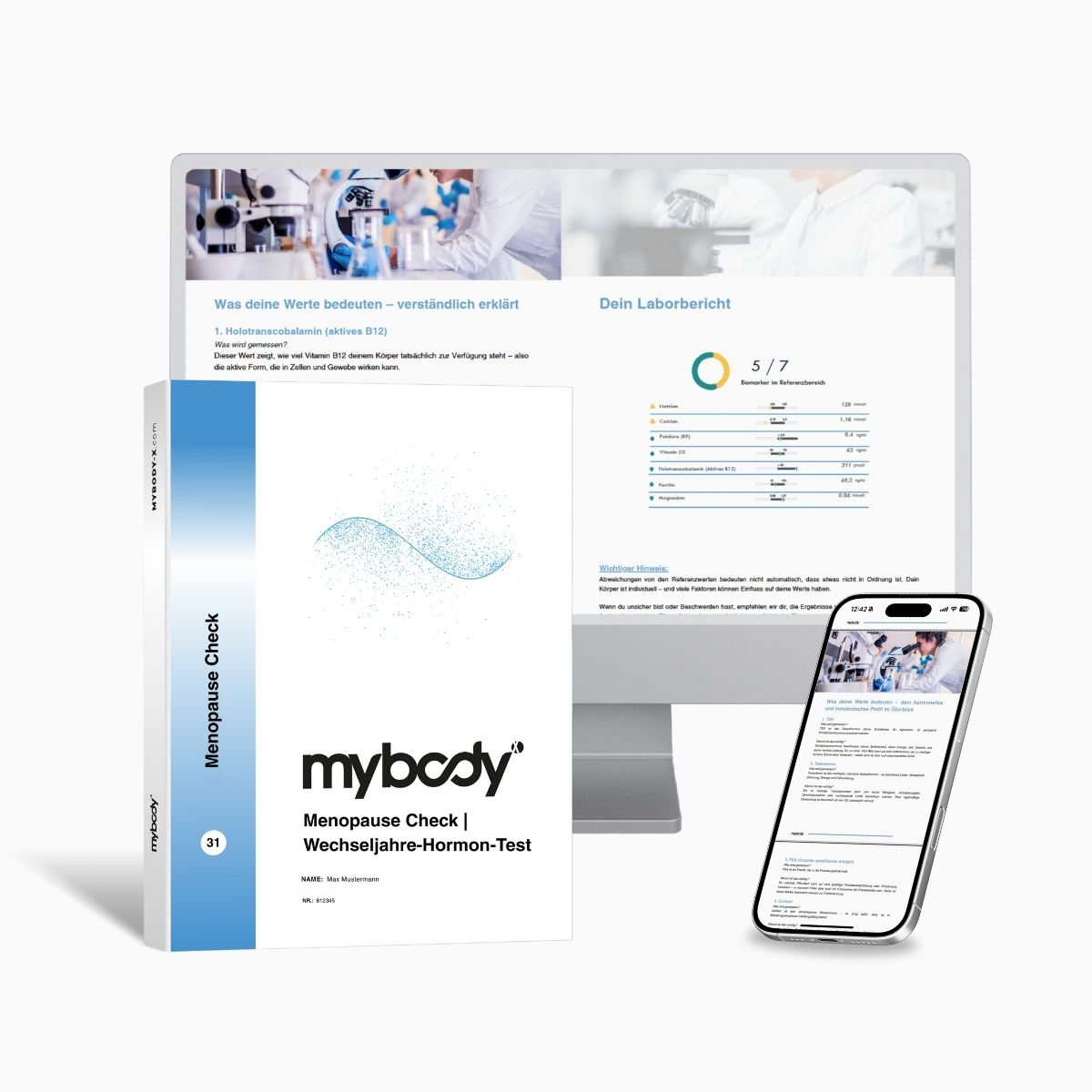
In the mybody®x (MYBODY Lab GmbH) range, there is exactly one test that measures progesterone for this purpose. First, the limitation that applies to it: It does not provide a diagnosis and does not answer the question of whether you are going through menopause. Its result is also difficult to interpret without your recorded cycle day. The product page states this as well.
Capillary blood test
Menopause Check | Menopause Hormone Test
Eight values from one blood sample: estradiol, progesterone, FSH, LH, testosterone, DHEA-S, SHBG, and TSH. According to the product page, no other test in the range measures progesterone. What the test does not do: It does not provide a diagnosis and does not answer whether you have entered menopause. It also does not indicate whether or for how long pregnancy is possible. The product page explicitly points out that estradiol, progesterone, FSH, and LH fluctuate significantly throughout the cycle and that the cycle day must be recorded as long as a cycle is still present.
Laboratory analysis 3–5 business days after sample receipt
Product page information, accessed 27 August 2026
The fact that eight values are measured instead of just one has a substantive reason. During hormonal changes, the relationship between the hormones shifts first, and TSH is included because the thyroid can cause symptoms similar to those of the menstrual cycle.
What the result gives you is a starting point for a conversation. What it does not give you is a decision. This distinction is the difference between a useful number and a number that causes concern.
Limits: what a hormone level cannot clarify
The first limitation is already stated in Chapter 2 and carries the greatest weight. According to the IQWiG (2023), determining hormone levels has no practical value for answering whether menopause has begun. Anyone hoping it will answer that question will be disappointed.
The second limitation concerns attribution. A value outside the reference range shows a state on one day. The result does not say whether that exact state is causing your poor nights or irritable mood.
The third limitation is practical. Without a recorded cycle day, a progesterone level can hardly be interpreted, and no laboratory can provide that information later. It is either recorded at home or not at all.
The fourth limitation concerns causes outside the hormones. Changes in the uterus and ovaries are detected through imaging procedures, not through markers in the blood. Anyone who notices one of the observations described in Chapter 3 in themselves cannot avoid an examination at a medical practice.
And one limitation for your own information: Reference ranges depend on the laboratory, method, and age. The information on your own report is always authoritative, not the figures in an article.
Who a measurement is useful for and who it is not
Useful for you if …
you have tracked your cycle for several months and can name the day on which your second half of the cycle began.
you have been medically evaluated, nothing requiring treatment was found, and you are now looking for a starting point for your next conversation.
your symptoms could also be related to your thyroid and you want to examine both areas in one go.
you want to track a change over time and need an initial comparison value for that purpose.
Probably not, if …
you notice one of the observations described in Chapter 3 in yourself. In that case, an appointment is the right next step—not the test.
you want to know whether you have entered menopause. According to the IQWiG (2023), hormone testing has no practical value for this purpose.
you are looking for an answer to the question of whether you are pregnant or how to prevent pregnancy. No laboratory value can answer that question.
you cannot provide a cycle day and do not want to start keeping records either. Then the finding remains a number without a reference point.
What matters in the end
If you take away just one action from this article, let it be this: Starting tomorrow morning, record your temperature and the day of your cycle alongside it. Two pieces of information per day, no more.
The reason is unremarkable. This record is the only piece of information that puts everything else into context. It shows you whether and when your second half of the cycle begins, gives the laboratory the missing reference point, and gives you something to bring to your next appointment that goes beyond a feeling.
What’s new here, and wasn’t mentioned above: This record is useful even if no test follows in the end. It costs nothing, and it changes the role you take into the conversation.
It began with the question of which symptoms indicate low progesterone. The most honest answer is: No symptom indicates this on its own, but the timing and progression do. That is less than the search query hoped for. And it is the only way a number can later have any meaning at all.
Frequently asked questions
Which symptoms indicate low progesterone?
No single symptom indicates this on its own. It has been documented that menstrual bleeding becomes irregular for most women from the beginning of menopause (IQWiG, as of 2022) and that hormonal changes can cause difficulty falling asleep or staying asleep and mood swings (IQWiG, as of 2023). It becomes meaningful only over the course of several cycles, not in a snapshot.
When should I have these symptoms medically evaluated?
In the event of bleeding after menopause, repeated bleeding between periods, severe lower abdominal pain, and bleeding that clearly exceeds the usual range. IQWiG (as of 2022) describes this range as lasting 3 to 7 days and totaling 20 to 60 milliliters of blood. Persistently low mood should also be discussed; IQWiG (2023) lists depressive moods as a possible consequence of the transition.
On which day of the cycle is progesterone measured?
In the second half of the cycle, that is, after ovulation, because progesterone is produced only in the corpus luteum. The often-cited twenty-first day applies to a 28-day cycle, but not necessarily to a longer one: A cycle usually lasts between 25 and 32 days (Federal Institute for Public Health, as of 2026). The temperature rise of at least 0.2 degrees Celsius on the day of ovulation or shortly afterward indicates which day is right for you (Federal Institute for Public Health, as of 2026).
Can a hormone test show whether I am going through menopause?
No. IQWiG (as of 2023) states that measuring hormone levels has no practical value for answering this question. An at-home hormone test measures levels on a specific day and therefore provides a snapshot, not an assessment of a phase. The assessment is based on the pattern of your cycles, your age, and a consultation at a gynecological practice.
Does a low progesterone level say anything about my fertility?
According to IQWiG (as of 2023), the result of a hormone test says nothing about whether a woman can still become pregnant or how long she still needs to use contraception. If this question concerns you, the next step is therefore an appointment at a gynecological practice, where your cycle pattern will be considered together with your age. You can contribute by recording your cycles over several months.
Next step
Cycle Day First, Number Second
Once your tracking is complete and you know the correct day of the second half of your cycle, the Menopause Check provides eight hormone values from a blood sample taken at home. It does not replace medical evaluation, and without the recorded cycle day, its results are difficult to interpret.
Go to the Menopause Check Menopause: Phases and SymptomsRead more
You may also be interested in
For an overview of the entire transition if your question goes beyond a single hormone.
Regarding which hormone levels are determined at all during this phase and what they do.
Sources
- Institute for Quality and Efficiency in Health Care (IQWiG): Menopausal symptoms (2023 edition) – gesundheitsinformation.de
- Institute for Quality and Efficiency in Health Care (IQWiG): How does the female cycle work? (2022 edition) – gesundheitsinformation.de
- Federal Institute for Public Health: Menstrual cycle (2026 edition) – familienplanung.de
- Federal Institute for Public Health: Progesterone glossary entry – familienplanung.de
The verbatim quotation regarding the significance of hormone testing, as well as the information on hot flashes, sleep, mood, and the variability of symptoms, comes from source [1]. The figures on the duration and amount of menstrual bleeding, the decline in follicles from around age 40, the average age of 51, and irregular bleeding are based on [2]. The cycle length of 25 to 32 days and the temperature rise of at least 0.2 degrees Celsius come from [3], as does the description of progesterone’s functions and the transition to the placenta from [4]. The information describing the corpus luteum comes from the IQWiG glossary entry on corpus luteum; it has no publication date and is therefore not included in this list. Information on price, markers, sample type, and laboratory comes from the mybody®x product page, accessed on 08/27/2026; processing times follow the central specification for blood tests. All sources were accessed and reviewed on 08/27/2026.

mybody®x Editorial & Expert Team
Women’s health Laboratory diagnostics Blood analysis interpretation Nutritional science
This article was created by the mybody®x editorial and expert team. The team combines laboratory diagnostics with the interpretation of blood analyses. Everyone involved can be found on the authors’ page.
Published on 02/01/2026 · Last updated on 08/27/2026
The content is for general information and does not replace medical advice, diagnosis, or treatment. Reference ranges depend on the laboratory, method, and age—the information on your test report is always authoritative.




Share now:
Good and harmful gut bacteria—explained simply
Understanding your DNA as the key to health and nutrition