

Personalized Health Goals: Your Path to Success
Personalized health goals are individually defined, clearly measurable, and realistic targets that help you improve your health in a targeted way. Unlike generic advice such as “exercise more” or “eat healthier,” they take into account your personal starting point, resources, and motivation. Methods such as the SMART formula and digital support from tools like AOK NAVIDA or mybody x show that individualized health planning is measurably more effective than standard programs. Formulating your goals concretely and reviewing them regularly significantly increases the likelihood of lasting change.
How to Formulate Personalized Health Goals Using SMART
The SMART method is the methodological framework that turns vague wishes into concrete health goals. SMART stands for Specific, Measurable, Achievable, Relevant, and Time-bound. Without a clear time frame, a goal loses its guiding function because you never know when you have succeeded or need to adjust your approach.

What a SMART Goal Specifically Means
A poor goal would be: “I want to lose weight.” A good SMART goal would be: “By September 30, I will reduce my body weight by four kilograms by going for a 45-minute walk three times a week and consuming no more than 1,800 kilocalories per day.” The difference lies not in the ambition but in the operationalization. Specific frequencies and objective criteria make progress visible and provide a basis for adjustments when progress is lacking.
More examples of SMART-formulated, personalized fitness goals:
- Endurance: “By the end of October, I will run for 30 minutes without a break three times a week, measured with my fitness app.”
- Nutrition: “Starting now, I will eat a vegetable-based lunch five times a week and document it in a food diary.”
- Sleep: “By the end of the month, I will go to bed before 11 p.m. on five out of seven days and track my sleep duration with a smartwatch.”
What Often Goes Wrong When Defining Goals
The most common mistakes are overly broad goals without measurable indicators. Anyone who sets “live a healthier life” as a goal has no clear indication of when they have succeeded. In practice, personalized health goals often fail not because of the idea, but because they are not made specific enough.
Pro tip: Write your goal down by hand and hang it somewhere you see every day. Behavioral psychology studies show that goals written down are achieved significantly more often than purely mental resolutions.
Why motivation matters more than knowledge when pursuing health goals
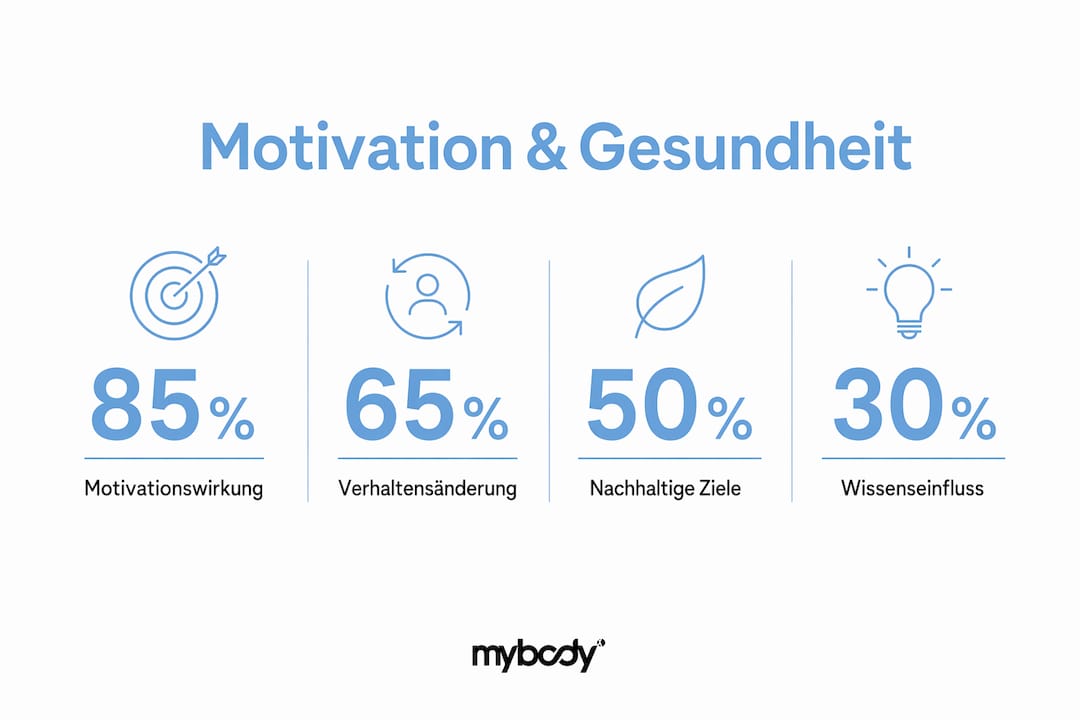
Knowledge alone does not change behavior. This is one of the key findings of modern behavioral psychology. Personalized risk information rarely leads to behavioral changes unless it is linked to specific environmental changes and incentives. Knowing that smoking is harmful does not automatically make someone quit.
Intrinsic motivation as the key
Self-Determination Theory distinguishes between autonomous (intrinsic) and externally controlled motivation. Autonomous motivation is the strongest predictor of lasting changes in health behavior. This means that people who pursue a goal of their own accord because it aligns with their values are more likely to stick with it in the long term. Those who do it only out of a sense of duty or social pressure give up at the first setbacks.
Effective combinations from behavioral research:
- Goal setting plus self-monitoring: Recording your steps, meals, or sleep times every day makes progress visible.
- Regular feedback: Weekly feedback on whether you are staying on track prevents you from gradually drifting off course unnoticed.
- Social support: A training partner, a community, or a coach significantly increases accountability.
- Environment design: Keep healthy snacks visible, have sports shoes ready, and reduce distractions.
How coaching promotes lasting change
Motivational interviewing is a proven coaching method based on acceptance, empathy, and so-called change talk. Motivational interviewing increases the likelihood of lasting behavior change by 10–15 percent. This is no coincidence: The method strengthens self-efficacy and autonomy—the exact factors that, according to Self-Determination Theory, are crucial. Coaching as individual support promotes precisely these abilities.
Pro tip: When you experience a setback, do not ask yourself, “Why can’t I do this?” Instead, ask, “What held me back this time, and what can I do differently next time?” This rephrasing prevents self-criticism and keeps motivation alive.
Which digital tools strengthen your health strategy
Digital health interventions with personalized elements are more effective than generic programs. Sixty-five percent of reviews show significantly positive results in at least one health behavior when personalized digital interventions are used. The key is the combination of self-monitoring, goal setting, and feedback.
Studies involving more than 1.3 million participants show that personalized digital prevention programs with individual support achieve better results than automated standard communication. This explains why apps alone are often not enough. They need to be supplemented with genuine feedback and personal adaptation.
Overview: Digital tools for personalized health strategies
| Tool | Focus | Personalization factor |
|---|---|---|
| AOK NAVIDA | Prevention and lifestyle | Individual risk profiles and course recommendations |
| mybody x | DNA, microbiome, nutrients | Laboratory-based analysis with personalized recommendations |
| MyFitnessPal | Nutrition tracking | Calorie calculator with personalized goals |
| Garmin Connect | Fitness and sleep | Heart rate, recovery, personalized training plans |
| Headspace | Mental health | Guided meditations based on stress level and goals |
The strength of mybody x lies in combining ISO-certified laboratory analysis with concrete recommendations for action. A DNA metabolism test does not provide generic nutrition tips; instead, it shows you how your body responds to fats, carbohydrates, and micronutrients. This is personalized nutrition on a different level from an app that only counts calories.
Pro tip: Use a maximum of two or three digital tools at the same time. Running too many apps in parallel makes you lose track and motivation. Choose one tool for nutrition, one for exercise, and one for sleep or stress.
Step by step: How to successfully achieve your health goals
Successful individual health planning follows a clear process. Anyone who approaches this process in a structured way avoids the most common obstacles and stays on track in the long term.
The five steps to implementation
- Clarify your starting point: Where are you today? Have relevant values measured, such as nutrient status, body weight, or sleep quality. Without a baseline, you do not know whether you are making progress.
- Formulate your goal using SMART: Write your goal down specifically. Use the SMART criteria and set a deadline. A goal without a deadline is a wish.
- Set up self-monitoring: Decide how you will document your progress. This could be a food diary, an app, or weekly weigh-ins. Feedback loops in digital systems enable continuous behavior regulation.
- Organize support: Find a training partner, join a community, or book coaching. Social reinforcement is one of the strongest factors in maintaining perseverance.
- Adjust regularly: Review your goal every four weeks. If you are not making progress, change the approach, not the goal. Flexibility is not failure; it is smart management.
Common obstacles and how to avoid them
| Obstacle | Solution |
|---|---|
| Goal formulated too vaguely | Apply the SMART criteria and set specific numbers and deadlines |
| Too many goals at once | Pursue a maximum of two goals at a time |
| No monitoring | Schedule and document weekly self-measurements |
| Lack of support | Involve a coach, community, or training partner |
| View setbacks as failures | Reframe setbacks as learning opportunities and adjust your strategy |
Anyone aiming for sustainable health improvement needs patience. Most measurable changes only appear after eight to twelve weeks of consistent implementation. This is normal and not a sign that anything is going wrong.
Key Insights
Personalized health goals succeed when they are formulated according to the SMART framework, supported by continuous feedback, and linked to intrinsic motivation.
| Point | Details |
|---|---|
| SMART formulation is essential | Specific numbers, dates, and criteria make progress measurable and manageable. |
| Motivation beats knowledge | Intrinsic motivation leads to more sustainable change than external directives or risk information. |
| Digital tools need feedback | Apps alone are not enough. Personalized guidance and feedback loops determine success. |
| Social support works | Coaching, community, and training partners significantly increase accountability and perseverance. |
| Regular adjustment is strength | Anyone who reviews and adjusts their goal every four weeks stays flexible and on track over the long term. |
What I have really learned after years of working with health goals
The most honest observation we repeatedly make at mybody x: Most people do not fail because they chose the wrong goal. They fail because they never made their goal truly specific. “I want to get fitter” is not a goal. It is a wish without an address.
What really surprised me after years in personalized health analysis: Even people with excellent lab results and precise recommendations do not change their behavior when motivation is lacking. Knowledge does not protect against passivity. That is uncomfortable but important. A DNA test or microbiome report is the starting point, not the solution.
What actually works is the combination of three things: a clearly formulated goal, an honest look at your starting point, and a system that regularly reminds you of your progress. Not once a month. Weekly. Sometimes daily.
I have also learned that setbacks are not an exception. They are part of the process. Anyone who plans for this from the beginning instead of being surprised by it remains more stable. The question is not whether you will stumble. The question is how quickly you get back up and what you learn along the way.
My advice: Start with a single, clearly defined goal. Measure it. Document it. Get feedback. Then adjust it if necessary. It may sound unspectacular. But it is the only way that really works.
— mybody x
Approach your health goals concretely with mybody x
Anyone who wants to build their personal health strategies on a solid foundation needs more than good intentions. mybody x offers ISO-certified laboratory analyses for DNA, the microbiome, nutrients, and hormones that show you where your body stands today.
Based on your individual test results, you receive specific nutrition recommendations and lifestyle tips suited to your biology. This is not a generic checklist, but a personal health plan based on your data. More than 11,300 customers with an average rating of 4.77 stars show that this approach works. Get started now at mybody-x.com and set your first measurable health goal based on real data.
FAQ
What exactly are personalized health goals?
Personalized health goals are individually defined, measurable objectives based on your personal starting point, resources, and values. They differ from generic recommendations because they are specifically tailored to your situation.
How do I formulate my health goal using the SMART method?
A SMART goal is specific, measurable, achievable, relevant, and time-bound. Instead of “move more,” a SMART goal would be: “Starting now, I will go for a 30-minute walk three times a week, measured with my fitness app, until the end of the month.”
Why isn’t knowledge about health risks enough?
Systematic reviews show that personalized risk information alone rarely leads to behavioral changes. Environmental changes, concrete action steps, and intrinsic motivation are crucial.
Which digital tools help with implementing health goals?
Tools such as AOK NAVIDA, mybody x, MyFitnessPal, and Garmin Connect support self-monitoring, goal setting, and feedback. According to research, combining these three elements is more effective than setting goals without feedback.
How often should I review my health goals?
A monthly review is the minimum. Anyone who documents their progress weekly and adjusts their goal every four weeks stays flexible and avoids quietly drifting away from the original plan.



Share now:
Slow Metabolism: Causes, Tests & What Helps in 2026
Beat Winter Fatigue: Causes & Tips 2026