
Foods for the gut microbiota: what is actually proven
The essentials at a glance
The best-supported lever is not a single ingredient but a number: The German Nutrition Society recommends that adults consume at least 30 grams of dietary fiber per day. The actual median intake in Germany is 18 grams for women and 19 grams for men. There is a gap of around one-third between the target and the actual intake.
This article examines the best-known individual candidates and explains what the evidence from studies shows for each one. For some, it is more than you might expect; for others, significantly less. Where no human study is available, that is explicitly stated here.
First, you will read why the diet affects the gut microbiota in the first place. This is followed by symptoms that require medical evaluation, figures on dietary fiber intake, a comparison of the individual candidates, and a fact check of four common statements.
What to expect in this article
1. Why the diet affects the gut microbiota in the first place
2. Dietary fiber: what actually matters
3. When abdominal symptoms should be medically evaluated
4. The gap between recommendation and reality
5. Where dietary fiber comes from in everyday life
6. The well-known individual candidates compared
7. Fermented foods and what a study showed about them
8. Kefir and banana: why they are mentioned only briefly here
9. Four statements about food and the gut microbiota
10. How you can have your gut microbiota tested
11. Who should consider getting tested
12. What ultimately matters
Frequently asked questions
Sources
Why the diet affects the gut microbiota in the first place
The connection is more direct than it sounds. The bacteria in the colon live on what the small intestine could not digest. Whatever arrives there and continues undigested is their food.
This means that the meal plan determines which groups of bacteria get enough to eat. Anyone who eats many indigestible plant components feeds the species that can process them. Anyone who eats little of them does not.
That is the mechanism, and it also explains why things happen quickly. Unlike genetic predispositions, which never change, the composition of the gut microbiota shifts within weeks.
Key message
The gut microbiota lives on what the small intestine leaves behind. That is why the diet does not affect it indirectly, but directly serves as its nutritional basis.
What is produced during fermentation in the colon
When bacteria break down dietary fiber, more remains than the bacteria themselves. Metabolic products are produced, the most important of which are short-chain fatty acids. They are the real reason why this process matters to humans.
The German Nutrition Society explains that the fermentation of dietary fiber produces various short-chain fatty acids, some of which are available to the body as an energy source.
This describes a chain that can be fully substantiated: Plant food reaches the colon undigested, bacteria break it down, and usable substances are produced in the process. Everything else in this article is measured against this chain.
Why diversity, not a single food, matters
Different groups of bacteria utilize different types of dietary fiber. One species can handle the fiber from oats, another the fiber from legumes, and a third the fiber from cabbage.
Those who always eat the same things always feed the same organisms. Those who eat broadly feed a broad range of organisms. That is why expert institutions talk about diversity rather than individual products.
Underlying this is a principle long described in ecology. A habitat with many different food sources supports more species than one with few. In this respect, the colon is no different from a forest.
What reaches the colon and what does not
Most of what is eaten does not reach the colon at all. Sugars, starch, protein, and fat are absorbed in the small intestine before getting that far.
What passes through are components for which humans lack the appropriate enzymes. That is precisely the definition of dietary fiber: indigestible components of plant foods.
Here, indigestible means indigestible only for humans. The bacteria in the colon have the enzymes we lack, and for them the same substance is a meal.
This division of labor is the heart of the matter. We eat something we cannot utilize and pass it on to tenants who turn it into something we can utilize again.
Dietary fiber: what actually matters
If there is one sentence in this field that gets to the heart of the matter, it is this one.
Documented source
“A diverse diet with various plant foods is generally associated with the intake of different types of dietary fiber as well as high ecological diversity of the gut microbiota.”
Max Rubner Institute (MRI), German Federal Research Institute of Nutrition and Food
Scientific classification of dietary fiber, as of June 2026
There are two points in this sentence, and both are important. First, it is about diversity, not a product. Second, it says “associated,” meaning connected, not “caused.”
This distinction is not mere hair-splitting. It marks the boundary between an observed association and a proven cause, and advice articles almost always cross it.
Soluble and insoluble fiber
Dietary fiber is not a uniform substance. The broad classification distinguishes soluble from insoluble fiber, and the difference matters for the gut microbiome.
The Max Rubner Institute states that soluble fiber is, in most cases, readily fermentable by the gut microbiota and therefore serves as food for it, and that the compounds produced in the process offer a range of physiologically beneficial effects (2026).
Insoluble fiber works differently. It binds water, increases stool volume, and thereby affects transit. Both are useful, but they are not the same.
In practical terms, this means that anyone who relies solely on wheat bran mainly covers the insoluble side. Oats, legumes, and fruit provide more of the soluble kind.
What resistant starch has to do with this
Alongside the classic dietary fibers, there is a group that is easy to overlook in everyday life. Resistant starch is starch that passes through the small intestine undigested and only reaches the large intestine.
It is produced, among other ways, when cooked potatoes, pasta, or rice cool down. The same plate of pasta provides more of it the next day when cold than it does when freshly cooked.
This is an example of how it is not the food alone that matters, but how it is prepared. An ingredient can end up in the small intestine or the large intestine depending on how it is processed, and that determines who utilizes it.
In practice, this does not mean that anyone has to remodel their kitchen. It means that potato salad and pasta salad can do more in this respect than their reputation might suggest.
When abdominal symptoms should be medically assessed
Before discussing individual foods, this section belongs in a visible place. A text that puts the criteria for stopping at the end reaches precisely the reader for whom they are intended.
These signs should be assessed by a doctor
Blood in the stool
reddish, black, or very dark stool, regardless of the amount
Unexplained weight loss
without any change in diet or physical activity
Bowel habits that have changed over several weeks
when the usual pattern changes significantly and permanently
Persistent pain or cramps
in the lower abdomen that do not improve on their own
Fatigue and weakness with pallor
that do not improve with rest
The points follow the compilation by the Institute for Quality and Efficiency in Health Care on intestinal symptoms requiring clarification (IQWiG, 2021). The same source notes that all these signs are nonspecific and usually have other causes.
Changing your diet is not an answer to any of these points. It is a good idea once this question has been clarified, and a delay if it has not.
The gap between recommendation and reality
There is a guideline value for fiber intake, and there are measurement data showing how much is actually eaten. Comparing these two figures is the most meaningful finding in this entire article.
Grams of fiber per day
30 g
German Nutrition Society guideline for adults: at least
19 g
Median actual intake among men in Germany
18 g
Median actual intake among women in Germany
Sources: Reference value from the German Nutrition Society; intake figures from the Max Rubner Institute, as of June 2026, based on the National Nutrition Survey II
So, on average, eleven to twelve grams are missing. This is not a minor rounding error, but a good third of the recommended amount.
Why this gap is the more interesting figure
When people think about foods for the gut microbiome, they usually look for an addition: something new to add. The figures suggest something else.
Half of the population is missing one-third of the recommended amount of dietary fiber. Anyone who closes this gap noticeably changes the nutritional foundation of their gut microbiome, regardless of whether a particular food is included.
This is the least spectacular finding in this field and, at the same time, the best documented. It sells poorly because it does not require a product.
Why the median and the average say different things here
The 18 and 19 grams are median values. This means that half of the respondents are below them and the other half above them. It is not the average, where a few very high values can raise the overall figure.
For interpretation, this is an advantage. A median describes the midpoint of a distribution and is therefore less sensitive to outliers than a mean.
In practical terms: If you are among the fifty percent below this value, you consume less than 18 or 19 grams. The figure does not say how much less.
Where the figures come from
The intake figures come from the National Nutrition Survey II. This is the major survey used in Germany to record what people actually eat.
The data is not exactly fresh; it was collected between November 2005 and January 2007. No newer survey of this scale is available for Germany, which is why institutions still rely on it today.
This is part of being honest. The gap between the target and the actual intake is well documented, but the data underlying it is older than most readers of this article would expect.
Where dietary fiber comes from in everyday life
The answer is surprisingly ordinary. The Max Rubner Institute identifies bread as by far the most important source of dietary fiber in Germany, followed by fruit, vegetables, and grain products (2026).
This means the greatest leverage does not lie in a new ingredient, but in a decision that is made every day anyway. Which bread is in the basket matters more than any addition.
For specific amounts in individual foods per one hundred grams, Germany has a reference database that is not freely accessible. Therefore, this article includes only the figures published by one institution.
Two documented peak values
The German Nutrition Society names two foods with particularly high amounts: ground flaxseed with 22 grams per 100 grams and wheat bran with 45 grams per 100 grams (2021).
No one eats either of them in large portions, and that is precisely where their benefit lies. One to two tablespoons of flaxseed in muesli or yogurt make a measurable contribution without changing the meal.
This comes with a note that the German Nutrition Society explicitly makes: fiber from whole-grain cereals binds water, which is why adequate fluid intake is particularly important with larger amounts.
Gradually rather than all at once
Anyone who doubles the amount from one day to the next will very likely have a few unpleasant days with bloating and a feeling of fullness.
Spread over two to three weeks, the same increase is hardly noticeable. The bacteria that feed on it also need time to multiply.
The familiar individual candidates compared
Now to the foods that appear on almost every list on the subject. The table compares them according to the same three criteria: What was studied, how large was the study, and what was the outcome.
| Criterion | Ginger | Apple | Sweet potato |
|---|---|---|---|
| Randomized human study | yes, 68 participants over 6 weeks | pilot study with 15 participants over 3 days | none found |
| Result regarding diversity | no significant effects on diversity | no significant shifts after correction | not studied |
| Other evidence | individual genera changed | review paper speaks of an apparent improvement | only animal and laboratory studies |
| What can be said | limited effect according to the authors themselves | provides fiber; broader claims are uncertain | provides fiber, with nothing else proven |
The information comes from Prakash and colleagues (Scientific Reports, 2024) for ginger, and from Roy Chowdhury and colleagues (Nutrients, 2026) and Del Bo' and colleagues (Food & Function, 2026) for apples. No randomized human studies on sweet potatoes were found in the course of this research.
The ginger finding in plain English
Ginger appears on many lists as a gut flora lever. The best available study on this reaches a different conclusion.
Prakash and colleagues studied 68 people over six weeks with ginger or a placebo. Their own conclusion in the abstract is that ginger supplementation appears to have a limited effect on the gut microbiome (2024).
Individual bacterial genera changed measurably, but overall diversity did not. If you like ginger, eat it. Based on these data, it is not the gut flora lever it is often thought to be.
Why a study with fifteen people provides little evidence
With apples, the situation is different. The only intervention study found involving whole apples included fifteen healthy adults over three days.
Three days is a very short time for a system that changes over the course of weeks. Fifteen people are too few to distinguish small differences from chance. Accordingly, the study found no significant shifts.
This is not evidence against it, but a lack of grounds for it. An apple provides fiber, and that is sufficient justification. Anything beyond that is currently speculation.
A review of thirty-eight studies puts it cautiously: Medium- to long-term studies appear to show an improvement in gut microbiome composition (Del Bo' and colleagues, 2026). The word “appear” is used deliberately.
What is missing for sweet potatoes
Sweet potatoes regularly rank near the top of lists on this topic. No randomized human studies on their effect on the human gut microbiome were found in this research.
What does exist are studies in pigs, mice, and laboratory fermentation. All three are scientifically meaningful, and none can readily be extrapolated to humans.
The leap from animals to humans is particularly uncertain for microbiome findings because gut flora differs greatly between species. What happens in a mouse says little about a human.
Sweet potatoes are still a worthwhile vegetable. They provide fiber, which is why they appear in this article. It is simply a different reason from the one given in the lists.
Regarding kimchi
A randomized, double-blind, placebo-controlled study of kimchi included ninety participants over twelve weeks. It found shifts in composition and an improvement in symptoms.
Two significant limitations must be considered. The participants ate 210 grams of kimchi daily, which is not an everyday amount. And they had irritable bowel syndrome, so they were not healthy.
This study therefore says nothing about healthy people who occasionally eat kimchi. It is evidence concerning a specific group under specific conditions, and nothing more.
This is a recurring pattern in this field. Studies examine high amounts in people with health conditions, while advisory articles apply the result to ordinary amounts in healthy people. There is a gap between the two that no one has bridged.
Fermented foods and what a study showed about them
For fermented foods, the evidence is better than it is for individual ingredients. A randomized study at Stanford University compared two diets over seventeen weeks.
Wastyk and colleagues reported that a diet rich in fermented foods steadily increased gut microbiome diversity and lowered inflammatory markers (Cell, 2021). The high-fiber diet, by contrast, left diversity stable.
This is a noteworthy result because it contradicts expectations. More fiber does not automatically mean greater diversity, but it does mean more enzymes for breaking down sugar compounds.
The limitation is important: there were eighteen people per group. This is a small study, and its result is a strong indication, not proof.
Chapter at a glance
In a randomized study lasting seventeen weeks, a diet rich in fermented foods increased gut microbiome diversity, while it remained stable on a high-fiber diet (Wastyk and colleagues, Cell, 2021). Each group consisted of eighteen people. Fermented foods and fiber therefore do not work in the same way, and both have their place.
Which fermented foods are suitable
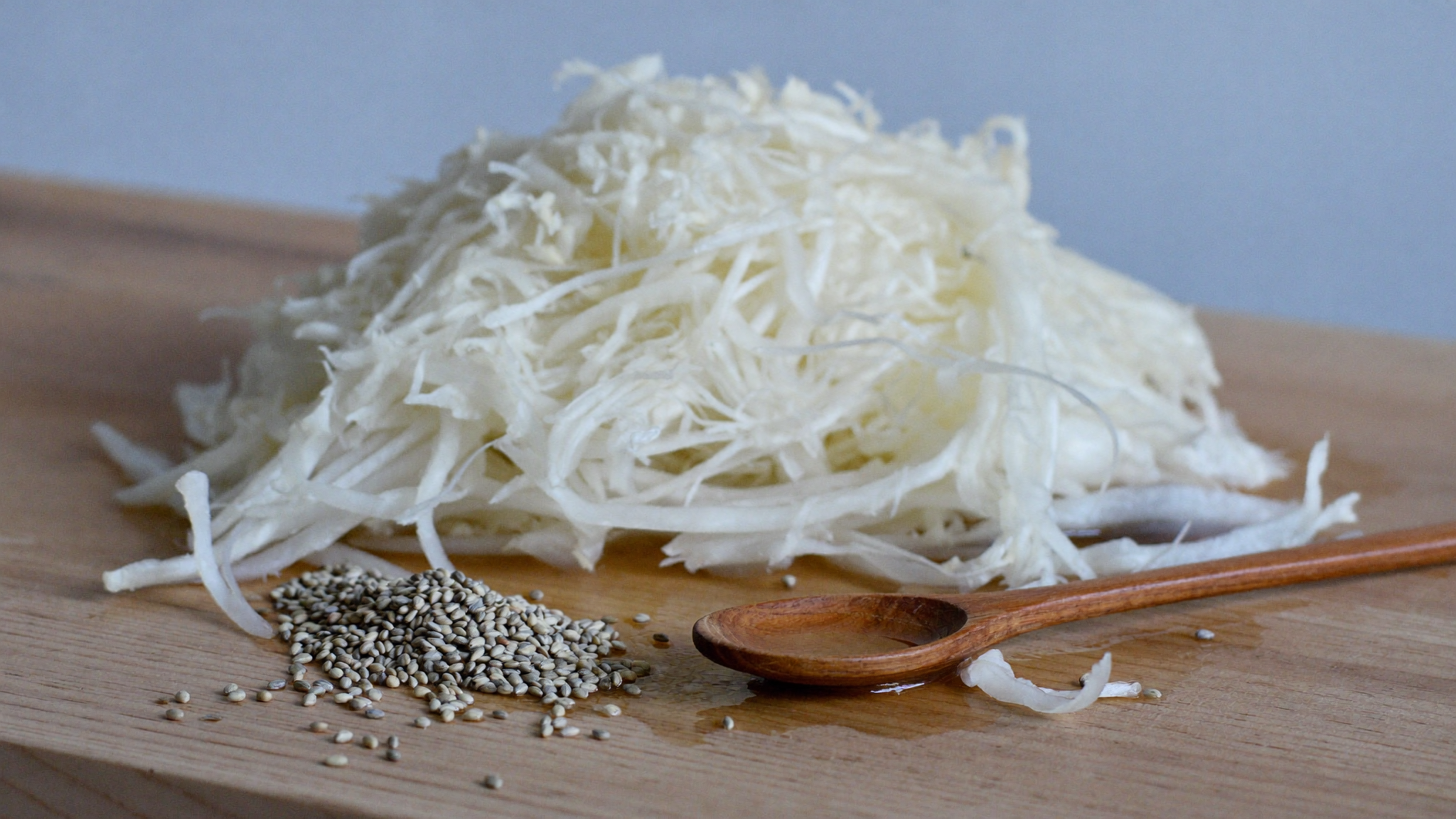
The list is longer than most people think, and it includes many foods that are already in the refrigerator. Sauerkraut, yogurt, buttermilk, pickled vegetables, miso, and sourdough bread are among them.
One factor also matters here: whether the product was heated after fermentation. Canned sauerkraut is pasteurized, so the cultures are no longer alive. Fresh sauerkraut from the refrigerated section usually still contains live cultures.
This makes no difference to the fiber content, but it does to the live cultures. If you want both, choose the uncooked version and do not heat it afterward.
Here, too, variety matters more than quantity. Six different fermented foods spread throughout the week provide more diverse cultures than a single one consumed in large amounts.
Kefir and bananas: why they are mentioned only briefly here
This article deliberately covers two foods from the usual canon only briefly because they are discussed in detail elsewhere.
Kefir is a fermented beverage containing live cultures and therefore belongs in the group from Chapter 7. What a kefir grain contains and where the evidence ends is explained in Kefir and the Gut Flora.
Bananas provide fiber, and their fiber content depends heavily on their ripeness. The details are provided in Banana Fiber.
Ripeness as an overlooked factor
One point nevertheless belongs here because it regularly gets overlooked in lists. The study that found an effect of bananas on certain groups of bacteria used green banana powder.
Green bananas contain resistant starch, while ripe bananas contain significantly less because it is converted into sugar as they ripen. Both are the same fruit, but not the same food.
Anyone who reads the study and turns it into “eat a banana” is applying a result to something that was not studied. This mistake runs through almost all lists on the subject.
Four statements about food and the gut microbiome
These four sentences appear on many lists. All four sound plausible, and none holds up in this form.
Checked against the evidence
Commonly claimed
“Ginger balances the gut microbiome.”
Supported by evidence
The only randomized human study found, with 68 participants, concludes that the effect on the microbiome appears limited, with no significant change in diversity (Prakash et al., 2024).
Commonly claimed
“Sweet potatoes are good for the gut microbiome.”
Supported by evidence
No randomized human studies were found on this question. Existing studies come from animal experiments and laboratory fermentation. The only thing established is that sweet potatoes provide fiber.
Commonly claimed
“Greater diversity in the findings is automatically better.”
Supported by evidence
In the Stanford study, diversity remained stable on a high-fiber diet even though the enzyme repertoire changed (Wastyk et al., Cell, 2021). Diversity and benefit are not the same thing.
Commonly claimed
“It’s all about the right superfoods.”
Supported by evidence
The Max Rubner Institute describes the relationship in terms of the diversity of plant foods and total intake, not individual products (2026). The documented gap is eleven to twelve grams of fiber per day.
Behind all four sentences lies the same desire for a simple rule. The simple rule does exist; it is just less appealing than hoped: greater plant diversity and more fiber overall.
Why individual studies are so often overestimated
A pattern runs through all four sentences. A single study finds an effect, a report picks it up, and by the third retelling, the indication has become a recommendation.
Along the way, precisely the details that determine the value of the study are lost: how many people took part, for how long, what condition they were in, and in what form the food was administered.
That is why these figures are included each time in this article. Fifteen people over three days is different from sixty-eight over six weeks, and both are different from a review of thirty-eight studies.
Anyone who knows these figures can decide for themselves how much weight to give a finding. That is worth more than any list that makes this decision in advance.
How to have your gut microbiome tested
Anyone planning a change and wanting to know whether anything shifts as a result can have their gut microbiome analyzed using a stool sample. The mybody®x Microbiome Gut Test from mybody®x (MYBODY Lab GmbH) reads the genetic material of the microorganisms in the sample.
This is particularly useful when comparing two measurements. What the test does not do is stated on the card itself.

Gut test from a stool sample
Gut Microbiome Test | Complete
Identifies over 1,500 bacterial species through DNA sequencing, along with biodiversity, enterotype, the FODMAP index, and eight bioindicators. What the test does not do: it does not tell you which food to eat, and it does not establish a link between an individual ingredient and a finding. It does not diagnose, detect inflammatory bowel disease, tumors, infections, or celiac disease.
Laboratory analysis 5–10 business days after sample receipt
Product-page information, accessed August 27, 2026
The figure of over 1,500 bacterial species comes from the product page. The specific species and markers are listed in the Gut Encyclopedia.
Who an examination is useful for
Useful for you if …
you want to increase your fiber intake significantly and monitor the progress with a measurement beforehand and another after three months.
your symptoms have persisted for months and have been medically evaluated.
you want to know how much fermentable carbohydrates matter in your case; that is what the FODMAP index classifies.
Probably not if …
you expect a list of which foods you should eat. The test does not provide one because it does not make dietary recommendations.
you notice one of the warning signs from Chapter 3 in yourself. Then making an appointment is the right order of action.
you have never looked at your fiber intake. This is where the better-supported, cost-free opportunity lies.
What matters in the end
If you take away one single action from this article, let it be this: roughly count your fiber intake for one week and compare the result with the DGE's 30 grams. Not to the exact gram, just in terms of magnitude.
The reason is explained in Chapter 4. Of everything in this text, this is the only measure with a clear target value, a documented current value for Germany, and an opportunity for change that costs nothing.
What matters alongside this is variety rather than selection. Anyone who adds a few more plant-based foods to their plate each week does more than someone who declares a single ingredient a superfood.
One caveat about expectations belongs here. The gut flora shifts within weeks, but how you feel does not necessarily change at the same pace. If you notice no difference after two weeks, you have done nothing wrong.
The starting point was the question of which foods are right for the gut microbiome. The most honest answer is: it is not about the right foods, but about many different foods. That is less catchy than a list suggests, and better supported by evidence than any individual item on it.
Frequently asked questions
Which foods are good for the gut microbiome?
The evidence-based answer focuses on variety rather than individual products. The Max Rubner Institute states that a varied diet containing different plant foods is generally associated with high gut microbiota diversity (2026). In concrete terms, what matters most is the total amount of fiber: the DGE recommends at least 30 grams per day for adults.
How much fiber am I eating too little of?
In Germany, the median shortfall is eleven to twelve grams per day. Actual intake is 18 grams for women and 19 grams for men (MRI, 2026, based on the National Nutrition Survey II), while the DGE guideline is at least 30 grams. That is just over one-third of the recommended amount and therefore the biggest evidence-based lever in this area.
Does ginger help the gut microbiome?
According to the best available evidence, only to a limited extent. Prakash et al. studied 68 people over six weeks and concluded themselves that ginger supplementation appears to have a limited effect on the gut microbiome (2024). Individual bacterial genera changed, but overall diversity did not. There is nothing wrong with using it as a spice, but ginger has not been proven to be an effective targeted intervention.
Are fermented foods better than fiber?
They work differently. In a randomized seventeen-week study, a diet high in fermented foods increased gut microbiome diversity, while it remained stable on a high-fiber diet; instead, the enzyme profile changed in that group (Wastyk et al., Cell, 2021). Each group comprised eighteen people, so the study was small.
How can I increase my fiber intake without causing discomfort?
Gradually over two to three weeks rather than from one day to the next, and with sufficient fluids. The German Nutrition Society (DGE) points out that fiber from whole grains binds water, which is why it is especially important to pay attention to fluid intake when consuming larger amounts. Ground flaxseed, with 22 grams per 100 grams, is a good choice because small amounts are sufficient.
Next step
Look it up first, then decide
Before deciding on an examination, you can check the Gut Encyclopedia to see which markers a report actually includes. If you want to accompany a dietary change, start with the Gut Test.
Go to the Gut Encyclopedia Go to the Gut TestRead more
You might also be interested in this
The fermented drink in detail, including the structure of the grains and the limitations of the available evidence.
Why ripeness changes fiber content.
The searchable overview of all markers that may appear in a test report.
Sources
- Max Rubner Institute (MRI), Federal Research Institute of Nutrition and Food: Scientific assessment of dietary fiber (as of June 2026) – mri.bund.de
- German Nutrition Society (DGE): Selected questions and answers on dietary fiber and reference values for dietary fiber – dge.de
- Wastyk H. C., Fragiadakis G. K., Perelman D. and colleagues: Gut-microbiota-targeted diets modulate human immune status. Cell, 2021 – europepmc.org
- Prakash A., Rubin N., Staley C. and colleagues: Effect of ginger supplementation on the gut microbiome. Scientific Reports, 2024 – europepmc.org
The exact quotation on the diversity of plant-based foods, the information on soluble fiber, the median intake values of 18 and 19 grams from the National Consumption Study II, and the classification of bread as the most important source of fiber come from source [1]. The guideline value of at least 30 grams, the information on flaxseed and wheat bran, and the note on fluid intake come from [2]. The results on a diet with fermented foods and the group size of eighteen people per arm come from [3]. The information on ginger comes from [4]. The information on apples comes from Roy Chowdhury and colleagues (Nutrients, 2026) and Del Bo' and colleagues (Food & Function, 2026); no randomized human studies were found on sweet potatoes. The information on kimchi comes from Kim and colleagues (Food & Nutrition Research, 2022). The warning signs in Chapter 3 follow the IQWiG text on signs of colorectal cancer, as of 2021. Information on price, marker range, sample type, and laboratory comes from the mybody®x product page, accessed on August 27, 2026; processing times follow the central guideline for intestinal tests. All sources were accessed and reviewed on August 27, 2026.

mybody®x Editorial & Expert Team
Nutritional science Microbiome science Gut science Laboratory diagnostics
This article was created by the mybody®x editorial and expert team. The team combines nutritional science, microbiome and gut science, and laboratory diagnostics. Those who contribute to it are listed on the author page.
Published on August 27, 2026 · Last updated on August 27, 2026
The content is for general information and does not replace medical advice, diagnosis, or treatment. Reference ranges depend on the laboratory, method, and age—what always matters are the details on your test report.



Share now:
Kefir and the gut microbiome: what it contains and what has been proven
Genetic test and health insurance: who pays and under what conditions