
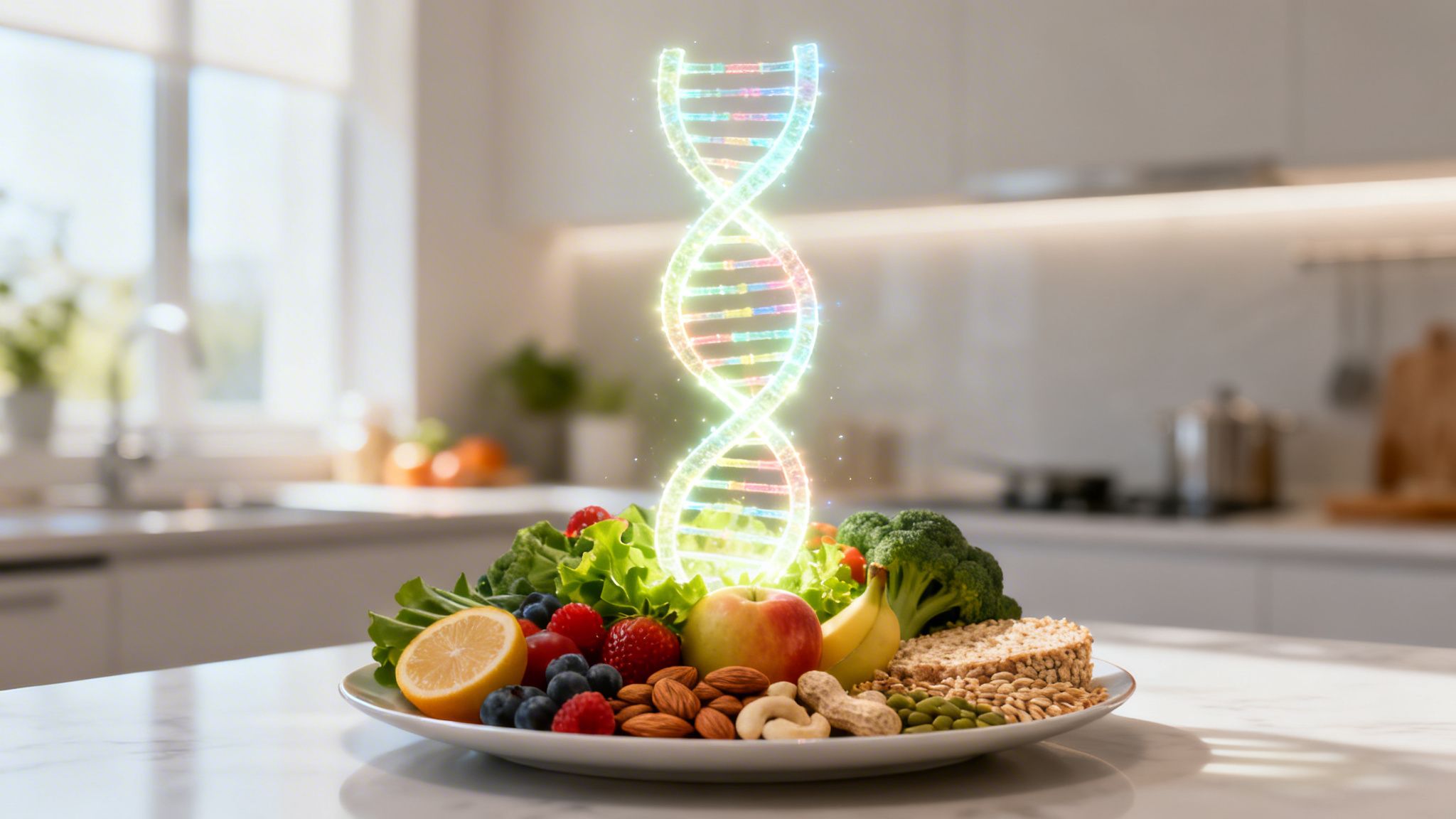
Nutrition genetic test: Your personal key to the optimal diet
Have you already tried countless diets, only to become frustrated when nothing really works or the yo-yo effect comes crashing back? Don’t worry—you are absolutely not alone. Here, a completely new approach comes into play: a genetic test for nutrition. It takes an in-depth look at your unique DNA to find out what your body really needs and how to sustainably boost your metabolism.
Why one plan for everyone is bound to fail

For years, people were told: “One size fits all.” Whether low-carb, low-fat, or intermittent fasting—what works wonders for your friend may be completely ineffective for you. The reason lies deep within your cells: your own personal genetic predisposition.
Imagine your DNA as an instruction manual for your body. This guide determines not only your eye color but also how you respond to certain foods. The field of science that focuses on this is called nutrigenetics.
It reveals how small, individual genetic variants influence the metabolism of nutrients. This explains why some people seem able to eat one plate of pasta after another without any problems, while others seem to gain weight just by looking at it.
Your genes are often the decisive factor determining whether a diet will be a resounding success or a frustrating struggle for you. They determine which nutrients your body efficiently converts into energy and which it prefers to store as fat reserves.
The genetic fingerprint of your metabolism
Your body has its own unique way of dealing with the three main nutrients—the so-called macronutrients. These genetic preferences are the key to greater well-being and your ideal weight. A genetic test can show you which metabolic type you have:
- Carbohydrate type: Your body is a master at metabolizing carbohydrates and using them as its primary energy source. A diet rich in whole grains, fruit, and vegetables could be just right for you.
- Fat type: You process fats, especially healthy unsaturated fatty acids, extremely efficiently. Avocados, nuts, and high-quality olive oil could be your best sources of energy.
- Protein type: A protein-rich diet is ideal for your body. It supports muscle growth and provides a feeling of fullness that truly lasts a long time. Lean meat, fish, legumes, and dairy products are your best friends here.
This knowledge is a real turning point. Instead of groping in the dark and trying the next fad diet, you get clear guidance based on your DNA. You learn to provide your body precisely with what it can make the best use of.
More than just losing weight
Nutrigenetics can do much more than simply manage weight. Your genes also have a say in how well you absorb certain vitamins and minerals. You may have a predisposition that results in an increased need for vitamin D or omega-3 fatty acids.
Without this knowledge, you could suffer from deficiencies despite following what you believe is a healthy diet, with symptoms such as constant fatigue or difficulty concentrating. A genetic test gives you precise guidance on which micronutrients are particularly important for you.
If you want to dive even deeper into the world of personalized nutrition, you can find more fascinating insights in our article on personalized nutrition. This lays the foundation for long-term health and vitality—based on what truly makes your body unique.
What your genetic code reveals about your diet
Imagine your DNA as an extremely detailed recipe book written exclusively for your body. Every recipe—that is, every gene—contains precise instructions for how your body should function. A genetic test for nutrition is like taking a curious look inside this very personal book. It translates the instructions that specifically relate to your metabolism and diet.
But what exactly are the experts looking at? The focus is on tiny but crucial variations in your genetic code: SNPs (Single Nucleotide Polymorphisms). You can think of SNPs as small deviations or alternative ingredients in your recipes.
These tiny differences are completely normal and make you unique. However, they have a huge influence on how your body responds to certain foods.
Understanding the language of your genes
A genetic test analyzes which specific SNPs are present in the genes that control your metabolism. These genetic markers reveal secrets that you would never discover through trial and error or with the naked eye. It is about finally deciphering the unique language of your genes.
Based on this information, we can make precise statements about various aspects of your diet and lifestyle.
A single SNP can determine whether caffeine keeps you awake for hours or has barely any effect. Another determines whether your body burns fat efficiently or prefers to store it as an energy reserve for lean times.
A genetic test for nutrition therefore does not impose rigid rules. Instead, it provides the scientific foundation for making smarter, personalized decisions about your health. It’s the difference between blind guesswork and informed knowledge.
What your genetic test specifically reveals
Analyzing your DNA provides actionable insights for your everyday life. You don’t receive abstract data, but clear guidance tailored directly to your genetic predisposition. Here are some of the most important questions a genetic test can answer:
- What is your metabolic type? We determine whether your body is genetically predisposed to obtain energy most effectively from carbohydrates, fats, or proteins. This knowledge is the foundation of any successful nutrition plan.
- How do you process vitamins and minerals? Your genes influence how efficiently you absorb and use important micronutrients such as folate, vitamin B12, or vitamin D. This allows you to take targeted steps to prevent deficiencies.
- How sensitive are you to certain substances? The analysis shows your genetic predisposition to sensitivities to caffeine, lactose, or gluten.
- What potential do you have for building muscle? Your genes provide insights into how your body responds to strength or endurance training and which nutrients best support your recovery.
These personalized insights are especially valuable because they help you take preventive action. It’s no surprise that personalized nutrition through genetic testing is rapidly gaining momentum in Germany. The latest scientific findings support this: specialized genetic test scores can identify the risk of obesity in children at an early stage, enabling targeted prevention long before symptoms appear.
Ultimately, it’s about understanding and meeting your body’s unique needs. If you’d like to delve deeper into the fascinating relationship between genes and nutrition, our article What is nutrigenetics and how does it shape our lives explains the scientific connections in greater detail. With this knowledge, you stop working against your body and start supporting it intentionally.
Your mybody® genetic test: From sample to personalized plan
A genetic test may initially sound like complicated science and laboratory work, right? The good news is that the journey from your initial curiosity to a nutrition plan truly tailored to you is surprisingly straightforward. Here, we guide you through the process step by step and show you how simple and transparent everything is at mybody®.
It all starts conveniently at home. You simply order your test kit online, and we’ll send it directly to your door. Inside, you’ll find everything you need: a cotton swab to easily collect a saliva sample from the inside of your cheek.
Don’t worry, it’s completely painless and takes just a few minutes. Clear instructions are included to ensure that nothing goes wrong. Once you’re finished, place the sample in the enclosed return envelope and send it to our laboratory free of charge.
What happens after you send in your sample?
As soon as your sample arrives at our ISO-certified partner laboratory in Germany, the scientific part begins. And here, protecting your data is our absolute priority. Your sample is immediately pseudonymized—this means that your name and all personal information are replaced with a unique code.
This measure ensures that the laboratory analysis is carried out completely anonymously. No one can link your genetic data to your identity. We strictly adhere to the high data protection standards of the GDPR. Your privacy is non-negotiable for us.
In the laboratory, our experts extract the DNA from your cheek cells and precisely analyze the gene variations (SNPs) that play a role in your nutrition and metabolism.
Trust and transparency are the cornerstones of our process. Your sample is used exclusively for the analysis you commission and is securely destroyed in accordance with regulations once the examination is complete. Your data belongs to you.
The infographic below shows you the entire process at a glance—from a simple saliva test at home and anonymous analysis to your completed nutrition plan.
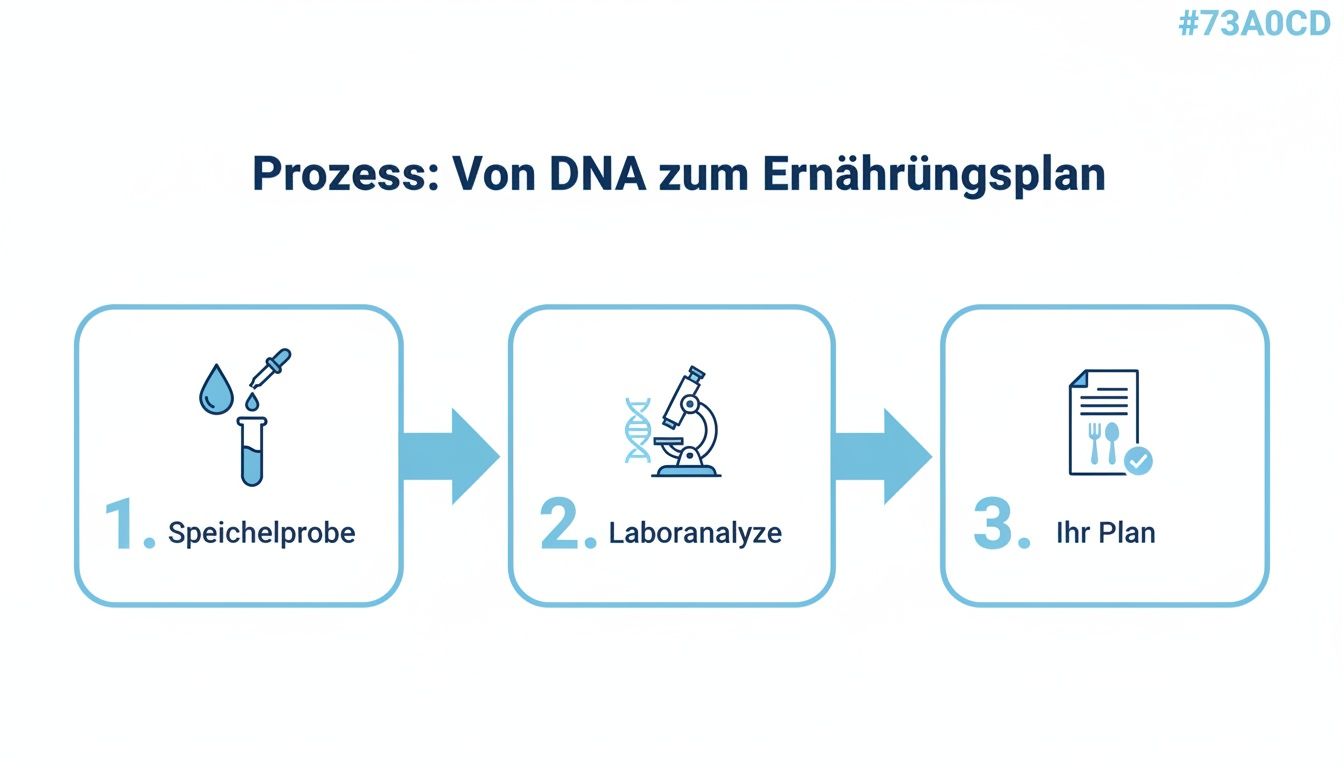
As you can see, there are only three clear stages that take you from your DNA to concrete, actionable recommendations.
This table summarizes the simple and transparent process of the mybody® genetic test, from ordering to implementing your personalized recommendations.
Your path to personalized nutrition in 4 steps
| Step | What happens? | Your advantage |
|---|---|---|
| 1. Order & Test | You order your kit online and collect a simple saliva sample at home. | No doctor’s appointment needed—everything can be done conveniently from home. |
| 2. Free return shipping | You send the sample to our laboratory in Germany in the prepaid envelope. | Safe, straightforward, and at no additional cost. |
| 3. Laboratory analysis | Your DNA is analyzed anonymously in our certified laboratory. | The highest scientific standards and maximum data protection. |
| 4. Receive your results | You’ll receive your personal results report with specific recommendations for your nutrition. | Finally, clarity and an easy-to-understand roadmap for your everyday life. |
The process is designed to ensure that you always feel confident and well informed.
From raw data to your personal roadmap
The laboratory analysis initially provides us with complex raw data. But that’s only half the story. The truly crucial step is translating this scientific information into clear, practical recommendations for everyday life. And that’s exactly where our expertise comes in.
Our scientists and nutrition experts interpret your genetic results and use them to create your personal results report. This isn’t incomprehensible technical jargon, but a practical guide for your everyday life. You’ll learn not only what type of metabolism you have, but also receive very specific tips to help you along the way.
The entire process is designed to give you maximum confidence and clarity. If you’d like to know more precisely how reliable sample collection is, you can find all the details in our guide, which explains exactly how a saliva test works. This way, you can be sure that the first step toward your personalized nutrition is as easy as possible.
Understanding your results and putting them into practice in everyday life

The moment has arrived: You’re holding your personal mybody® results report in your hands—a page full of valuable information, taken directly from your genetic code. But what do you do with this knowledge now? How do you turn the analysis into noticeable results in your everyday life?
Don’t worry, we won’t leave you on your own. Think of this section as your personal guide, showing you how to read and truly understand your results and effortlessly integrate them into your daily routine. It’s not about turning your life upside down overnight. It’s about making smart, informed adjustments that are perfectly suited to you.
From knowledge to practical application
Your results report is designed to translate complex genetics into simple, directly applicable recommendations. Let’s take a look at a specific example.
Imagine your report identifies you as a “carbohydrate type”. This means your body is genetically programmed to convert carbohydrates into energy particularly efficiently. While a low-carb diet may work wonders for some people, in the long run it would more likely slow you down and leave you feeling tired.
This means for you, quite specifically:
- Choose complex carbohydrates: Opt for whole-grain products, oats, quinoa, sweet potatoes, and legumes. They provide long-lasting energy without sending your blood sugar on a roller coaster.
- Combine wisely: Ideally, always eat carbohydrates together with protein and healthy fats. Think whole-grain bread with avocado and chicken breast rather than just jam.
- Timing is everything: Plan carbohydrate-rich meals around your training sessions. This gives your body energy exactly when it needs it for performance and recovery.
A specific example from the results report
Another important piece of the puzzle could be your predisposition to needing certain micronutrients. Let us assume that your analysis shows a tendency toward an increased need for omega-3 fatty acids.
These essential fats are extremely important, for example, for brain function and fighting inflammation in the body. A genetically determined increased need is a clear indication that you should consciously make sure to consume enough omega-3 sources.
Your DNA is not a rigid prescription but a personalized map. It shows you the most efficient paths to your health goals and helps you avoid unnecessary detours and frustrating dead ends.
Practical tips for getting more omega-3:
- Fatty fish: Include salmon, mackerel, or herring in your diet two to three times a week.
- Plant-based sources: Supplement your meals daily with flaxseed oil, chia seeds, or walnuts. A tablespoon of flaxseed oil in your morning yogurt is a super-simple way to start.
- Quality matters: If you cannot meet your needs through food alone, be sure to choose high-quality, pure dietary supplements.
Such targeted adjustments are far more effective than blanket nutrition trends. In Germany, studies show that up to 70 percent of people fail with unsuitable diets because these diets completely ignore their genetic predispositions. With ISO-certified analyses, mybody® provides precise recommendations that address this very issue. The experiences of more than 11,300 customers with 4.77 stars confirm it: Personalized genetic tests make modern nutrition trends truly effective. Find out more about current developments in the Trend Report from the German Federal Ministry of Food and Agriculture.
Your perfect training plan according to your DNA
Your mybody® genetic test reveals not only information about your optimal diet, but also about your athletic predisposition. Your genes indicate whether you are more likely to respond to endurance or strength training.
- The endurance type: Your body is made for long, moderate exertion. Jogging, cycling, or swimming will probably get you to your goal more effectively than short, explosive workouts.
- The strength type: Your muscles respond particularly well to intense strength stimuli. Traditional strength training or high-intensity interval training (HIIT) is right up your alley.
- The mixed type: You benefit from a balanced combination of both—the perfect balance is what matters.
With this knowledge, you can tailor your training to achieve maximum results with minimal frustration. You work with your body, not against it.
The key is to implement the recommendations step by step. Start with one or two small changes. Replace white bread with whole-grain bread. Plan one additional fish meal per week. Once these new habits are established, tackle the next one. In our guide, we show you in even greater detail how to optimize your diet based on your test results. This turns your genetic test into the starting point for sustainable, positive change.
What a genetic test can—and cannot—really do
A nutrition genetic test is a fascinating tool that gives you a kind of personal map of your biology. Based on scientific evidence, it shows you how your body works and helps you finally move away from one-size-fits-all advice. But as with any map, it is crucial to read it correctly and assess its possibilities as realistically as its limitations.
Your genes are the foundation—the “hardware,” so to speak, that you were born with. They determine your basic predispositions—for example, whether your metabolism prefers carbohydrates or fats, or whether you naturally need more of certain vitamins. This genetic blueprint remains the same throughout your life.
Genes are your starting point, not your destiny
Now comes the exciting part: Your genes alone do not determine your health. This is where epigenetics enters the picture. Think of it as the “software” of your body. This software is rewritten every day by your lifestyle, diet, and habits.
Factors such as diet, stress, sleep, and exercise can virtually “switch” certain genes on or off. This means your daily choices directly influence which of your genetic predispositions ultimately become noticeable.
A genetic test reveals your potential and tendencies. But it is not a definitive prediction or an unchangeable destiny. Your daily decisions are the key to making the most of your genetic makeup.
What a Genetic Test Is Not
To truly make use of the results, we need to clear up a few myths. A nutrigenetic test is a guide, but it is not everything.
- Not a disease diagnosis: A genetic test for nutrition does not diagnose diseases. It reveals predispositions or risks, but it does not tell you whether you will develop a particular disease. It is a tool for prevention, not a diagnostic instrument used by a doctor.
- Not a miracle cure: The test provides you with a personalized plan, but putting it into practice is up to you. It is the scientifically grounded starting point, not the finish line. Your success depends on whether you are willing to adapt your habits.
- No excuse: A predisposition to less efficient fat burning is not a free pass for burgers and fries. Quite the opposite! This knowledge gives you the power to take targeted countermeasures and adapt your lifestyle so that this weakness does not come into play in the first place.
So nutrigenetics does not give you the one simple answer. Instead, it empowers you to ask the right questions and finally make decisions based on facts about your body. It is an invitation to consciously take responsibility for your health.
A genetic test is the perfect first step. It replaces blind guesswork with clear knowledge and gives you direction. When you know your genetic strengths and weaknesses, you can shape your lifestyle to fit your unique biology optimally. That way, you can finally work with your body instead of fighting against it—for lasting health and genuine well-being.
Your Most Important Questions About the Nutrition Genetic Test
Are you considering a genetic test but still have a few questions on your mind? That is completely normal—and even a good thing. Before taking such a personal step, you naturally want to know exactly where you stand. Here, we answer the most frequently asked questions and give you the clarity you need to make a good decision.
Is there real science behind it?
Yes, absolutely. What we do here is called nutrigenetics, and it is based on decades of research. At its core, it is about understanding the relationship between specific gene variants (known as SNPs) and the way our bodies process nutrients.
This isn’t esotericism, but solid biology. To ensure that your results are not only interesting but also completely reliable, at mybody® we work exclusively with a partner laboratory in Germany certified to ISO standards. This guarantees the highest scientific standards.
Does the test tell me whether I will get sick?
One very important point: No. A genetic test for nutrition is not a medical diagnostic tool. It does not tell you whether you will develop a particular disease.
Think of it this way: The test shows you the genetic cards you’ve been dealt. You learn where your strengths and sensitivities lie. With this knowledge, you can adjust your lifestyle and diet to minimize risks and proactively take charge of your well-being. It’s about prevention, not diagnosis.
Your result is not a verdict, but an opportunity. It provides the “why” behind the recommendations and gives you a whole new motivation to stick with them—because you know the plan is precisely tailored to your unique biology.
What happens to my genetic data?
Protecting your data is non-negotiable for us. The entire process at mybody® is subject to the strictest GDPR guidelines. As soon as your sample arrives at the laboratory, it is pseudonymized—which means your name is replaced with a code.
From this point onward, no one can link the analysis directly to you. After the analysis, your sample is destroyed in accordance with regulations. Your data will not be shared with third parties. You have our word.
Why go to the effort when you can do without it?
Because “doing without it” simply doesn’t work for most people. Just look at the figures: The latest DKV Report shows that only a laughable 2 percent of Germans lead a truly healthy lifestyle. At the same time, we sit for more than ten hours a day on average.
These figures prove why one-size-fits-all advice falls short. A genetic test is the ultimate shortcut. It puts an end to frustrating guesswork and finally gives you a clear, scientifically grounded strategy that works for you. You can find more about the study’s shocking findings here: How healthy Germany really lives.
Are you ready to stop experimenting and finally understand what your body really needs? At mybody®, you get more than just data. You receive a clear, actionable roadmap for your health, tailored specifically to you.



Share now:
How at-home genetic testing works: Step-by-step guide
Discover 10 foods that fight fatigue: More energy in a short time