
DNA test for nutrition: which question it answers and which it does not
The key points in brief
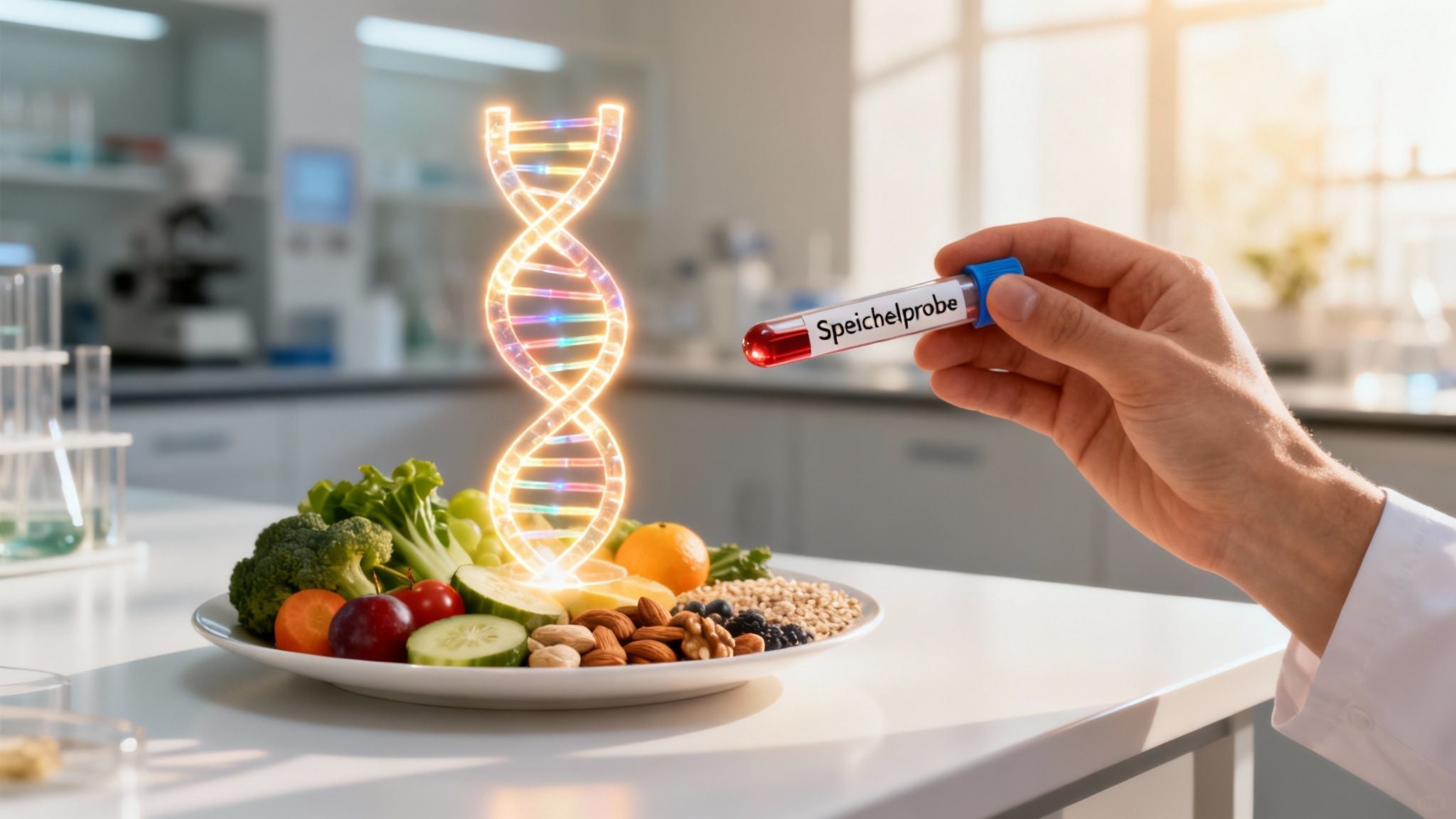
A DNA test for nutrition examines a saliva sample at specified locations in the genetic makeup and uses them to describe predispositions: how your body processes caffeine, lactose, or alcohol, and where your needs might differ from those of other people. It does not measure a current value, make a diagnosis, or predict success.
People who search for this term are usually at the beginning. That is why this article organizes the entire field instead of exploring a single detailed question in depth. It begins with the question you actually want answered and shows which method can clarify it: genetics, a blood test, a stool analysis, or a consultation at a medical practice.
You will first read the explanation of the terms and the matching of questions to methods. This is followed by the technology, the content of a report, a documented source describing the market, the position of a German professional society together with our counterposition, and a study that directly examined this exact question. The conclusion covers the process, costs, decision support, and limitations.
What to expect in this article
1. What a DNA test for nutrition examines
2. Which question you want to clarify and which method answers it
3. How a result is obtained from a saliva sample
4. What an actual nutrition report contains
5. How the offering is described in the market
6. What the German Nutrition Society states and what we argue in response
7. What emerged when this exact question was examined directly
8. What determines your nutrition before genes come into play
9. Which questions remain unanswered and who answers them
10. What the process looks like from ordering to receiving the report
11. How much a DNA test for nutrition costs
12. Who it is worthwhile for and who it is not
13. How to recognize a reputable offer
14. What happens to your sample and your data
15. What matters when considering this question
Frequently asked questions
Sources
What a DNA test for nutrition examines
A DNA test for nutrition is a laboratory analysis of your genetic information tailored to nutrition and metabolism. You provide a saliva sample, a laboratory uses it to determine individual genetic variants, and you receive a report that translates these variants into everyday language.
It does not examine your entire genetic makeup. Instead, it checks previously defined individual positions where people differ. The technical term for such a position is a single-nucleotide polymorphism, or SNP for short—one deviation in the genetic text.
The second technical term you will encounter in this context is nutrigenetics. It refers to the field of research that examines why two people react differently to the same food. A DNA test for nutrition is the commercial application of this field, not the field itself.
Predisposition and condition are two different things
The most important distinction in the entire subject is contained in two words. A predisposition describes a tendency that you carry with you throughout your life. A condition describes how you are doing today, measured on a specific day using a specific method.
A DNA test works exclusively at the level of predisposition. Whether you are currently deficient in iron, whether your blood sugar is elevated today, or whether your digestion has been out of balance for four weeks—these are measurements from blood or stool and do not appear in any genetic report.
This distinction also determines the appropriate frequency. Your DNA does not change, so one sample is sufficient for your entire lifetime. Blood values shift over the course of months and are therefore measured repeatedly when you want to track a development.
Key message
A DNA test for nutrition describes predispositions from a saliva sample. It does not measure current nutrient status, provide a diagnosis, or change over time, because the basis being examined never changes.
Why the term is used so differently
Very different things are offered under the same name. Some analyses examine a handful of markers, while others examine several hundred thousand. Some provide a file with abbreviations, while others provide a fully written report with sections.
That is why, before making any purchase decision, it helps to check three details: which method is used, how many markers are examined, and which sections the report contains. If you cannot find these three details, you cannot properly assess the offering.
Which question you want to clarify and which method answers it
Most people are not looking for a DNA test. They are looking for an answer and encounter a DNA test along the way. That is why it makes sense to start with the question, not the product.
The following comparison organizes three methods according to the same five criteria. It is the core of this article because it answers in one table what would otherwise require five separate articles.
| Criterion | DNA analysis (saliva) | Blood test (capillary blood) | Gut analysis (stool) |
|---|---|---|---|
| Answers the question | Why do I react differently from others? | What is my body like today? | How is my gut currently colonized? |
| What the sample shows | predisposition, unchangeable | current status, shifts over months | internal ecosystem, shifts within weeks |
| How often it makes sense | once in a lifetime | every 6 to 12 months | Follow-up check after 3 months, then every 6 to 12 months |
| Laboratory analysis after the sample arrives | 15 to 25 business days | 3 to 5 business days | 5 to 10 business days |
| What it does not provide | no diagnosis, no statement about your current condition | no statement about the cause of a value | no statement about your genetic predisposition |
The table leads to a simple sequence. If you have an acute complaint, first measure a current condition. If you want to understand why a pattern keeps recurring over the years, look at predisposition.
A fourth path is missing from the table because it does not require a laboratory: writing down what you eat and how you feel afterward. Over two to four weeks, this often provides more useful clues than any analysis and costs nothing.
Where This Article Sends You Next
This article is an introduction to a topic that we explore in greater depth elsewhere. It organizes the information and points you onward rather than answering every question itself. There are four paths, and each answers something different.
If you are interested in the product category and the question of price, Genetic Nutrition Test: What It Shows and What It Costs provides the relevant in-depth information. If you are interested in the field behind it, Nutrigenetics Test Experiences goes further and shows how to recognize a substantiated interaction.
If you are looking for personal accounts, DNA Test Nutrition Experiences explains what such reports can demonstrate. And if your specific focus is weight loss, Genetic Test Weight Loss Experiences and DNA Test for Weight Loss: Experiences are relevant. This article stays focused on the overview.
How a Saliva Sample Becomes a Result
Cells from the lining of your mouth float in saliva. The laboratory extracts the DNA from them, amplifies it, and then reads the previously defined positions. So it does not read the entire text; it looks up specific passages.
This method is called SNP genotyping. It is different from whole-genome sequencing, which determines the entire genetic makeup letter by letter. mybody®x (MYBODY Lab GmbH) uses genotyping, analyzing more than 700,000 positions.
The number sounds large and still says little about the quality of a report. What matters is which positions were selected and how well the connection between a position and a trait has been studied. Selection beats quantity.
Why a Position Does Not Have to Be the Cause
Genetic associations are found in large comparative studies. Such studies show that a variant occurs more frequently in people with a particular trait. They do not automatically show that this variant causes the trait.
Variants in the genome often lie close together in blocks and are inherited together. What is found may then be a position that is merely carried along, while the actually effective site lies a few thousand building blocks farther on. For a report, this means describing a statistical association, not a mechanism.
That is precisely why the language in a reputable report is cautious. It says that a variant is associated with a trait, not that it determines it.
What a nutrition report actually contains
A nutrition report is not a diagnosis but a piece of reading. It organizes the variants found by topic, explains them, and derives suggestions from them. The scope varies considerably depending on the analysis.
Four topic areas appear in almost every report of this kind: how you process caffeine, how you process lactose, how you process alcohol, and how pronounced your sense of satiety is. Research is comparatively strong in these areas because individual variants explain a relatively large share of the differences.
Other chapters rest on shakier ground. Everything related to body weight, fat distribution, or training success is influenced by many variants at once, each contributing little on its own. A report can describe this, but it cannot derive a successful outcome from it.
How the four most common chapters read
Caffeine concerns the speed at which your body gets rid of the substance. A report classifies you as processing it more quickly or more slowly and uses this to suggest moving your espresso to a different time in the afternoon.
With lactose, the question is whether your body continues to produce the enzyme lactase into adulthood. This is the area with the clearest genetic basis in the entire report, and even here it remains a predisposition: Only everyday experience or a test can show whether you actually tolerate dairy products poorly.
Alcohol involves two breakdown steps that can proceed at different speeds. If the second step is slower, an intermediate product builds up, causing facial flushing and discomfort. A report describes this; it does not give advice.
Satiety is the most difficult area. Many variants act simultaneously here, each contributing only a small amount, so at best the report can describe a predisposition. The helpful part is that knowing your sense of satiety is less pronounced can help you understand why portion control takes more effort for you than for others.
How to recognize a useful report
A useful report identifies the position examined for each statement and assesses how robust the connection is. It distinguishes between well-supported and weakly supported chapters instead of making claims about everything in the same tone.
A useless report can be recognized by the opposite. It gives instructions instead of descriptions, uses percentages without a reference base, and promises an outcome that depends on your behavior rather than your genetic information.
How the market offering is described
Anyone who wants to know what is actually sold in this market will find the most matter-of-fact description at the consumer advice centers. They describe the procedure and the most common analysis approach without promoting it.
Documented source
“One approach in currently marketed personalized nutrition is to use genetic analysis to determine whether someone is what is known as a ‘Fat Responder’ or more of a ‘Carbohydrate Responder’.”
Consumer Advice Center of Baden-Württemberg
From metabolic diets to food combining, section on gene diets, as of 2022
The sentence identifies precisely the claim against which this market segment must be measured. It asserts that people can be classified according to whether they respond better to fat or to carbohydrates, and that an appropriate diet follows from this.
The same source also describes the procedure matter-of-factly: “As a rule, your genes are analyzed using a saliva sample by a laboratory specializing in this.” This corresponds to what the chapter on the technology states.
Whether the classification into responder types holds up is an empirical question. It was asked, and it was answered. Both points are covered in the next two chapters.
The consumer advice center of North Rhine-Westphalia has commented on this market segment in its specialist magazine Knack·Punkt. In essence, according to the special issue “Personalized Nutrition” (Issue 1, February 2023), personalized dietary recommendations, as currently offered mainly by commercial providers, are not evidence-based.
Leaving this assessment unmentioned would be the worse option. An provider who conceals what has been discussed in their own industry for years loses precisely those readers who look into it.
What the German Nutrition Society states and what we set against it
There is an explicit position from a German professional society on the evidence for gene-based dietary recommendations. It comes from the “Personalized Nutrition” working group of the German Nutrition Society and has been published in a peer-reviewed format.
The original wording of the key sentence is: “evidence for the success of gene-based dietary recommendations is still generally lacking”. In German, this means that evidence for the success of gene-based dietary recommendations is still largely lacking. The German wording is a translation in its own right, not a second quotation.
The work was authored jointly by Holzapfel C, Waldenberger M, Lorkowski S, and Daniel H, together with the research group named above. It was published under the title “Genetics and Epigenetics in Personalized Nutrition: Evidence, Expectations, and Experiences” in Molecular Nutrition and Food Research, 2022, DOI 10.1002/mnfr.202200077, and is listed on dge.de under “Statements and Position Papers”.
What this position disputes and what it does not
The position does not dispute that genetic variants exist. It does not dispute that these variants can be described. It disputes that dietary recommendations based on them have been proven to lead to better results.
The position paper does not reject the field either. It calls for concepts that incorporate data beyond genetic information, such as measured physical values and digital tools. Anyone who overlooks this distinction turns a research agenda into a verdict.
Our position on this
We are not selling a dietary recommendation with promises of effects, but rather a way of understanding the situation. This position was not formulated after the fact; it can be seen in the wording of our own product page: It refers to insights, suggestions, and inspiration, to ideas for a diet that fits your everyday life, and to a practical foundation.
What it explicitly does not say is that a result is promised. No number of kilograms, no time frame, no success rate. We are not making the very claim that the position paper considers unsubstantiated.
The objection is nevertheless understandable: Why conduct an analysis at all, then? The answer is unremarkable. A description of your predispositions explains why certain things work differently for you than for others. What you do with that is up to you.
We are not selling a dietary recommendation with promises of effects, but rather a way of understanding the situation.
What emerged when this exact question was investigated directly
The classification into response types from the quotation above can be tested. People can be classified genetically, assigned either the corresponding or the opposite diet plan, and then measured to see who lost how much weight.
That is exactly what happened. Höchsmann and colleagues published a randomized controlled study in the journal Nature Communications in 2023 under the name POINTS. Of the 145 adults assigned, 122 were included in the analysis, and the observation period was twelve weeks.
One half received a diet plan that matched their genetically determined response type, while the other half received the opposite. If the classification holds up, the first group should lose significantly more weight.
Weight change after twelve weeks
Compatible and opposite diet plans in direct comparison
Source: Höchsmann et al., Nature Communications, 2023
The two upper bars are almost the same length, and that is the result. Those who received the diet matching their genotype lost an average of 5.3 kilograms, compared with 4.8 kilograms in the control group. The difference of 0.6 kilograms was not statistically significant; the associated value was 0.50 (Höchsmann et al., Nature Communications, 2023).
The authors sum it up in their concluding sentence: “With the current ability to genotype participants as fat- or carbohydrate-responders, evidence does not support greater WL on genotype-concordant diets.” Given today’s ability to classify people as fat- or carbohydrate-responders, the evidence does not support greater weight loss on a genotype-matched diet.
The other half of the result is noteworthy. Both groups lost weight, and significantly so. What worked, then, was the structured support over twelve weeks, not the genetic classification.
What determines your diet before genes come into play
If a genetic classification adds nothing in a direct comparison, the question is what actually makes a difference. The answer is unromantic and has been the same for decades.
In its fact sheet on healthy eating (as of 2026), the World Health Organization identifies three measures with specific figures: at least 400 grams of fruit and vegetables per day for everyone aged ten and over; less than 5 grams of salt per day for adults; and free sugars below 10 percent of daily energy intake.
None of these three measures depends on your genetic makeup. They apply to everyone, and for most people they offer greater leverage than any fine-tuning based on genetic variants.
That does not make genetic analysis worthless. It simply belongs at a different point in the sequence than the advertising for this market segment suggests. It is a refinement, not a substitute for the fundamentals.
Chapter at a glance
The World Health Organization recommends at least 400 grams of fruit and vegetables per day for adults, less than 5 grams of salt per day, and free sugars below 10 percent of energy intake (as of 2026). These three measures apply regardless of genetic information. Genetic analysis refines the picture; it does not replace these fundamentals. Anyone pitting the two against each other is confusing the foundation with the finishing touches.
Which questions remain unanswered and who answers them
An overview article would be dishonest if it described only what a DNA test can do. The list of what it cannot determine is longer and more important for making a decision.
It does not determine your nutrient status. A blood test shows whether you are currently deficient in iron, vitamin D, or vitamin B12. After the sample is received, it is analyzed within 3 to 5 business days and repeated every 6 to 12 months if you want to track changes.
It does not clarify an acute complaint. Persistent abdominal pain, unintentional weight loss, blood in the stool, or symptoms that have accompanied you for weeks belong in a doctor's office. A self-test is the wrong approach for this, regardless of how good it is.
It does not clarify an intolerance in the medical sense. For lactose, the hydrogen breath test is the established method because it tests actual digestive function rather than predisposition. A genetic result may indicate it, but does not replace the measurement.
It also makes no statements about diseases. Predictive genetic testing for diseases is subject to separate regulations in Germany and must be handled by a doctor. A lifestyle and nutrition analysis is explicitly something different.
Key message
A DNA test for nutrition replaces neither a blood test nor a medical evaluation nor the hydrogen breath test for lactose. It answers the question of genetic predisposition—and only that.
What the process looks like from ordering to receiving the report
The process is similar with all providers and consists of four stages. Two are handled by the provider and two by you. The waiting time therefore consists of several parts that should be considered separately.
Four stages to the report
The test kit arrives at your address
Shipping the kit takes 1 to 3 business days. It includes the collection kit, instructions, and a prepaid return envelope.
You provide the saliva sample
For a short period before collecting the sample, you must not eat, drink, or smoke so that no foreign cells enter the sample. It is then sent back to the laboratory. You determine this stage yourself.
The laboratory analyzes it
The laboratory analysis of a DNA test takes 15 to 25 business days after receipt of your sample. This period is not combined with the shipping time into a single figure because both stages fluctuate independently of each other.
You read and interpret it
The report is available digitally. The real benefit only emerges afterward, when you try out individual points in everyday life and observe whether they make any difference for you.
The fourth section is the one most people underestimate. A report that remains unread has the same value as no report at all. If you think beforehand about which question you want it to answer, you will get much further here.
How much a DNA test for nutrition costs
The question of price can be answered clearly for our own range. The DNA analyses from mybody®x cost between €169.00 and €369.00, as of August 27, 2026; prices may change. We do not quote third-party market prices because no one in the company is responsible for an external figure.
Within this range, the scope differs, not the care taken in the laboratory work. At the lower end is an analysis with a narrowly defined focus; at the upper end is an analysis that brings together several subject areas.
The answer regarding reimbursement is straightforward: You pay for a genetic-based nutritional analysis yourself. If you expect reimbursement, it is better to clarify that beforehand than afterward.
Why the amount works out differently than with a blood test
A DNA test is a one-time expense. Because the result does not change, there is no reason to repeat it. A blood test, by contrast, reflects a current state and is repeated every 6 to 12 months if you want to track changes.
Over a longer period, the ratio therefore often reverses. The one-time amount seems high at the time of purchase, while the recurring amount seems small, and calculated over five years, the two are closer together than they initially appear.
Who it is worthwhile for and who it is not
Based on everything stated in the preceding chapters, the decision can honestly be answered in either direction. The following comparison does exactly that.
Makes sense for you if …
you are interested in a recurring pattern that cannot be explained by how you feel on a given day, such as how you respond to caffeine or lactose.
you are already implementing the basics and are looking for a description that helps you interpret your own observations.
you prefer a one-time expense to a recurring one and know that the result remains valid for life.
Probably not if …
you have an acute complaint. In that case, clarification belongs in a consultation, and a description of your predispositions will only delay you.
you expect it to produce measurable weight loss. The available evidence does not support that claim, and we do not make it.
you want to know how you are doing today. For that, you need a blood or stool test, not a genetic analysis.
A fourth case belongs in the right-hand column, even if it looks uncomfortable there: If money is tight and you have to choose between a genetic analysis and a blood test, measure your current status first. Your status can change; your genetic predisposition cannot.
How to recognize a reputable offer
When you decide to have an analysis performed, the choice of provider affects the result more than the price does. Four characteristics can be checked before purchase without requiring specialist knowledge.
The method is named explicitly
A reliable product page states whether genotyping or sequencing is performed and how many positions are examined. Anyone who instead only refers to an analysis of your DNA has left out that information. This is not proof of poor work, but it is the first missing building block.
The language describes rather than promises
A reputable offering uses descriptive language. It states which predisposition is present and what may follow from it. An unreliable offering gives figures in kilograms, weeks, or success rates, thereby promising something that depends on your behavior.
The limitations are clearly stated in the text
Every analysis has topics it does not cover. When those limitations are stated openly, you can assess the offering. When everything seems to work equally well, the context is missing—and without context, a report is just a list of claims.
There is an accessible human contact
A genetic report raises follow-up questions, for almost everyone. That’s why it matters whether there is a place where you can direct those questions and whether someone there responds who understands the report. A contact form without a way to receive a response does not meet that standard.
What happens to your sample and data
A saliva sample is the most personal sample you can provide. That’s why the question of what happens to it afterward belongs in every overview of this subject, not in the fine print.
At mybody®x, samples are processed using pseudonyms, the results are transmitted in encrypted form, and processing complies with the General Data Protection Regulation. The saliva sample and DNA sequence are destroyed two months after the analysis.
Before any purchase, every provider deserves the same scrutiny. Three questions are enough: Where is the analysis performed, how long are the sample and data stored, and are data shared with third parties? If you can’t find a clear answer, you already have your answer.
What matters when considering this question
This article began with the observation that most people aren’t looking for a DNA test but for an answer. That is precisely what determines whether such an analysis is useful to you.
For questions about your current condition, a blood test is the method of choice. For an acute complaint, it’s a consultation. For a pattern that has repeated over the years, genetic predisposition is the right place to look—and that’s what genetic analysis is for.
What remains from this research can be read between the lines of the 2023 POINTS study. Both groups lost weight, regardless of their genetic classification, because both were given structured support for twelve weeks. The structure was the effective part.
This leads to one concrete next step, and it costs nothing. Write down what you eat and how you feel afterward for two weeks. If a pattern emerges that you can’t explain, that’s when a genetic predisposition report may make sense.
And if you’re not sure which of the three methods is right for your question: The consultation is free, and it won’t sell you anything.
Frequently asked questions
What exactly does a DNA test for nutrition do?
It analyzes a saliva sample for predetermined positions in the genome. The method is called SNP genotyping and is different from whole-genome sequencing. The variants found are used to create a report describing predispositions, such as how the body handles caffeine, lactose, or alcohol. It does not measure a current level or provide a diagnosis.
Has it been proven that gene-based dietary recommendations work better?
No, this evidence is still largely lacking. The Personalized Nutrition working group of the German Nutrition Society states this in a peer-reviewed position paper (Holzapfel C, Waldenberger M, Lorkowski S, Daniel H, Molecular Nutrition and Food Research, 2022). What is disputed is the recommendation derived from it, not the existence of the variants. An analysis describes predispositions and does not promise an outcome.
How long does it take for the result to be available?
The waiting time consists of two separate periods, which should not be merged into one figure. Shipping the test kit takes 1 to 3 working days. Laboratory analysis of a DNA test takes 15 to 25 working days after your sample is received. In between is the time you need to collect and return the sample yourself.
Can a DNA test detect a nutrient deficiency?
No. It describes predispositions, not a current condition. Whether you are currently deficient in iron, vitamin D, or vitamin B12 is shown by a blood test. Such a determination from capillary blood is evaluated within 3 to 5 working days after the sample is received and repeated every 6 to 12 months if you want to track changes.
How much does a DNA test for nutrition cost?
The DNA analyses from mybody®x cost between €169.00 and €369.00, as of 27 August 2026; subject to change. The difference within this range lies in the scope of the reports. We do not state prices from other providers. You pay the costs yourself; if you expect reimbursement, it is better to clarify this beforehand.
Next step
A description, not a promise
If, after this overview, you want a description of your genetic predispositions as a starting point, the INFINITY DNA test, including a 28-day plan and recipe book, provides that. It costs €297.00 (as of 27 August 2026; subject to change), uses a saliva sample, and is taken once. It does not predict a better nutritional outcome. If you are unsure whether it fits your question, ask beforehand.
View the INFINITY DNA test Question for the expert teamRead more
You might also be interested in this
An in-depth look at the product category: report scope, process, and pricing explained in detail.
For anyone who wants to know how to recognize a substantiated interaction between genes and diet.
Sources
- Consumer Advice Centre of Baden-Württemberg: From metabolic diets to food combining, section on gene diets (as of 2022) – verbraucherzentrale-bawue.de
- German Nutrition Society (DGE): Statements and position papers, Positions section, entry “Genetics and Epigenetics in Personalized Nutrition: Evidence, Expectations, and Experiences”; Holzapfel C, Waldenberger M, Lorkowski S, Daniel H, Molecular Nutrition and Food Research (2022), DOI 10.1002/mnfr.202200077 – dge.de
- World Health Organization (WHO): Healthy diet, fact sheet (as of 2026) – who.int
- Consumer Advice Centre of North Rhine-Westphalia: Knack·Punkt, special issue “Personalized Nutrition,” issue 1, February 2023 – verbraucherzentrale.nrw
The verbatim quotation on the approach of classifying fat- and carbohydrate-response types, as well as the sentence about the saliva sample and specialized laboratory, comes from source [1]. The verbatim-quoted English sentence about the lack of evidence for gene-based dietary recommendations, the attribution to the working group, and the call for more comprehensive approaches come from source [2]; the German rendering is an original translation and not a second quotation. The three quantities for fruit and vegetables, salt, and free sugars come from source [3]. The classification that currently primarily commercially offered personalized dietary recommendations are not evidence-based is a paraphrase based on source [4]. The information on the POINTS study is attributed in the body text with the authorship, journal, and year (Höchsmann et al., Nature Communications, 2023) and therefore does not require a separate line. Information on the price range, procedure, sample type, and destruction of the sample and DNA sequence comes from the product and information pages of mybody®x, accessed on 27.08.2026; processing times follow the central specifications for DNA, blood, and stool tests. All sources were accessed and reviewed on 27.08.2026.

mybody®x Editorial & Expert Team
Nutrigenetics Nutritional science Laboratory diagnostics Blood analysis interpretation
This article was created by the editorial and expert team at mybody®x. The team combines nutrigenetics, nutritional science, laboratory diagnostics, and the interpretation of blood analyses. Those who contribute to it are listed on the authors page.
Published on 11.12.2025 · Last updated on 27.08.2026
The DNA analysis is intended for nutritional and lifestyle counseling. It is not a diagnostic procedure, does not predict disease, and does not replace a medical examination or consultation. Genetic variants describe probabilities in population groups, not fixed outcomes for individuals.




Share now:
Achieve your weight-loss goals step by step: Your path to success
At-home hormone test: The honest guide to your body