
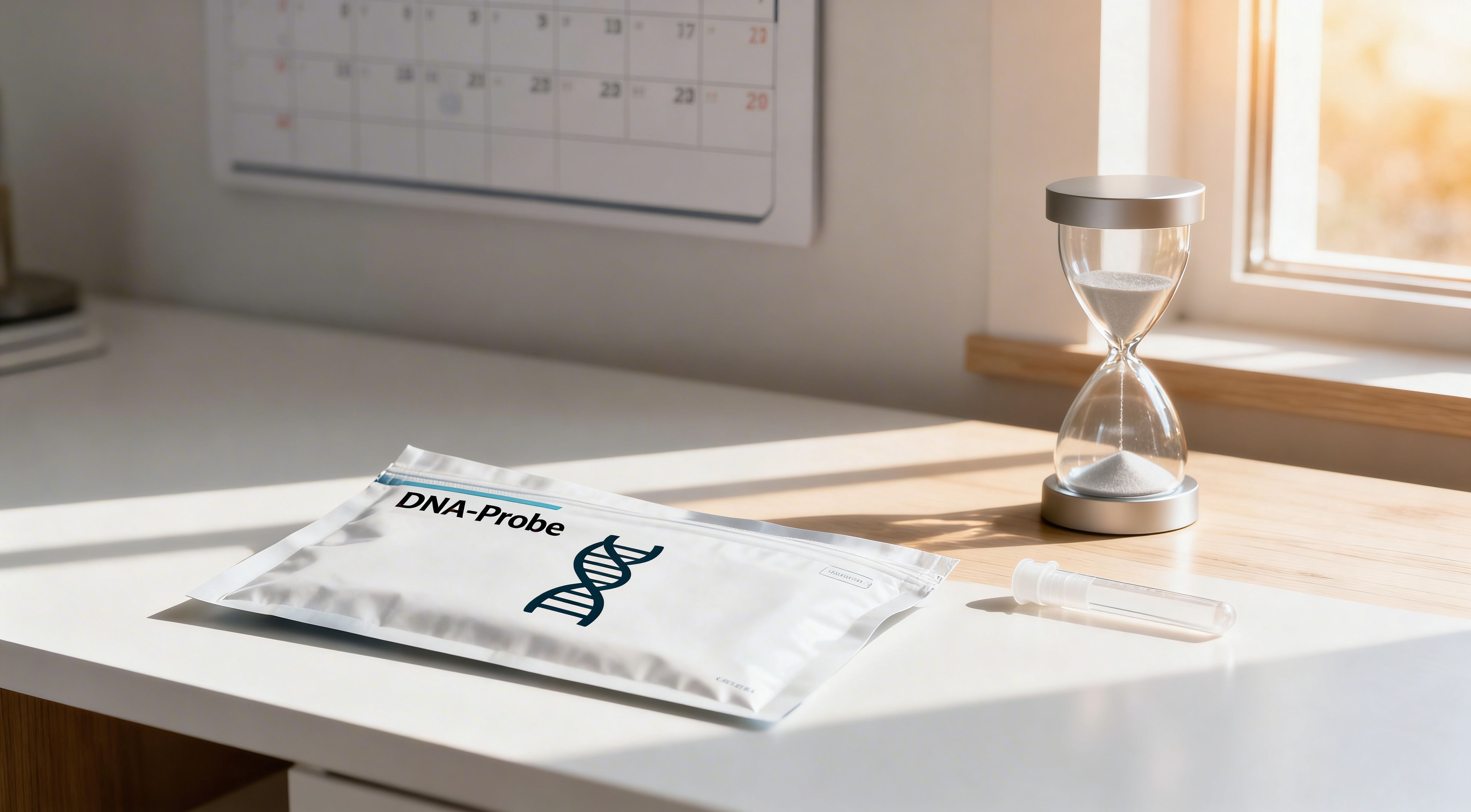
How long does a DNA test take? Your timeline explained
You've sent in the test, been checking your mailbox for days, and are wondering: How long does a DNA test really take? This is a perfectly normal question. Especially when you don't just want any result, but finally want to understand what's behind your metabolism, your diet, or your body's reaction to exercise.
Many sites vaguely say "a few weeks." That's not very helpful in everyday life. You want to know exactly what happens between the saliva sample and the result, why some DNA tests are significantly faster than others, and what you can do yourself to avoid unnecessary delays.
From Waiting to Certainty: Your DNA Test Timeline
The waiting time often feels longer than it is. You've provided the saliva sample, mailed the envelope, and from then on, everything happens out of your sight. That's exactly what makes many people impatient.

If you're currently asking yourself, how long does a DNA test take, a realistic look at the process helps. First comes shipping. Then your sample is registered in the lab. After that, the actual analysis begins. Finally, your results report is created and provided.
What you can realistically expect
For health DNA tests for metabolism, nutrition, or longevity, the waiting time often ranges from days to a few weeks. The reason is simple: here, it's not just about checking for a DNA match, but creating a comprehensive health report.
This is more comparable to a thorough evaluation than a simple yes-no test. If you want to get an overview of test types beforehand, the DNA Test Guide offers a good starting point.
Important: A longer processing time is not automatically a negative thing. For health tests, it often indicates additional review and evaluation steps.
Why impatience is understandable
Many people don't do a DNA test purely out of curiosity. They finally want answers. Why isn't weight loss working despite discipline? Why does one diet work for others but not for you? That's why waiting often feels so emotional.
The good news is: the process is usually well-plannable. If you know which stages your sample goes through, the waiting time feels much more tangible and less vague.
The journey of your DNA sample explained step by step
Your sample doesn't just move "to the lab and back." It goes through several stages. If you view it like a package with fixed stops, it quickly becomes clear why a clean and secure process takes some time.

Order and sample collection
It starts with the test kit at your home. You register the test and collect the saliva sample according to the instructions. This part is usually the easiest.
Nevertheless, this moment often determines whether everything runs smoothly. If you want to know what really matters when taking the sample, the guide to how a saliva test works can help.
Return shipping and lab receipt
After collection, you send the sample back. As soon as it arrives at the lab, it is assigned, registered, and prepared for analysis.
This is not just about organization. Data protection and clear assignment also play a role. A sample must be meticulously recorded so that your report truly belongs to your sample later.
The actual analysis
Now comes the most technically complex part. The DNA is extracted from the saliva sample, relevant genetic markers are examined, and the data is bioinformatically evaluated.
For modern health DNA tests, this is significantly faster than it was a few years ago. Early commercial DNA tests around 2010 still took 6 to 8 weeks, but modern methods like Next-Generation Sequencing now allow processing times of under 4 weeks for complex analyses (Information on historical comparison and NGS).
Raw data becomes an understandable report
Raw data alone is not helpful for most people. Only through interpretation does it become practical advice on diet, exercise, and lifestyle.
Therefore, the process does not end with the technical analysis. In the next step, the results are structured, checked, and translated into a report that you can actually use.
Result delivery
Finally, you gain access to your report. This is the moment most people wait for. It's not just about when the result arrives, but also whether you can use it in everyday life.
A good evaluation answers not only the question "What was found?" but, more importantly, "What does this mean for me?"
Key takeaway: A DNA test is not an instant product. The actual waiting time primarily results from analysis, data verification, and clear preparation.
Health, genealogy, and paternity: Timeframes compared
Not every DNA test has the same goal. That's why processing times can differ significantly.

Some people simply type "how long does a DNA test take" into search engines, but they mean very different things. Is it about a paternity question, genealogy, or a metabolism test? These differences are crucial.
The times in direct comparison
| Test type | Typical duration | Why it takes so long |
|---|---|---|
| Paternity test | 3 to 7 business days | Comparison of fewer samples, clearly defined question |
| Health test | up to 21 business days | additional validation and evaluation for recommendations |
| Ancestry test | 4 to 8 weeks | Shipping routes and database matching |
These timeframes are described for Germany as follows: Paternity tests often take 3 to 7 business days, ancestry tests 4 to 8 weeks, and health tests with medical validation can take up to 21 business days (Comparison of DNA test types).
Why paternity is often faster
A paternity test answers a very narrow question. Do certain DNA markers of two or more individuals match or not? The scope of interpretation is limited.
With health tests, it's different. There, it's not just about genetic matching, but about the meaning of many markers in connection with diet, exercise, and individual predisposition.
Why ancestry can take longer
Ancestry tests often depend on logistics and databases. Shipping can take longer, especially if international labs are involved. In addition, there is the comparison with large sets of reference data.
If you're still considering which test suits your goal, an overview of where you can get a DNA test might help.
What can delay your DNA test result
Most delays have nothing to do with a "bad lab." They often arise from very practical things that easily happen in everyday life.
Common causes
The sample was not ideal. Too little saliva or a contaminated sample can complicate the analysis.
The timing was inconvenient. Holidays, weekends, or a high volume of samples can shift the standard time.
Rework is necessary. If a lab has doubts about the quality of the sample, it will be checked more closely instead of being evaluated prematurely.
According to one provider, insufficient sample quality is a common cause of delays and can extend the total duration to over 8 weeks. Holidays or a high volume of samples can also affect the standard processing time of 2 to 5 weeks (Notes on delay factors in DNA analyses).
What many underestimate
Many people only think about the lab process. But quality already starts at home. If you ate, drank, or only half-read the instructions directly before collection, the risk of queries or delays increases.
Good to know: A careful sample often saves more time than any express idea.
How to get your results faster
You can't speed up the lab analysis. But you can do a lot to ensure your sample can be processed without detours.
Your practical checklist
- Read instructions carefully: Small details in the collection make a big difference.
- Collect sample cleanly: Make sure you provide the saliva sample calmly and carefully.
- Register test immediately: This allows the lab to assign the sample more quickly.
- Send back promptly: Don't leave the sample lying around at home for days.
- Use weekdays: If you avoid sending it back directly before a weekend, the process often remains more consistent.
What helps in practice
Many people do the test "just in passing." That's when typical mistakes happen. Instead, take a few quiet minutes and follow the instructions step by step.
This sounds trivial, but it's the easiest lever. A good sample is half the battle.
Your mybody® DNA Test: Quality and Transparency in Focus
When you choose a health DNA test, it's not just about the duration. You also want to know how cleanly the process is organized, how your data is handled, and what you actually get in the end.

What you can concretely expect
For mybody® in Germany, analysis typically takes 2 to 4 weeks. Upon completion, customers receive a 132-page report. The provider also highlights GDPR-compliant data security, the destruction of the sample after analysis, and over 11,300 customers. More information can be found in the description of mybody®'s DNA analysis.
Why transparency is important here
Especially with genetic data, trust matters. A transparent process is therefore more than a nice extra. It shows you that not only the analysis, but also data protection and results preparation are taken seriously.
For many health-conscious people, this is the real difference between a quick gimmick and a test that is truly usable in everyday life. You are not just waiting for a document, but for insights that you can use for nutrition, training, and lifestyle.
Conclusion: Patience that transforms into knowledge
The answer to the question how long does a DNA test take is usually not just "a few days" or "a few weeks." It depends on the test type, the sample, and the evaluation. Paternity tests are often faster, ancestry tests slower, and health DNA tests usually fall somewhere in between.
If you know the process, waiting becomes much more relaxed. Then you know: This time is not downtime, but the path to useful knowledge about your body.
If you want to better understand your diet, metabolism, or genetic predispositions, you'll find health analyses for home at MYBODY Lab GmbH, focusing on DNA, microbiome, nutrients, and other biomarkers. This way, you can not only read insights but translate them into concrete steps for your daily life.



Share:
Constant Bloating in Women: Causes & Solutions 2026
Best Microbiome Test 2026: Your Comprehensive Comparison