
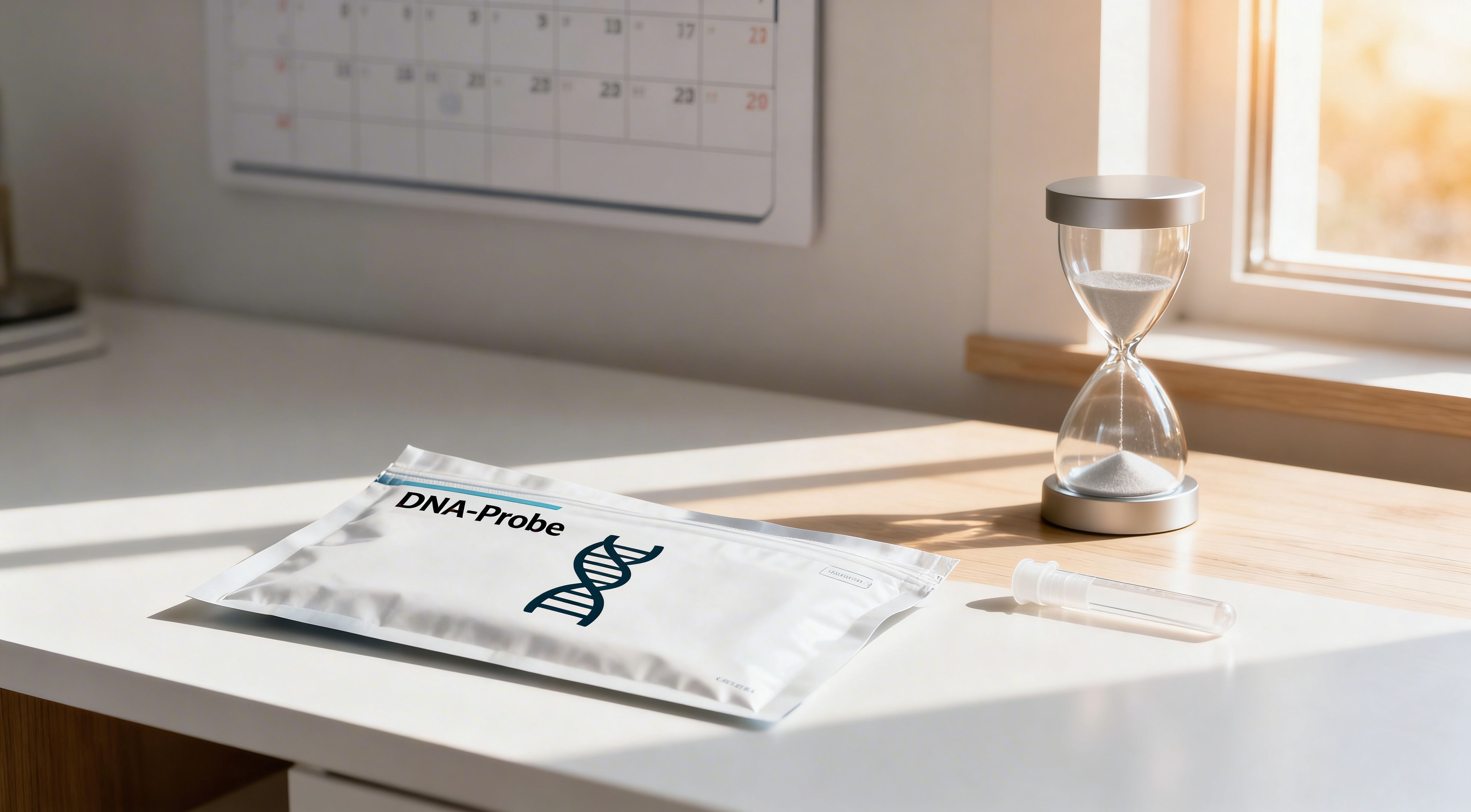
How long does a DNA test take? The timeline step by step
The essentials at a glance
There is no single answer to the question of how long it takes because two separate periods run consecutively: the test kit’s journey to you and back, followed by laboratory analysis. Laboratory processing time begins only when your sample arrives. Anyone who combines both into a single figure is not reflecting reality.
This article states both time frames separately and gives their precise ranges in the very first chapter. It then explains what the longer of the two periods consists of and at which points in the process days are actually added. Whenever a figure comes from an institution, the institution and year are stated here.
You will first read the figures, then the distinction between the two time frames and the journey of your sample from ordering to receiving the report. Next come the laboratory steps, the reasons for delays, and a comparison with other types of tests. The final section covers planning the waiting time, the limitations of every time estimate, and whether the wait is worthwhile for you at all.
What to expect in this article
1. How long a DNA test takes: the two figures that matter
2. Why shipping time and laboratory time remain separate
3. What happens before the laboratory even starts
4. The journey of your saliva sample, step by step
5. What actually takes time in the laboratory
6. What extends the waiting time and what does not
7. How long other types of tests take
8. Why a faster result is not necessarily better
9. How to plan the waiting time when an appointment depends on it
10. Which time estimates appear on the product pages
11. Limitations: what a time estimate does not cover
12. Who the wait is worth it—and who it is not
13. What ultimately matters when it comes to the duration
Frequently asked questions
Sources
How long a DNA test takes: the two figures that matter
The answer consists of two figures, not one. Shipping the test kit takes 1 to 3 business days. Laboratory analysis of a DNA test takes 15 to 25 business days, calculated from the time your sample arrives at the laboratory (central requirement from mybody®x for all tests in the range, as of August 27, 2026).
Between them is a third leg that no one can reasonably specify in business days: the return journey of your sample to the laboratory. How long a letter takes depends on when it is posted and the postal route. Include this leg in your own calculation, but not in the laboratory time.
Key takeaway
A DNA test does not have one overall duration, but two separate time frames: 1 to 3 business days for kit shipping and 15 to 25 business days for laboratory analysis after the sample is received. The postal transit time for the sample to the laboratory falls between these two periods and is covered by neither figure.
Why business days are counted instead of days
A laboratory operates on business days. If a long weekend or public holiday falls during your waiting period, the result is shifted on the calendar without any change to the processing. Fifteen to 25 business days correspond to approximately three to five calendar weeks, depending on how many non-working days fall in between.
This conversion is the most common reason for disappointment. Anyone who reads 15 business days as “two weeks” ends up waiting longer than expected and suspects an error where there is none.
How to tell where your sample currently is
A test that has been activated can be tracked. The product page for the DNA Metabolism Analysis describes the purpose of activation precisely: “Activate your test on the mybody® platform to track the status of your sample and results later” (product page, accessed on 27 August 2026).
This gives you a reference point that no advice article can provide. As long as the status does not show that the sample has been received, laboratory processing time has not even started.
Why shipping time and laboratory processing time remain separate
Many services state a single duration. This is convenient but ultimately misleading, because the two time periods depend on different factors and are handled by different parties.
Kit delivery depends on stock and the shipping provider. Laboratory analysis depends on sample quality, the number of genetic variations examined, and preparation of the report. Laboratory processing time does not begin when you place your order, but when your sample is received.
Documented source
“It can take several weeks for the result to be available.”
Institute for Quality and Efficiency in Health Care (IQWiG)
What happens during a genetic test?, as of 2026
The IQWiG (2026) describes a genetic test here in a medical context, not a lifestyle analysis of diet and metabolism. The order of magnitude is nevertheless comparable, for the same reason: the time-consuming part is the laboratory analysis, not the transportation.
What is and is not a genetic test in the legal sense
Genetic testing in Germany is regulated by the Genetic Diagnostics Act (IQWiG, 2026). Among other things, the law requires that genetic testing may only be carried out if the person has given prior written consent.
An analysis of diet and lifestyle is not a diagnostic procedure. It does not predict illness and does not replace a medical examination. This distinction is also important for the duration: no genetic counseling appointment is required that would need to be scheduled separately.
Anyone interested in the substantive side of the waiting time can find it in the article Why does a genetic test take so long. It covers the individual steps involved in the laboratory. Here, the focus is on the timeline and on what you can control yourself.
What happens before the laboratory even starts
The first part of the waiting time takes place entirely at home. This is precisely where the days arise that no one talks about later because they appear in none of the processing times.
The product page for the DNA Metabolism Analysis states that kit delivery takes “1-3 days” (accessed on 27 August 2026). What happens afterward is up to you: when you collect the sample, when you activate the test, and when the envelope goes into the mailbox.
Four simple actions determine whether this section takes three days or three weeks. Together, they take less than half an hour.
Read the instructions before collecting the sample
Not afterward. Most avoidable follow-up questions arise from a detail stated in the first paragraph of the instructions.
Do not eat for 15 minutes beforehand
The product page specifies at least 15 minutes without eating or drinking before providing the saliva sample. This quarter of an hour protects sample quality.
Activate the test immediately
Activation links the sample to your account and makes the status visible later. Without it, the laboratory cannot assign the sample.
Send it back on the same business day
A sample left on the dresser until Monday extends your waiting time by exactly those days. It appears in none of the processing times.
The product page does not provide any information about return shipping itself. It does not say whether a prepaid return envelope is included in the kit, so it is not stated here either. That is an open question for customer service, not a figure that can be estimated.
The journey of your saliva sample, step by step
The sequence of steps is mandatory. None can be skipped, and each depends on the previous one. That is exactly what determines the duration.
From ordering to the report
Order and kit shipping
The test kit leaves the warehouse and arrives at your address within 1 to 3 days, according to the product page. This time is logistics, not analysis.
Activation and sample collection at home
You activate the test on the platform and provide the saliva sample as instructed. Duration: minutes. Any time lost here is only due to postponement.
Return to the laboratory
The mailing route. There is no documented time estimate for it because it depends on when the item is posted and the delivery area. It is not included in the laboratory processing time.
Receipt by the laboratory and DNA isolation
The laboratory processing time now begins. The sample is recorded using a pseudonym, and the genetic material is isolated from the cells—the first step that IQWiG (2026) describes for every genetic examination.
Genotyping of the selected sites
Individual point variants in the genome, known as SNPs, are examined. This is a targeted selection of defined sites, not a complete decoding of the genome.
Evaluation and release of the report
The raw data is turned into a readable report. It will be available on the platform 15 to 25 business days after the sample is received.
Stages 1 to 3 are your responsibility, while stages 4 to 6 belong to the laboratory. Anyone who wants to know where their own waiting time arose only needs to check how long the first three stages took.
What actually takes time in the laboratory
The idea that a tube is placed in a device in the laboratory and a result emerges two hours later persists. It describes a rapid test, not a genetic analysis.
The U.S. National Library of Medicine (NIH) describes the process as follows: The sample is sent to a laboratory, where technical staff look for specific changes in chromosomes, DNA, or proteins (MedlinePlus, as of 2021). “Look for” is meant literally here. It is a testing process involving several intermediate steps.
DNA isolation and quality control
The genetic material is isolated from the cells and examined using precise methods (IQWiG, 2026). Before the actual analysis, the question is whether there is enough usable material at all.
If this check produces a negative result, the process starts over: a new kit, a new sample, and a new mailing. This is the most costly loss of time in the entire process, and it occurs at the point that was entirely in your hands.
Genotyping instead of complete decoding
According to the product pages, “only the most relevant SNPs (Single Nucleotide Polymorphism)” are examined (accessed on 27 August 2026). SNPs are individual letters in the genome that differ between people. Depending on the variant, the DNA Metabolism Analysis covers more than 80 to 160 genetic variations, while the INFINITY DNA Test covers more than 140.
This is a deliberate selection, not a complete decoding of the genome. The selection also explains why a larger report scope does not automatically extend laboratory time: the same analysis provides the data for more reports.
From raw data to a readable report
A combination of letters at a gene location does not help anyone. Only interpretation turns it into a sentence that can be used in everyday life.
This translation step is the least visible and most necessary part of the waiting time. It is also why a report with 140 or 200 pages cannot be ready the day after the sample arrives.
What extends the waiting time and what does not
A great deal is written and little is substantiated about the reasons for delays. The following list separates what actually costs days from what is often claimed.
This really extends the waiting time
The sample is left sitting
Every day between collection and mailing is an additional day, and it does not appear in any processing time
Insufficient or unusable sample material
The sample must then be requested again, and the entire process starts over instead of continuing from the middle
The test was never activated
A sample cannot be analyzed without being assigned, even if it arrived a long time ago
Public holidays and long weekends
They shift the date on the calendar without changing the number of business days
An additionally ordered printed booklet
The product page states an additional 2 to 3 weeks after the digital analysis (accessed on 27 August 2026)
The last point is regularly overlooked. Anyone who orders the printed booklet as well still receives the digital analysis within the usual timeframe. Only the booklet arrives later.
What does not explain the duration
The price of a test says nothing about its processing time. Both DNA analyses in the range have the same laboratory processing time of 15 to 25 business days, even though they cost different amounts and include different numbers of reports. What the price reflects instead is explained in the article How much does a DNA test cost.
The season does not explain the duration either. An order placed in January is not analyzed any faster than one placed in July, and express shipping of the kit does not shorten the laboratory processing time by a single business day.
How long other types of tests take
A DNA test is the slowest type of test in the range. This is not a weakness, but a consequence of what is being examined. The table compares four types of tests according to the same five criteria.
| Criterion | DNA test | Blood test | Stool test | Rapid test |
|---|---|---|---|---|
| Kit shipping | 1–3 business days | 1–3 business days | 1–3 business days | 1–3 business days |
| Laboratory analysis after sample receipt | 15–25 business days | 3–5 business days | 5–10 business days | No laboratory processing; read after 5–10 minutes |
| Sample type | Saliva | Capillary blood | Stool | depending on the test, read at home |
| What the result describes | predisposition that does not change | current status at the time of sampling | Composition of the gut microbiome | a single value as a yes-or-no indicator |
| Meaningful repetition | once; the result remains valid | every 6 to 12 months | Follow-up test after 3 months | when needed, as a snapshot |
The processing times in this table are a central specification from mybody®x for all tests in the range (as of 27 August 2026). They are not an institution’s figure or an industry-wide figure.
The final line explains the second: A DNA result is a result for the rest of your life, while a blood value is a snapshot. For a one-time analysis, three to five weeks is a different benchmark than for a value you measure again twice a year.
Why a faster result is not necessarily better
When comparing providers, people often view processing time as a quality indicator. Shorter seems more modern. For genetic analyses, this conclusion does not hold.
The U.S. National Library of Medicine (NIH) gives a range of a few days to several weeks for genetic tests from sample collection and attributes the differences to the type of examination, not the provider’s speed (MedlinePlus, as of 2021).
Key takeaway
The processing time for a genetic test depends on the type of examination, not on the provider’s performance (U.S. National Library of Medicine, 2021). A shorter time frame therefore usually indicates a smaller scope of examination.
The objection is justified: No one likes waiting longer just because an analysis is thorough. Even so, something else is decisive. Your DNA does not change, and the result remains valid. Three weeks once is a different proposition from three weeks every year.
How to plan the waiting time when you have an appointment to meet
Many people order a test with a date in mind: a doctor’s appointment, the start of training, or the beginning of a dietary change. For this, you don’t need a total duration, but the individual time frames and a buffer for the postal service.
The time frames you should expect
1–3
Business days for kit shipping, until the test kit arrives. Applies to every type of test in the range
15–25
Business days for laboratory analysis of a DNA test, calculated from receipt of your sample at the laboratory
3–5
Business days for laboratory analysis of a blood test – the faster option when time is of the essence
Source: central specification from mybody®x for the processing times of all tests in the range, as of 27 August 2026
The reliable plan therefore looks like this: order date, plus kit shipping, plus your own response time, plus postal transit, plus the 15 to 25 business days in the laboratory. The only item without a number is postal transit, so allow plenty of time for it.
If the date cannot be moved
If the appointment is set for two weeks from now, a DNA test is the wrong choice for that appointment. Not because it shows too little, but because it will not be ready in time.
In this situation, a blood test with 3 to 5 business days of laboratory analysis provides results for a consultation more quickly. The DNA test remains useful, but for the question that follows, not for the appointment itself.
What time estimates appear on the product pages
Two DNA analyses from mybody®x (MYBODY Lab GmbH) use a saliva sample collected at home. Both product pages use the same wording for the analysis: “After 15–25 business days, once we have received your sample” (accessed 27 August 2026).
The laboratory processing time does not begin when you place your order, but when your sample arrives.
First, the limitation that applies to both: neither analysis provides a diagnosis, and neither predicts weight-loss success. Neither product page specifies the duration of return shipping, nor do they mention an affordable way to speed up laboratory processing.

DNA test using a saliva sample
DNA Metabolism Analysis | Includes a 28-day plan & recipe book
According to the product page, it analyzes selected SNPs and provides between 24 and 54 analysis reports depending on the variant, with the basic version covering 5 chapters over 140 pages. What the test does not provide: it does not diagnose, predict weight-loss success, or specify the duration of return shipping. According to the product page, an additionally ordered printed booklet arrives 2 to 3 weeks after the digital analysis.
Laboratory analysis 15–25 business days after receipt of the sample
Product page information, accessed 27 August 2026

DNA test using a saliva sample
INFINITY DNA Test | Includes a 28-day plan & recipe book
The more extensive version of the same analysis: 54 analysis reports in 8 chapters over 200 pages, covering more than 140 genetic variants. The laboratory processing time is the same as for the smaller analysis, but the price is not. What the test does not provide: no diagnosis, no disease prediction, and no faster analysis, even though it contains more reports.
Laboratory analysis 15–25 business days after receipt of the sample
Product page information, accessed 27 August 2026
One detail concerns the period after the report: According to the product pages, the saliva sample and DNA sequence are completely destroyed two months after the analysis is completed (accessed on 27 August 2026). Anyone who wants an expanded analysis later must therefore submit a new sample.
Limitations: what a time estimate does not cover
Every processing time is a range, not a promise for an individual case. 15 to 25 business days describe the expected window, not a guaranteed date.
The second boundary concerns the beginning and the end. The stated period begins when the sample arrives at the laboratory and ends when the report is made available. Both postal journeys fall outside it, and both can take several days.
The third boundary is the most important. A fast analysis says nothing about the usefulness of the result. A report that arrives on time but answers no question has helped no one.
And one boundary worth stating: A DNA test for diet and lifestyle is not a diagnostic procedure. It describes predispositions, not diseases, and it does not replace a medical consultation, regardless of how quickly it becomes available.
Who will find the wait worthwhile—and who will not
At its core, the question of how long it takes is a decision question. It is not “how quickly,” but “is the result worth this amount of time to me?”
Makes sense for you if …
you are planning to change your diet anyway and are working without a fixed start date. In that case, the waiting time becomes part of the preparation.
you are prepared to actually read the report afterward. A DNA result only becomes useful through what you do with it.
you are convinced by the one-time nature of it: Your DNA does not change, and the report remains valid.
Probably not if …
you need a result for a fixed appointment within the next three weeks. The laboratory processing time cannot be shortened.
you are looking for a current measurement. A predisposition says nothing about your current iron levels or thyroid function.
you are expecting a medical assessment. A lifestyle analysis is not a diagnostic procedure and does not replace an examination.
you are hoping for an answer about your ancestry or family relationships. This test examines diet and metabolism.
What ultimately matters for the duration
If you take away one action from this article, let it be this: Note the date on which you drop the envelope into the mailbox. From that point on, the time you can track begins.
The reason is unremarkable. Without this date, you compare your waiting time with the order date, and then every processing time seems too long. With the date, you know whether the 15 to 25 business days have even started running.
The starting question was how long a DNA test takes. The most honest answer is this: The largest part of the waiting time belongs to the lab, and the part that people find most frustrating belongs to them. That is uncomfortable. It is also the only part you can change.
Frequently asked questions
How long does a DNA test take in total?
There is no single overall figure because two separate periods run consecutively. Kit shipping takes 1 to 3 business days, while laboratory analysis of a DNA test takes 15 to 25 business days after your sample arrives at the lab (central requirement from mybody®x, as of August 27, 2026). Between these stages is the postal transit time for your sample to the lab, for which there is no documented time estimate. In calendar days, 15 to 25 business days amount to approximately three to five weeks.
Why does laboratory analysis take so long?
Because several steps follow one another. The sample is registered, the genetic material is isolated from the cells, and it is analyzed using precise methods (IQWiG, 2026). The selected point variants are then determined, and only at the end is the raw data turned into an easy-to-read report. IQWiG (2026) states generally regarding genetic testing: “It can take several weeks for the result to be available.”
Can I speed up the processing time?
Not the laboratory processing itself. The only part that can be expedited is the stage before the sample reaches the lab, and that is entirely up to you: Read the instructions before collecting the sample, do not eat or drink anything for at least 15 minutes beforehand, activate the test immediately, and return the sample on the same business day. An unusable sample is the most costly loss of time because the entire process then has to start over.
Is a blood test faster than a DNA test?
Yes, significantly. A blood test takes 3 to 5 business days to analyze in the lab after the sample is received, a stool test takes 5 to 10 business days, and a DNA test takes 15 to 25 business days (central requirement from mybody®x, as of August 27, 2026). Rapid tests do not require laboratory processing and can be read at home after 5 to 10 minutes. However, the types of tests answer different questions: A blood value shows your current status, while a DNA result indicates a predisposition.
Do I have to repeat a DNA test later?
No. Your DNA does not change, so the result remains valid. However, one point should be noted: According to the product pages, the saliva sample and DNA sequence are completely destroyed two months after the analysis is completed (accessed on August 27, 2026). So if you want a more comprehensive report later, you will need to submit a new sample and wait another 15 to 25 business days.
Next step
Choose the date first, then place your order
If you are not planning around a fixed target date, the wait is a worthwhile investment. If an appointment is pressing, the blood test produces results faster. Neither replaces medical evaluation.
DNA Metabolism Analysis INFINITY DNA TestRead more
You might also be interested in
In case you are less interested in the timeline than in the individual steps involved in the laboratory.
To put the price into context and explain why it has nothing to do with the processing time.
Sources
- Institute for Quality and Efficiency in Health Care (IQWiG): What happens during a genetic test? (As of 2026) – gesundheitsinformation.de
- U.S. National Library of Medicine (NIH), MedlinePlus: How is a genetic test performed? (As of 2021) – medlineplus.gov
- U.S. National Library of Medicine (NIH), MedlinePlus: How much does a genetic test cost, and how long does it take to get the results? (As of 2021) – medlineplus.gov
The verbatim quotation concerning the duration, as well as the information on the Genetic Diagnostics Act, written consent, and isolation of genetic material from cells, comes from source [1]. The description of what happens to the sample in the laboratory is based on [2]. The range from a few days to several weeks after sample collection, and the attribution of the differences to the type of examination, come from [3]. There are three core sources rather than four because multiple details could be drawn from each one. Information on prices, product names, report scope, sample type, activation, booklet delivery time, and image URLs comes from the product pages and mybody®x's shop feed, accessed on 08/27/2026. Processing times are a central specification by mybody®x for all tests in its product range and are not attributed to any institution. All sources were accessed and reviewed on 08/27/2026.

mybody®x Editorial & Specialist Team
Nutrigenetics Laboratory Diagnostics Nutritional Science Blood Test Interpretation
This article was created by the mybody®x editorial and specialist team. The team combines nutrigenetics with laboratory diagnostics. Everyone involved is listed on the authors page.
Published on 06/04/2026 · Last updated on 08/27/2026
DNA analysis is intended to provide nutritional and lifestyle guidance. It is not a diagnostic procedure, does not predict disease, and does not replace a medical examination or consultation. Genetic variants describe probabilities in population groups, not predetermined outcomes for individuals.




Share now:
Persistent Bloating in Women: Causes & Solutions 2026
Best microbiome test 2026: Your comprehensive comparison