

Heavy metals in blood: what can really be measured and what cannot
The essentials at a glance
Not every heavy metal can be measured meaningfully in blood. Lead can, mercury in its organic form can, cadmium only to a limited extent, and nickel, according to the assessment of the Human Biomonitoring Commission of the Federal Environment Agency, cannot be measured reliably at all. These four cases are different, and anyone who lumps them together will misinterpret every result.
There is also a distinction that determines how the results should be interpreted: A reference value describes how exposed the population is. An HBM value describes the point at which an adverse health effect may occur. Only the latter has health significance.
First, you will read what these values mean. This is followed by exposure figures for Germany, the decline since the 1980s, a comparison of the four metals, sources of exposure, three common statements in a fact check, and the question of what a self-test can achieve in this context. The limitations come at the end.
What to expect in this article
1. Two types of values that are constantly confused
2. What a reference value really says
3. HBM values and why they no longer exist for lead
4. How exposed the population actually is
5. The decline that hardly anyone knows about
6. Four metals, four different measurement situations
7. Where exposure comes from in everyday life
8. Three statements about heavy metals in a fact check
9. The special case of nickel and what we openly acknowledge about it
10. How you can determine your values at home
11. Limitations: what a blood test cannot answer
12. What matters about these values
Frequently asked questions
Sources
Two types of values that are constantly confused
In Germany, the Human Biomonitoring Commission at the Federal Environment Agency assesses how concentrations of substances in the body should be classified. It works with two different measures, and the difference between them is the core of this article.
The reference value is a statistical measure. According to the Commission, it is derived from a series of measurements taken from a sample of a defined population group using a specified statistical method. The HBM value, by contrast, is based on toxicological considerations.
Key message
A value above a reference value means nothing in terms of health. It means that you are more exposed than most other people. That is information about the population, not about your health.
What a reference value really says
The Commission already stated this in its 1996 concept paper, and the sentence has not become outdated since. It is the most important source for this article.
Documented source
“Reference values, as defined above, have no health relevance per se. They merely describe the exposure situation of the reference population at the time of the investigation.”
Human Biomonitoring Commission, German Environment Agency (UBA)
Concept of Reference and Human Biomonitoring Values, Bundesgesundheitsblatt, as of 1996
This sentence is why we do not create fear-inducing imagery in this article. Anyone who turns an exceeded reference value into a health hazard is quoting against the source from which the value originated.
The same Commission adds that additional toxicologically justified criteria are necessary to assess the health implications of an exposure measured through human biomonitoring. That is precisely what the HBM values are for.
The HBM values and why they no longer exist for lead
The Commission defines two levels. The HBM-I value corresponds to the concentration of a substance in a body medium below which, according to the current state of the assessment, no adverse health effects are expected. The HBM-II value corresponds to the concentration above which a health impairment considered relevant is possible (1996).
For mercury in blood, the Commission specifies an HBM-I value of 5 micrograms per liter and an HBM-II value of 15 micrograms per liter (2009). For cadmium, HBM values exist only for urine: 1 microgram per liter as HBM-I and 4 micrograms per liter as HBM-II for adults (2011).
For lead, the Commission suspended the values
This is unusual and rarely reported. In an addendum to the substance monograph on lead, the Commission suspended the HBM values for blood lead for all population groups. The reason: A threshold for lead's effects has not yet been defined, and any value set would therefore be arbitrary and unjustifiable (2009).
The World Health Organization formulates the same point in its fact sheet by stating that no level of exposure is known to remain without harmful effects. In other words: for lead, there is no value below which the all-clear can be given.
This sentence is the most popular lever for fear marketing in the entire field. It nevertheless belongs in the text, but only together with the figures from the next chapter. Without them, a toxicological precautionary rule becomes a threat.
How exposed the population actually is
The following three figures all refer to blood lead and come from studies by the German Environment Agency. They use the same unit and can therefore be compared directly side by side.
Blood lead in figures
9,47
Micrograms per liter was the geometric mean among 3- to 17-year-olds in the GerES V environmental study
30
Micrograms per liter is the current reference value for adult women; for men, it is 40
70
Micrograms per liter or more were measured in students in Münster in 1981, the starting point of the time series
Source: German Environment Agency (UBA), German Environmental Survey on the Health of Children and Adolescents GerES V (Vogel et al., 2021), updated reference values in the Federal Health Gazette 2019, and the Environmental Specimen Bank, as of 2022
What these figures do not cover
The GerES V environmental health study ran from 2014 to 2017 and examined only children and adolescents between the ages of three and seventeen. The study contains no values for adults.
The adult data come from the Environmental Specimen Bank and concern a student cohort, not a representative sample of the population. A statement such as “the average German adult has X micrograms per liter” therefore cannot currently be substantiated rigorously, and it does not appear here.
Cadmium was below the detection limit
In the same study, blood cadmium levels in children and adolescents were below the limit of quantification of 0.06 micrograms per liter (Vogel et al., 2021). In urine, the more suitable medium for cadmium, 0.6 percent of those tested exceeded the HBM-I value.
Regarding mercury, the German Environment Agency states that less than one percent of the population has concentrations in blood and urine for which adverse health effects cannot be ruled out with sufficient certainty (2016).
The decline that hardly anyone knows about
For decades, the German Environmental Specimen Bank has measured the same population in the same location. According to its data, the blood lead concentration of students in Münster fell from more than 70 micrograms per liter in 1981 by around 83 percent over 26 years, to levels below 15 micrograms per liter in 2008.
One major reason has been identified: Following the Leaded Gasoline Act, atmospheric lead emissions in Germany fell by up to 65 percent between 1985 and 1995. This is one of the better-documented success stories of German environmental policy.
The trend is continuing. The German Federal Institute for Risk Assessment notes that blood lead levels in children and adolescents in GerES V were 38 percent lower than in the preceding study from 2003 to 2006.
Why this figure belongs in the assessment
Anyone measuring their blood lead level today is measuring it in a population whose exposure has declined by several orders of magnitude over forty years. A level that would have been unremarkable in 1981 is now well above the reference value.
This also explains why the reference values themselves have fallen. Until 2019, the values for adults were 70 and 90 micrograms per liter, respectively; since then, they have been 30 for women and 40 for men. Anyone using the old figures—and they are still circulating—systematically underestimates their own classification.
The reference value therefore shifts with the population. This is logical because it is a statistical measure, and it is also why exceeding it does not imply anything about a person's health. It measures the distance from the average, and the average has shifted.
What this means for expectations
Most people in Germany have unremarkable heavy-metal levels, and that is not disappointing but the expected finding. Anyone who measures with the expectation of finding an explanation for their symptoms will generally not find it here.
Measurement makes sense where a known source is present: regular consumption of large predatory fish, years of smoking, a home with old lead pipes, or occupational exposure. In these cases, a result answers a specific question.
Four metals, four different measurement situations
A test panel lists the four metals side by side, as though they were equivalent. Scientifically, they are not. The table compares them according to the same four criteria.
| Criterion | Lead | Cadmium | Mercury and nickel |
|---|---|---|---|
| Blood as a medium | Suitable. Mainly shows exposure over the past 3 to 5 weeks | Only to a limited extent. Shows current intake, not the body burden | Mercury: recommended for the organic form. Nickel: according to the UBA, cannot be reliably detected |
| Where the substance accumulates | In the bones, with half-lives ranging from years to more than twenty years | In the kidneys, with a half-life of 10 to 30 years. About half of the body burden is located there | Mercury in the brain, with half-lives of several years |
| Health-based limit value | None. The HBM values are suspended because no effect threshold can be defined | Urine only: HBM-I 1, HBM-II 4 micrograms per liter for adults | Mercury in blood: HBM-I 5, HBM-II 15 micrograms per liter. Nickel: cannot be derived |
| What a blood value can tell you | High for recent exposure, low for the overall body burden | Low. In GerES V, the value was below the limit of quantification | Mercury: useful. Nickel: not useful according to the cited sources |
The final line is the most uncomfortable one in this article, and it also concerns the test we offer ourselves. Chapter 9 explains why it is included here nonetheless.
Where everyday exposure comes from
For cadmium, the German Federal Institute for Risk Assessment provides the clearest breakdown. Cereals and cereal products account for the largest share of cadmium intake, at 40 to 50 percent, followed by potatoes at 13 to 15 percent. Foods with high levels include porcini mushrooms, cocoa powder, sunflower seeds, flaxseeds, and shellfish.
There is also a source that is not a food source. According to the BfR, smokers additionally absorb cadmium through inhaling tobacco smoke. The institute identifies the kidneys as a particularly sensitive organ.
Lead and mercury
For lead, the BfR states in its November 2025 opinion that grains and grain products, as well as water and water-based beverages, are the main contributors, each accounting for 15 to 20 percent; among adults, coffee, cocoa, and tea additionally account for around 16 percent. Its conclusion: Since there is no safe level of intake, exposure should continue to be minimized as far as possible.
The situation is clearer with mercury. According to the BfR, people take in methylmercury mainly by eating fish, and in fish and seafood, mercury is found almost exclusively in this form. The German Environment Agency identifies dental amalgam fillings as a typical source of elemental mercury.
What the European assessment says about this
The European Food Safety Authority gives a tolerable weekly intake for cadmium of 2.5 micrograms per kilogram of body weight, most recently confirmed in 2011. For methylmercury, the corresponding value is 1.3 micrograms per kilogram of body weight per week, and for inorganic mercury it is 4 micrograms (2012).
These values refer to intake through food, not to a concentration in blood. They therefore cannot be compared with a measured value, even though both are given in micrograms. This is one of the most common mistakes of confusion in texts on this topic.
For practical purposes, one simple rule applies. With fish, the species matters: Large, long-lived predatory fish accumulate more methylmercury than small, short-lived fish. The BfR advises pregnant and breastfeeding women to avoid shark, swordfish, halibut, and tuna.
Three statements about heavy metals in the fact check
The following three statements appear in almost every other text when researching this topic. All three contain a kernel of truth and draw a false conclusion from it.
Checked against the available evidence
Widespread
“My level is above the reference value, so my health is at risk.”
Documented
According to the HBM Commission, reference values have no intrinsic health relevance (1996). They describe the exposure situation of the population, not a risk.
Widespread
“Cadmium is classified as carcinogenic, so every level is concerning.”
Documented
The IARC Group 1 classification describes a hazard property of the substance, not a risk assessment for a measured individual. In the case of nickel, it also refers to workplace inhalation.
Widespread
“An elevated level can be detoxified with a treatment.”
Documented
We found no permissible source supporting detoxification treatment for exposure levels found in the general population. Chelation therapy is a medical intervention for high exposure.
The third point is the most expensive. Anyone who buys a treatment after receiving an elevated result spends money on something for which no evidence exists in the reviewed institutional sources. The evidence-based approach is to address the sources of exposure, not to undergo a detoxification treatment.
The special case of nickel—and what we openly say about it
Nickel appears in many test panels, including ours. The Human Biomonitoring Commission addressed this in an opinion in 2001, and its assessment is clear.
According to the available sources, a blood nickel level tells us less than a list of markers might suggest.
According to the available sources, a blood nickel level tells us less than a list of markers might suggest. The commission states that the nickel concentration in blood or plasma is less suitable for this purpose because the available analytical methods are not sensitive enough to reliably detect the levels that typically occur. And even for nickel excretion in urine, no HBM values could be derived based on the available data.
What nickel actually matters for clinically
As a contact allergen. In 2001, the commission estimated that between 10 and 15 percent of women and around 2 percent of men in the general population were sensitized to nickel. A publication by the German Environment Agency cited around 17 percent of women and 3 percent of men in 2014. Both are estimates, not current representative surveys.
This type of contact allergy is not diagnosed through blood, but through a patch test. IQWiG describes it as a patch containing the suspected allergens that is applied to the back for one to two days (2024).
Why it is nevertheless included in the test panel
Because the four metals are measured in the laboratory in a single procedure, and nickel is included in the process. That is an honest technical explanation, not a substantive argument.
We could have left out this section, and no one would have noticed. We believe mentioning it is more accurate. A level whose limits you know is worth more than one you trust without justification.
How you can determine your levels at home
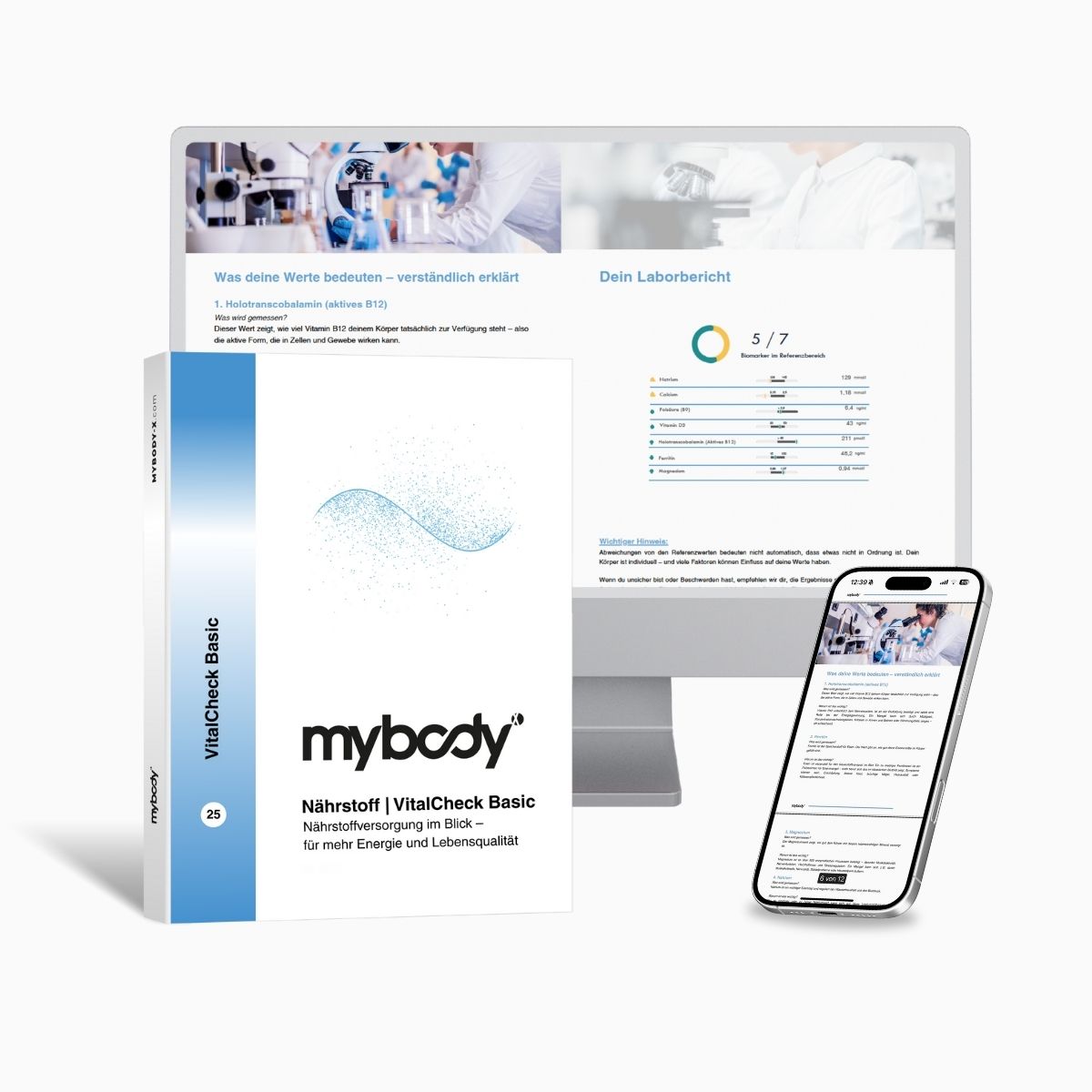
mybody®x (MYBODY Lab GmbH) offers a test that measures four metals: the BalanceCheck. You collect the sample at home with a finger prick, and it is analyzed in a certified medical laboratory.
Blood test using capillary blood
BalanceCheck | Electrolytes & Minerals Test
15 elements from a blood sample, including lead, cadmium, nickel, and mercury, plus five electrolytes and six trace elements. What the test cannot do: According to the available sources, blood is the weaker medium for cadmium, and a blood nickel level cannot be measured reliably using analytical methods, according to the UBA Commission. The test does not establish a diagnosis and is not a basis for detoxification.
Laboratory analysis 3–5 business days after sample receipt
Product page information, accessed 10 August 2026
If you measure, do so with a clear expectation. The following four points describe what can reasonably follow from such a result.
Note everyday sources
Smoking, eating fish, older buildings, workshops, amalgam fillings. This list explains more than any number.
Distinguish reference and HBM values
One tells you how you compare with others. Only the other has health significance.
Know the right medium
For cadmium, urine is the more informative medium. A low blood level does not mean no exposure.
Have an abnormal result medically assessed
Not with a detox cure, but with an appointment. Environmental medicine questions belong in expert hands.
Chapter at a glance
A heavy-metal blood test provides useful values for lead and organic mercury, a weak indicator for cadmium, and, according to the cited sources, no reliable value for nickel. A result does not indicate detoxification; it raises the question of sources in everyday life. Anyone who wants to explain an abnormal result needs medical assessment and, in the case of cadmium, a urine test.
Limitations: what a blood test cannot answer
A blood test does not establish a diagnosis and is not an environmental medicine assessment. Neither HBM-I nor HBM-II is a diagnostic threshold. The former means that no adverse health effects are expected; the latter means that such effects may be possible and that specialists should become involved.
It also does not measure the total body burden. Lead accumulates in the bones with half-lives ranging from years to more than twenty years, while the blood level primarily reflects exposure over the last three to five weeks. A low blood level does not rule out previous exposure.
The data also have limitations. Current representative population data are available only for children and adolescents because GerES V included exclusively this age group. There is no comparable figure for adults, so none is given here.
We deliberately left out two common claims. We found no admissible source for a connection between exposure levels in the general population and symptoms such as chronic fatigue or concentration problems. Nor did we find one for the benefits of hair mineral analysis.
Finally, amalgam: It is established that amalgam fillings are the typical source of elemental mercury and are associated with higher measured levels. None of the sources reviewed claims that amalgam fillings cause health damage. Recommending removal as a consequence of a test result would not be justified.
What matters about these levels
If you take away one action from this article, let it be this: Write down which of the known sources occur in your everyday life. Smoking, regular fish consumption, an older building, a workshop, amalgam fillings. It takes five minutes.
The reason is unremarkable. Of everything discussed in this text, this list is the only factor you can change yourself. A measurement tells you where you stand. A source explains why.
It started with the question of what can be measured in blood. The most honest answer is: less than four lines on a test report might suggest. And the second-most honest answer: Exposure levels in Germany have fallen dramatically since the 1980s, and that fact appears in none of the advertising brochures.
Frequently asked questions
What does it mean if my level is above the reference value?
Initially, nothing from a health perspective. The German Environment Agency’s Human Biomonitoring Commission states that reference values have no health significance per se and merely describe the exposure situation of the reference population at the time of the study (1996). A value above that range means you are more heavily exposed than most other people. HBM values are used for a health assessment.
Which heavy metals can be meaningfully measured in blood?
Lead is suitable, as it reflects exposure over the past three to five weeks. For organic mercury, the Human Biomonitoring Commission explicitly recommends testing whole blood; urine is suitable for inorganic mercury. Cadmium accumulates in the kidneys and is assessed more accurately through urine. For nickel, the Commission states that its concentration in blood cannot be measured reliably using analytical methods (2001).
How heavily are people in Germany exposed?
In the GerES V environmental study, the geometric mean blood lead level in 3- to 17-year-olds was 9.47 micrograms per liter, while blood cadmium was below the limit of quantification of 0.06 micrograms per liter (Vogel et al., 2021). According to the German Environment Agency, less than one percent of the population has mercury levels at which adverse health effects cannot be safely ruled out. Current representative data for adults are not available.
Where do most people get cadmium from?
According to the German Federal Institute for Risk Assessment, cereals and cereal products account for the largest share, at 40 to 50 percent, followed by potatoes at 13 to 15 percent. Higher levels are found, among other things, in porcini mushrooms, cocoa powder, sunflower seeds, flaxseeds, and mussels. Smokers also have additional exposure through tobacco smoke. The kidneys are particularly sensitive to cadmium.
Can heavy metals be eliminated from the body?
We found no evidence in the reviewed institutional sources for detoxification in the exposure range of the general population. Chelation therapy is a medical intervention for high exposure and is not intended for home use. The evidence-based approach is to address the sources of exposure, for example by avoiding smoking or choosing certain types of fish. For lead, the German Federal Institute for Risk Assessment recommends minimizing intake as much as possible.
Next step
Four values that no one else tests
Lead, cadmium, nickel, and mercury rarely appear in routine laboratory tests. The BalanceCheck measures them together with electrolytes and trace elements. The limits for each metal are listed in Chapters 6 and 9, and remain unchanged.
Go to the BalanceCheck Understand electrolytes in the bloodRead more
You might also be interested in this
The basics of the substances included side by side in the same test.
When a measurement is actually useful—and when it is not.
Sources
- Commission on Human Biomonitoring, German Environment Agency: Concept of Reference and Human Biomonitoring Values, German Federal Health Gazette 39(6), 1996 – umweltbundesamt.de
- Human Biomonitoring Commission, German Environment Agency: Substance monographs on lead (2nd addendum, 2009), nickel (2001), and cadmium (updated 2011), Federal Health Gazette – lead, nickel, cadmium
- Vogel N et al. (German Environment Agency): Lead, cadmium, mercury, and chromium in urine and blood of children and adolescents in Germany, GerES V. International Journal of Hygiene and Environmental Health 237, 2021 – pubmed.ncbi.nlm.nih.gov
- World Health Organization (WHO): Lead poisoning and health, fact sheet (as of 2026) – who.int
The verbatim quotation on the health relevance of reference values, as well as the definitions of reference value, HBM-I, and HBM-II, comes from source [1]. The suspension of HBM values for lead and its rationale, the assessment of nickel measurement, the estimate of nickel sensitization, as well as the HBM values for cadmium and the information on storage and half-lives, come from the three substance monographs under [2]. The exposure figures from GerES V come from [3], and the statement concerning the absence of a threshold of effect for lead comes from [4]. The time series from the Environmental Specimen Bank, the updated reference values from 2019, and the information on mercury in the population come from the relevant pages of the German Environment Agency; the information on sources of exposure to cadmium, lead, and mercury comes from the German Federal Institute for Risk Assessment; and the tolerable weekly intake amounts come from the European Food Safety Authority. All are attributed in the text by institution and year. Information on price, biomarkers, sample type, and laboratory comes from the mybody®x product page, accessed on 10/08/2026; processing times follow the central specifications for blood tests. All sources were accessed and reviewed on 10/08/2026.

mybody®x Editorial & Expert Team
Laboratory diagnostics Nutritional science Blood analysis interpretation Nutrigenetics
This article was created by the mybody®x editorial and expert team. The team combines laboratory diagnostics, nutritional science, and the interpretation of blood analyses. Everyone involved can be found on the authors page.
Published on 10/08/2026 · Last updated on 10/08/2026
The content is intended for general information and does not replace medical advice, diagnosis, or treatment. Reference ranges depend on the laboratory, method, and age—what always matters is the information provided on your test report.




Share now:
Lose weight quickly in one week: what’s really possible in seven days
DNA Test for Weight Loss: What It Can and Cannot Do