
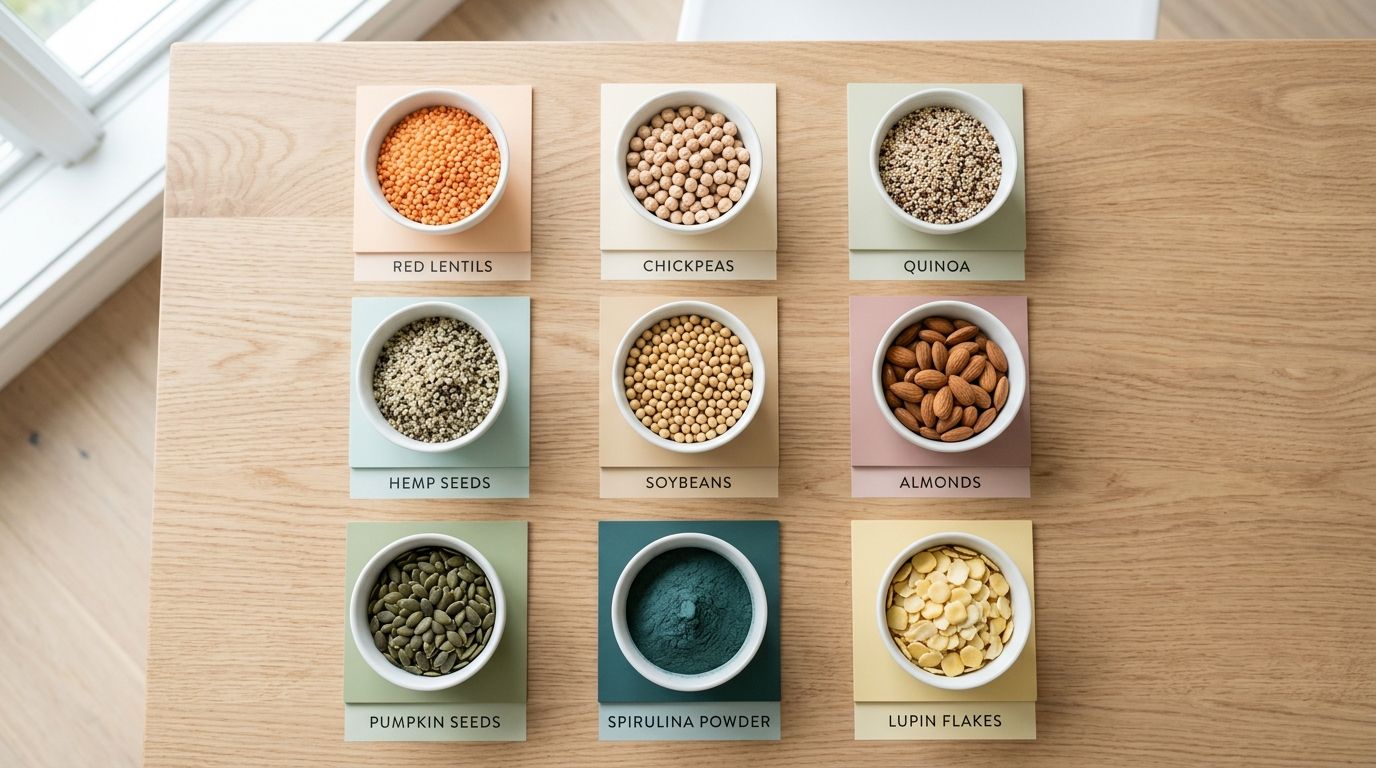
Plant-Based Protein Sources Table: Your 2026 Guide
You may be sitting in front of a search results page right now, opening the next Plant-Based Protein Sources Table and thinking: great, there are the numbers. But what do I actually do with them? Are lentils, tofu, and oats really enough if you want to eat more plant-based, lose weight, or preserve your muscle during training?
This is exactly where things become confusing for many people. Some say that plant-based protein is fully sufficient. Others warn of gaps, low-quality protein, or poor utilization. Both views fall short. What matters is not only how much protein a food provides on paper, but also how well your body can actually use that protein.
That is why it is worth looking beyond simple table values. If you want to eat a plant-based diet in everyday life, numbers can help. But if you want to understand why you feel differently satiated, capable, or recovered despite choosing good foods, you need more than numbers. You can also find a good introduction to the topic in the article on healthy vegan nutrition.
Plant-Based Nutrition and Protein Myths Put to the Test
Many people start with a simple assumption: eliminate meat, and you have a protein problem. In practice, I see the opposite more often. Most people do not eat too little plant-based protein; they rely on individual favorite foods and expect too much from them.
A typical example is a quick bowl made with vegetables, some avocado, and quinoa. It sounds healthy, and it is. But healthy does not automatically mean optimal for every goal. If you are specifically focusing on satiety, muscle retention, or recovery, you need more structure in your choice of protein sources.
Why the protein myth is so persistent
The myth persists because many tables show only the raw value. That seems clear-cut, but it is only part of the truth. If you shop exclusively by grams per 100 grams, you can quickly overlook two things:
- Combination matters. A single food does not have to do everything on its own.
- Utilization matters just as much. Your body does not work with tables, but with amino acids, digestion, and metabolism.
Many uncertainties surrounding plant-based protein do not stem from an actual deficiency, but from unclear expectations of individual foods.
What works in practice
What works is usually unspectacular. Eat legumes regularly. Use soy products wisely. Don’t view nuts and seeds as mere decoration. Consciously add grains and pseudocereals. And above all, don’t expect vegetables alone to become your main source of protein.
What usually does not work well is a very “clean” plate with lots of vegetables but little substance. Anyone who eats a plant-based diet and is constantly hungry often does not have a vegan problem, but a planning problem.
The good news is that a plant-based diet can fully meet your protein needs. It only becomes interesting when you want to understand which sources suit your everyday life, your goals, and your personal biology.
Understanding the basics of protein quality
Protein is not simply protein. Two foods can contain similar amounts of protein and still have very different effects in everyday life. The reason lies in protein quality.

Essential amino acids explained simply
Proteins are made up of amino acids. Some of them are essential, meaning they are building blocks that your body cannot produce on its own. You need to get them through your diet.
Here is a simple way to picture it: Imagine protein as a toolbox. If an important tool is missing, you cannot complete the job properly. Amino acids work the same way. A food can provide a lot of total protein but be weaker in certain individual amino acids.
Why tables only show half the truth
This is exactly where the classic Plant-Based Protein Sources Table falls short. According to PETA’s information on vegan nutrition and protein quality, the widespread focus on protein content alone critically overlooks the bioavailable amino acid composition and its individual genetic usability. Tables often show only total protein content, but not important quality criteria such as the PDCAAS score or the individual utilization of essential amino acids such as lysine or methionine, which can be influenced by genetic variants.
So if you have only compared foods by grams so far, it is worth looking at them from a different perspective. You can also find more guidance in the overview of protein-rich foods and their sources.
Three terms you really should know
-
Digestibility
It describes how well your body can absorb the protein it contains in the first place. -
Biological value
It shows how efficiently dietary protein can be converted into the body’s own protein. -
PDCAAS score
This term evaluates protein quality not only based on quantity, but also on amino acid profile and digestibility.
Practical rule: Do not rely on a single “superfood.” With plant-based protein, variety is usually wiser than perfectionism.
For people who want to tailor their diet not just broadly but individually, a genetic perspective may be useful. The NutriCare | INFINITY DNA test from mybody®x analyzes genetic nutrient utilization, food intolerances, micronutrient requirements & metabolic type. The most comprehensive nutritional DNA package for a permanently personalized nutrition plan—precise, scientific & convenient from home.
The comprehensive table of plant-based protein sources
If you want to use a plant-based protein sources table effectively, do not read it like a ranking, but like a toolbox. Concentrated sources are often at the top. For everyday use, however, the mid-range values are also important because they are more likely to end up on your plate.
According to the information from ALDI SÜD on plant-based protein sources, plant-based protein sources vary considerably in their content: Concentrated sources such as soy chunks, with around 50 g of protein per 100 g, and lupin flakes, with 43 g, top the table, while high-fat seeds such as pine nuts, with 37.3 g, and hemp seeds, with 31 g, also provide outstanding values. Traditional legumes such as lentils, with 25 g, and chickpeas, with 20 g, are excellent sources, while even grains such as oats, with 13.5 g, and quinoa, with 14.8 g, make a significant contribution to protein intake.
How to use the table effectively
Consider three questions:
- Is the source concentrated or practical for everyday use? Soy chunks are very high in protein, but they usually do not end up on your plate every day.
- Is it a staple or a supplement? Oats and quinoa are strong contributors, but are rarely the main source on their own.
- How well does it fit into your daily routine? The best food is of little use if you never eat it.
Comprehensive table of plant-based protein sources
| Food | Protein (g/100 g) | Calories (kcal/100 g) | Fiber (g/100 g) | Category |
|---|---|---|---|---|
| Soy chunks | 50 | n/a | n/a | Soy product |
| Lupin flakes | 43 | n/a | n/a | Legume product |
| Pine nuts | 37,3 | n/a | n/a | Nuts and seeds |
| Dried soybeans | 36 to 38.2 | n/a | n/a | Legumes |
| Pumpkin seeds | 35,6 | n/a | n/a | Nuts and seeds |
| Hemp seeds | 31 | n/a | n/a | Nuts and seeds |
| Lentils | 25 | n/a | n/a | Legumes |
| Chickpeas | 20 | n/a | n/a | Legumes |
| Tempeh | 20 | n/a | n/a | Soy product |
| Firm tofu | 15 to 17 | n/a | n/a | Soy product |
| Quinoa | 14,8 | n/a | n/a | Pseudocereals |
| Rolled oats | 13,5 | n/a | n/a | Grains |
The columns for calories and fiber are deliberately omitted here. The released data does not contain complete values for the entire table for these foods. This is also a good reminder: tables often look complete, but they are not.
What works well in the kitchen
- For hot dishes, lentils, chickpeas, tempeh, and tofu are suitable.
- For breakfast and snacks, oats, hemp seeds, and pumpkin seeds are practical choices.
- For a high protein density, textured soy protein and lupin flakes are interesting options if you are specifically focusing on protein.
After a test, anyone specifically supplementing a nutrient deficiency often looks beyond protein alone. The Vitamin D3 K2 Complex | Shield from mybody®x combines high-dose D3 with K2 for optimal calcium utilization, bone health & immune system support. Ideal after DNA or blood testing when a deficiency has been identified, precisely dosed, with maximum bioavailability.
The top 3 protein sources in detail
Some foods come up repeatedly in consultations because they are practical, familiar, and rich in protein. Three stand out in particular: soybeans, pumpkin seeds, and hemp seeds.
Soybeans as an all-rounder
According to the released information, soybeans contain approximately 36 g of protein per 100 g. Their major advantage is not just the amount, but also their versatility. Soy is used to make a wide variety of everyday products, from tofu to tempeh.
In practice, soy products are the easiest bridge between theory and everyday life for many people. They can be seasoned mildly, neutrally, or boldly and work in a pan, oven, bowl, or packed meal. If you have little time, soy is often a better choice than complicated specialty products.
Pumpkin seeds as a concentrated addition
According to the additional information provided by the content owner, pumpkin seeds, with approximately 30 g per 100 g, are a source with a high protein ratio. Their major everyday advantage is how easy they are to incorporate. You do not need to precook, marinate, or soak anything.
Pumpkin seeds are more of an addition than a main source. A tablespoon makes a meal more nutritious, but it does not replace a real protein base. This is exactly where many misconceptions arise: toppings are overestimated, while main components are underestimated.
Pumpkin seeds are powerful, but they work best as a boost to a meal that is already well planned.
Hemp seeds as an underrated insider tip
According to the approved data, hemp seeds provide around 31 g of protein per 100 g. The available information also describes them as an insider tip with a complete amino acid profile. This makes them particularly interesting for people who want to enhance their diet with minimal effort.
Hemp seeds fit into porridge, salads, bowls, and smoothies. They are not a substitute for legumes or soy products, but a smart addition for people who want more consistency in their everyday routine.
Looking beyond the numbers
In the end, the most interesting question is not which food “wins.” The more important question is: What does your body get from it? This is precisely where personalization becomes relevant. The Longevity | ALL IN ONE DNA test from mybody®x analyzes genetic risk factors for aging, inflammation, nutrient utilization & metabolism. This is interesting when you want to view nutrition not only according to figures on lists, but also as part of a long-term metabolic strategy.
The art of combining sources for a complete profile
The statement “plant-based protein is incomplete” persists, but in everyday life it is usually too broad. A more useful statement is: Individual plant-based sources can have different strengths and weaknesses in their amino acid profiles. That is why combination works so well.

The approved information from Veganleben on vegan protein sources emphasizes the following: A higher proportion of plant-based proteins is positive because it is often associated with more fiber and fewer saturated fatty acids. In practice, however, many people do not achieve optimal results despite high protein figures in tables because they neglect the synergy of combining sources. How often legumes need to be combined with grains, or which newer sources such as lupin seeds with 42 g of protein or spirulina with 57 g offer high bioavailability, is often overlooked.
The simplest basic rule
The classic combination is: legumes plus grains. This is not a fitness hack, but sound nutritional practice.
Examples include:
- Lentils with rice for a simple lunch
- Chickpeas with whole-grain bread as a hummus meal
- Beans with corn or grains in a bowl, chili, or salad
How to put this into practice in everyday life
Not every meal has to be calculated perfectly. Much more important is a reliable pattern throughout the day.
-
Choose a main source
Use lentils, chickpeas, tofu, or tempeh as a base. -
Add a structured side
Rice, oats, quinoa, or bread often fill gaps effectively. -
Use seeds or nuts strategically
Hemp seeds, pumpkin seeds, or pine nuts enhance small meals. -
Keep it repeatable
The best combination is the one you eat regularly without any effort.
What often does not work
Many people eat randomly during the week and try to “make up for it” with healthy eating on the weekend. This usually works poorly for protein. Simple standard combinations that you can use without thinking are better.
A good plant-based diet rarely depends on perfection. It depends on repeatable combinations.
How your genes influence protein utilization
Some people eat a varied diet, pay attention to legumes, use soy, add seeds, and still do not feel as stable, satisfied, or capable as they expect. In that case, it is worth taking a clear-eyed look at a factor that tables do not show: individual utilization.
The available information makes it clear that the widespread focus on protein content alone critically overlooks the bioavailable amino acid composition and its individual genetic utilization. This is more than an academic point. It explains why the same diet can affect two people differently.
Why standard recommendations have limitations
General dietary recommendations are useful. They provide guidance. But they remain averages. They do not tell you how your metabolism processes certain nutrients, where you may be more sensitive, or how well you can tolerate individual dietary strategies in the long term.
That is precisely why nutrigenetics is becoming so interesting to many people. You can find more background in the article about nutrigenetics and its influence on our lives.
What personalized analyses can contribute
A genetic test does not replace a good diet. But it can help identify blind spots. This concerns not only protein itself, but also the context in which protein works: nutrient utilization, metabolic type, possible intolerances, and individual responses to dietary patterns.
Anyone who lives solely by general lists is working with average data. Those who use personalized information can make more targeted decisions about which foods to eat more often, where they need variety, and which strategies actually feel practical in everyday life.

How to tell that blanket rules aren't enough
- You eat “pretty well,” but do not feel consistently capable of performing
- You make conscious combinations but cannot establish a stable routine
- You want to build a diet that is not only healthy but also specifically suited to you
Such situations do not automatically mean that anything is pathological. They often simply show that your body should be considered more individually than a standard table allows.
When a diet looks good on paper but does not work in everyday life, the problem is often not a lack of discipline but insufficient individualization.
Adjusting Protein Intake to Your Goals
At the latest, this is when the practical question arises: How much protein do you actually need? According to the approved information, the German Nutrition Society recommends that adults between 19 and 65 years consume 0.8 grams of protein per kilogram of body weight, which corresponds to 56 grams of protein per day for a body weight of 70 kg. From the age of 65, the recommendation increases to 1.0 gram per kilogram to counteract physiological changes. A plant-based diet can fully meet this requirement, especially through a combination of legumes, soy products, nuts, and seeds. This information is summarized by iglo in its overview of plant-based protein sources and German Nutrition Society recommendations.

How to Calculate Your Needs for Everyday Life
The basic formula is simple: body weight multiplied by the recommendation.
Examples from the approved data:
- Adults aged 19 to 65 should calculate with 0.8 g per kg of body weight
- People aged 65 and over should calculate with 1.0 g per kg of body weight
If you want to plan your meals better, the article on daily protein requirements can also help.
What This Means for Typical Goals
In everyday life, this means you do not need to pack as much protein as possible into every meal. More important is that each of your main meals contains a recognizable source of protein and does not consist only of vegetables and quick side dishes.
For people with weight management goals, structure is especially important. Protein-rich meals are often easier to plan and more filling than highly processed snacks. For older adults, consciously ensuring sufficient protein intake becomes increasingly important, as the body may respond more sensitively to muscle loss with age.
A Simple Daily Approach
- Breakfast with a substantial base, such as oats plus hemp seeds and a soy product
- Lunch with legumes or soy protein as the main component
- Dinner should be planned to be not only light but also a source of protein
People who eat plant-based and combine foods only in a generally “healthy” way often fall short of their potential. Those who consciously structure every main meal usually notice a more settled eating routine quite quickly.
Frequently asked questions about plant-based protein
Is plant-based protein really sufficient
Yes, if you structure it wisely. The available data clearly show that a plant-based diet can meet nutritional needs. Problems usually arise not from the concept itself, but from a selection that is too monotonous or from meals that lack structure.
Do I need to combine foods perfectly at every meal
No. What matters is eating a varied diet throughout the day and week. Nevertheless, proven combinations are helpful in everyday life because they make planning easier and help avoid common gaps.
What is the best plant-based protein source
There is rarely one best source. For high protein density, textured soy protein is an excellent choice. For practical everyday meals, lentils, chickpeas, tofu, and tempeh work very well. For small upgrades, hemp seeds, pumpkin seeds, or pine nuts are useful.
Why do protein analyses surprise many people
Because numbers alone often create a false sense of security. Many people expect too much from a single food. Others underestimate how much utilization, combinations, and individual biology can make a difference.
Such surprises show how important precise analyses are compared with rules of thumb.
Does soy play a special role
Yes, especially from a practical perspective. Soy is versatile, easy to incorporate, and for many people the simplest way to make plant-based meals higher in protein. However, if you do not like soy or do not tolerate it well, you can also build a solid diet around other sources.
When is a personalized analysis worthwhile
If, despite eating well, you still cannot find a clear approach to energy, satiety, or practicality in everyday life. A general plant-based protein sources table is often no longer enough. Personalized analyses are especially interesting if you want to tailor your diet not just to be “healthy,” but to suit your metabolism.
If you no longer want to eat based solely on general reference tables but want to understand how your body processes nutrients individually, MYBODY Lab GmbH offers scientifically grounded at-home DNA, metabolic, and health analyses. This is useful if you want to approach plant-based nutrition, weight management, and long-term health goals in a more personal, data-driven way.

Share now:
Your Omega-3 Athlete Guide: Performance & Recovery
Balance Your Acid–Base Levels: Your Path to Balance