
Libido and hormones: which values really matter
The essentials at a glance
When desire declines, the first suspicion almost always turns to hormones. That is understandable, and based on the available evidence, it is less often the explanation than most people assume.
This article shows what can be said based on evidence about the connection between hormones and sexual desire, which values are even mentioned in this context, and what else plays a role.
What you will not find here: a way to increase desire. We have no evidence-based source for this, and anything that makes this promise should make you suspicious.
What to expect in this article
1. Why hormones are always the first suspected cause
2. What the evidence actually shows
3. Which values are mentioned in this context
4. What else plays a role
5. In men: testosterone and its pitfalls
6. In women: what the transition changes
7. Comparing three approaches
8. What you will take away from this article
Frequently asked questions
Sources
Why hormones are always the first suspected cause
There is a simple explanation for why hormones are mentioned first on this topic: They are measurable. Everything else involved here is difficult to express as a number, and a number feels like an answer.
There is also the narrative spread online and in advertising: A value is too low, you raise it, and everything comes back. This narrative is catchy, sells well, and does not stand up to the evidence.
This does not mean that hormones play no role. It means that they are one of several factors and do not take precedence over those factors simply because they can be measured. Whoever measures first sometimes finds something and often overlooks what is more obvious.
This article therefore reverses the usual order. It begins with what has been established, then names the values that are even discussed, and places them in the context they belong to.
What the evidence actually shows
For the stage of life in which this connection is most often suspected, the statement by the Institute for Quality and Efficiency in Health Care is unusually clear:
Evidence-based source
“So far, there is no evidence that the hormonal transition itself impairs sexual sensation or desire.”
Institute for Quality and Efficiency in Health Care (IQWiG)
Well-being during menopause, as of 02/01/2023
This sentence is the most uncomfortable and at the same time most useful information in this article. It does not say that no one experiences a change during this phase. It says that the change cannot be attributed to the hormonal transition as such.
Key message
Experiencing a change and having a hormonal cause for it are two different statements. The first is common; the second has not been established.
The same source puts this into further perspective: The effects of menopause on sexuality vary, and aging itself apparently plays a more important role here. According to the same source, psychological, social, and cultural factors also play a role, as does the situation within the relationship (IQWiG, 2023).
That sets the framework. Anyone who looks exclusively at laboratory values on this subject is searching where the light is brightest, rather than where the source suspects the causes lie.
Why “normal” is not a benchmark here
There is hardly any subject where people ask about the normal value so often and gain so little from it. Sexual desire varies considerably between people, changes over the course of life, and fluctuates from week to week. There is no reference range for it as there is for a blood value.
That is why the question “is this still normal?” is rarely helpful. More helpful is: Has anything changed, since when, and is it bothering you or someone else? A change that burdens no one does not need to be investigated. One that causes distress does, regardless of whether a value is abnormal.
This difference is also why comparisons with others are particularly unhelpful on this subject. Survey figures describe averages across very different people. They say nothing about what feels right for you and primarily create pressure.
Which values are mentioned in this context
Despite this, there are values that are regularly measured in this context. Not because they provide the answer, but because they reveal other causes that can produce similar symptoms.
Total and free testosterone. This value is mentioned for both men and women. The distinction is important: total testosterone may appear unremarkable while the amount that is actually active in the body is lower. This requires SHBG and albumin, which are used to calculate free testosterone.
The thyroid. TSH, free T3, and free T4 are included because thyroid dysfunction causes fatigue, lack of motivation, and mood changes. These are symptoms that affect how someone experiences things without having anything to do with sex hormones.
Prolactin. An elevated level affects other hormonal axes and is therefore included in hormone profiles. It is rarely the explanation, but it should still be checked because it is easy to measure.
Iron, vitamin B12, and vitamin D. They are not on the list because of desire, but because of exhaustion. Anyone who is tired all the time experiences many things differently, and fatigue is the most reliable opponent of almost everything.
The pattern behind this list is crucial: Not one of these results measures desire. They all measure something that can provide another explanation, and that is precisely where their usefulness lies.
What else plays a role
The factors mentioned by the source cannot be measured and are nevertheless the ones it points to. Overlooking them here would be dishonest, even if they fit less neatly into a guide than a list of test results.
No lab result measures desire.
Sleep. Persistent sleep deprivation changes motivation, mood, and resilience. It is rarely mentioned in this context and is one of the few areas where something can be changed with reasonable effort.
Prolonged stress. Anyone who remains tense for months experiences a shift in priorities, and that is not a question of character but an adaptation. Interpreting it as personal failure adds a second burden.
Medications. Several common groups of active ingredients can affect sexual experience. This is one of the most frequently overlooked points and, at the same time, the one where a conversation can help most quickly. Therefore, never stop taking anything on your own; bring it up instead.
The relationship and your own history. The source explicitly mentions psychological, social, and cultural factors, as well as the situation within the relationship (IQWiG, 2023). There is no test or shortcut for this, and yet this is the area where the answer most often lies.
What a finding can accomplish in this case
Because no test result measures desire, it is worth taking a close look at what a measurement actually contributes. It has exactly one task: to rule in or rule out explanations that come from elsewhere and feel similar.
An underactive thyroid makes you tired and lethargic. Iron deficiency does too. A significant vitamin D deficiency is also mentioned in this context. All three can be measured, all three can be treated, and all three are regularly overlooked in everyday life because their signs are so nonspecific.
That is precisely where the benefit lies: not in answering the original question, but in ruling things out. Anyone who knows that their thyroid, iron, and prolactin levels are unremarkable can turn to the areas where the source suspects the causes lie, without constantly wondering whether a physical explanation has been overlooked.
And the other side of the coin is part of it too: An abnormal result proves nothing. It offers a possible explanation that is investigated and, if necessary, treated. Whether this changes anything only becomes clear afterward, and that too should be medically supervised.
In men: Testosterone and its pitfalls
When men have measurements taken in relation to this topic, it is almost always testosterone. Two characteristics of the level regularly lead to incorrect conclusions, and both are easy to avoid.
The first is the daily pattern. Testosterone fluctuates considerably throughout the day and is highest in the morning. A single measurement in the afternoon consequently says little, which is why the time the sample was taken should be included in the results. A low value measured late in the afternoon is not a result but a scheduling error.
The second is the difference between the total level and the free fraction. A large proportion of testosterone is bound to transport proteins and is inactive in this state. The total level can therefore appear normal while the active fraction is lower. Anyone who has only the total level measured receives half the information.
The regulatory hormones LH and FSH, as well as prolactin, are also included. They show whether the signal from the brain is getting through or whether the problem lies further down the line, helping distinguish between different possible causes. Estradiol is also part of the picture in men; its presence in the results is not an error but part of the assessment.
Why testosterone is also mentioned in women
Testosterone is considered a male hormone, yet the female body produces it too, in smaller amounts. It is therefore also included in hormone profiles for women and regularly comes up in discussions on this topic.
There is little that can be stated with certainty about this, and that is important information. This article therefore gives no target values and makes no recommendation to influence the level. Testosterone treatment in women is a medical decision involving its own considerations, not an area for self-experimentation.
What the value can do is the same as with the others: It is part of a profile that provides an overall picture. Together with DHEA-S and SHBG, it describes an area that would otherwise not be visible at all, which is why it is included in the Menopause Check.
In women: what the transition changes
For the period of hormonal transition, the source identifies a physical issue that differs from desire and is often confused with it: Around 3 in 10 women experience symptoms from around the time shortly before menopause because their vaginal lining is more sensitive and drier than before (IQWiG, 2023).
This distinction is practically important. Symptoms during sexual intercourse are different from reduced desire, even if both are experienced together. Someone who has one but talks about the other receives an answer to the wrong question.
To treat these symptoms, the source states: Vaginal hormone treatment can alleviate such symptoms (IQWiG, 2023). Whether this is an option can only be decided by a medical practice. This article does not make a recommendation on this and cannot do so.
As for desire itself, the following still applies: There is no evidence that the hormonal transition impairs it (IQWiG, 2023). The article Losing weight during menopause describes what else this phase of life can change, and the article Perimenopause explains which values change first.
What you can gather before an appointment
Many people find a conversation about this topic difficult, and it becomes easier when a few details are already clear. Four points are enough, and they can be written down in ten minutes.
First: since when. A period in months is more precise than “for a while,” and it distinguishes a gradual change from one that began suddenly. Second: what coincided in time. A new job, a new medication, a period of sleep disruption, a change in the relationship.
Third: the complete list of medications and products, with start dates, explicitly including those you consider insignificant. Fourth: whether there are any physical symptoms. This is the information that most quickly changes the direction of the conversation, and it is often omitted out of embarrassment.
Bringing these four points with you shortens the conversation and makes it more useful at the same time. It also removes the pressure of having to formulate everything spontaneously during the appointment.
How to recognize an unserious promise
Hardly any topic is marketed so heavily, and the patterns keep repeating. Four characteristics appear together almost every time, and knowing them saves money and disappointment.
First: a quick result within a set period. Second: a single active ingredient presented as the explanation for an issue that the source explicitly attributes to multiple factors. Third: testimonials instead of references. Fourth: no information about what the product does not achieve.
The fourth characteristic is the most reliable. Anyone who lists only advantages is selling. Anyone who mentions the limitations is explaining. This test applies just as much to guides as to products, including this offering explicitly.
And a note on safety: Products with hormonal effects are not dietary supplements, even when they are marketed as such. They intervene in a self-regulating cycle, may interact with medications, and their use should be medically supervised.
Three options compared
Anyone who wants to do something about this issue has three options. The table compares them side by side using the same criteria, with an honest column showing what each option does not achieve.
| Criterion | Rule out other causes | Medical consultation | Know your own values |
|---|---|---|---|
| What it is based on | sleep, stress, medication, and your personal circumstances | the assessment provided by someone who can ask follow-up questions | whether something measurable is out of balance in the background |
| What it can do | according to the available sources, most closely targets the area where the cause lies | distinguishes symptoms from declining desire | rules out or includes thyroid problems, elevated prolactin, and nutrient deficiencies as explanations |
| Effort | weeks to months, no cost | one appointment, but it takes resolve | one-time measurement, sample collection in the morning |
| What it does not do | works slowly and is difficult to measure | does not take away the observations that make the conversation useful | does not measure desire, provide a diagnosis, or replace an appointment |
What stands out is what is missing from the table: products that promise to increase desire. That is intentional. We have no substantiated source for any of them that would support a recommendation, and hormone-active preparations belong in medical care without exception.
The honest reading: Based on the available sources, column one is the most likely starting point, column two provides the most reliable assessment, and column three is one piece of the puzzle that rules out other explanations. For mybody®x (MYBODY Lab GmbH), the HormoneCheck covers the third approach for men, with analysis conducted in an ISO-certified laboratory in Germany.
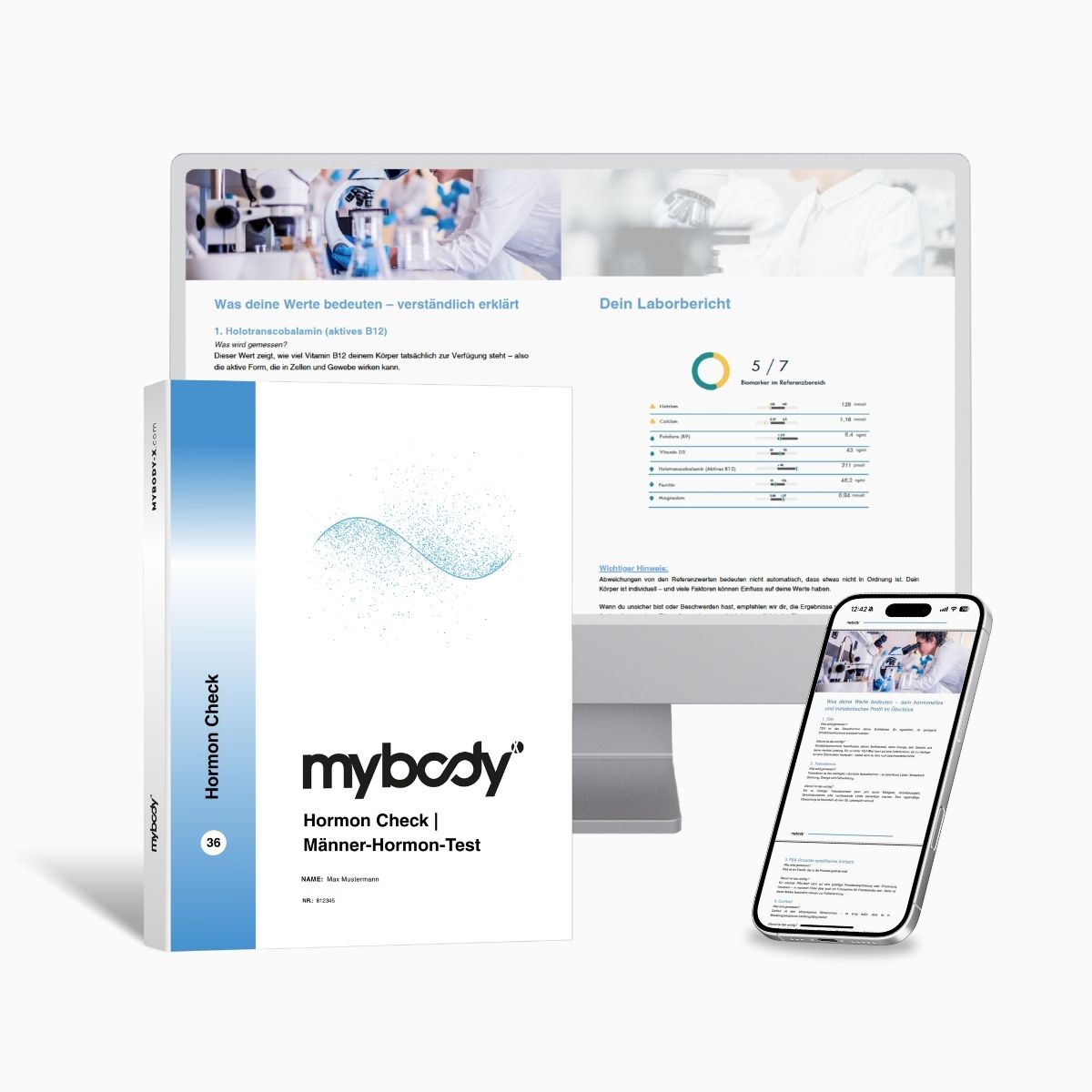
Hormone profile from a blood sample
HormoneCheck | Men's Hormone Test
Total and free testosterone, along with SHBG and albumin; the regulatory hormones LH, FSH, and prolactin; as well as DHEA-S, estradiol, and TSH. What the test does not do: It does not measure sexual desire, provide a diagnosis, or replace a consultation with a doctor.
Laboratory results 3–5 business days after sample receipt
Information from the product page, accessed on 26 August 2026
For women, the Menopause Check measures cycle hormones along with testosterone and DHEA-S, while the Women's Wellness Check measures the thyroid profile along with ferritin, B12, and D3. The Biomarker Lexicon with 67 explained blood values explains what the individual values mean. The comparison honestly answers whether testing is worthwhile for you, in both directions:
Useful for you if …
if you are also persistently tired and lacking drive and want to know whether there is something measurable behind it.
you are preparing for a conversation and want to bring numbers on testosterone, thyroid function, and prolactin.
you can arrange sample collection in the morning, because otherwise the value is difficult to interpret.
Rather not if …
you are hoping it will answer the question of desire. No laboratory value measures desire.
the stress or relationship situation is the obvious factor. Then a measurement is targeting the wrong place.
you have physical symptoms. These should be discussed and investigated, not measured and interpreted on your own.
Next step
If you first want to see where you stand
The HormoneCheck calculates free testosterone from total testosterone, SHBG, and albumin, and also measures the regulatory hormones. The Biomarker Dictionary explains what the individual values mean and what to consider regarding the timing of sample collection.
Go to the HormoneCheck Go to the Biomarker DictionaryWhat you should take away from this article
If you remember one thing, let it be the sentence from the source: So far, there is no evidence that hormonal changes themselves affect sexual sensation or desire (IQWiG, 2023). This does not invalidate anyone’s experience; it shifts the search toward where the source suspects the causes lie.
And keep the role of the lab values in mind: They do not measure desire. They make other explanations visible, above all thyroid problems, prolactin, and nutrient deficiencies, all of which can cause fatigue. That is a limited but real benefit, and no one should promise more.
It started with a suspicion that feels plausible. What remains is a more honest order: first sleep, stress, and medications, then the conversation, and then the lab values. If you want to know what your body is currently dealing with: the consultation is free, and it does not sell you anything.
Frequently asked questions
Are hormones to blame when desire declines?
There is still no evidence for this in relation to hormonal changes (IQWiG, 2023). The same source identifies aging itself, psychological, social, and cultural factors, as well as the situation within the relationship as the areas where the explanation is more likely to lie.
Which blood values should I have tested?
Total and free testosterone with SHBG, the thyroid panel, prolactin, as well as ferritin, vitamin B12, and vitamin D are mentioned. None of these values measures desire. They make other explanations visible, especially those that cause fatigue.
Why should testosterone be measured in the morning?
Because the level fluctuates considerably throughout the day and is highest in the morning. A single measurement in the afternoon therefore says little. The time of sample collection must therefore be included in the test report; otherwise, the number can hardly be interpreted.
What helps with declining desire?
We have no documented source for a general recommendation and therefore this article does not provide one. What the source suggests is the direction to take: look at sleep, stress, medication, and your personal circumstances first, rather than starting with laboratory values.
What about symptoms rather than a lack of desire?
These are two different issues. Approximately 3 in 10 women experience symptoms from the period just before menopause onward because the vaginal lining is more sensitive and drier than it used to be; vaginal hormone treatment can alleviate such symptoms (IQWiG, 2023). Whether this is suitable is decided by a medical practice.
Read more
You might also be interested in this
Why a single hormone level says little without knowing the cycle day.
When the thyroid is being considered as an explanation.
Sources
- Institute for Quality and Efficiency in Health Care (IQWiG): Well-being during menopause (as of 02/01/2023) – gesundheitsinformation.de
The verbatim quotation concerning the lack of evidence for a connection between hormonal changes and sexual sensation comes from [1], as do the statements about the various effects of menopause on sexuality, the role of aging, the approximately 3 in 10 women with vaginal mucosal symptoms, and vaginal hormone treatment. The source’s sentence about psychological, social, and cultural factors contains an em dash and was therefore reproduced with attribution only. No statements are deliberately made about ways to increase sexual desire because there is no documented source for this. Information on price, sample type, scope of services, and laboratory is taken from mybody®x product pages, accessed on 26/08/2026; processing times follow the central specification for each test type. The source was accessed and reviewed on 26/08/2026.

mybody®x Editorial & Specialist Team
Blood analysis interpretation Nutritional science Laboratory diagnostics
This article was created by the mybody®x editorial and specialist team. The team combines the interpretation of blood analyses, nutritional science, and laboratory diagnostics. Everyone who contributes to it is listed on the authors page.
Published on 26/08/2026 · Last updated on 26/08/2026
The content is intended for general information and does not replace medical advice, diagnosis, or treatment. Reference ranges depend on the laboratory, method, and age; the information on your test report is always authoritative.



Share now:
Losing belly fat: what really works and what is a myth
Hair Loss in Women: Understanding Causes and Interpreting Test Results