

Hypothyroidism and diet: what is actually supported by evidence
The essentials at a glance
The short answer differs from what most guides say. The guideline of the German Society for General Practice and Family Medicine states that there is no evidence of a patient-relevant benefit from trace elements, herbal preparations, or dietary supplements for hypothyroidism and Hashimoto’s thyroiditis (2024). This explicitly includes iodine, selenium, and vitamins.
Something else is supported by evidence, and it concerns diet in the narrower sense: the timing of taking medication. The same guideline recommends waiting at least 30 minutes before a meal and before taking other medications, and identifies calcium, iron, and other substances that interfere with absorption.
You will first read what hypothyroidism is and how common it is. Next come TSH levels in numbers, the evidence-based timing gap, a fact-check of selenium, gluten, and cruciferous vegetables, iodine supply in Germany, and finally what a test can show. This article does not replace medical treatment.
What to expect in this article
1. What hypothyroidism is and how common it is
2. What the guideline says about dietary supplements
3. Subclinical and overt: the difference
4. TSH levels in numbers
5. The medication timing gap: the evidence-based connection to diet
6. Three common recommendations fact-checked
7. Iodine: reference values and supply situation
8. Why algae need a chapter of their own
9. What a package may say and what it may not
10. What a TSH self-test shows and what it does not
11. Limitations: what this article does not answer
12. What remains of the diet question
Frequently asked questions
Sources
What hypothyroidism is and how common it is
With hypothyroidism, the thyroid gland produces too few hormones. The Institute for Quality and Efficiency in Health Care states the prevalence as follows: In countries such as Germany, approximately 5 in 100 people have hypothyroidism.
The DEGAM guideline gives an annual prevalence of 2.0 percent for general practices, broken down into 3.0 percent among women and 0.9 percent among men. According to the same guideline, at least 4.8 million people in Germany were receiving thyroid hormones in 2019.
Key message
Hypothyroidism is a condition treated by a doctor. In the sources reviewed, diet is not a treatment; it is relevant in exactly one respect: the timing of taking the medication.
Why this article is structured differently
Most texts on this topic provide lists of foods that are supposedly beneficial or should be avoided. For this article, we checked IQWiG, DEGAM, DGE, BfR, the Max Rubner Institute, and the MSD Manual to determine which of these lists are supported by evidence.
The result was sobering and is the reason for the structure of this text. It first states what is actually established and then explains just as fully what is not found in any of these sources.
What the Guideline Says About Dietary Supplements
The DEGAM guideline on elevated TSH levels in primary care devotes a sentence of its own to this question, and it leaves little room for interpretation.
Documented Source
“There is no evidence that the (additional) administration of trace elements, herbal preparations, or dietary supplements (e.g., iodine, selenium, vitamins) provides a patient-relevant benefit in hypothyroidism and Hashimoto’s thyroiditis.”
DEGAM and AWMF
S2k Guideline: Elevated TSH Level in Primary Care, Register No. 053-046, as of 07/2024, page 40
Three things are contained in this sentence. First, the substance groups, explicitly including iodine, selenium, and vitamins. Second, the two conditions, hypothyroidism and Hashimoto’s thyroiditis. Third, the standard: patient-relevant benefit, meaning a benefit that the person being treated can feel.
What the Sentence Does Not Mean
Lack of evidence does not mean proven ineffectiveness. The sentence states that a benefit has not been demonstrated, not that harm has been demonstrated.
In practice, both come together at the same point. Anyone who takes a preparation whose benefit for this condition has not been established bears the cost and the risk of an interaction without a proven countervailing benefit. Whether this makes sense should be discussed with the treating physician.
Subclinical and Overt: The Difference
Two forms are distinguished, and the distinction determines what happens next. In the subclinical form, the TSH level is elevated while the thyroid hormones are within the reference range. In the overt form, the hormone levels are also below it.
The sources quantify how often one develops into the other. Each year, 2 to 5 out of 100 people with subclinical hypothyroidism develop the overt form.
Hashimoto’s Thyroiditis
The most common cause of hypothyroidism in Germany is inflammation of the thyroid gland in which the immune system targets the body’s own tissue. The DEGAM guideline names a diagnostic indicator: In 90 percent of patients with Hashimoto’s thyroiditis, the TPO antibody level is elevated.
The distinction matters for the question of nutrition because the guideline quotation cited at the outset explicitly names both conditions. The finding therefore applies to hypothyroidism in general and to Hashimoto’s thyroiditis in particular.
Why Symptoms Alone Do Not Help
The symptoms associated with hypothyroidism are nonspecific. Fatigue, lack of motivation, feeling cold, dry skin, and weight gain also occur with numerous other causes.
This lack of specificity leads to two conclusions. Having these symptoms does not mean someone has hypothyroidism, and not having them does not rule it out. The latent form often progresses without noticeable symptoms.
That is why every evaluation begins with a laboratory value, not a list of symptoms. Which value this is and from what point it is considered elevated are explained in the next chapter.
For the question of nutrition, this means taking additional care. An improvement in symptoms after changing one’s diet cannot be attributed to the thyroid without a laboratory value. This is precisely the attribution made in many personal accounts.
TSH levels in numbers
The TSH level is the starting point for every evaluation. It is not a thyroid hormone but the signal the control center in the brain uses to request more supplies. When it rises, the body is asking for more.
From what point is a TSH level considered elevated?
> 4.0
mU/l in people aged 18 to 70
> 5.0
mU/l in people aged 70 to 80
> 6.0
mU/l in people over 80
Source: DEGAM and AWMF, S2k guideline Elevated TSH Value in General Practice, registry number 053-046, as of 2024
Why the cutoff rises with age
The three numbers are not coincidental. The same guideline states that the cutoff values used by laboratories vary between 2.5 and 5.0. Thus, a value of 4.5 may be reported as elevated in one laboratory and as normal in another.
For personal interpretation, this leads to a clear rule: the reference range shown on your own lab report is decisive. A value without its corresponding range cannot be assessed.
The interval between taking it: the documented connection with nutrition
This is the only place where nutrition actually appears in the guidelines reviewed, and it concerns not the food itself but the time interval between eating and taking the tablet.
The DEGAM guideline recommends taking levothyroxine at least 30 minutes before a meal and before taking other medications, or alternatively in the evening before going to bed.
Which substances interfere with absorption
The same guideline lists them individually: cholestyramine, iron supplements in the form of ferrous sulfate, sucralfate, calcium, and antacids interfere with the absorption of levothyroxine. A corresponding interval of at least 30 minutes is recommended.
In practical terms, this means that a calcium supplement or an iron supplement should not be taken at the same time as the thyroid tablet. The same applies to calcium-rich foods within the short period around taking it.
The guideline says nothing about coffee. The common recommendation not to drink coffee with the tablet comes from other contexts and cannot be substantiated by the sources reviewed here. Anyone who wants more detailed information should ask at the pharmacy or their doctor’s office.
Why the interval matters at all
The active ingredient is absorbed in the intestine, and certain substances bind to it there before it can be absorbed. What is bound leaves the body unused.
In practical terms, this means that the amount taken and the amount absorbed are not the same. Anyone who regularly takes the tablet together with a calcium supplement absorbs less than the dose prescribed on the prescription.
That is why the guideline explicitly specifies the interval and why it deserves the same attention as the dose itself. The alternative of taking it in the evening, which the guideline offers, solves the same problem in a different way.
One qualification is necessary: The treating practice decides which option is suitable in each individual case. Anyone wishing to change when they take it should discuss this with their doctor, because their blood values may change as a result.
Three common recommendations fact-checked
Three pieces of advice appear in almost every text on this topic. We compare them with the sources for this article.
Claim and evidence
“Selenium helps with Hashimoto’s”
A Cochrane Review evaluated four studies with a total of 463 participants and concluded that the results do not provide sufficient evidence to support the use of selenium in treating Hashimoto’s thyroiditis (2013). The DEGAM guideline explicitly denies any patient-relevant benefit (2024).
“A gluten-free diet improves Hashimoto’s”
Neither IQWiG nor the DEGAM guideline nor the MSD Manual mentions gluten or a gluten-free diet in connection with hypothyroidism at all. No evidence of a benefit exists in the sources reviewed.
“Cruciferous vegetables and soy should be avoided”
None of the institutions reviewed makes any statement about cruciferous vegetables, soy, or so-called goitrogens in connection with the thyroid. There is therefore no institutional basis for a blanket recommendation to avoid them.
All three points share the same structure. The issue is not that something has been disproven, but that the relevant sources say nothing about it. Anyone passing on such advice is not passing on a verified statement.
Iodine: Reference values and supply status
Iodine is the building block the thyroid uses to produce its hormones. That it is needed for this is undisputed. That additional intake is beneficial in cases of existing hypothyroidism is not, and that is precisely what the guideline citation in Chapter 2 states.
The DGE recommends an intake of 150 micrograms per day for adults aged 19 and over, 220 micrograms for pregnant women, and 230 micrograms for breastfeeding women. According to the European Food Safety Authority, a long-term intake of up to 600 micrograms per day poses no health risk to adults.
What iodine supply looks like in Germany
The Max Rubner Institute quantifies the situation: 32 percent of adults and 44 percent of children and adolescents in Germany face an increased risk of insufficient iodine intake. The same source cites as one reason the fact that only about 10 percent of bread and small baked goods contain iodized salt.
These figures describe the population and say nothing about any individual person. Above all, they support the use of iodized table salt at home, not an iodine supplement for someone with an existing thyroid disorder.
The difference between nutritional supply and treatment
Two questions regularly get conflated on this topic. The first is whether the population is adequately supplied with iodine. The second is whether additional iodine is beneficial in cases of existing hypothyroidism.
The DGE and the Max Rubner Institute answer the first question with reference values and supply data. The DEGAM guideline answers the second with the sentence from Chapter 2, which denies any patient-related benefit and explicitly includes iodine.
Anyone who mixes up the two answers concludes that an iodine supplement is useful for hypothyroidism because iodine supply in Germany is inadequate. The first statement does not support the second.
In the case of an existing thyroid disorder, there is the additional factor that the BfR explicitly points out the risks of high iodine intake for this group. The question of taking an iodine supplement therefore belongs in a medical practice, not in a guide list.
Why algae need a chapter of their own
Algae products are often advertised as a natural source of iodine. They are the subject of one of the clearest warnings in this entire field.
Brown algae can contain 2,000 to 10,000 milligrams of iodine per kilogram of dry matter.
The figure comes from a 2026 statement by the Federal Institute for Risk Assessment and refers to brown algae of the species Laminaria digitata. For context: the recommended daily intake is 150 micrograms, or 0.15 milligrams.
Where the BfR draws the line
The BfR classifies dried algae products with an iodine content above 20 milligrams per kilogram as harmful to health. Accordingly, excessive iodine intake can occur after consuming as little as around 10 grams.
In the same statement, the BfR assesses a discussed EU maximum level of 1 gram of iodine per kilogram of dry matter as insufficient to ensure safe intake with regular consumption. The institute explicitly points out the risks for people with thyroid diseases.
A note about how current the information is is appropriate. This statement is dated 5 August 2026 and is therefore very recent. Before using it for any broader purpose, it is worth checking whether its status has changed in the meantime.
What a package may and may not say
Product labels regularly state that a nutrient contributes to normal thyroid function. This statement is permitted, and it says something different from what many people read into it.
The table compares what is legally permitted and what is not.
| Statement | Permitted? | What it concerns |
|---|---|---|
| “Contributes to normal thyroid function” | Yes, as an authorized claim under the Health Claims Regulation | About a nutrient's contribution to normal function when intake is adequate |
| “Supports thyroid function in hypothyroidism” | No. Disease-related claims are not permitted for foods | About an effect on an existing disease |
| “Helps with Hashimoto's” | No. In addition, the DEGAM guideline finds no proven benefit | About treating an autoimmune disease |
| “Replaces hormone tablets” | No, and the statement is dangerous | About stopping treatment, which may only be decided by a doctor |
The first line is the one most often misunderstood. A contribution to normal function presupposes a functioning thyroid. In the case of hypothyroidism, the statement no longer describes one's own situation.
What a TSH self-test shows and what it does not
A self-test measures TSH levels from a blood sample. What it provides is an indication of whether medical evaluation is advisable. What it does not provide is a diagnosis.
A proper evaluation requires more: thyroid hormones, TPO antibodies where appropriate, and a doctor's assessment in the context of symptoms and medical history. A single TSH value is not conclusive.
mybody®x has been active since 2016, in the direct-to-consumer business since 2022, and complies with the GDPR.
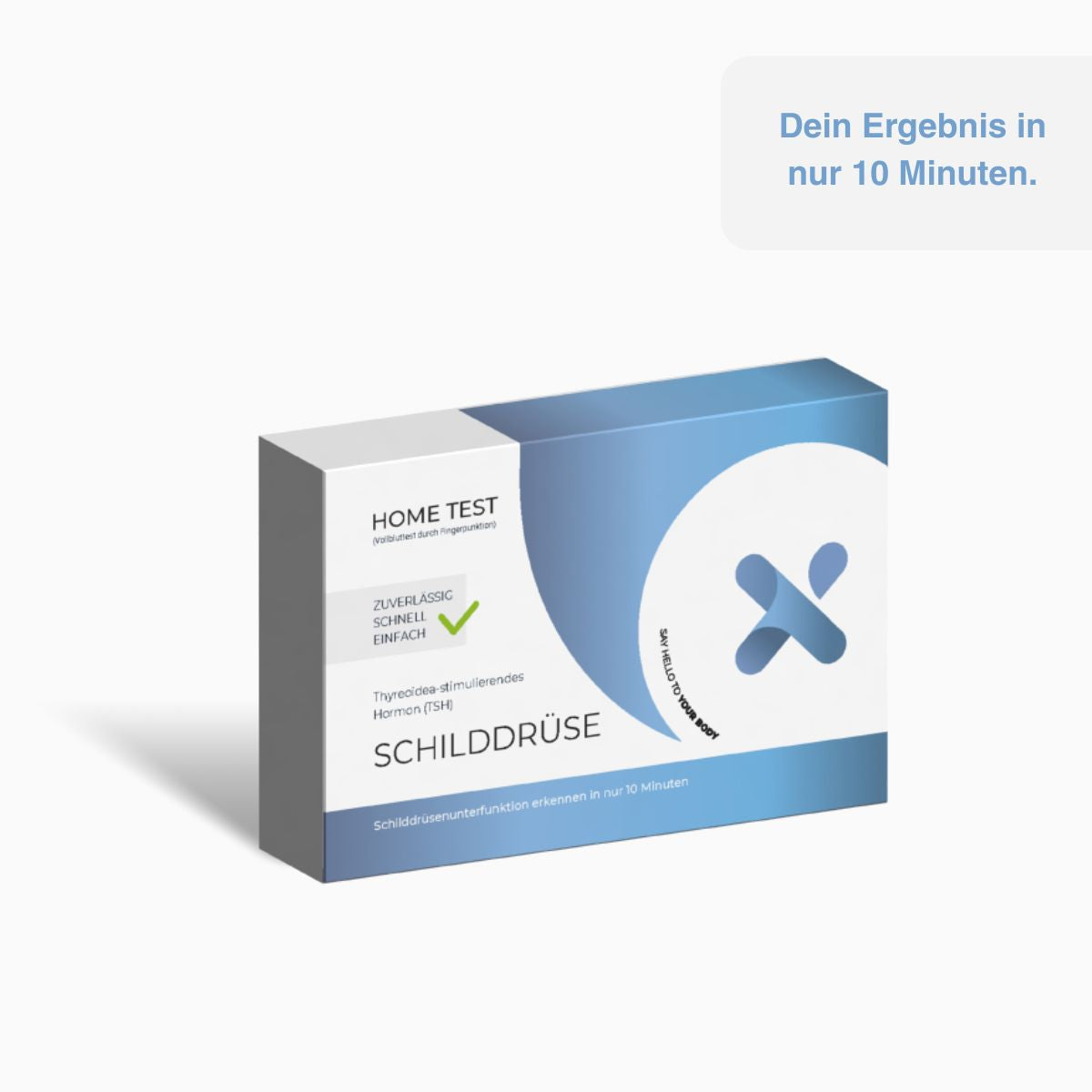
Self-test using capillary blood
Thyroid TSH self-test
A rapid test for TSH levels using a blood sample from the fingertip. What the test does not do: It does not provide a diagnosis, distinguish between subclinical and overt hypothyroidism, measure thyroid hormones, or detect antibodies. An abnormal result should be medically evaluated. Hypothyroidism may only be treated by a doctor.
Product page information, accessed 11 August 2026
Chapter at a glance
A TSH self-test provides an indication, not a diagnosis. Evaluation also requires thyroid hormones, antibodies where appropriate, and medical assessment. Hypothyroidism is treated exclusively by doctors, and this article does not change that.
Limitations: what this article does not answer
This article does not name any foods that help with hypothyroidism. The reason is given in Chapter 2: The responsible guideline rejects any patient-relevant benefit from trace elements, herbal preparations, and dietary supplements for this condition.
It likewise does not name any foods that should be avoided. We found no statement about cruciferous vegetables, soy, or goitrogens in any of the institutional sources reviewed, and we do not invent one.
The DEGAM guideline says nothing about the interaction between coffee and levothyroxine, even though it explicitly mentions milk, calcium, iron, and other substances. We therefore do not present the common recommendation about coffee as being supported by the guideline.
One final important caveat. Hypothyroidism is a condition that must be diagnosed and treated by a doctor. Existing hormone therapy must never be changed or discontinued on your own. This article is for informational purposes and does not replace medical advice.
What remains of the nutrition question
If you take one habit away from this article, make it keeping the right interval. Wait at least 30 minutes between taking the tablet and eating breakfast, and keep the same 30-minute interval from calcium and iron supplements.
This is unspectacular, but it is also the only connection to nutrition that the responsible guideline makes at all. Everything else circulating on this topic either has no institutional basis or is expressly rejected by the guideline.
It began with the question of how nutrition can support the thyroid. The most honest answer is this: When hypothyroidism has been diagnosed, treatment involves hormones, and nutrition ensures that this treatment is effective.
Frequently asked questions
Does selenium help with Hashimoto’s?
A Cochrane review evaluated four studies involving 463 participants and concluded that the results do not provide sufficient evidence to support the use of selenium in the treatment of Hashimoto’s thyroiditis (2013). The DEGAM guideline states that there is no evidence of a patient-relevant benefit from trace elements in hypothyroidism and Hashimoto’s thyroiditis (2024).
When should I take my thyroid medication?
The DEGAM guideline recommends taking levothyroxine at least 30 minutes before a meal and before other medications, or alternatively in the evening before going to bed (2024). According to the same source, cholestyramine, iron supplements, sucralfate, calcium, and antacids interfere with absorption; here too, an interval of at least 30 minutes is recommended. Discuss the specific dosing schedule with your doctor.
Do I need to avoid cruciferous vegetables or soy?
None of the institutional sources reviewed for this article contains a statement about cruciferous vegetables, soy, or so-called goitrogens in connection with the thyroid. A blanket recommendation to avoid them therefore cannot be substantiated. Discuss what applies to you with your treating medical practice.
How much iodine do I need per day?
The DGE recommends 150 micrograms per day for adults aged 19 and over, 220 for pregnant women, and 230 for breastfeeding women (2025). According to EFSA data, long-term intake of up to 600 micrograms per day poses no health risk to adults. If you have an existing thyroid condition, discuss the use of iodine supplements with a doctor.
At what TSH level is hypothyroidism diagnosed?
The DEGAM guideline defines elevated levels as above 4.0 mU/l for people aged 18 to 70, above 5.0 for those aged 70 to 80, and above 6.0 for those over 80 (2024). The same guideline notes that laboratory reference limits vary between 2.5 and 5.0. The reference range on your own test report is decisive, and interpretation is a medical matter.
Next step
30-minute interval
This is the only dietary connection made by the relevant guideline: wait at least 30 minutes between taking the tablet and eating, and leave the same interval before taking calcium and iron supplements. Anyone who wants to check their TSH level as a point of reference for a conversation with their doctor can find a self-test in the shop.
TSH self-test What ft3 and ft4 meanRead more
You may also be interested in this
The thyroid hormones themselves, if you are interested in the results beyond your TSH level.
Where TSH levels fit into the bigger picture of measurable metabolic markers.
Sources
- DEGAM and AWMF: S2k guideline on elevated TSH levels in general practice, registry number 053-046, status 07/2024 – register.awmf.org
- Institute for Quality and Efficiency in Health Care (IQWiG): Hypothyroidism, status 2024 – gesundheitsinformation.de
- German Nutrition Society (DGE): Reference values for nutrient intake, iodine, derivation status 2025 – dge.de
- Federal Institute for Risk Assessment (BfR): Mandatory maximum iodine levels in algae can help reduce amounts of intake that are harmful to health. Statement No. 044/2026 dated 05.08.2026 – bfr.bund.de
The verbatim quote regarding the lack of evidence, the TSH thresholds by age group, the laboratory range of 2.5 to 5.0, the annual prevalence of 2.0 percent, the 4.8 million people receiving care, the 90 percent with elevated TPO antibodies, and all information on taking levothyroxine and the substances that interfere with absorption come from source [1]. The frequency of approximately 5 in 100 people and the annual transition of 2 to 5 in 100 people from the latent to the overt form come from [2]. The iodine reference values of 150, 220, and 230 micrograms, as well as the EFSA value of 600 micrograms, come from [3]. The iodine content in brown algae, the threshold of 20 milligrams per kilogram, the consumption amount of 10 grams, and the assessment of the EU maximum content under discussion come from [4]. Also cited: the analysis of four studies with 463 participants on selenium in Hashimoto's thyroiditis by Cochrane Germany (2013); the proportions of 32 and 44 percent with an increased risk of insufficient iodine intake, as well as the 10 percent of bread and small baked-goods products containing iodized salt, from the Max Rubner Institute (2025). Information on price, sample type, turnaround time, and procedure comes from the mybody®x product page, accessed on 11.08.2026. All sources were accessed and reviewed on 11.08.2026.

mybody®x Editorial & Expert Team
Laboratory diagnostics Nutritional science Blood analysis interpretation Nutrigenetics
This article was created by the mybody®x editorial and expert team. The team combines laboratory diagnostics, nutritional science, and the interpretation of blood analyses. The people who contribute to it are listed on the author page.
Published on 14.03.2025 · Last updated on 11.08.2026
The content is provided for general information and does not replace medical advice, diagnosis, or treatment. Existing treatment with thyroid hormones must never be changed or discontinued without authorization. Reference ranges depend on the laboratory, method, and age; the information on your test report is always decisive.



Share now:
Understanding skin problems: What your DNA test reveals about your skincare
Uncovering intolerances: How a genetic test detects hidden food allergies