

What type of eater am I? Find out now
The question “What type of eater am I?” is often the first and most important step toward greater well-being. The answer is as individual as you are. There is simply no perfect diet for everyone—only the one that perfectly suits your unique metabolism. The key to discovering your personal type lies in your DNA. A DNA metabolic analysis provides the exact blueprint for your body and shows you which “fuel” truly moves you forward.
Why there is no one perfect diet
You probably know this situation: A friend raves about her low-carb diet and seems to lose weight effortlessly, while it only leaves you feeling sluggish and frustrated. This is no coincidence, but a clear sign of your bio-individuality. Every body processes nutrients differently, and that is precisely the key to sustainable health and your goal weight.
Imagine your body as a highly advanced engine. Some engines run best on premium fuel rich in protein and fat. Others are designed for efficiency and primarily need carbohydrates as a quick source of energy. If you fill up with the wrong fuel, the engine runs unevenly—you feel sluggish, constantly crave food, or simply do not lose weight no matter what you try.
The three basic metabolic types
As an initial guide, we can broadly distinguish between three basic metabolic types. Each type has very different needs when it comes to the composition of macronutrients.
- The protein type: Feels truly energized and stays full for a long time after a meal rich in protein and fat. Too many carbohydrates, especially simple ones such as sugar or white flour, often leave this type feeling tired and sluggish.
- The carbohydrate type: Needs regular complex carbohydrates from whole-grain products, fruit, and vegetables to keep energy levels stable. Meals that are too high in fat and protein can slow this type down.
- The mixed type: Performs best with a balanced mix of all three macronutrients—protein, fat, and carbohydrates. Finding the right balance is crucial here.
The three metabolic types at a glance
This table provides a quick overview of the basic metabolic types as an initial guide. Remember that these are generalized profiles, and reality often involves fluid transitions. A DNA analysis will give you a precise answer here.
| Metabolic Type | Typical Characteristics | Optimal Nutrients |
|---|---|---|
| Protein Type | Often hungry, craves savory foods, tends to feel tired after eating carbohydrates. | High proportion of protein and healthy fats, few carbohydrates. |
| Carbohydrate Type | Lower appetite, prefers sweet foods, needs carbohydrates for energy. | High proportion of complex carbohydrates, moderate protein, little fat. |
| Mixed Type | Moderate appetite, needs a balanced mix to feel good. | Balanced ratio of proteins, fats, and carbohydrates. |
This classification helps you understand why certain diets might work for you – or might not.
The following graphic illustrates how your body forms the basis for these three different nutrition types.
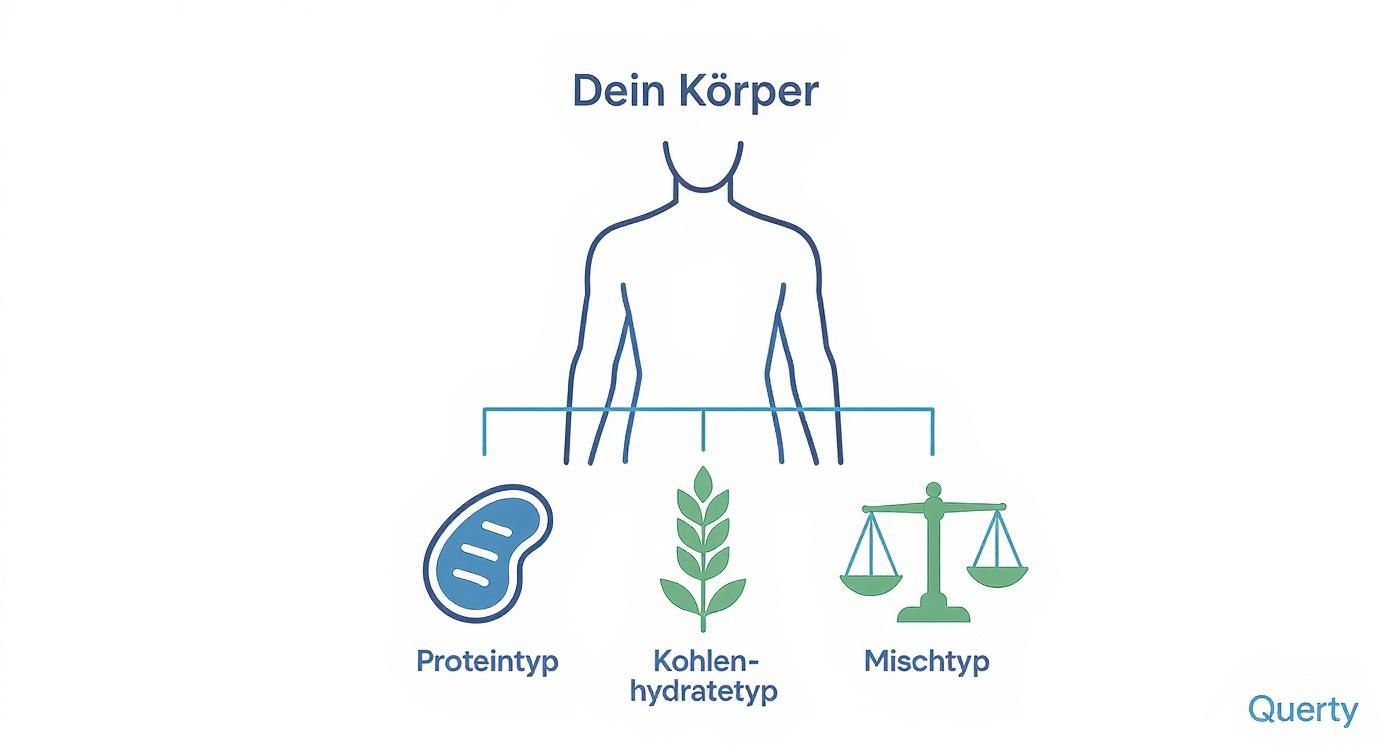
The graphic shows that your body naturally has a clear preference for certain energy sources.
The key point is: Understanding which “fuel” your body prefers is the first step toward more energy and lasting health.
Of course, your lifestyle and personal preferences also play a crucial role. While these types offer a useful starting point, the truly precise answer to the question “Which nutrition type am I?” is hidden in your DNA.
To dive deeper into the concept of personalized nutrition and understand how your genes determine your needs, read our in-depth article. A DNA metabolic analysis from mybody-x.com provides you with the exact blueprint for your body.
The Three Metabolic Types Explained in Detail
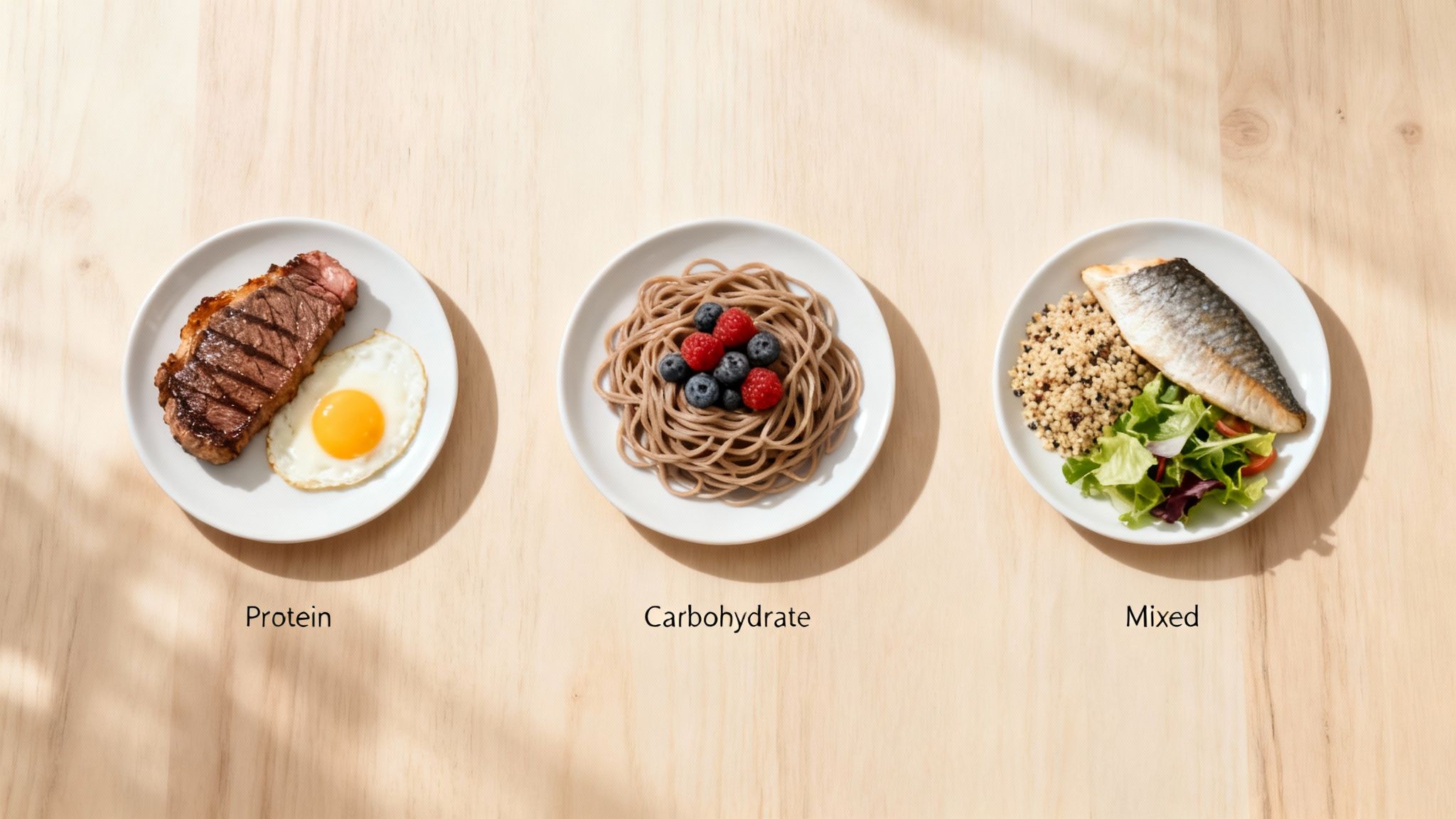
Now that we’ve covered the basics, things are about to get really exciting. We’re diving deeper into the world of metabolic types. Using concrete everyday examples, you’ll quickly notice just how strongly nutrition really affects our well-being – and why the question “Which nutrition type am I?” is so incredibly important.
Each of us processes the three major building blocks of our food – proteins, fats, and carbohydrates – in our own unique way. These differences have a direct impact on your energy levels, cravings, and even how well you build muscle or lose fat.
The Protein Type: The Powerhouse
Sound familiar? You eat a large plate of pasta for lunch and afterward feel as though you could take a nap right away. The next day, you have a juicy steak with salad and suddenly feel energized and ready to go for hours. If this sounds familiar, you could be a protein type.
This type is a true master at converting proteins and fats into energy. Their metabolism often struggles with a large serving of carbohydrates, which throws their blood sugar levels off balance. The result: fatigue and intense cravings.
Typical characteristics of the protein type include:
- Strong appetite: You’re often hungry and need meals that keep you feeling full for a really long time.
- Craving savory foods: Instead of craving chocolate, you’re more likely to crave salty or hearty foods.
- Energy crash after carbohydrates: White flour products or sugar in particular can completely drain your energy.
For the protein type, a diet rich in high-quality protein (meat, fish, eggs) and healthy fats (avocado, nuts) is ideal.
The carbohydrate type: the endurance runner
The exact opposite is the carbohydrate type. They start the day with a bowl of oatmeal and really thrive on it, full of energy for hours. A very high-fat meal, on the other hand, often sits heavily in their stomach and leaves them sluggish and unfocused.
Their metabolism is programmed to convert carbohydrates into energy slowly and steadily. They need a constant supply to maintain their energy levels, but often tolerate less fat and protein.
Typical characteristics of the carbohydrate type:
- Lower appetite: You often get by on smaller portions and aren’t hungry all the time.
- Preference for sweets: When cravings hit, they tend to be for something sweet rather than something salty.
- Sensitive to fat: Meals that are too fatty can quickly lead to a feeling of fullness or digestive problems.
Complex carbohydrates from whole grains, vegetables, and fruit are the best fuel for this type. If you want to learn more about how your body processes nutrients, check out our guide, which explains metabolism in simple terms.
The mixed type: the master of adaptation
And then there’s the mixed type—the flexible all-rounder. They feel best when their plate offers a balanced mix of all three macronutrients. A chicken breast fillet (protein) with sweet potatoes (carbohydrates) and some avocado (fat) is the perfect meal for them.
This type needs the right balance. Too much or too little of just one building block can disrupt their equilibrium and quickly lead to an energy slump or discomfort.
These examples are intended to help you identify initial patterns in your eating habits. They provide a good foundation for sharpening your awareness of your body. However, if you’re looking for an exact, scientifically based answer, a DNA metabolism analysis is the best way.
Get to Know Yourself: A Practical Test for Home
After all that theory about the different metabolic types, you’re surely eager to find out where you stand. It’s time to take the first step and take a closer look at your own body. This simple self-test is the perfect place to start.
Please don’t view this little check as a scientific diagnosis, but rather as a valuable guide. It is intended to help you develop a better sense of your own patterns and the subtle signals from your body. So be completely honest with yourself when answering—the point, after all, is to get to know yourself better.
Your Personal Nutrition Check
Take a quiet moment and answer the following questions as intuitively as possible. Ideally, note down right away which letter (A, B, or C) applies to you most.
1. How do you feel after a carbohydrate-rich breakfast, such as a bread roll with jam?
- A) I quickly feel hungry again and somewhat tired.
- B) I have good energy for the next few hours.
- C) It’s okay, but not optimal. A combination would be better.
2. Which snack appeals to you most during an afternoon slump?
- A) Something savory, such as a handful of nuts or a piece of cheese.
- B) Something sweet, such as a piece of fruit or a small granola bar.
- C) A combination, perhaps an apple with nut butter.
3. How does a protein-rich meal, such as a large steak or a lot of fish, affect you?
- A) I feel energized, satisfied, and full for a long time.
- B) I feel rather heavy and sluggish afterward.
- C) It does me good, but I definitely still need carbohydrates with it.
4. How would you describe your general appetite?
- A) Rather strong; I quickly become impatient when I’m hungry.
- B) Rather low; I can occasionally skip meals.
- C) Fairly balanced and regular.
5. If you eat a large portion of pasta in the evening, how do you sleep afterward?
- A) Often restless, and I feel bloated the next morning.
- B) I sleep wonderfully and feel good.
- C) It’s fine as long as the portion isn’t too huge.
Your assessment: Initial tendencies
And now things get interesting: Count which letter you chose most often. The result gives you an initial, but genuinely valuable indication of the direction your metabolism tends to lean.
Important note: This test does not replace professional analysis. It is a self-reflection tool that sharpens your awareness of your body’s reactions.
-
Mostly A answers: Your answers strongly point toward the protein type. It seems your body prefers proteins and fats as primary energy sources and tends to react negatively to a high intake of carbohydrates.
-
Mostly B answers: Your tendency clearly leans toward the carbohydrate type. You apparently get your energy best from complex carbohydrates, while meals high in fat and protein tend to slow you down.
-
Mostly C answers: You are most likely a mixed type. Your well-being depends on a balanced combination of all three macronutrients. Extremes in either direction simply don’t suit you.
This test is a fantastic starting point for understanding yourself better. But if you’re looking for a method that goes beyond mere tendencies and provides you with precise, scientifically sound data, then the DNA metabolism analysis from mybody-x.com is the next logical step. This way, you replace guesswork with facts and discover how your body really works.
Why Most Diets Are Destined to Fail
Sound familiar? Your friends rave about the sensational results of their low-carb diet, but for you, eating fewer carbohydrates leads only to constant hunger, a bad mood, and leaden fatigue. Or the hyped intermittent fasting that seems to give everyone energy leaves you at the end of your tether and simply makes you feel drained. This isn’t a personal failure—it’s the logical consequence of a widespread misconception.
There’s a name for this: bio-individuality. Every one of us is unique. Your genes are like a personal fingerprint that precisely determines how your body processes nutrients, which foods give you energy, and which ones simply slow you down.
The Problem with a One-Size-Fits-All Solution
Standard diets completely ignore this biological uniqueness. They force everyone into the same mold, without considering individual metabolism. It’s like trying to fuel every engine with the same fuel—some will sputter, others will overheat, and only a few will run smoothly.
A diet that does not suit your metabolic type can quickly backfire:
- It simply does not work: You follow all the rules, but frustratingly little changes on the scale.
- You risk nutrient deficiencies: Important vitamins and minerals are missing because the diet radically eliminates certain food groups from your meal plan.
- The yo-yo effect kicks in: As soon as you stop, the pounds come back—often with even more than before because your metabolism has been thrown completely out of balance.
Experiences like these are extremely frustrating and leave you feeling that you are doing something wrong. But the problem is not you; it is the approach. It fails to recognize your body for what it is: a highly individual system.
Stop blindly following rigid rules. Instead, learn to listen to your body’s signals. A DNA metabolic analysis is the best way to finally understand its language.
Your body has known the answer for a long time
The trend is already moving away from rigid diet plans toward a more mindful approach to food. Surveys indicate that in 2025, 69% of Germans are expected to actively try to avoid ultra-processed foods. At the same time, it is becoming clear that for 55% of respondents, cost plays a greater role than weight management alone, which can make healthy eating a real challenge. Find out more in the report on attitudes toward healthy eating in Germany on mintel.com.
This shift shows how important it is to find an eating pattern that is not only healthy but also sustainable and, above all, right for you. So instead of struggling through the next fad diet developed for a completely different metabolic type, turn your focus inward. The goal is to decode your very own “user manual.”
Are you wondering how to finally gain clarity without trying things out for years? A genetic analysis is the answer. In our article, you'll learn how genetic weight loss instead of diets provides exactly the information you need to give your body the best possible support.
The answer lies in your DNA metabolic analysis
Self-tests and daily observation of your body are fantastic tools for getting to know yourself better. But what if you no longer want to guess and instead want to know exactly? If you are looking for a definitive, scientifically sound answer to the question “What type of diet is right for me?”, the path leads directly to your genes.
This is where the DNA Metabolism Analysis comes in. It is not a guess or a trend, but provides you with your body's personal blueprint—in black and white.

Your Genes as Your Personal Instruction Manual
Imagine your DNA as an extremely detailed instruction manual for your body. Until now, you may have discovered only individual pages of it by chance—but a genetic analysis deciphers the entire manual for you. And these instructions were written long before you ate your first bite. They do not change.
Among other things, it tells you precisely:
- How efficiently your body processes carbohydrates: Are you someone who gets pure energy from pasta and bread, or do they send your blood sugar on more of a roller coaster ride?
- How well you use fat as an energy source: Are healthy fats the ideal fuel for you, or should you be a little more cautious about your fat intake?
- How your body responds to proteins: How much do you personally need to maintain muscle and stay full for a long time?
This genetic information is the key reason why a particular diet works wonders for a friend but has no effect on you at all. It is not about willpower, but pure biology.
A DNA analysis replaces guesswork with facts. You no longer have to experiment to find out what works for you; instead, you receive a clear, scientific basis for your dietary decisions.
From Guesswork to Certainty
A self-test like the one you learned about in the previous section gives you a valuable indication. It sharpens your awareness and helps you interpret your body's signals more effectively. However, a DNA analysis takes the decisive next step.
It provides you with objective data that is completely independent of your current life situation, stress level, or habits.
This clarity is priceless. Instead of wondering whether you feel tired because you slept poorly or because the potatoes the night before were the wrong choice, you simply know. You can deliberately plan your meals to match your genetic profile exactly.
This is how a DNA analysis from mybody-x.com works
The process could hardly be simpler, and you can conveniently complete it from home. A simple saliva test is used to collect a sample, which is then sent to our certified laboratory. There, experts analyze the relevant gene segments that control your metabolism.
What you get back is not an incomprehensible laboratory report. It is a comprehensive, easy-to-understand guide to your diet. It explains exactly which metabolic type you are and provides you with specific, immediately actionable recommendations—including food lists and the optimal distribution of macronutrients for you.
This answers the question “What type of diet am I suited to?” once and for all. Precise, scientific, and tailored entirely to you personally. This is the foundation for a diet that truly nourishes and strengthens you and helps you reach your full potential.
Your path to a diet that truly suits you
If you have read this far, one thing is clear: the question “What type of diet am I suited to?” is far more than just a passing trend. It is the foundation for a life that truly feels good—full of energy and balance.
Together, we explored what metabolic types are all about, why self-observation is so valuable, and what incredibly precise answers lie within your DNA. Now comes the most important part: using this knowledge and taking responsibility for your well-being into your own hands.
Listen to your body—it knows best what it needs
Your body is constantly sending you signals. Think of a DNA analysis as a perfect translator that helps you finally speak this language fluently. Instead of clinging to rigid, one-size-fits-all rules, you learn to create a diet tailored precisely to your genetic needs.
This personalized approach is perfectly in tune with the times. In Germany, too, the trend is moving away from strict dogmas toward greater flexibility. Experts expect plant-focused, flexitarian models to set the tone by 2025. Vegetables, fruit, and legumes take center stage and are complemented with ease. This combines health awareness with sustainability without forcing you to give up everything. You can read more about this exciting development in the 2025 nutrition trends on milchland.de.
Your journey begins right here: It is not about making everything perfect overnight. It is about getting started. Every small step toward a diet that truly suits you is a huge gain for your quality of life.
Are you ready to listen to your body? Learn more now about the mybody-x.com metabolism analysis and start your journey toward greater energy and well-being.
Your most frequently asked questions about nutrition types
Do you still have a few questions? Perfect! Here we will clear up the remaining uncertainties so you can start your journey toward an optimal diet with complete confidence.
Does my nutrition type change over the course of my life?
Your genetic predisposition—that is, your fundamental metabolism type—is like your fingerprint: it remains the same throughout your life. It is the stable foundation anchored in your DNA.
What can certainly change, however, are your circumstances. Your age, stress level, or how often you exercise—all these external factors influence how your body reacts to certain foods. A DNA analysis therefore gives you the unchanging foundation on which you can continually adapt your diet flexibly to your current situation.
Do I really need a DNA test to find my type?
It is not necessary, but it is definitely the most precise and scientific approach. While self-observation or questionnaires can already provide valuable insights and point you in the right direction, a DNA analysis gives you objective, unchanging facts about your body.
Think of it as a shortcut. Instead of experimenting and guessing for years, you replace assumptions with crystal-clear certainty. This allows you to optimize your diet in a targeted and confident way from the very beginning.
What exactly do I get after a DNA analysis from mybody-x.com?
You will receive a comprehensive and above all easy-to-understand report created exclusively for you. It not only explains which metabolism type you are, but also provides tailored recommendations that can genuinely be implemented in everyday life.
This includes, for example, specific food lists and the optimal distribution of proteins, fats, and carbohydrates for you. This finally gives you a solid, scientific foundation for achieving your personal health goals.
Are you ready to stop guessing and finally gain clarity? Discover with the DNA metabolism analysis from mybody-x.com which nutrition type you really are and how to optimally nourish your body.



Share now:
Optimize your diet based on test results: Step-by-step guide
Genetic analysis – How it influences health and nutrition