
Longevity Meaning: How to understand the secret to a long life
What longevity really means: More than just a long life
Imagine your body as a valuable, well-maintained car. In the end, it's not just the mileage that counts, but above all, how smoothly and powerfully the journey was over the entire distance. This very idea forms the core of modern longevity research. While many associate the term with maximum lifespan, the true meaning of longevity is far deeper: it's about the quality of the years we live.
Life expectancy vs. healthspan: The crucial difference
The focus is on distinguishing between two important terms: life expectancy and healthspan . Life expectancy is a purely statistical measure – the number of years a person is expected to live. Healthspan, on the other hand, describes the time we spend in good health, free from chronic diseases or significant physical limitations. The goal is therefore not to live to 100 if the last 20 years are marked by illness and suffering. Rather, it is about bringing healthspan as close as possible to life expectancy.
This difference marks a paradigm shift compared to traditional anti-aging approaches. While anti-aging often attempts to mask the external signs of aging, longevity views aging as a biological process that we can actively influence. Science has recognized that many age-related diseases are not an inevitable fate. Instead, they are the result of specific cellular processes that can be slowed down or potentially even reversed. The importance of longevity shifts the focus away from simply treating symptoms and toward proactively nurturing our cellular health.
The dimensions of longevity
A comprehensive approach is crucial here, because longevity rests on several pillars that influence each other:
- Physical health: The body's ability to ward off disease and maintain its functions optimally.
- Cognitive health: Maintaining mental clarity, a good memory, and the ability to learn new things.
- Emotional and social health: Stable social bonds and a sense of purpose have been proven to contribute to a longer and healthier life.
The following graphic shows the development of life expectancy, which represents an important, but only one aspect of longevity.

The data impressively demonstrates that our lifespan has steadily increased in recent decades – a remarkable achievement. The real challenge now lies in ensuring that these extra years are also years filled with vitality and well-being. The key is to take action not just when illness strikes, but to lay the foundations for a long and healthy life early on.
Germany's longevity revolution: From 35 to over 80 years
Today's discussion about longevity would be almost inconceivable without a striking historical development. To grasp the true meaning of longevity , a brief journey back in time is helpful. Imagine Germany around 1875: The average life expectancy of a newborn boy was a mere 35.6 years , and that of a girl 38.5 years . A long life was a rarity, characterized by high infant mortality, catastrophic hygienic conditions, and virtually nonexistent medical care. Data from the Federal Statistical Office confirms this dramatic starting point.
These figures clearly illustrate the enormous leap we have made. Doubling life expectancy in just about 150 years is one of humanity's greatest achievements. But how did this happen? It wasn't a single breakthrough, but rather a chain of advances that fundamentally changed our lives and laid the foundation for our modern understanding of longevity.
Milestones that extended our lives
The revolution began with the basics. Improvements in public hygiene, such as the construction of sewage systems and the provision of clean drinking water, drastically reduced the spread of deadly diseases like cholera and typhoid. Almost simultaneously, the discovery of antibiotics in the first half of the 20th century transformed medicine. Infections that had often been a death sentence suddenly became treatable.
Another crucial element was improved nutrition. Growing knowledge about vitamins and nutrients, along with a year-round reliable food supply, strengthened the immune system and the general health of the population. These developments laid the foundation upon which modern preventive medicine is built today.
The following infographic illustrates the remarkable increase in global life expectancy over the last 120 years.
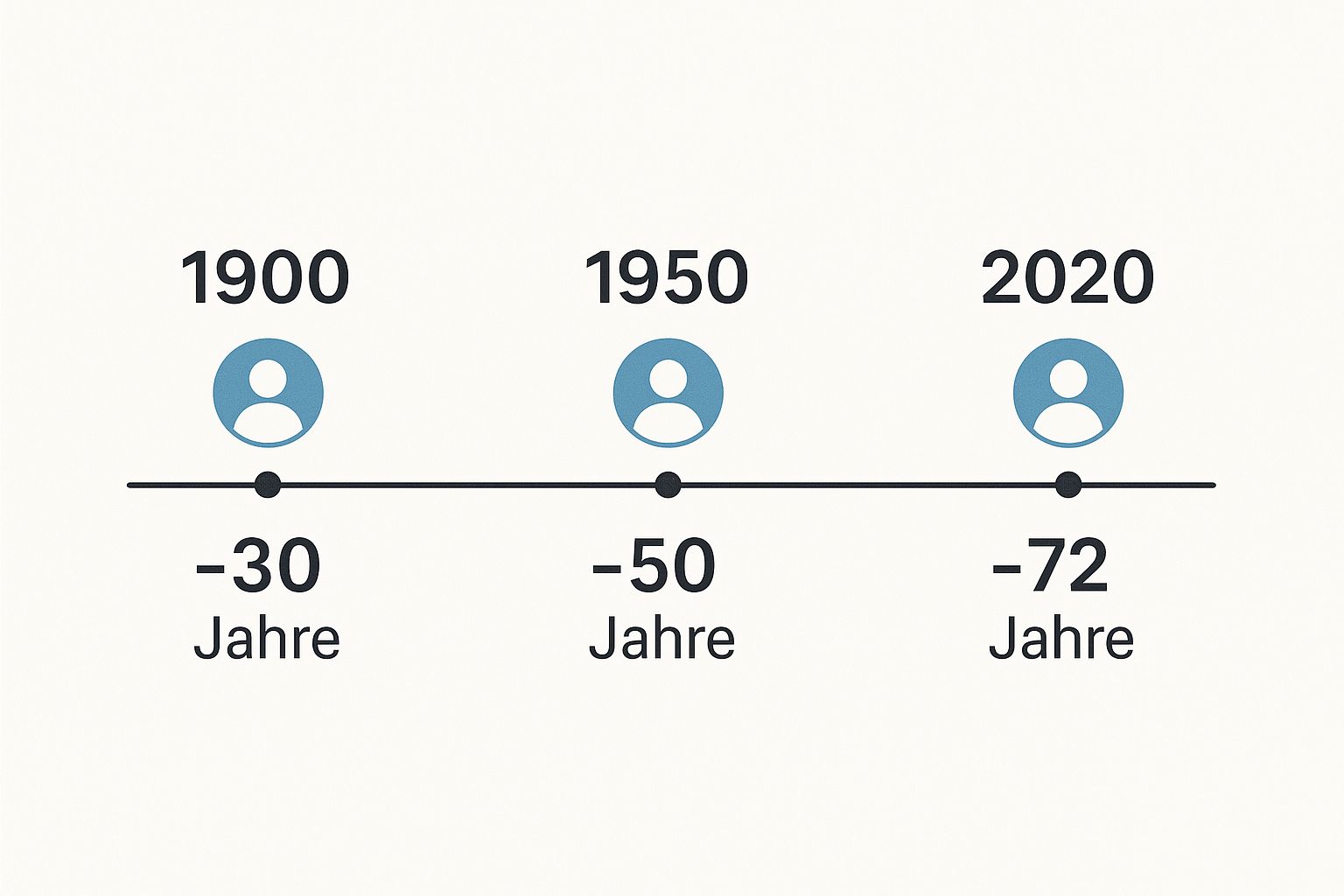
The graphic impressively illustrates how advances in public health, medicine, and living conditions have more than doubled life expectancy.
From lifespan to healthspan
This historical perspective is crucial. It shows that our long lives today are not a product of chance, but the result of targeted measures and scientific breakthroughs. The next stage of this revolution now focuses not only on extending life, but above all on improving the quality of those extra years .
The following table provides an overview of the development of life expectancy in Germany and the decisive factors in the respective eras.
Development of life expectancy in Germany: Comparison of life expectancy in different time periods by gender
| Period | Men (years) | Women (years) | Main influencing factors |
|---|---|---|---|
| 1871/1881 | 35.6 | 38.5 | Poor hygiene, high infection rates, high infant mortality |
| 1949/1951 | 64.6 | 68.5 | Antibiotics, vaccinations, better nutritional foundations |
| 2021/2023 | 78.2 | 83.0 | Modern medicine, prevention, better working conditions, lifestyle |
The modern meaning of longevity is thus inextricably linked to the lessons of the past. The table clearly illustrates how the focus has shifted: from combating infectious diseases to optimizing lifestyle. The pioneers of the 19th and 20th centuries gave us years; our task now is to fill those years with life, health, and vitality.
The four pillars of longevity: Your blueprint for a long life
Imagine your health like a sturdy house. Even the most beautiful design is of little use if the foundation is crumbling. In longevity research, a long and healthy life rests on four fundamental pillars. These are not separate building blocks, but rather work closely together. The true meaning of longevity only becomes apparent when these areas are brought into harmonious balance. It's not about being perfect in one pillar, but about achieving a balanced interplay of all four.

Pillar 1: Nutrition as cellular medicine
The first pillar, nutrition, is far more than just counting calories. Don't think of your food as mere fuel, but as information for your cells. Every bite you take influences cellular repair processes, inflammation levels, and even the activity of your genes. Studies show that a plant-based diet rich in antioxidants and polyphenols—like the Mediterranean diet—can slow down cellular aging. It's about the quality of the nutrients, not just the quantity. Learn more about how an epigenetic lifestyle shapes your health in our article on longevity and nutrition .
Pillar 2: Exercise as a rejuvenating treatment
Exercise is the second, equally important pillar. Regular physical activity is like a rejuvenation treatment at the cellular level. It improves the function of the mitochondria – the powerhouses of your cells – promotes blood circulation, and releases hormones that stimulate repair processes. Just 150 minutes of moderate exercise per week can significantly reduce the risk of many age-related diseases. The right mix makes all the difference.
- Endurance training (e.g. jogging, swimming) strengthens your cardiovascular system.
- Strength training maintains muscle mass, which is crucial for a stable metabolism and independence in old age.
- Flexibility and balance (e.g. through yoga or Pilates) help to avoid falls.
Pillar 3: Sleep as daily regeneration
The third pillar is often underestimated, but it's fundamental: restful sleep. While you sleep, your body works at full speed to regenerate. The brain flushes out metabolic waste, cells repair themselves, and the immune system is strengthened. Chronic sleep deprivation, on the other hand, accelerates the aging process by promoting low-grade inflammation and disrupting the hormonal balance. For most adults , seven to nine hours of quality sleep per night is ideal to support these vital processes.
Pillar 4: Stress management as a protective shield
The fourth pillar, effective stress management, is the invisible shield that protects your longevity. While acute stress can be beneficial in the short term, chronic stress leads to a sustained release of the hormone cortisol. This hormone damages cells, weakens the immune system, and accelerates the shortening of telomeres—the protective caps on our chromosomes. Methods such as meditation, mindfulness, or spending time in nature are not just relaxation exercises, but scientifically sound ways to mitigate the negative biological consequences of stress.
To give you a better overview, the following table summarizes the key points of these four pillars.
The four pillars of longevity compared
Overview of influencing factors, impact and practical implementation of each pillar
| column | Main effect | Practical measures | Scientific evidence |
|---|---|---|---|
| Nutrition | Reduces inflammation, optimizes cell function | Colorful, plant-based diet; healthy fats; avoidance of highly processed foods | Numerous studies confirm the link with a longer healthspan. |
| Movement | Strengthens mitochondria, muscles and the cardiovascular system | A mix of endurance, strength, and flexibility; at least 150 minutes per week. | Reduces the risk of chronic diseases such as type 2 diabetes and heart disease. |
| Sleep | Promotes cell repair, cognitive health, and immune function | 7–9 hours per night; fixed sleep times; dark, cool environment | Crucial for the "detoxification" of the brain and hormonal balance |
| Stress management | Reduces cortisol levels, protects telomeres, lowers inflammation | Meditation, mindfulness, time spent in nature, social contacts | Direct influence on the biological aging rate has been demonstrated. |
As you can see, these four pillars are not a rigid set of rules, but a dynamic system that influences each other. A healthy diet gives you the energy for exercise, good sleep makes you more resilient to stress, and less stress leads to better choices regarding nutrition and sleep. The art of longevity lies in discovering this system for yourself and gradually integrating it into your daily life.
Biological vs. chronological age: More than just a number on paper
Your birth certificate is a snapshot that merely counts the years you've spent on Earth. But the true story of your aging isn't told in years, but in the vitality of your cells. Have you ever noticed this phenomenon? A 60-year-old who's bursting with energy and looks 40, while another 40-year-old already appears exhausted and older. This is precisely the difference between chronological age and biological age .
Chronological age is a fixed quantity – it progresses relentlessly with each birthday. Biological age, on the other hand, is a dynamic reflection of your body's actual condition. It shows how fit your cells and organs truly are, influenced by your lifestyle, diet, and stress levels. The most important insight from this: you largely control the rate at which you age.
The clocks in our cells: Telomeres and epigenetics
To understand how quickly we age biologically, scientists look deep inside our cells. Two factors are particularly revealing:
- Telomeres: Imagine telomeres like the small plastic caps at the ends of your shoelaces. They protect your chromosomes, the carriers of your DNA, from fraying. With each cell division, these caps become a little shorter. If they become too short, the cell can no longer divide properly and ages. The length of the telomeres is therefore a direct indicator of the aging process of your cells.
- Epigenetic clocks: Your DNA is the hardware, but epigenetics is the software that determines which parts of it are used. Small chemical tags, called methylations, attach to your DNA and switch genes on or off. This pattern changes in a predictable way throughout your life. Researchers like Steve Horvath have used this to develop precise "epigenetic clocks" that can determine biological age with astonishing accuracy.
The following illustration shows the structure of a chromosome and highlights the protective function of the telomeres at the ends.

This illustration makes clear how important telomeres are for protecting our genetic information and why their shortening is such a significant marker for biological aging.
Your biological age is not your destiny.
The best part is: biological age isn't set in stone. While our genes provide a certain starting point, your lifestyle significantly influences how quickly your epigenetic clock ticks and your telomeres shorten. Factors like chronic stress or smoking accelerate this process, while a nutrient-rich diet, regular exercise, and good sleep can slow it down. Modern analyses reveal your individual predisposition. You can learn more in our article about how a longevity DNA test can influence your healthy aging .
By focusing on lowering your biological age, you are directly investing in your healthspan – the years you spend active and free from age-related diseases. It's a process in which you can actively take control of your aging.
Germany in a longevity comparison: The expensive failure
Looking at healthcare spending in Europe, one might think Germany is a model student. We spend more money on healthcare than almost any other nation, yet we only rank in the middle when it comes to life expectancy. This worrying paradox shows that we haven't quite grasped the true meaning of longevity . It's not about how much money is pumped into a system, but how that system actively promotes health and extends life. We are world champions at treating illnesses, but we often neglect the most important part: prevention.
The dilemma: High expenses, low returns
The figures are sobering. Despite massive investments in its healthcare system, Germany's average life expectancy is only 81.2 years – even below the EU average. An OECD study shows that Germany spends around 12.6 percent of its gross domestic product (GDP) on healthcare. This equates to approximately €5,300 per capita, roughly 50 percent above the EU average. You can learn more about this alarming finding in this Tagesschau report . This raises a crucial question: Why don't we buy ourselves more years of life with more money?
The answer lies in the way our system is structured. It's like a fire department constantly putting out fires instead of preventing them from starting in the first place. It's reactive, not proactive. Countries that lead the way in longevity, like Spain, Italy, and Switzerland, do things differently. There, a healthy lifestyle and preventative measures are deeply rooted in the culture. The Mediterranean diet, close social ties, and an active daily life aren't contrived health strategies there, but simply a given.
Cultural barriers and the way forward
In Germany, deeply ingrained habits often thwart our efforts. Risk factors such as high alcohol consumption, smoking, and an unbalanced diet are widespread and often still tolerated by society. Furthermore, our healthcare system rewards surgical procedures and the prescription of medication more than comprehensive advice on a healthy lifestyle.
What does this mean for you personally? You don't have to wait for major political reforms to take control of your own longevity. The first step is understanding your individual genetic makeup. Modern analytical methods can show you where your personal strengths and weaknesses lie. Find out how a longevity DNA analysis can help you develop tailored strategies. By learning the lessons from more successful countries and applying them to our lives—more exercise in our daily routines, a more nutritious diet, and nurturing social connections—we can compensate for the system's shortcomings and actively extend our healthspan.
Longevity and gender: Why women win the game
It's one of the most consistent observations in health research worldwide: women, on average, live longer than men. This fascinating gap in longevity is no coincidence, but rather the result of a complex interplay of biology, behavior, and societal factors. Let's take a closer look at what lies behind this and what it means for the significance of longevity for both genders.
Biological advantages: A natural advantage
From birth, women seem to be equipped with a kind of biological shield that gives them an advantage in the race for longevity. A key factor is the female hormonal balance. Estrogen , the primary female sex hormone, has a protective effect on the cardiovascular system. It helps keep blood vessels elastic and can positively regulate cholesterol levels. In contrast, men produce high levels of testosterone, which is sometimes associated with riskier behavior and a higher susceptibility to heart disease.
But biology has another, deeper trump card up its sleeve:
- The second X chromosome: Women have two X chromosomes (XX), while men have only one X and one Y chromosome (XY). This second X chromosome functions as a genetic reserve. If a gene defect occurs on one X chromosome, the second, healthy chromosome can often compensate for this error. Men lack this "backup copy," which makes them more susceptible to certain genetically inherited diseases.
Lifestyle and behavior: The learned difference
Biology alone doesn't explain everything, as our behavior also plays a crucial role. Statistically, women tend to lead healthier lifestyles. They go for preventative checkups more often, tend to eat a more balanced diet, and smoke less. Men, on the other hand, more frequently exhibit riskier behavior – whether in traffic, through higher alcohol consumption, or by choosing more dangerous professions. These lifestyle differences contribute significantly to the longevity gap.
Data from Germany supports this trend. According to the latest mortality tables for 2020/2022, newborn boys have a life expectancy of 78.3 years , while girls can expect 83.2 years . That's a difference of almost five years. If you'd like to learn more about the details of life expectancy in Germany , you can find interesting insights here.
This gap, however, is not set in stone. In recent decades, the gap has narrowed. One reason for this is that women are increasingly adopting similar risk factors to men, such as increased stress at work or a rise in smoking rates. This demonstrates how strongly lifestyle can influence biological predispositions. For men, this presents a great opportunity: by adopting healthier behaviors, they can significantly extend their personal healthspan. For women, it underscores the need to actively protect their natural advantages through conscious choices.
Your personal longevity action plan: From knowledge to action
Understanding the principles of longevity is one thing – actually applying them is quite another. Theoretical knowledge is like a detailed map without taking the first step outside. It shows the way, but it doesn't get you to your destination. This section is your practical guide, transforming knowledge into concrete action.
We won't overwhelm you with an endless to-do list. Instead, we'll show you a clear, achievable approach that integrates well into your daily life. The true meaning of longevity unfolds through small but consistent habits that have a big impact over time. The key is to focus on the actions that will make the biggest difference to your healthspan.
The most effective starting points for your longevity journey
Instead of completely turning your life upside down overnight, start with small, targeted adjustments in the most crucial areas. Always remember: consistency is more important than short-term intensity.
- Simple nutrition optimization: Forget radical diets. Instead, start with a simple meal upgrade. Add a handful of colorful vegetables or a serving of berries to every meal. These are packed with polyphenols and antioxidants that protect your cells from everyday stress and damage. Another easy step is swapping white bread or sugary snacks for whole-grain products.
- Effective 15-minute exercise: Lack of time is often the biggest obstacle. Integrate a 15-minute routine into your day. This could be a brisk walk during your lunch break, a short high-intensity interval training (HIIT) session at home, or some strength exercises using your own body weight. Such short but intense sessions have been proven to boost metabolism and strengthen the cardiovascular system.
- Scientifically proven stress reduction: Chronic stress is a silent accelerator of aging. Take just five minutes each day for a simple breathing exercise. Inhale for four seconds, hold your breath for seven seconds, and then exhale slowly for eight seconds. This "4-7-8" technique is a proven way to calm the nervous system and lower levels of the stress hormone cortisol.
Measure progress and stay on course
Nothing is more motivating than visible success. And that goes far beyond the number on the scale. A truly personal approach begins with understanding your own biological makeup. You might think your genes determine your destiny, but modern science tells us otherwise. In our article, you'll learn how you can take control of your health with a longevity DNA test . Such an analysis can show you precisely which measures will be most beneficial for you personally.
Besides genetic tests, there are also simple methods to track your progress in everyday life:
- Sleep tracking: An app or wearable helps you monitor the duration and quality of your sleep.
- Energy Log: Rate your energy level daily on a scale of 1 to 10. This will help you quickly see how your diet, exercise, and sleep affect it.
- Heart rate variability (HRV): Many wearables measure HRV. It is a strong indicator of your stress level and how well your body recovers.
Long-term strategies: Supplements and lifestyle adjustments
Once the basics are in place, you can think about targeted supplements. But remember: dietary supplements don't replace a healthy lifestyle, but they can provide valuable support.
| strategy | Specific recommendation | Proven effect |
|---|---|---|
| Targeted supplementation | Omega-3 fatty acids, vitamin D3, magnesium, coenzyme Q10 | They reduce inflammation and support heart and mitochondrial function. |
| Lifestyle adjustment | Intermittent fasting (e.g., the 16:8 method) | Promotes autophagy (a type of cellular waste disposal), improves insulin sensitivity. |
| Social interaction | Plan regular weekly meetings with friends or family. | It strengthens psychological resilience and has been proven to reduce the risk of mortality. |
Your journey to a longer and healthier life doesn't begin sometime in the future, but today. With these small, actionable steps, you'll turn knowledge about longevity into a lived reality.
Are you ready to put your health on a sound footing and start with a personalized plan? Discover the scientifically based analyses of mybody®x and take the first step towards a longer, healthier life.



Share:
Want to lose weight sustainably? Your genetic code knows the way.