

Why you aren't losing weight despite dieting: Your slow-metabolism type
Does this sound familiar? Do you often feel sluggish, seem to gain weight just by looking at a piece of cake, and wonder why your friend apparently can eat anything without consequences? If so, the thought has probably crossed your mind: “Could I have a slow metabolism?”
The good news first: You are absolutely not alone. More importantly, your body isn't “broken.” It simply handles energy in its own unique way—a way that is often determined by your genes. In this guide, we explain in an easy-to-understand way how different metabolic types work and why a DNA-based test is the most precise way to find your personal nutrition strategy.
Is your metabolism really slow, or is it just a myth

Sometimes it's enough to drive you crazy: You count calories and exercise regularly, but the scale simply won't budge. Countless people know this feeling of frustration. It's easy to blame a “slow metabolism.” But what's really behind it?
Your metabolism, also known medically as metabolism, is essentially the sum of all the biochemical processes that take place in your cells. It is the control center that converts nutrients from food into the energy your body needs for absolutely everything—from breathing and thinking to your next workout.
What your individual basal metabolic rate has to do with it
A key factor in your metabolism is your basal metabolic rate. Think of it like a car idling: it's the amount of energy your body uses when completely at rest, simply to maintain vital functions such as your heartbeat, breathing, and body temperature.
This basal metabolic rate varies greatly from person to person and depends on various factors:
- Your genetics: A large part of your metabolic rate is essentially determined from birth.
- Your age: Yes, it's true—with age, metabolism tends to slow down somewhat.
- Your sex: Because they have a higher proportion of muscle, men generally have a slightly higher basal metabolic rate.
- Your muscle mass: Muscles are your body's power plants. Even at rest, they burn significantly more calories than fat tissue.
So it is not that your metabolism is faulty. It simply works differently—perhaps it stores energy more efficiently but burns it more slowly. This realization is a real game-changer because it takes away the pressure of constantly having to fight against your own body.
The term “slow metabolism type” therefore does not describe an illness, but an individual predisposition that is often genetic. Your body is essentially thrifty with energy. Rather than fighting it, it is much wiser to understand this characteristic and adjust your diet and lifestyle accordingly.
In modern nutritional counseling, categorizing people by metabolic type is also playing an increasingly important role. The slow metabolism type is often associated with the so-called sympathetic type, which tends to process carbohydrates less efficiently. This can lead to blood sugar fluctuations and a tendency toward insulin resistance. Research confirms that this metabolic profile is often associated with a lower basal metabolic rate—the body burns fewer calories at rest, making weight gain more likely. You can find out more about this topic in studies on nutrition according to metabolic types.
So instead of tormenting yourself with blanket diet tips that simply do not suit your body, the first step is to get to know your individual metabolism. This is the only way to develop a strategy that truly suits you and leads to more energy and well-being in the long term.
Typical signs of a slow metabolism

Your body is a master of communication. Sometimes it practically screams for attention, while at other times it merely whispers—and we often overlook precisely these subtle signals. If you feel that your internal engine is sputtering, your metabolism could be behind it.
A slow metabolism simply means that the biochemical power plants in your cells are running on low power. This is not your imagination; it shows up in very concrete, everyday patterns. Your body burns fewer calories at rest, which directly affects your energy levels, your weight, and your overall well-being.
Picture it this way: You want to go full throttle, but your engine is constantly running at the lowest RPM.
Fatigue and weight gain: the classics
The most frustrating signs are probably leaden fatigue and weight gain that seems to have no explanation. You wake up exhausted, drag yourself through the day, and the thought of exercising feels like climbing Mount Everest—even though you actually get enough sleep.
At the same time, the number on the scale slowly creeps upward, even though you have barely changed your diet. Small indulgences that used to simply burn off now seem to settle directly on your hips. This is because your body stores excess energy—even tiny amounts—as fat extremely efficiently instead of burning it.
It's important to understand: Your body is not working against you. It is in a clever energy-saving mode. The key is to send it the right signals so that it leaves this mode and increases energy expenditure again.
From cold hands to digestive problems
But the symptoms often go far beyond fatigue and weight. A sluggish metabolism can make itself felt in many different ways. Take a moment to consciously pay attention to the following signals:
- You're constantly cold: Especially cold hands and feet, even in warm rooms, are a typical sign. Your body reduces heat production to conserve energy.
- Brain fog: Do you find it difficult to focus? Do you often feel forgetful? Your brain is an energy hog—when your metabolism runs slowly, your mental clarity suffers too.
- Sluggish digestion: Everything also slows down in the intestines. This can manifest as constipation, a constant feeling of fullness, or general digestive problems.
- Dry skin & brittle hair: Supplying your skin and hair cells is also part of your metabolism. Inadequate nourishment often shows up as dry skin, hair loss, or brittle nails.
Here is a short checklist to help you better interpret your body's signals.
Checklist: Signs of a slow metabolism
Use this table to identify typical signals that are often associated with a slower metabolism.
| Symptom | Description in everyday life | Possible effect |
|---|---|---|
| Unexplained weight gain | You are gaining weight even though you have not changed your eating habits. | Frustration because diets have little effect. |
| Persistent fatigue | You often feel sluggish and low on energy, even after getting enough sleep. | Reduced performance in everyday life and during sports. |
| Sensitivity to cold | You often feel cold, especially in your hands and feet. | Feeling unwell and the need to constantly bundle up warmly. |
| Digestive problems | Your digestion is sluggish and prone to constipation. | Feeling full, bloating, and general discomfort. |
| Poor Concentration | "Brain Fog"—you have difficulty concentrating. | Reduced productivity and mental fatigue. |
| Dry Skin & Hair Loss | Your skin is dry, your hair is brittle or falling out. | External signs of a possible nutrient deficiency. |
Recognizing these signals is the first important step. The goal is not to diagnose yourself, but to better understand the language of your body.
If you want to learn more about the background, you can find further details in our guide about the typical symptoms of a slow metabolism.
It is important to note, however, that these symptoms can also have other causes, such as a nutrient deficiency or an underactive thyroid. If you recognize several of these signs in yourself and are unsure, seeking medical evaluation is always the right course of action.
Your DNA as a Blueprint for Your Metabolic Rate
Why is your metabolism the way it is? Of course, we often look for the answer in our lifestyle—what we eat and how much we exercise. But the actual cause lies much deeper, in a blueprint written before you were born: your DNA. It sets the basic rules according to which your body processes energy.
Think of your genes as your body's operating system. This system naturally determines how efficiently your cells convert nutrients into energy. For some people, it is designed for lightning-fast carbohydrate burning. Others, meanwhile, are genetically programmed to use fat particularly efficiently as an energy source.
This exact genetic predisposition explains why your best friend may be able to eat huge amounts of pasta and still stay slim, while even a small portion makes you feel sluggish and causes you to gain weight. It is not a matter of willpower, but simply individual biochemistry.
Genetics Meets Everyday Life
Your DNA may be the blueprint, but it is not a rigid prison. So you are not helplessly at the mercy of your genes. Rather, this genetic blueprint is constantly interacting with your environment and lifestyle. This fascinating field is called epigenetics.
Think of your genes as the hardware of a computer. Your lifestyle—meaning nutrition, exercise, sleep, and stress management—is the software you install on it. And this software can either optimize the hardware or slow it down.
- Nutrition: If you eat nutrients that your body is genetically unable to process efficiently (for example, too many carbohydrates as a “fat-burning type”), you force your system into an inefficient mode.
- Exercise: Regular exercise, especially strength training, sends a signal to your genes to build more muscle mass. And muscles are, after all, your body's most important fat-burning furnaces.
- Sleep & stress: Chronic stress and lack of sleep can trigger hormonal signals that instruct your metabolism to switch to energy-saving mode and store fat.
You can see that you can actively influence how your genes are “expressed.” Knowledge of your genetic foundation is the decisive compass. It shows you which measures will be most effective for you personally.
The role of hormones in your metabolism
In addition to your genetics and lifestyle, there is another powerful player that dictates the pace of your metabolism: your hormonal system. Hormones are your body's messengers and send crucial instructions to your cells—including those responsible for burning fat.
Your metabolism is a dynamic interplay of genetic predisposition, daily habits, and hormonal regulation. Only when you understand all three areas can you support your body in a targeted way.
Some of the most important hormonal regulators are:
- Thyroid hormones (T3 & T4): They are, so to speak, the top managers of your metabolism. Even a mild underactive thyroid can noticeably reduce the body's overall energy expenditure.
- Insulin: This hormone regulates your blood sugar level. With insulin resistance, your cells no longer respond properly to insulin, which promotes fat storage and slows down your metabolism. This is particularly relevant for the slow metabolism type, which often tends to process carbohydrates less efficiently.
- Cortisol: When released chronically, the “stress hormone” can promote muscle breakdown and encourage fat storage, especially around the abdomen.
These factors show that the speed of your metabolism is not an unchangeable fate. It is a complex system, but one you can understand and control. If you are curious about how deeply your metabolism is rooted in your genes, you can find more information in our health portal. The first and most important step is to know your personal blueprint. Because only those who have the map can find the right path.
How to reliably determine your metabolic type
Okay, you have noticed your body’s signals and understood that your genes play a pretty big role here. But how can you really find out which metabolic type you are? No more guesswork—there are now precise methods that finally provide clarity and take you from vague assumptions to targeted action.
Imagine you want to explore an unfamiliar city. Sure, you could simply set off and hope to discover the best spots. Or you could use a detailed map that shows you the most efficient route to the highlights. That is exactly what modern metabolic analyses do for your body.
From rough estimates to precise analyses
On the way to determining your metabolic type, there are various steps that provide results with different levels of accuracy. It is important to know the differences so that you can find the method that is truly right for you.
- Online calculators: Super quick and free, but they are based only on general data such as age, weight, and activity level. The result is a rough estimate of your calorie needs, while your individual genetic predisposition is completely left out.
- Blood tests at the doctor’s office: Testing your thyroid levels (TSH, fT3, fT4) or blood sugar levels can provide important clues about hormonal imbalances that are slowing down your metabolism. The problem? It is only a snapshot of your current state, not your genetic foundation.
- Breath gas analysis: This measures, through your exhaled air, how much oxygen your body consumes and how much carbon dioxide it produces. This can be used to determine your basal metabolic rate quite accurately and identify whether you are currently burning more fat or carbohydrates. But this is also just a snapshot influenced by your last meal or your current stress level.
All these methods are valuable pieces of the puzzle. But if you want to see the whole picture and develop a strategy that lasts a lifetime, there is no getting around your genetic blueprint.
The following graphic shows quite well how your genetic predisposition and daily habits interact and ultimately shape your metabolism.
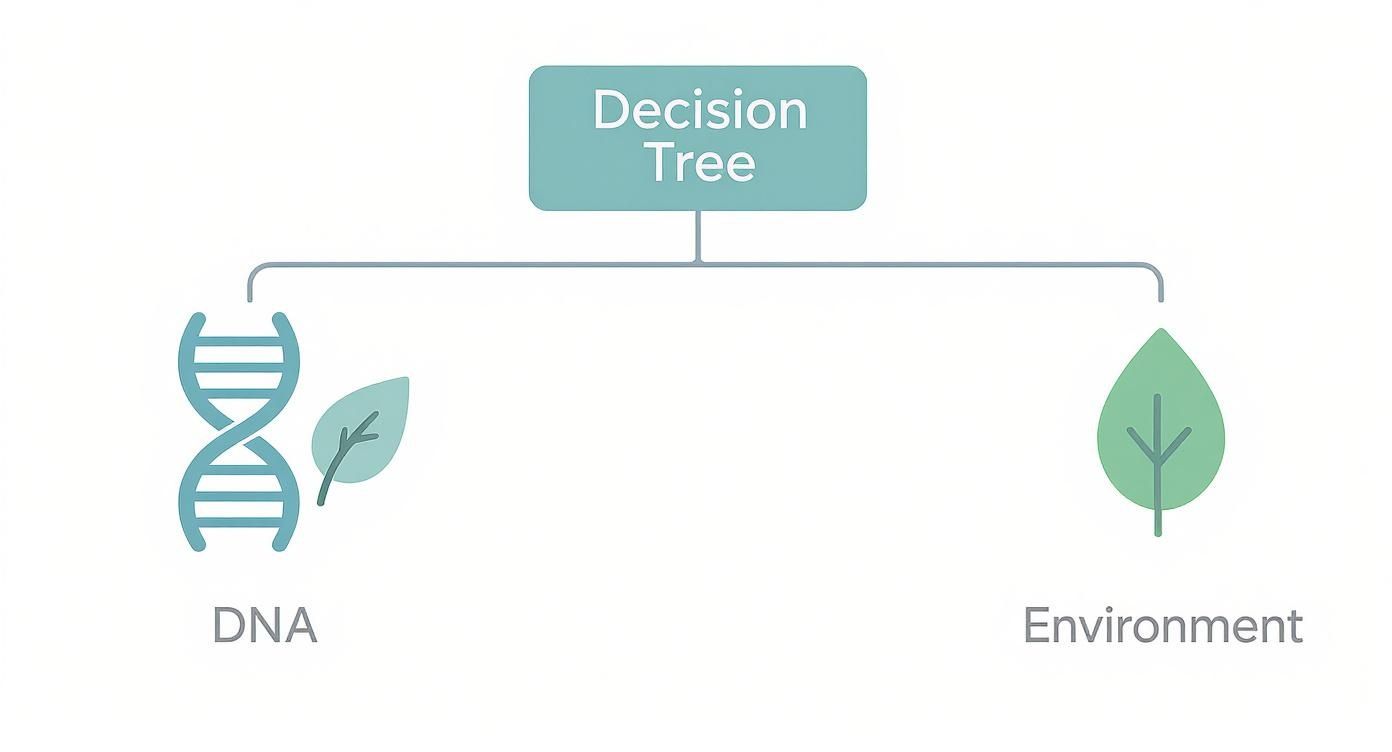
The decision tree makes it clear: Your DNA provides the foundation, while your lifestyle determines how this predisposition actually affects you in everyday life.
The gold standard: DNA-based metabolism analysis
The most precise way to determine your individual metabolism type is through a DNA analysis. Think of it as the operating manual for your body. Instead of measuring only your current state, it deciphers the genetic instructions that have controlled your metabolic rate and nutrient utilization since birth.
A DNA test, such as the mybody® metabolism test, specifically analyzes gene variants scientifically proven to be associated with the metabolism of fats and carbohydrates. The result is not a vague guess, but a scientifically grounded classification into a specific meta-type.
A DNA analysis gives you a blueprint that remains valid for life. It tells you not only that your metabolism is slower, but above all, why—and what you can do specifically to work with it optimally.
For example, you can find out whether your genes make you more likely to burn carbohydrates or fats efficiently. This information is incredibly valuable because it allows you to finally tailor your diet specifically to your needs. This helps you avoid frustration and find a strategy that works for your body—permanently. In our article on testing your metabolism type, we take a closer look at the various testing methods and what they can tell you.
Unfortunately, unfavorable lifestyle habits often contribute to slowing down an already naturally slow metabolism even further. The DKV Report 2023 shows that although around 72 % of Germans meet the WHO physical activity recommendations, but a closer look reveals a different picture. Interestingly, only 7 % of people with obesity to meet all the benchmarks for a healthy lifestyle (exercise, diet, smoking, alcohol, stress), compared with 20 % among people of normal weight. This is exactly where understanding your metabolism type comes in: it gives you the decisive impetus to finally activate the right levers for you.
The right diet for your slow metabolism

The realization that your metabolism runs a little more slowly is a real turning point. At last, you understand why generic diets have only frustrated you so far. But what does this genetic insight actually mean for what you put on your plate? It’s about giving your body exactly the nutrients it can work with best—without starving yourself or constantly going without.
Think of your metabolism as an efficient oven that prefers a very specific fuel. Give it the wrong fuel, and it will merely smolder and produce hardly any heat. Give it the right fuel, and it will run hot and powerfully. That is exactly what we are now achieving with an intelligent nutrition strategy.
Fewer carbohydrates, more high-quality nutrients
For the slow-metabolism type, the decisive factor is often the amount and type of carbohydrates. This does not mean you have to eliminate them completely. It is about reducing them moderately and focusing on the right sources.
Instead of relying on quick energy from white flour, sugar, and processed snacks that send your blood sugar on a roller coaster ride, choose complex carbohydrates. They provide long-lasting energy and truly keep you full.
- Whole grains: Oatmeal, quinoa, and brown rice provide valuable fiber and keep your blood sugar stable.
- Legumes: Lentils, chickpeas, and beans are true powerhouses of complex carbohydrates and plant-based protein.
- Vegetables: Broccoli, leafy greens, and bell peppers provide you with important vitamins and minerals while being low in carbohydrates.
The focus therefore shifts to high-quality proteins and healthy fats. Proteins have a higher thermic effect—your body burns more calories digesting them. At the same time, they provide long-lasting satiety and protect your valuable muscle mass. Healthy fats from avocados, nuts, or olive oil, in turn, are essential for hormone production and cell health.
Consistency beats radicalism
Another key to success is the regularity of your meals. Long breaks between them can put your body into a conservation mode in which it slows down your metabolism even further.
Your body loves routine. Regular meals signal that a steady supply of energy is coming in and that it does not need to switch into starvation mode. This keeps your blood sugar level stable, prevents cravings, and keeps your metabolism active.
An ideal routine often consists of three main meals that genuinely satisfy you. This helps you avoid constant snacking between meals and gives your digestive system the necessary breaks.
In Germany, a slow metabolism is often one of the causes of the rising number of people who are overweight. Data from the Federal Statistical Office show that the obesity rate (BMI ≥ 30) among adults rose from 14,7 % in 2009 16,8 % increased in 2021. This underscores how important a personalized approach is—one that takes living conditions and individual metabolism into account.
An Example Day for Your Metabolism Type
What might such a day look like in practice? Here is an example that can serve as inspiration:
- Breakfast (around 8 a.m.): A protein-rich start to activate your metabolism. Greek yogurt with a handful of berries and nuts, or scrambled eggs with spinach and tomatoes.
- Lunch (around 1 p.m.): A balanced meal that keeps you full for a long time. A large mixed salad with grilled chicken breast, avocado, chickpeas, and a light vinegar-and-oil dressing.
- Dinner (around 6 p.m.): A lighter but nutrient-rich meal. Steamed salmon with a large portion of roasted vegetables such as broccoli, zucchini, and bell peppers.
As you can see, it is not about deprivation, but about intelligent combinations. These meals provide proteins, healthy fats, and fiber that keep you full and satisfied. There are numerous foods that can boost your metabolism and can be perfectly integrated into your meal plan. The goal is a flexible and enjoyable diet perfectly tailored to your body's needs and providing you with energy in the long term.
Your Path to More Energy and a Healthy Weight
If you have read this far, one thing is clear: Your metabolism is not an unchangeable fate condemning you to a life with less energy. Instead, see it as your very own starting point—as a guide to an entirely new feeling in your body. The most important message you should take away is as simple as it is decisive: Individuality is the absolute key to success.
The days of following standard diets and ending up frustrated because nothing happened are over. You now know that your body plays by its own rules—rules that are deeply rooted in your DNA. Fighting these rules is like swimming against the current: incredibly exhausting and rarely successful.
From Knowledge to Action – Your DNA as a Compass
The crucial step to finally take control is understanding your own genetics. A one-size-fits-all diet may somehow get you to your goal in the short term, but for lasting success without the dreaded yo-yo effect, you need a strategy that is truly tailored to you. And this is exactly where science comes into play.
A DNA-based metabolism test, such as the one from mybody®, is much more than just an analysis – it is your personal user manual. It provides the scientific foundation you need to finally make the right decisions about your diet and training.
Instead of continuing to guess which nutrients your body actually prefers, the test gives you a crystal-clear answer. You’ll find out whether you burn carbohydrates or fats more efficiently and can tailor your meal plan accordingly. This knowledge takes away all the uncertainty and gives you back the power to support your body in a targeted way.
Your personal roadmap to sustainable success
How can you now put this new knowledge into practice to achieve lasting success? Consider the results of your DNA test your foundation. Build the following pillars of your new lifestyle on it:
- Personalize your diet: Adjust the balance of protein, fat, and carbohydrates to your individual Meta Type. This has nothing to do with deprivation, but rather with making intelligent choices that truly satisfy you and give you energy.
- Exercise intelligently: Combine strength training to build muscle – your most important metabolism boosters – with endurance workouts you genuinely enjoy. Your body will thank you with more energy in everyday life.
- Optimize your lifestyle: Good sleep is non-negotiable. Also find ways to manage stress. Both have a huge impact on your hormones and therefore directly on your metabolism.
- Be patient and stick with it: Your body needs time to adjust to the new strategy. Trust the process and celebrate even the small successes. Every meal that suits your type is an important step in the right direction.
This journey is the beginning of your new, informed path toward better health. By stopping the fight against your body and instead beginning to work with it, you lay the foundation for more energy, a healthy weight, and a completely new, positive feeling about your body.
Frequently asked questions about a slow metabolism
After all that information, you probably still have one or two questions running through your mind. That’s completely understandable. Here, we answer the most frequently asked questions we receive about the “slow metabolism type” and shed even more light on the subject.
Can you really stimulate a slow metabolism?
Yes, absolutely. Even though your genetically determined basal metabolic rate is a fixed factor, you have several powerful levers at your disposal to significantly boost your total energy expenditure.
The most effective approach? Strength training. Muscles are your body's power plants and burn energy even when you're lying on the sofa. Add regular everyday movement, a protein-rich diet, and good sleep—and you'll actively help your body get back into gear.
Why doesn't any diet work for me even though I eat very little?
Ah, the classic. This problem is not only extremely frustrating, but also a typical dilemma for people with a slow metabolism. If you drastically reduce your calorie intake, your body sounds the alarm and switches into survival mode—it thinks a famine is imminent. The logical consequence: It slows your metabolism down even further to conserve valuable energy.
The nutrient distribution is often another issue. Too many carbohydrates, which your body may process poorly, lead to constant blood sugar fluctuations and cravings. So the key is not to eat less, but to eat the right foods—specifically, those that match your individual metabolic profile.
One of the biggest myths about losing weight is the belief that eating less automatically leads to success. For people with a slow metabolic type, an intelligent nutrient composition is infinitely more important than simply counting calories.
Is a DNA metabolic test necessary, or is regular nutritional counseling enough?
Good nutritional counseling is always a valuable first step. But a DNA test like the one from mybody® provides you and your advisor with the crucial missing piece: your personal genetic predisposition.
While traditional counseling often relies on observation and trial and error, the DNA test gives you a scientifically backed shortcut. It shows you from the outset which macronutrients your body processes best and which strategy makes the most sense for you. This makes the entire process more precise, leads to sustainable results faster, and spares you unnecessary frustration. It is the most direct route to a diet that finally feels as though it were made just for you.
Stop guessing and find out what your body really needs. The DNA test from mybody® gives you the scientific foundation for a diet that finally works. Discover your personal metabolic type and start your journey toward more energy and well-being today at https://mybody-x.com.



Share now:
Benefits of genetic analyses for individual health
Understanding Genetic Tests: How They Work, Benefits, and Safety