
Alcohol intolerance test: Finally, clear answers for you
One glass of wine in the evening, and your face immediately feels hot and turns red? This is often more than just a “normal” reaction. Rather, it may be a clear signal from your body that something is wrong. With an alcohol intolerance test, you can find out whether a genetic predisposition that affects how your body breaks down alcohol may be behind it.
Redness and nausea after drinking alcohol: What is behind it?
You may know the feeling: You enjoy a drink in good company, but instead of relaxing, you feel unwell. Your face starts to burn, your heart beats faster, or you even feel nauseous. Many people simply dismiss these symptoms and think they just “couldn’t handle it.” But often it is more than just one drink too many.
Such reactions may indicate alcohol intolerance. This is a condition that is often genetic and one that many people affected do not even know they have. They mistake the symptoms for the usual aftereffects of drinking alcohol, when in fact their body is trying to tell them something important.
The hidden cause: An enzyme deficiency
The main culprit is usually a deficiency of the enzyme aldehyde dehydrogenase 2 (ALDH2). Think of this enzyme as a diligent helper in your body whose job is to neutralize a toxic substance called acetaldehyde. Acetaldehyde is produced when the liver breaks down alcohol.
When this helper is missing or works only at a very slow pace, toxic acetaldehyde builds up in the blood. And that is exactly what triggers the typical, highly unpleasant symptoms.
A lack of the ALDH2 enzyme is by no means a rare quirk of nature. An estimated 500 million people worldwide are affected, particularly in East Asian populations. Understanding this genetic predisposition is the first and most important step toward better managing your own health.
This is how you learn to interpret the signs correctly
The symptoms of alcohol intolerance are actually quite clear, but they are easily misinterpreted. That is why it is so important to distinguish them from the general effects of alcohol.
Here are the most common signs your body may send you:
- Flush reaction: Sudden, often blotchy redness on the face, neck, and chest.
- Rapid heartbeat: Your heart beats unexpectedly fast or irregularly.
- Headaches: Severe headaches or migraines that occur after consuming even small amounts of alcohol.
- Nausea and stomach problems: A queasy feeling in the stomach, ranging from discomfort to vomiting.
- Blocked nose: A runny or blocked nose, similar to having a cold.
These symptoms are not merely bothersome—they are a warning signal. They show that your body is overwhelmed by the process of breaking down alcohol. Distinguishing between an intolerance and a true allergy is also crucial, as the underlying mechanisms are completely different. If you want to learn more about the genetic causes of your alcohol intolerance, you can explore the topic in greater depth in our article about the alcohol DNA test.

Intolerance or normal alcohol effects?
This table helps you distinguish the symptoms of alcohol intolerance from normal alcohol reactions and make an initial assessment.
| Symptom | Description of an intolerance | Typical alcohol effects for comparison |
|---|---|---|
| Skin redness | Sudden, intense redness (flushing) of the face, neck, and chest | Slight, diffuse redness caused by dilated blood vessels, usually less intense |
| Heart palpitations | Severe, unpleasant heart palpitations (tachycardia), often after only a small amount of alcohol | A slightly elevated pulse that is usually barely noticeable |
| Headaches | A rapid, often throbbing headache or migraine that occurs while drinking | The “hangover headache” typically occurs only hours later or the next day |
| Nausea | Immediate discomfort and nausea, often after the first drink | Nausea generally occurs only after consuming larger amounts of alcohol |
| Blocked nose | Feeling of a blocked or runny nose shortly after drinking | Rarely a direct result of alcohol; rather, a nonspecific symptom |
If you recognize yourself in the middle column, there are many indications of an intolerance. Then it is time to take a closer look.
The German Nutrition Society (DGE) has found that around 21 to 23 percent of adults in Germany engage in risky alcohol consumption. However, if you have an existing intolerance, amounts well below these limits can already cause significant problems. A test helps you assess your individual risks much more accurately. Here you can learn more about the findings on alcohol consumption in Germany.
Understanding why your body reacts this way is the crucial first step. An alcohol intolerance test gives you the opportunity to finally gain clarity and make informed decisions for your well-being.
How an alcohol intolerance test works
You suspect that there is more behind your reactions than just “one drink too many,” but how can you finally be sure? If you no longer want to rely on guesswork, a modern alcohol intolerance test is the next logical step. The good news is that the days of complicated and time-consuming doctor’s visits are long gone.
Today, you can easily and discreetly get to the root of your symptoms from the comfort of your own home. The most reliable method is a genetic test that specifically looks for the genetic cause of alcohol intolerance.
A look at your genes for a lifelong answer
A genetic test is not a fleeting snapshot. It provides fundamental information about your body that will not change throughout your life. The focus here is the gene responsible for producing the enzyme aldehyde dehydrogenase 2 (ALDH2). As you already know, this enzyme plays the main role in breaking down the toxic acetaldehyde produced when you drink alcohol.
The test examines your DNA very closely and looks for a specific genetic variant. If this variant is present, your ALDH2 enzyme functions only to a limited extent or, in the worst case, not at all. The result is a clear yes-or-no answer to the question of whether you carry a genetic predisposition to alcohol intolerance.
That is precisely the unbeatable advantage of a genetic test: It does not measure fluctuating values that may look different again tomorrow. You receive a definitive, scientifically sound statement about your body’s ability to process alcohol. This clarity is the best basis for all further decisions.
The process: From the sample at home to the result
The idea of a “genetic test” still sounds to many people like a visit to the doctor’s office involving complex procedures. Fortunately, reality is quite different today. A home test, such as the one from mybody-x, is designed so that you can easily integrate it into your daily routine. The entire process is designed for comfort and maximum accuracy.
1. Simple sample collection All you need is a simple saliva sample. Your test kit contains everything you need: a sample tube and easy-to-follow instructions. You simply put a small amount of saliva into the tube—it is completely painless, quick, and hygienic.
2. Secure shipping to the specialist laboratory Once the sample is in the tube, you package it securely in the enclosed, already stamped return envelope. From here, the experts take over. Your sample goes directly to a certified specialist laboratory, where it is analyzed according to the strictest quality standards.
3. Your personal results report After a few days, as soon as the analysis is complete, you will receive a notification. You can then conveniently access your detailed results report online. It is presented in a way that you can understand even without a medical degree. You’ll learn not only whether the gene variant is present in your case, but also what this specifically means for your health and lifestyle.
What you should keep in mind before the test
To make your result as accurate as possible, there’s just one small thing to keep in mind. You should not eat, drink, smoke, or chew gum for about 30 minutes before collecting the saliva sample. This ensures that your sample is clean and not distorted by external influences.
As you can see, it’s incredibly easy to use and finally puts your uncertainty to rest. A test like this is a powerful self-care tool that helps you understand your body better. If you’re wondering how you can generally test for intolerances, you’ll find more information in our guide.
An alcohol intolerance test is more than just a finding—it’s your personal key to taking a more mindful approach to your health.
How to use your home test correctly
Now, let’s get down to business. You’ve chosen an alcohol intolerance test and are holding the kit in your hands—a very important step toward finally getting some clarity. To ensure that the result is truly meaningful, I’ll guide you through the entire process now. Step by step, as if I were right there with you.
Don’t worry, it’s really simple. With a few practical tips, you can avoid common mistakes and ensure that your sample can be evaluated perfectly in the laboratory.
The right preparation for a clean sample
The key to an accurate result? A clean, uncontaminated sample. This is the most important part that you can control yourself. Think of it this way: The laboratory can only analyze what you send it. Foreign DNA or food and drink residues can significantly interfere with the analysis.
That’s why a little—but crucial—preparation is everything.
- Observe the waiting period: Please do not eat or drink anything at all for at least 30 minutes before collecting the sample. Yes, that includes water.
- No smoking or chewing gum: You should also completely avoid cigarettes, chewing gum, or lozenges during this half hour.
This simple rule ensures that your mouth contains only your own, pure saliva. This allows the laboratory to isolate and analyze your DNA without interfering factors.
Remember: The quality of your sample directly determines the quality of your result. Set aside these 30 minutes consciously, as they are the foundation for the clarity you want.
Step by step to the perfect saliva sample
As soon as the waiting time is over, you can get started. Your mybody-x test kit contains everything you need. The process is hygienic, completely painless, and takes just a few minutes.
And it's that easy:
- Collect saliva: Open the sample tube. Now collect saliva in your mouth until you have enough liquid to fill the tube to the mark. A little trick: gently massage the inside of your cheeks with your tongue to stimulate saliva flow.
- Provide the sample: Carefully spit the collected saliva directly into the tube. Make sure you reach the fill line without significantly exceeding it.
- Add the solution and close the tube: Close the tube firmly with the cap. It contains a stabilizing liquid that now mixes with your saliva and protects your DNA on its way to the laboratory. Then shake the tube vigorously for about five seconds.
The following graphic provides a quick overview of the entire process—from collecting your sample to receiving the completed results report.
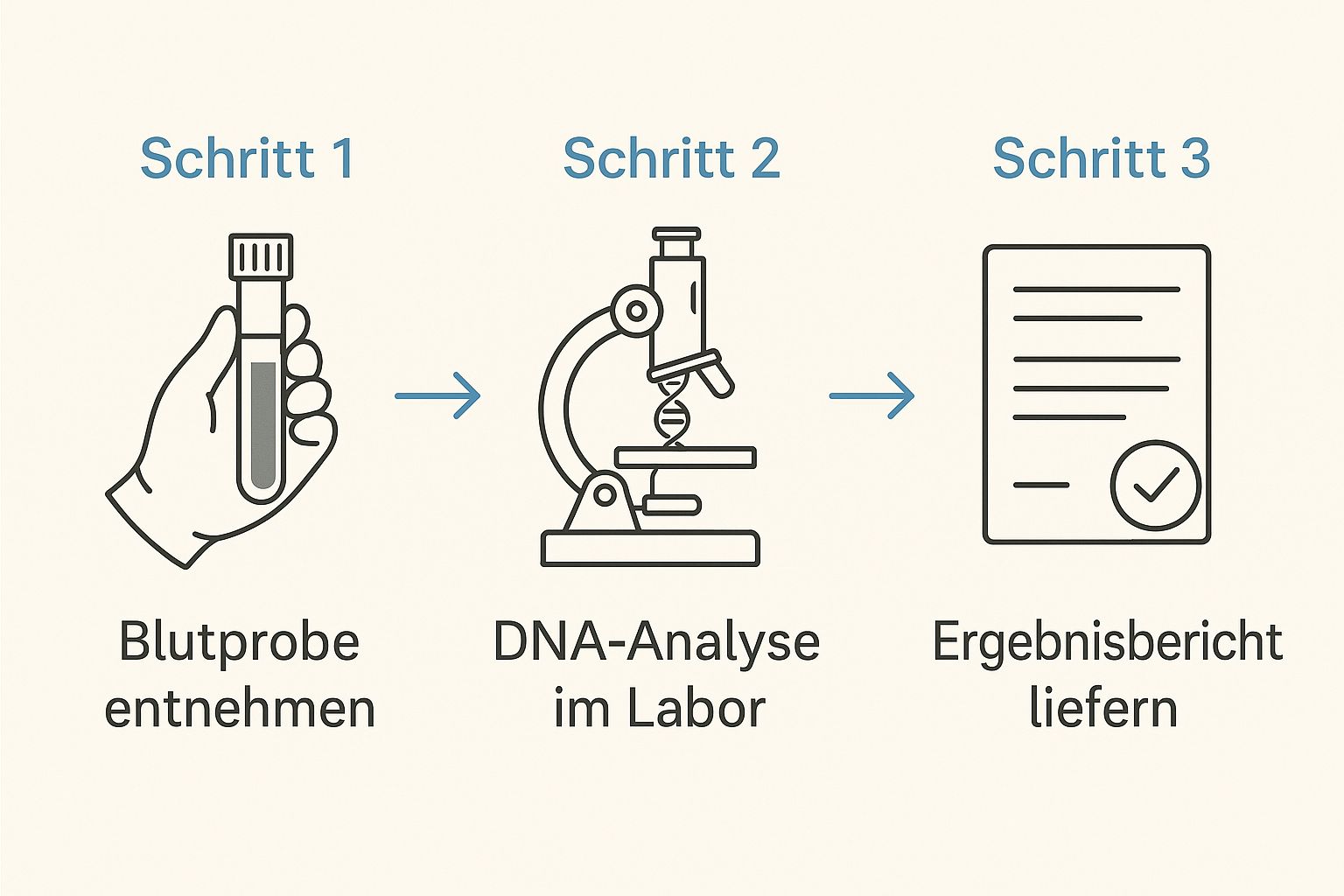
As you can see, the process is designed to give you maximum security with minimal effort—from the first step at home to the final evaluation in the laboratory.
Activate your test kit and send it securely
One often overlooked but absolutely crucial step: activating your test kit. Every test has a unique ID number. It is the only link between your sample and your personal customer account. Without this activation, the laboratory does not know whom the sample belongs to—it will be processed completely anonymously.
Before shipping, be sure to visit the mybody-x website, log in to your account, and enter the test ID found on the tube and inside the packaging. Only then will your sample be assigned to your account, allowing you to access your result later.
Once this is done, place the sealed sample tube in the enclosed, already stamped return envelope. Simply take it to the nearest post office—we'll take care of the rest. In the laboratory, your sample will then be analyzed under the strictest quality standards to detect the genetic variant associated with ALDH2 deficiency.
With this careful approach, you ensure that your path to a clear result runs smoothly. It simply feels good to take an active role in your own well-being. If you are generally curious about the options available, mybody-x offers various at-home intolerance tests to help you understand your body even better.
What your test result means for you
The moment has arrived: You are holding your results report in your hands. At last, you have in black and white what is behind your reactions to alcohol. But what now? A finding alone does not change anything yet. See it as the starting point for a more mindful and healthier approach to your body.
This section is your personal guide to understanding the “technical jargon” in your result and translating it into concrete, positive changes in your everyday life. It’s not about forbidding you from doing anything. It’s about giving you the knowledge you need to make smart, independent decisions for your well-being.
When ALDH2 deficiency has been confirmed
Your result from the Alcohol Intolerance Test shows that you have the genetic variant associated with ALDH2 deficiency. This is the clear answer you have been looking for. Quite simply, it means that your body cannot efficiently neutralize the toxic breakdown product acetaldehyde.
Think of it as an overburdened waste collection service. While the “waste” (acetaldehyde) is quickly disposed of in other people, it builds up in your body. That is exactly what causes typical symptoms such as facial flushing, a racing heart, and headaches. This reaction is therefore not a sign of weakness, but a direct consequence of your genetic makeup.
Your test result is not bad news but a valuable tool. It frees you from uncertainty and gives you back control. You now know why your body reacts this way and can support it in a targeted manner.
Understanding the health connections
Knowing about your ALDH2 deficiency is extremely important from a health perspective. The accumulated acetaldehyde is not only unpleasant; it is considered damaging to cells and potentially carcinogenic. Studies suggest that people with this genetic variant have a significantly increased risk of certain diseases when they regularly consume alcohol.
These include, above all:
- Esophageal cancer: With regular consumption, the risk can increase severalfold.
- Cardiovascular problems: The flush reaction is associated with fluctuations in blood pressure and puts strain on the heart.
- Liver damage: Even if you may drink less, your liver can be more severely affected by acetaldehyde.
This knowledge is not meant to scare you. It is meant to strengthen your motivation. Every time you choose to abstain from alcohol or consciously reduce your consumption, you are actively doing something to minimize these risks.
Concrete recommendations for your everyday life
The most important part now is putting this knowledge into practice. It’s not about radical abstinence, but about developing a new, informed relationship with alcohol.
1. Consciously reduce your alcohol intake or avoid it altogether The most logical and safest consequence is to cut down your alcohol consumption significantly or give it up completely. Pay close attention to how your body reacts even to the smallest amounts. You’ll probably quickly notice that on the days when you don’t drink, you feel much more energetic and fit.
2. Choose more tolerable alternatives If you don’t want to give up alcohol completely, there really are differences. Drinks with a high histamine content, such as red wine or certain types of beer, can make the symptoms even worse. Clear spirits such as gin or vodka are better tolerated by some people, but the same applies here: The dose makes the poison—and with an ALDH2 deficiency, that dose is extremely low.
3. Discover the world of non-alcoholic drinks The market for non-alcoholic alternatives has virtually exploded in recent years. This is your chance to discover something new:
- Non-alcoholic wines and sparkling wines: Many taste surprisingly good nowadays and have nothing to do with the grape juice of the past.
- Creative mocktails: Mix drinks with fresh juices, herbs, and high-quality tonics.
- Non-alcoholic craft beers: There’s a huge selection that goes far beyond classic pilsner.
4. Open communication in social settings You don’t have to justify yourself. A simple “No, thank you, I’m not drinking today” is usually more than enough. If someone does ask, you can calmly explain: “I’ve found out that I don’t tolerate alcohol well, and I simply feel better without it.”
A diagnosis of alcohol intolerance is especially important when considering the general health risks. According to surveys, around 3 million adults in Germany were affected by alcohol-related disorders. A genetic test can help you identify your personal risk early and thus prevent long-term harm. You can read more about the figures and facts on alcohol in Germany.
Your test result is the first step. Use it as a compass to guide you toward decisions that benefit you and your health.
Your everyday life with alcohol intolerance
You have your diagnosis—the alcohol intolerance test has provided clarity. That’s a huge step forward. But now comes the real challenge: How do you deal with it in everyday life without constantly feeling like a party pooper or an outsider?
Don’t worry, it’s easier than you think. Here you’ll find practical tips to help you navigate parties, restaurant visits, and get-togethers with friends confidently.
Confidently saying “No, thank you”
Social pressure can be pretty annoying. A well-intentioned “Oh, come on, one little glass won’t hurt!” or the questioning looks when you reach for a bottle of water—who does not know that? The trick is to have a short, clear, and confident response ready that does not require lengthy explanations.
You do not have to share your entire health history with anyone. Try one of these responses:
- Direct and clear: “No, thanks, I’m not drinking anything today.” Short, simple, and leaves no room for discussion.
- Health-conscious: “I’ve realized that alcohol simply doesn’t agree with me, so I’m leaving it out.”
- Put positively: “I’d rather keep a clear head tonight.”
- Generally speaking: “Thanks, but I’m sitting this one out today.”
You will quickly notice that most people accept it without any problems. It is about your health, and setting this boundary is simply an act of self-care.
Stylish alternatives instead of bland deprivation
Thankfully, the days when you could only drink still water at parties are over. The market for non-alcoholic drinks has practically exploded in recent years—creative, diverse, and genuinely delicious. It is no longer about deprivation but about discovering something new.
Knowing about your intolerance is not a loss but a real gain. You learn to listen to your body better and make choices that truly benefit you. This turns a supposed “must” into a conscious choice for a better quality of life.
Here are a few ideas for stylish and delicious alternatives:
- Mocktails and signature drinks: Many bars and restaurants now mix fantastic non-alcoholic cocktails. At home, you can get creative—with fresh juices, herbs such as mint or basil, ginger beer, or high-quality tonics.
- Non-alcoholic wine and sparkling wine: Thanks to modern production methods, many non-alcoholic wines and sparkling wines now taste surprisingly close to the original. Perfect for making a stylish toast.
- Craft sodas and kombucha: Instead of sticky-sweet standard sodas, there are exciting varieties with less sugar and complex flavors. Kombucha is also a probiotic and wonderfully refreshing choice.
- Non-alcoholic beer: The selection is huge—from pilsner and IPA to wheat beer. You often barely notice a difference in taste.
Precisely because intolerances such as those to alcohol and histamine often go hand in hand, it is important to know the exact causes. Many alcoholic drinks, especially red wine, are true histamine bombs. If you want to learn more, read our article on how to test for histamine intolerance.
Detecting hidden alcohol in food
Alcohol does not only hide in glasses. It often turns up unexpectedly, especially in restaurants or ready-made products, and can really ruin your day.
Keep an eye out for these sources:
- Sauces: Dark sauces in particular, such as gravy, or delicate cream sauces are often deglazed with wine, cognac, or sherry.
- Desserts: Classics such as tiramisu, chocolate mousse, or Black Forest gateau often contain alcohol. Liqueur poured over fruit is another popular trick.
- Marinades and soups: Wine tenderizes meat and gives soups, such as classic French onion soup, their distinctive flavor.
- Ready-made meals: Here, the only solution is to take a close look at the ingredients list. Sometimes alcohol is even found in jams or chocolates.
If you are unsure at a restaurant, just ask. A friendly “Does the sauce contain alcohol?” is a perfectly normal question and simply shows that you are taking care of yourself.
Alcohol consumption is deeply rooted in our culture. According to the Epidemiological Addiction Survey, around 19 percent of Germans between the ages of 18 and 59 engage in problematic alcohol consumption. An alcohol intolerance test is therefore not only valuable for you personally, but also helps raise awareness of individual health risks. Find out more here about the prevalence of problematic alcohol consumption in Germany.
Frequently asked questions about alcohol intolerance
Finally, I would like to clarify a few questions that keep coming up in connection with an alcohol intolerance test. This will ensure you are well informed and can put your remaining uncertainties to rest.
Can alcohol intolerance develop suddenly?
Yes, that is indeed possible, but we need to take a closer look here. The classic, genetically caused intolerance—ALDH2 deficiency—is congenital. You have it from birth, and it remains for life. So it does not suddenly develop, but you may not notice the symptoms until later in life, or they may become more pronounced over time.
However, acquired intolerances can indeed develop. Certain medications, liver diseases, or other health problems can affect your body’s ability to break down alcohol—sometimes only temporarily, and sometimes permanently. Age also plays a role, as enzyme activity in the body can generally decline over time.
Is alcohol intolerance connected to histamine intolerance?
Absolutely, this connection is extremely important and is unfortunately often overlooked. Many alcoholic beverages are veritable histamine bombs, especially red wine, sparkling wine, and certain types of beer. At the same time, alcohol disables the enzyme diamine oxidase (DAO), which is responsible for breaking down histamine in the intestine.
This is a genuine double burden for your body: you consume a lot of histamine while simultaneously blocking its breakdown. The result is symptoms such as skin flushing, headaches, or gastrointestinal problems that can look confusingly similar to those of alcohol intolerance. It is therefore quite possible that both factors play a role for you.
How reliable is a genetic test for home use?
A high-quality genetic test analyzed by a certified specialist laboratory is extremely reliable. It analyzes your DNA—in other words, your genetic blueprint—which does not change throughout your life. The result is therefore not a snapshot, but information that remains valid for life.
The accuracy of such DNA tests is over 99 %. The only important thing is to follow the sample collection instructions carefully so that a clean, uncontaminated saliva sample reaches the laboratory. You will then receive a scientifically validated and reliable answer to the question of your genetic predisposition.
What is the difference between intolerance and an allergy?
Even though the symptoms may sometimes be similar, they are caused by completely different mechanisms. Knowing the difference is crucial.
- Intolerance: This involves a metabolic problem. Your body lacks a specific enzyme (such as ALDH2) needed to process a substance properly. The reaction depends on the amount consumed—the more you drink, the stronger the symptoms. The immune system is not involved.
- Allergy: An allergy is an overreaction of the immune system to a substance that is actually harmless (an allergen), such as grains in beer or sulfites in wine. Even tiny amounts can trigger severe and potentially life-threatening reactions, such as breathing difficulties or anaphylactic shock. A true alcohol allergy is extremely rare, however.
The distinction is therefore crucial for your health and for managing your symptoms appropriately.
With the knowledge gained from an alcohol intolerance test, you are well equipped to make informed and healthy decisions for yourself and your body. At mybody-x.com, you will find scientifically validated tests that help you understand your body better and take control of your health.

Share now:
Metabolism test – find out your metabolic type
Coffee or Tea: Which Is Better for Your Metabolism?