

Weight Loss Metabolism Analysis: Your Personal Path to Success
A metabolism analysis for weight loss is your most personal guide to a diet that truly works for you. Instead of general diet rules, it provides scientifically sound insights into how your body processes fats, carbohydrates, and proteins in its own individual way. This allows you to replace guesswork with a clear, personalized plan for sustainable success.
Why most diets are bound to fail
Does this sound familiar? You have already tried countless diets, yet the pounds always come back. That is incredibly frustrating. But let me tell you: You are not alone. The reason for this yo-yo effect is rarely a lack of discipline, but usually a fundamental misunderstanding of how your body really works.
Imagine your metabolism as a unique, highly complex engine. Every engine has its own design and needs a very specific fuel to run optimally. While one runs best on gasoline (that is, carbohydrates), another may need diesel (that is, fats) to deliver its full performance.

The problem with the one-size-fits-all solution
Standard diets are like a gas station that offers only one type of fuel. They give everyone the same plan while ignoring the crucial differences in our biochemistry. These one-size-fits-all solutions are almost always based on the simple formula: “Eat fewer calories than you burn.” Yet for many people, this calculation simply does not work.
Countless people then wonder why they simply cannot lose weight despite being in a calorie deficit. The answer is more complex and lies in your very personal metabolism. If you would like to delve deeper into this phenomenon, you will find valuable insights in our guide.
This is a huge topic. In Germany, the number of adults with obesity has increased dramatically over the past two decades. According to the Robert Koch Institute, the rate rose from 12.2% in 2003 to 19.7% in 2023. Experts agree that impaired metabolism, often caused by an unsuitable diet, is one of the main reasons.
What really controls your metabolism
Your metabolism—that is, the sum of all biochemical processes that convert food into energy—is controlled by factors that go far beyond simply counting calories.
These include three things in particular:
- Your genetics: Your DNA provides the blueprint for how efficiently your body can process different nutrients.
- Your hormone balance: Hormones such as insulin, cortisol, and thyroid hormones are the key regulators of fat burning and storage.
- Your basal metabolic rate: This is the amount of energy your body uses when completely at rest—and this value varies enormously from person to person.
So it’s not your fault if nothing has worked so far. You simply lacked the right operating manual for your personal engine. A metabolic analysis provides you with exactly that manual.
When you understand your body’s unique needs, you lay the foundation for a path based not on deprivation, but on knowledge. It’s about finally giving your body exactly the fuel it needs to be healthy, perform at its best, and stay slim in the long term.
What methods are available for metabolic analysis
The term “metabolic analysis” may sound complicated at first, perhaps even a little intimidating. But don’t worry: there’s no magic involved. Just imagine that you want to have a car repaired. A good mechanic doesn’t rely on just one tool. They listen to the engine, measure the oil pressure, and check the electronics.
Health analysis also uses various “tools” to examine your metabolism closely. Each method sheds light on a different area of your body and provides another piece of the puzzle for your personal overall picture. Let’s take a closer look at the most important approaches.
DNA analysis: your personal blueprint
The most fundamental and informative method is probably genetic metabolic analysis. Your DNA is like your body's personal blueprint—written at birth and unchangeable forever. This blueprint determines how your cells respond to specific nutrients, types of exercise, and even stress.
A DNA analysis such as the one offered by mybody® specifically examines gene variants that have been proven to control your metabolism. It gives you answers to crucial questions:
- What type of metabolism do you have? Do you process carbohydrates, fats, or proteins particularly well? This explains why a low-carb diet works wonders for some people, while others barely make any progress with it.
- How does your sense of hunger work? Your genes have a major influence on how quickly you feel full or whether you are more prone to cravings.
- Which type of exercise burns fat most effectively for you? Are you more of an endurance type, or should you focus on intense strength training to achieve visible results?
The huge advantage of this method is that it remains valid for life. Your genes do not change. A DNA-based analysis therefore provides a stable foundation for all your future decisions about nutrition and fitness.
The biggest key to your weight-loss success is not working against your genetics, but with them. A DNA analysis shows you how.
Blood analysis: a current snapshot
While DNA describes your predisposition, a blood analysis is like a current status report. It measures what is happening in your body right now. To continue with the car analogy, it is like checking the operating fluids—oil, coolant, and brake fluid. These levels can and should change depending on your lifestyle, diet, and health.
A blood analysis is particularly useful for examining these areas:
- Your hormone balance: Hormones such as thyroid hormones (TSH, fT3, fT4), the stress hormone cortisol, or insulin have a huge impact on your metabolism. An imbalance here can block any attempt to lose weight.
- Nutrient deficiencies: If you lack important vitamins (e.g., vitamin D) or minerals (such as iron or magnesium), your metabolic engine cannot run smoothly.
- Blood sugar and blood lipid levels: Values such as long-term blood sugar (HbA1c) or cholesterol reveal how your body is responding to your current diet.
A blood analysis is perfect for identifying acute blockages or checking the success of a dietary change. It ideally complements DNA analysis because it shows how your current lifestyle affects your genetic predispositions in practice.
Measuring your resting metabolic rate (calorimetry): your exact calorie needs
Indirect calorimetry is a technical method that measures your basal metabolic rate with great precision. It sounds complicated, but it’s simple: A breathing mask analyzes how much oxygen you consume and how much carbon dioxide you release. This allows us to calculate exactly how many calories your body burns at complete rest.
This method answers one of the most important questions of all: What is my individual calorie requirement really? Online calculators provide only rough estimates. Calorimetry, on the other hand, gives you a precise value that serves as the basis for an effective calorie deficit.
The microbiome analysis: a look inside your gut
Trillions of bacteria live in your gut, and together they form your microbiome. These tiny helpers are responsible not only for digestion but also influence your immune system and even your mood. A stool analysis can examine the exact composition of your gut flora.
It provides insights into:
- Whether an imbalance, known as dysbiosis, is present.
- How well you can utilize certain nutrients, such as fiber.
- Whether certain bacterial strains predominate that are associated with obesity.
A healthy gut flora is the foundation of a functioning metabolism. So if you are struggling with digestive problems or a weight-loss plateau despite eating a healthy diet, taking a look at your microbiome can be extremely revealing.
Comparison of methods for metabolic analysis
This table provides you with a quick and clear overview of the most common types of analyses, what they measure, and what they are best suited for.
| Analysis method | What is measured? | What is it ideal for? | Accuracy/focus |
|---|---|---|---|
| DNA analysis | Genetic predisposition (metabolic type, sense of hunger, athletic type) | As a lifelong foundation for personalized nutrition and training. | Very high, as it is unchangeable. Shows your potential. |
| Blood analysis | Hormones, vitamins, minerals, blood sugar, blood lipids | To uncover acute obstacles, such as hormonal disorders or deficiencies. | High, but only a snapshot. Shows the current state. |
| Resting metabolic rate measurement | Oxygen consumption and CO2 output for calculating calorie expenditure | To determine your exact individual basal metabolic rate. | Highly precise for determining calorie needs, but without qualitative information. |
| Microbiome analysis | Composition of gut bacteria | For digestive problems or when weight loss stalls. | Provides insights into gut health and nutrient utilization. |
Each of these methods has its strengths. For a truly complete picture, a smart combination is often the key to success. DNA analysis provides the unchanging foundation on which all other measures are built.
If you want to delve even deeper into the subject, you’ll find many more valuable insights in our detailed guide to the types of metabolic analyses.
How your DNA provides the key to losing weight
Imagine having an exclusive user manual for your body—one that tells you exactly which fuel gets you running at full speed and which merely holds you back. That is precisely what a DNA-based metabolic analysis does. It is the most accurate way to find your perfect nutrition strategy because it is not based on guesswork but directly on your genetic code.
Your DNA is like the unchangeable blueprint of your body. It was established at birth and determines the fundamental rules of your metabolism. It decides how efficiently your cells convert fats, carbohydrates, and proteins into energy. This genetic blueprint is also why general diet advice simply does not work for so many people.
Your genes determine your metabolic type
Have you ever wondered why your friend seems to lose weight effortlessly on a low-carb diet, while hardly anything happens for you despite strictly avoiding bread and pasta? The answer lies in your genes. Researchers have now identified very specific genetic markers that directly influence how your body responds to certain nutrients.
A well-known example is the FTO gene, often referred to as the “fat-mass and obesity-associated” gene, or the “fat mass and obesity gene.” Certain variants of this gene can increase the tendency toward overweight because they intensify feelings of hunger and affect fat burning. People who carry this gene variant often gain weight more easily when they eat a lot of saturated fatty acids. For this group, a high-fat low-carb diet would therefore be counterproductive.
Another very clear example is genetically determined lactose intolerance. Due to the structure of the DNA, the enzyme lactase is missing to break down milk sugar. Similar but much subtler genetic differences determine whether your body is more of a “carbohydrate type” or a “fat type.”
A DNA analysis like the one from mybody® takes a close look at these genetic markers. It deciphers whether you tend to quickly convert excess carbohydrates into fat or whether you can use fat particularly efficiently as an energy source.
This insight is the crucial lever: Instead of fighting against your genetic predisposition, you start working with it.
The following infographic shows you at a glance how a metabolic analysis can help you find the right path toward your individual goals.
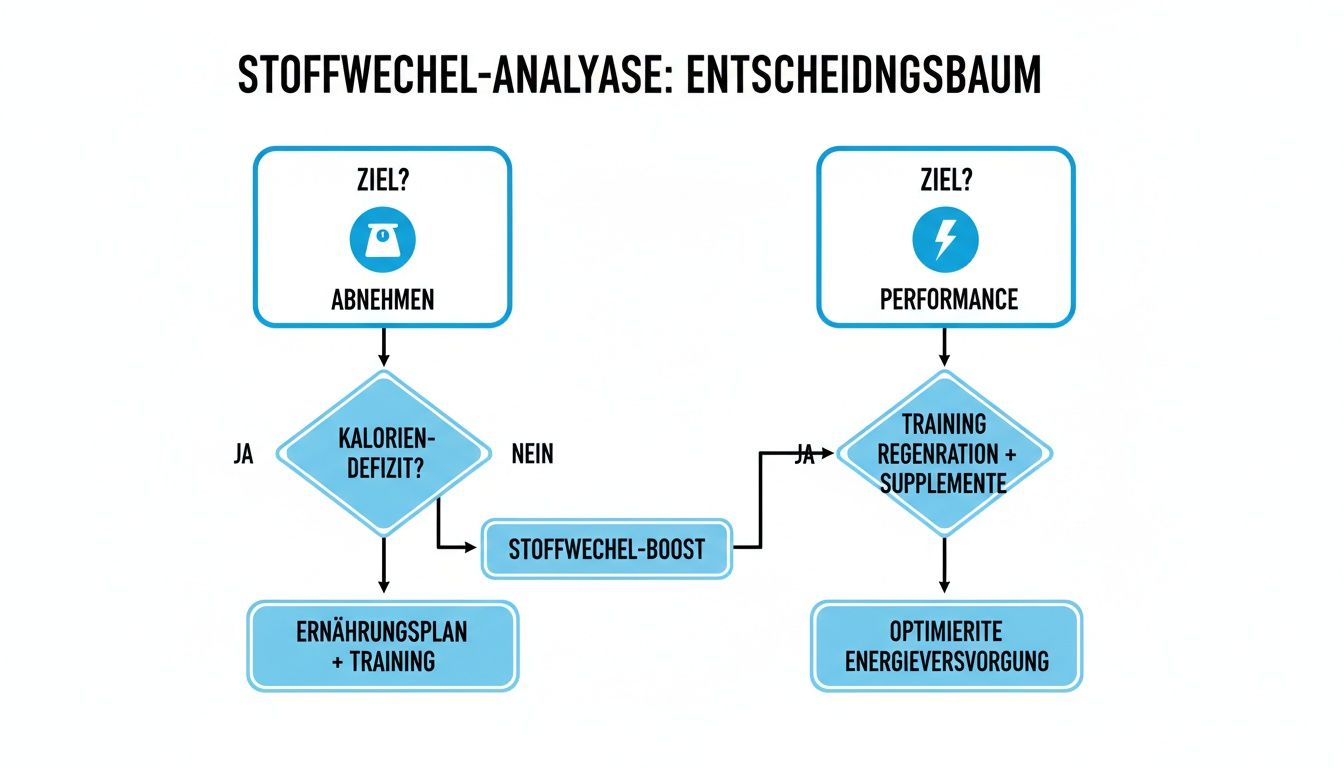
The decision tree makes it clear: Whether you want to lose weight or improve your performance, analyzing your unique metabolism is the first and most important step.
From a simple test to a clear roadmap
The process of a DNA-based metabolic analysis is remarkably straightforward and completely painless. It demystifies the complex processes in your body and translates them into understandable, practical recommendations for everyday life. This is what the process typically looks like:
- Simple sample collection at home: A test kit will be sent to your home. Using a cotton swab, you collect a simple saliva sample from the inside of your cheek. It only takes a few minutes and can be done conveniently from home.
- The scientific analysis in the laboratory: You send your sample to a specialized, ISO-certified laboratory. There, your DNA is isolated and examined for the relevant gene variants that regulate your metabolism, sense of hunger, and response to exercise.
- Your personal results report: After the analysis, you will receive a detailed and, above all, easy-to-understand report. Without complicated technical jargon, it explains what your genetic results mean for you. You will learn exactly which distribution of macronutrients (carbohydrates, fats, proteins) is optimal for you and which sports will get you to your goal most effectively.
This scientifically grounded approach builds trust and gives you the confidence that your efforts will finally pay off. You don't simply receive data, but a personalized roadmap that's valid for a lifetime. If you'd like to explore more deeply how your genes influence your diet, you'll find fascinating insights in our article on the basics of nutrigenetics.
DNA analysis is therefore the gold standard for truly personalized and sustainable weight loss. It puts an end to diet hopping and gives you a powerful tool instead: knowledge about yourself.
How to put your analysis results into practice in everyday life
A detailed analysis report is a fantastic tool, but the data alone won't make the pounds melt away. The crucial step is always putting it into practice in everyday life. Here, I'll show you how to turn the insights from your metabolic analysis for weight loss into a concrete plan that truly fits into your life.
You now know in black and white which metabolic type you are—but what do you do with this information? It’s about turning this knowledge into simple habits that feel good and don’t feel like deprivation.

From data sheet to plate
The most important recommendation from your analysis concerns the optimal distribution of macronutrients—carbohydrates, fats, and proteins. It is your personal compass for every meal.
Let’s imagine Anna: Her DNA analysis revealed that she is a carbohydrate type. This means her body can process carbohydrates quite well, but reacts more sensitively to too much fat.
For Anna, this means specifically:
- Breakfast: Instead of the high-fat scrambled eggs with bacon she often used to eat, she now has oatmeal with berries and low-fat quark. This provides complex carbohydrates for long-lasting energy.
- Lunch: Instead of a salad with oily dressing and cheese, she now makes herself a large bowl with quinoa, colorful vegetables, and grilled chicken breast.
- Dinner: She replaces the rich cream sauce on her pasta with a light tomato sauce with lentils and fresh herbs.
The key is not radical restriction, but smart substitutions. You simply prioritize the nutrients your body handles best.
If you want to learn more about how to optimize your diet based on your test results, you’ll find a detailed guide with many practical tips here.
The right training for your metabolic engine
In addition to nutrition, a good metabolism analysis also gives you valuable insights into which type of exercise is most effective for you. Not every workout has the same effect on everyone. Let’s take another look at Anna here.
Her analysis shows that she is genetically more inclined toward endurance. Her body particularly boosts fat burning during longer, moderate exercise sessions.
Her new strategy could look like this:
- Focus on endurance sports: Instead of exhausting herself with heavy weights only at the gym, she now plans a 45-minute running, cycling, or swimming session three times a week.
- Strength training as a supplement: She continues with one strength-training session per week to strengthen her muscles—for they increase her basal metabolic rate.
- More everyday movement: She consistently takes the stairs instead of the elevator and incorporates a walk into her lunch break.
This combination of diet tailored to your type and suitable training is a true metabolism booster. How strongly exercise actually influences fat metabolism was impressively demonstrated in a metabolomic analysis: After 80 days of intensive training, blood analyses of the participants showed significantly reduced free fatty acids and a decrease by a factor of 9 reduced concentration of a specific metabolic product – a clear indication of much more efficient fat breakdown.
Sustainable integration without stress
The best plan is useless if it does not fit into your life. The transition should therefore take place gradually and without pressure. Start with small changes that feel good.
- Plan your meals: Set aside an hour on the weekend to roughly plan your meals for the coming week. This prevents unhealthy impulse purchases.
- Be patient with yourself: There will be days when everything does not go perfectly. That is completely normal. What matters is simply getting back on track the next day.
- Listen to your body: Your analysis is a roadmap, but how you feel remains an important guide. Pay attention to how you feel – do you have more energy, and are you sleeping better?
When you implement the insights from your metabolic analysis, you give your body exactly what it needs. You work with it as a team instead of fighting against it. This leads not only to sustainable weight loss but also to noticeably greater well-being and energy in everyday life.
Finding the right provider for your analysis
The market for metabolic analyses is booming, and the number of providers is growing with it. That’s great because you have more choice. At the same time, however, it is becoming trickier to find a truly trustworthy partner for your health journey. So how do you separate the wheat from the chaff?
To help you make a safe and well-informed decision, we have put together a clear checklist for you. These criteria will help you identify a reputable provider such as mybody® and invest your money wisely.
What you should look for when choosing
A good provider is more than just a stylish online shop. Look out for the following quality features, which guarantee you security and genuine added value:
- Scientific foundation: The provider should be transparent about what its analysis is based on. Are specific genes examined? Are references to recognized studies provided? A reputable partner like mybody® works with ISO-certified laboratories and bases its evaluations on evidence-based findings.
- Crystal-clear data protection: Your genetic data is extremely sensitive. Be sure that the provider meets the highest data protection standards (GDPR-compliant). This includes a commitment to pseudonymize and destroy your sample after the analysis and never pass your data on to third parties.
- Easy-to-understand results: What good is the best report if you do not understand it? A top provider translates complex scientific data into clear, practical recommendations for everyday life. You should receive specific guidance for your diet and lifestyle, not just a dry collection of data.
- Personal support: What happens if questions arise after you receive the results? A reliable partner will not leave you on your own. Check whether there is customer service or even personal consultation to help you interpret and implement your results.
A reputable provider will not sell you a quick miracle cure. Instead, they give you a scientifically sound tool and provide competent support along the way.
Red flags: How to recognize untrustworthy offers
In addition to the positive criteria, there are also clear warning signs that should set off your alarm bells. Be especially cautious if you encounter these points:
- Unrealistic promises: Statements such as “Guaranteed to lose 10 kilos in 4 weeks” are a clear sign of an untrustworthy provider. A metabolic analysis is a tool, not a magic pill.
- Lack of transparency: If you cannot find any information about the laboratory, the scientific method, or data protection, you should be skeptical.
- Hidden costs: Make sure all costs are communicated clearly. Could there be expensive subscriptions or additional fees for the evaluation?
- Aggressive sales pressure: Dubious analyses are often tied to the sale of overpriced dietary supplements that are allegedly essential.
Your weight loss metabolic analysis is an important investment in your health. So take the time to choose the provider carefully. A partner such as mybody® offers you the necessary scientific depth, transparency, and support to help you achieve your goals safely and sustainably.
Frequently asked questions about metabolic analysis
Deciding to understand your own body better through a metabolic analysis for weight loss is a major step. Naturally, questions often arise along the way. We have collected the most common ones here and answered them clearly to resolve any remaining uncertainties and give you confidence in your decision.
How quickly will I see results after an analysis?
This is one of the most important questions, and the honest answer is: It depends entirely on how consistently you implement the recommendations. The analysis itself is the starting point, not the finish line. However, many of our customers report noticeable, positive changes after just two to three weeks.
What they often notice first:
- More energy and less tiredness during the day, because your body is finally getting the right fuel.
- A greater feeling of fullness and fewer cravings, because meals are optimally tailored to your individual predisposition.
- The first visible results on the scales or measuring tape, which naturally provide enormous motivation to keep going.
Remember: This is not about a crash diet, but about making a sustainable change. The greatest and most lasting results come when you firmly integrate the new habits into your everyday life.
Will I ever need to repeat a DNA analysis?
No, and that is one of the greatest advantages of a genetic metabolic analysis. Your DNA is the unchanging blueprint of your body—it remains the same throughout your life. A one-time analysis therefore provides you with a foundation that remains valid for life for your decisions about nutrition and exercise.
While other values, such as hormone levels or nutrient status in the blood, change with your lifestyle and may warrant a new measurement, your genetic metabolic type remains constant. You are therefore making a one-time investment in knowledge that will always be available to you.
Think of the DNA analysis as buying a detailed map of your body. The landscape (your body) may change over the years, but the basic roads and paths (your genetics) remain the same.
Do health insurers cover the cost?
As a rule, statutory health insurers in Germany do not cover the cost of a preventive metabolic analysis, such as one conducted for weight optimization. Such analyses are generally considered individual healthcare services (IGeL), which you pay for yourself.
However, some private health insurers or supplementary insurance providers are more accommodating and contribute toward the cost of such preventive measures. It is therefore always worth asking your health insurer directly and checking whether cost-sharing is possible. It is best to view the analysis as a valuable investment in your long-term health and well-being.
Is a metabolic analysis scientifically sound?
Yes, absolutely. Modern metabolic analyses, particularly DNA-based ones, are supported by years of research in human genetics and nutrigenetics. Reputable providers such as mybody® work exclusively with ISO-certified specialist laboratories and evaluate only genetic markers whose influence on metabolism has been demonstrated in scientific studies.
Other personalized approaches have also shown great success. An independent study demonstrates the effectiveness of blood-analysis-based metabolic programs: More than 62% of participants lost at least 5% of their body weight and kept it off for over a year. Compared with standard diets, where 80–95% of people regain the weight they lost, this shows the remarkable sustainability of a personalized approach. You can find more information about these findings on metabolic programs at praktischarzt.de.
Who is an analysis actually useful for?
A metabolic analysis makes sense for almost anyone who wants to take control of their health and truly understand their body. You’ll benefit particularly if one of these points applies to you:
- You’ve already tried many diets but haven’t achieved lasting success. The analysis shows you why previous attempts may have failed and which approach really works for you.
- You want to lose weight in a targeted, sustainable way without starving yourself. You’ll learn which foods really keep you full and are good for you.
- You often feel low on energy or tired, or struggle with digestive problems. An analysis can help uncover the causes in your diet.
- You exercise but aren’t seeing the results you want. Find out which form of training is most effective for your body to burn fat.
Basically, it’s for anyone who wants to end the guesswork and make better decisions about their health based on a sound understanding of their own body.
Are you ready to end the guesswork and discover your personal path to greater well-being? At mybody®, you’ll find scientifically grounded analyses that give you clear, actionable insights into your unique metabolism. Start your journey to a healthier you today.
Discover the right metabolic analysis for you now at mybody-x.com



Share now:
Understand metabolic types: Find out how you really lose weight
Metabolic analysis: Your personal guide to optimal nutrition