

Abdominal pressure: What causes it and when you should have it evaluated
The essentials at a glance
Abdominal pressure usually occurs because the stomach or intestines become distended—due to a large meal, gas or slowed transit. The cause is usually harmless and temporary. If warning signs such as significant weight loss, blood in the stool, fever or paleness occur, the pressure should be medically evaluated.
This guide focuses on the pressure and feeling of fullness themselves: where they occur, when they appear and which causes are most often behind them. The institution and year are provided in the text for every statement—including where a commonly recommended approach is not supported by scientific evidence.
Read Chapter 2 for the warning signs, Chapters 3 and 4 for location and timing, Chapters 5 to 7 for the causes, Chapters 8 and 9 for what helps and what does not—and Chapters 10 to 12 to find out whether a gut microbiome test may be suitable for you.
What to expect in this article
2. Where does the pressure come from—and when should it be medically evaluated?
3. Where is the pressure located—and what does its location indicate?
4. When does the pressure occur—after eating or independently of meals?
5. What role do the gut microbiome and dietary fiber play in the feeling of pressure?
6. What do irritable bowel syndrome and functional dyspepsia have to do with abdominal pressure?
7. What are the most common causes of abdominal pressure?
8. What helps with pressure and a feeling of fullness in everyday life?
9. What does not help—or has not been proven?
10. What can an examination of the gut microbiome contribute?
11. How mybody® can help
12. Putting it into perspective: What a microbiome test can—and cannot—do
13. Conclusion
Frequently asked questions
Sources
What does abdominal pressure actually mean?
Abdominal pressure is a feeling of tension and fullness in which the abdominal area feels more constricted than it should. Unlike pain, it often cannot be pinpointed to one spot but describes an area.
This refers to several sensations: early satiety, tension in the abdominal wall or a pulling sensation toward the diaphragm.
Key message: Abdominal pressure is a symptom, not a diagnosis. It only becomes meaningful when considered as a pattern of location, timing, duration and accompanying signs—these are exactly the four details a doctor needs for assessment.
How do pressure, a feeling of fullness, bloating and pain differ?
A feeling of fullness mainly describes the state after eating: the stomach is full and empties more slowly than would be comfortable. It typically subsides once the meal has left the stomach.
Bloating is the visible version: the abdominal circumference increases over the course of the day because gas accumulates in the intestine. Pressure, on the other hand, can also occur without visible distension.
Pain, by contrast, is sharper, easier to localize, and often cramp-like. For irritable bowel syndrome, the Institute for Quality and Efficiency in Health Care (IQWiG, 2023) lists “persistent abdominal or lower abdominal pain, cramps, and altered stool” as typical symptoms—pain and changes in bowel movements are the focus there, not pressure alone.
How does this article differ from the related articles?
This guide focuses on the key symptom of pressure and fullness: where it occurs, when it appears, and what lies behind it. If nausea is your main symptom, Nausea after eating for the relevant article. If pain is the issue, Stomach pain after eating for more information. And if intestinal inflammation has already been diagnosed, turn to Intestinal inflammation: What to eat? for dietary advice.
Where does the pressure come from—and when should it be medically evaluated?
Abdominal pressure always occurs when a hollow organ is stretched: the stomach by a meal, the intestine by gas, fluid, or stool. The stretching irritates nerve endings in the wall—the brain translates this stimulus into a feeling of tension.
Three factors determine how intense this sensation is: the volume in the organ, the speed at which it is transported onward, and the sensitivity of the nerves that report the stimulus.
“
“Among other things, it is suspected that hypersensitive intestinal nerves, disorders of the intestinal muscles, changes in the gut microbiota, and inflammation of the intestinal wall may play a role.”
Institute for Quality and Efficiency in Health Care (IQWiG)
“Irritable bowel syndrome,” as of February 22, 2023
The word “suspected” carries all the weight in this sentence. In the case of irritable bowel syndrome, the most common functional cause of persistent abdominal symptoms, the mechanisms have still not been fully clarified.
Which warning signs require medical attention?
There are accompanying symptoms that mark the point where self-monitoring should end. Regarding irritable bowel syndrome, IQWiG wrote (as of 2023): “Additional symptoms such as significant weight loss, blood in the stool, fever, or pallor are more likely to indicate another intestinal disease.”
IQWiG (2023) is particularly clear about one sign: “Blood in the stool should always be medically examined to determine the cause.”
These warning signs require medical evaluation
- ✓ Significant, unintentional weight loss—without changes in diet or physical activity (IQWiG, 2023).
- ✓ Blood in the stool—according to IQWiG (2023), should always be medically evaluated, even if it occurs only once.
- ✓ Fever—argues against a purely functional cause (IQWiG, 2023).
- ✓ Paleness—may indicate anemia (IQWiG, 2023).
- ✓ Persistent vomiting—if someone repeatedly cannot keep meals down, this is no longer a dietary issue.
- ✓ Symptoms at night or sudden onset of severe pain—both require prompt medical attention.
Where is the pressure located—and what does its location indicate?
The location of the pressure sensation narrows down the possible causes without proving them. Pressure in the upper abdomen, lower abdomen, or diffusely throughout the abdomen each points in a different direction.
Pressure in the upper abdomen: the stomach and functional dyspepsia
Pressure directly below the rib cage, in the middle or slightly to the left, most likely points to the stomach. It typically occurs during or shortly after eating and is accompanied by early satiety.
This is exactly the pattern described by functional dyspepsia. IQWiG (as of 2025) lists “a feeling of fullness in the upper abdomen, nausea, and belching” as key symptoms, along with “pain and burning in the upper abdomen.”
Pressure in the lower abdomen: intestinal transit and bowel movements
If the pressure is lower, below the navel or on the sides, the large intestine is more likely to be involved. This is where gas and stool volume develop, and where slowed transit has the greatest effect.
A clue that this is the source is its connection with bowel movements: if the pressure improves significantly after going to the toilet, this suggests involvement of the large intestine.
Irritable bowel syndrome falls precisely within this area. According to IQWiG (2023), its typical symptoms include “persistent abdominal or lower abdominal pain, cramps, and altered bowel movements.”
Diffuse pressure throughout the abdomen
Pressure that cannot be clearly attributed to a specific cause and affects the entire abdomen is often accompanied by a visibly distended abdomen. It occurs when gas is distributed across longer sections of the intestine.
When does the pressure occur—after eating or independently of meals?
If the pressure begins during or immediately after eating and subsides within one to two hours, the meal itself is the most likely trigger: the amount, fat content, or speed at which it was eaten.
If, on the other hand, the pressure builds throughout the day and is strongest in the evening, this is more suggestive of gas production in the colon—a process that occurs hours after a meal and therefore should not be attributed to the food eaten most recently.
If the pressure occurs independently of eating, persists for weeks, or wakes you at night, it goes beyond the scope of self-observation. Medical assessment is then the next step.
Example: Jonas, 34
Fictional scenario for illustration
For about three months, Jonas has felt pressure in his abdomen that is absent in the morning and becomes so strong by evening that his waistband feels tight. He eats little during the day and then eats a large meal late in the evening, often in under ten minutes. After three weeks of taking notes, he recognizes a pattern: on days with a regular lunch and a smaller dinner, the pressure does not occur; on days when he skips lunch, it does. His experience is consistent with what IQWiG (as of 2025) identifies as a key symptom of functional dyspepsia: “a feeling of fullness in the upper abdomen.” Jonas has no warning signs such as weight loss, blood in his stool, or fever; his primary care physician classifies the symptoms as functional. What the scenario does not show is whether another cause is also present—that could only be clarified by a doctor, not inferred from a notebook.
What role do the gut microbiome and dietary fiber play in the feeling of pressure?
The gut microbiome is a studied but unproven factor in functional gastrointestinal symptoms. IQWiG (2023) states that it is “among other things, suspected” that, in addition to hypersensitive intestinal nerves, “changes in the gut microbiome” could also play a role.
A connection with the feeling of pressure is plausible: gut bacteria break down undigested food components and produce gas in the process. How much gas is produced depends on the gut microbiome and on what reaches the colon.
The gut microbiome alone does not determine the feeling of pressure; it is the interplay of volume, pace, and transit time. Therefore, no trigger can be inferred from a single bacterial pattern.
The gut microbiome alone does not determine the feeling of pressure; it is the interplay of volume, pace, and transit time.
Why dietary fiber is the decisive lever here
Dietary fiber directly affects the factor at the center of the feeling of pressure: transit time. The German Nutrition Society (DGE; as of 2021) states: “Dietary fiber—also known as roughage—affects the transit time of food through the stomach and intestines, the volume and consistency of stools, and the frequency of bowel movements.”
As a guideline for adults, the German Nutrition Society (DGE; as of 2021) recommends at least 30 g of dietary fiber per day. This amount refers to foods—vegetables, fruit, legumes, and whole-grain products—not a powder.
However, there is an important limitation regarding the feeling of pressure: Increasing fiber intake too quickly temporarily produces more gas and therefore often exactly the symptoms one wanted to get rid of. A gradual increase over several weeks and sufficient fluids are more important here than the target amount itself.
What do irritable bowel syndrome and functional dyspepsia have to do with pressure in the abdomen?
Irritable bowel syndrome and functional dyspepsia are the two most common diagnoses behind persistent pressure without an identifiable organ abnormality. Both are considered functional: the process is impaired, but the tissue is not.
Irritable bowel syndrome is extremely common. According to IQWiG (2023): “Estimates suggest that around 10 to 20 out of 100 people have irritable bowel syndrome.”
How dangerous are functional symptoms?
IQWiG (as of 2023) is clear on this point: “Irritable bowel syndrome is not dangerous. Most people affected have a mild form that they can manage well without treatment.”
Similarly, IQWiG (as of 2025) describes functional dyspepsia: “Functional dyspepsia is not dangerous, but it can be burdensome and long-lasting.”
When is a chronic inflammatory bowel disease the underlying cause?
Chronic inflammatory bowel diseases are the rare but serious alternative. “Crohn’s disease is a chronic inflammatory bowel disease,” writes IQWiG (as of 2026).
The prevalence puts the picture into perspective: According to IQWiG (as of 2026), an estimated 320 out of 100,000 people in Europe have Crohn’s disease, and around 3 to 6 out of 100,000 people develop it each year.
The pattern of symptoms also differs. IQWiG (2026) states: “During an acute Crohn’s disease flare-up, abdominal pain and diarrhea are the main symptoms.” A feeling of pressure alone, without these accompanying signs, is therefore not the typical pattern.
Important and often misunderstood: The IQWiG overview on Crohn’s disease (as of 2026) does not identify any diet proven to affect an existing chronic inflammatory bowel disease. Diet may alleviate symptoms, but it does not replace medical treatment.
What are the most common causes of pressure in the abdomen?
The most common causes can be divided into four groups: an overly large or fatty meal, functional dyspepsia, irritable bowel syndrome, and—much less frequently—a chronic inflammatory bowel disease.
The following overview compares these four groups using the same four criteria: where the pressure is felt, when it occurs, which accompanying signs are typical, and whether medical evaluation is necessary.
| Criterion | A meal that is too large, too fatty, or eaten too quickly | Functional dyspepsia | Irritable bowel syndrome | Chronic inflammatory bowel disease |
|---|---|---|---|---|
| Where is the pressure located? | Upper abdomen, centrally below the ribcage | Upper abdomen; the IQWiG (2025) refers to “a feeling of fullness in the upper abdomen.” | Lower abdomen and pelvic area, often shifting from side to side | Variable, not limited to one area |
| When does it occur? | Minutes to about an hour after eating, with no symptoms in between | During or shortly after eating, recurring over weeks and months | Building over several hours, often linked to bowel movements | Regardless of meals, including at night |
| Typical accompanying symptoms | Belching, early satiety, tense abdominal wall | “A feeling of fullness in the upper abdomen, nausea, and belching” as well as “pain and burning in the upper abdomen” (IQWiG, 2025) | “Persistent abdominal or lower abdominal pain, cramps, and altered bowel movements” (IQWiG, 2023) | During an acute Crohn’s disease flare-up, “primarily … abdominal pain and diarrhea” (IQWiG, 2026) |
| Is further evaluation needed? | Generally no, as long as no warning signs occur. | Yes—the diagnosis is made by ruling out other causes. | Yes; according to the IQWiG (2023), 10 to 20 out of 100 people have irritable bowel syndrome. | Yes, always. According to the IQWiG (2026), an estimated 320 out of 100,000 people in Europe have Crohn’s disease. |
The overview reveals a pattern: The more closely the pressure is linked to a single meal and the more clearly it disappears afterward, the more likely it is to have a harmless cause.
What helps with pressure and fullness in everyday life?
The four most effective everyday approaches are to record the pattern, reduce portion sizes and the fat content of each meal, eat more slowly and move afterward—and gradually increase fiber.
This is consistent with the first steps the IQWiG (as of 2025) recommends for functional dyspepsia: “adjusting the diet, getting more exercise, and using individually tailored medication.”
Note the location and timing
Keep a record for two to four weeks: where the pressure is located, when it starts, and whether it improves after a bowel movement.
Distribute portions more evenly
Have several smaller meals instead of one large late meal—and reduce the amount of fat per meal.
Slow down, then move
Eat more slowly and do not lie down afterward. The IQWiG (2025) identifies more exercise as a first step for functional dyspepsia.
Increase fiber slowly
Gradually work toward the at least 30 g per day recommended by the DGE (2021) through food.
What you can do in the acute situation
If the pressure is already there, anything that creates more space in the abdomen can help: stay upright, loosen tight clothing, sip fluids, and take a short walk.
In brief
In everyday life, four approaches that cost nothing can help with pressure and fullness in the abdomen: record where and when the pressure occurs over two to four weeks, spread meals more evenly throughout the day, eat more slowly and move around afterward instead of lying down, and gradually increase fiber intake—the German Nutrition Society recommends at least 30 g per day (as of 2021). For functional dyspepsia, the Institute for Quality and Efficiency in Health Care recommends the same general approach (as of 2025) as initial steps: “adjusting the diet, getting more exercise, and using individually tailored medication.” If the pressure persists for weeks or warning signs such as significant weight loss, blood in the stool, fever, or paleness occur, it should be evaluated at a doctor’s office.
What doesn’t help—or hasn’t been proven?
There is a large market of claims surrounding pressure in the abdomen: powders, cleansing treatments, and elimination diets. Evidence is lacking for the measures most heavily advertised—and that belongs in a guide just as much as information about what works.
Intestinal cleansing treatments, detoxification, and probiotics
The situation is similarly clear regarding intestinal cleansing treatments and detoxification. The German Nutrition Society (DGE, DGEinfo 3/2018) states: “There is currently no scientific evidence for the effectiveness of so-called detoxification or detox diets.”
Regarding probiotics, IQWiG states (as of 2023): “In general, probiotics are well tolerated: only rarely do mild side effects such as bloating occur.”
However, being well tolerated is not the same as being effective. This does not support a claim that it relieves pressure in the abdomen—and the stated side effect, bloating, happens to concern the very symptom at issue here.
Key message: According to IQWiG (as of 2023), it has not been proven that fiber supplements help; according to the German Nutrition Society (DGE; DGEinfo 3/2018), there is no scientific evidence for cleansing and detox diets. According to IQWiG (as of 2023), a low-FODMAP diet carries a risk of malnutrition and should be undertaken with professional guidance.
What can a gut flora analysis contribute?
A microbiome test answers a different question than “Why does my stomach feel uncomfortable?” It describes which bacteria occur in the gut and in what proportions—not which disease is present or which meal triggered the discomfort.
Such an analysis is most useful when the symptoms have been medically assessed, no condition requiring treatment has been found, and you want a documented assessment of the current state of your gut flora.
It is of limited value while warning signs are present. In cases of significant weight loss, blood in the stool, fever, or paleness, medical evaluation takes priority; a self-test would only delay it.
A gut flora analysis is just as unsuitable if you need a quick answer or expect a diagnosis: Processing takes several weeks, and according to IQWiG (as of 2023), the role of the gut flora is “suspected,” not proven.
How mybody® may help
mybody® (MYBODY Lab GmbH) offers two tests from a single stool sample to examine the gut flora—both with ISO-certified laboratory analysis and ISO 27001-compliant data processing.
Both tests describe the current state of your gut flora. Neither provides a diagnosis or explains why your stomach felt uncomfortable on a particular evening.
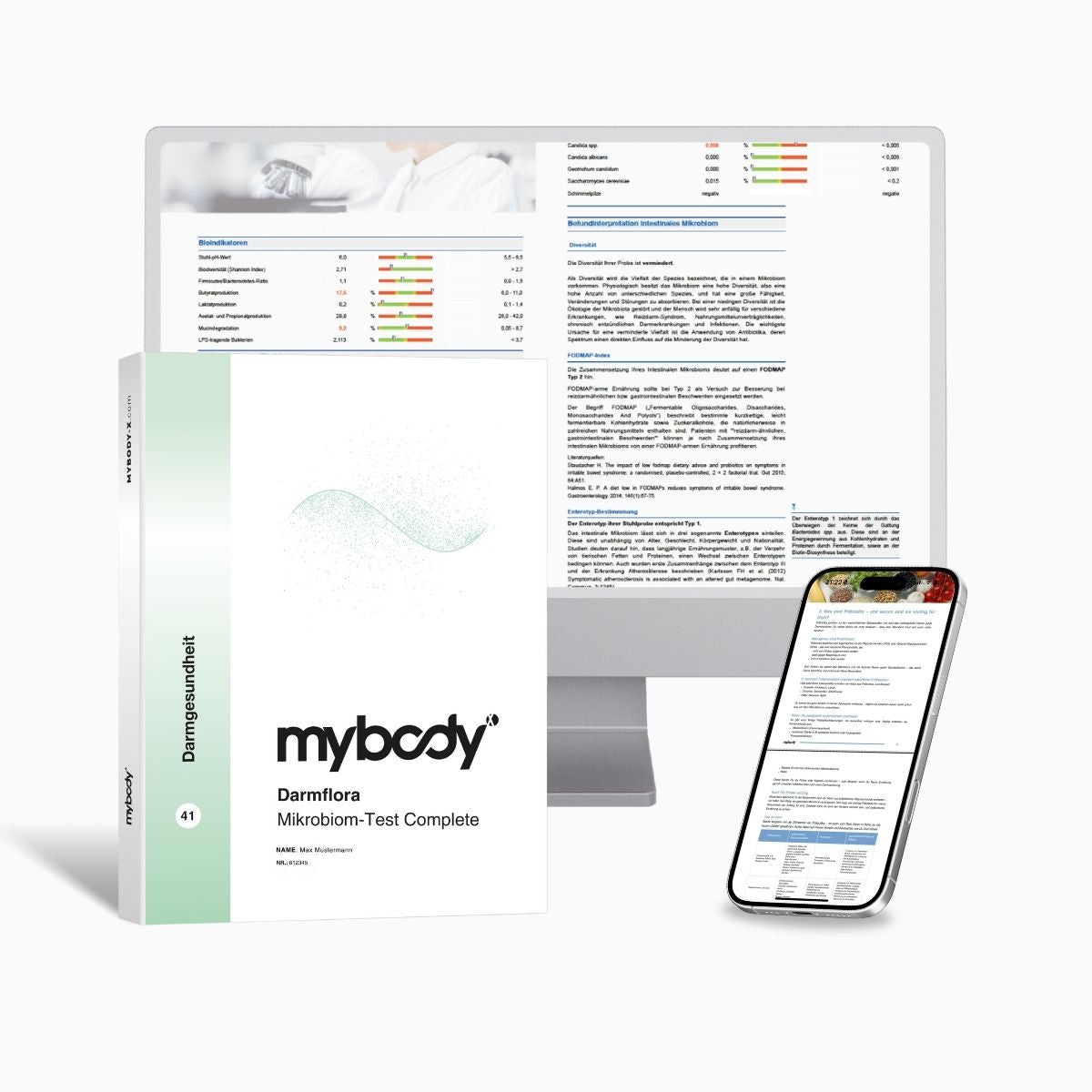
Gut Flora MICROBIOME Test Complete
The Gut Flora MICROBIOME Test Complete analyzes more than 1,500 bacterial species from a stool sample using DNA sequencing and summarizes the results in around 15 pages—with bacterial diversity, the ratio of protective to potentially problematic microbes, indications of dysbiosis, as well as a FODMAP index and enterotype classification. A diagnosis is explicitly not included: The test does not detect inflammatory bowel disease, tumors, infections, or celiac disease, and does not replace medical evaluation when warning signs are present.
Price: €189.00 (instead of €219.00) · Sample type: Stool sample · Processing time: approx. 20–25 business days after receipt of the sample · Laboratory: ISO-certified laboratory analysis, ISO 27001
Go to the Complete MICROBIOME testThose who prefer a more limited introduction will find the same sample collection process in the Basic version, with a shorter report. The difference lies in the depth of analysis, not in diagnostic value—neither test provides that.
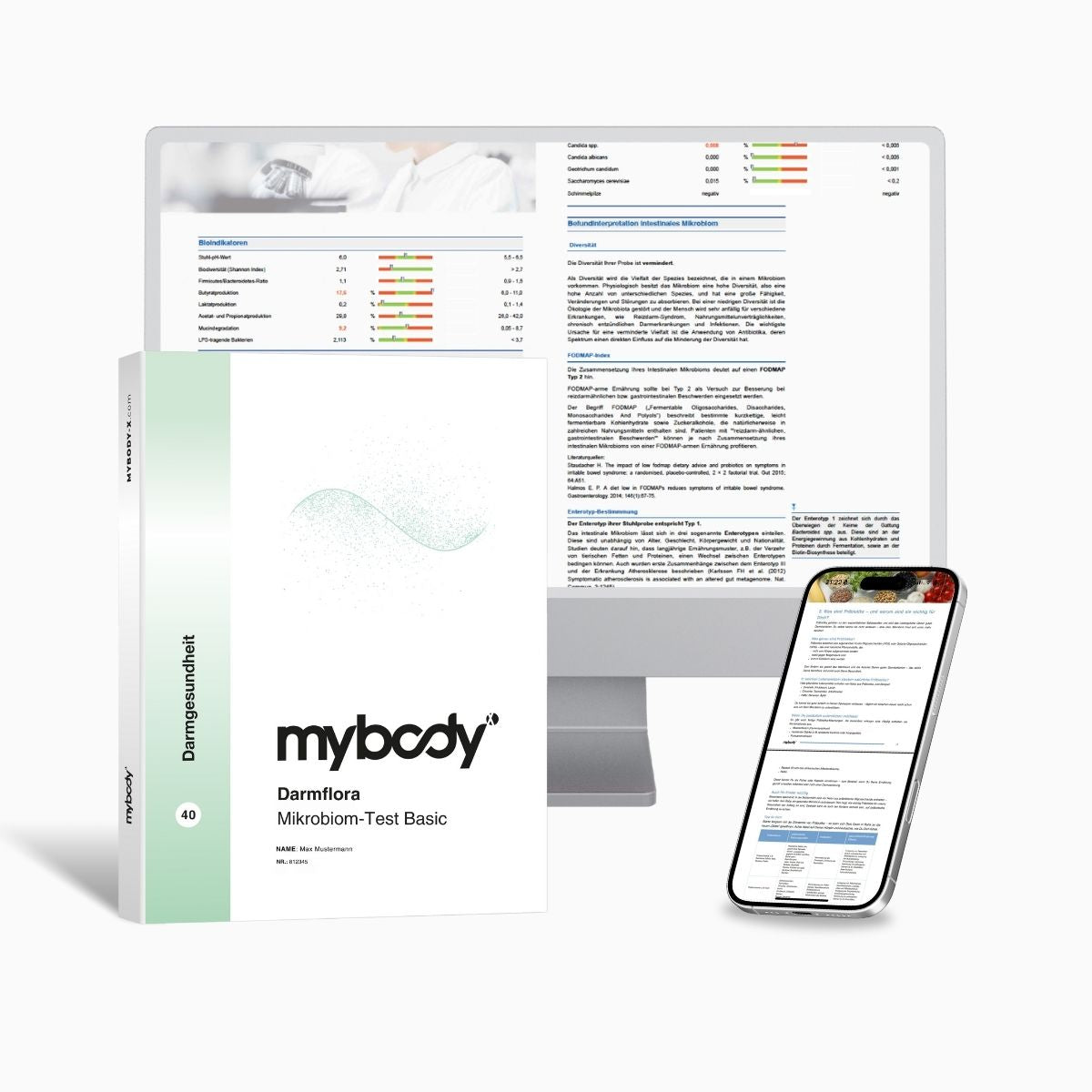
Gut flora MIKROBIOM Basic test
The Basic version analyzes the composition of the gut flora from a stool sample, the ratio of protective and potentially harmful bacteria, the gut environment based on pH levels, possible fungal colonization, and indications of dysbiosis; the report is approximately 15 pages long. It does not include a FODMAP index, enterotype classification, or sequencing of more than 1,500 bacterial species—and this test does not provide a diagnosis either.
Price: €139.00 · Sample type: Stool sample · Processing time: approx. 20–25 business days after receipt of the sample · Laboratory: ISO-certified laboratory analysis, ISO 27001
About the MIKROBIOM Basic testPrices as of July 28, 2026. Prices, report scope, and processing times may change—the linked product page is authoritative.
mybody® works with an ISO-certified partner laboratory and processes samples in pseudonymized form in compliance with the GDPR. What to look for when choosing a microbiome analysis is explained in Gut flora tests: Microbiome analysis meets practical recommendations for action.
Putting it into perspective: What a microbiome test can—and cannot—do
A microbiome test describes a snapshot of the bacteria in your gut. Its limitations follow directly from this—and they are significant when the leading symptom is pressure in the abdomen.
First, a microbiome test is not a diagnostic procedure. It does not detect chronic inflammatory bowel disease, tumors, infections, or celiac disease.
Second, the role of the gut microbiota in functional complaints has not been proven. As of 2023, IQWiG explicitly describes it as a hypothesis when mentioning changes in the gut microbiota alongside hypersensitive intestinal nerves and disturbances of the intestinal muscles.
Third, a finding says nothing about where or when the pressure occurs. Whether it is located in the upper or lower abdomen and whether it occurs after eating or in the evening can only be determined through your own observations over several weeks.
Fourth, mybody® does not offer a standalone test product for lactose or fructose intolerance. For both, the H2 breath test is the medical standard.
And fifth, medical evaluation takes priority: In the event of weight loss, blood in the stool, fever, pallor, persistent vomiting, nighttime symptoms, or sudden severe pain, a doctor’s office is the first step – not a self-test.
Conclusion
Abdominal pressure is caused by distension: The stomach is full, the intestines contain gas, or passage is slowed. Usually, the cause is related to the amount or speed of eating, or is a functional disorder – not an abnormality in an organ.
Location and timing are the most important clues. Pressure in the upper abdomen during or shortly after eating is consistent with an irritable stomach (functional dyspepsia), for which IQWiG lists “a feeling of fullness in the upper abdomen, nausea, and belching” as of 2025. Pressure in the lower abdomen that improves after a bowel movement points more toward irritable bowel syndrome, which, according to IQWiG (as of 2023), affects about 10 to 20 out of 100 people.
More specifically: Write down where and when the pressure occurs for two to four weeks. Spread meals more evenly throughout the day, eat more slowly, and exercise afterward. Gradually increase fiber intake toward the minimum of 30 g per day recommended by the DGE (as of 2021) – through food, not supplements.
And draw the line early: Significant weight loss, blood in the stool, fever, pallor, or persistent vomiting should be evaluated in a doctor’s office. Once the pressure has been medically assessed, a microbiome analysis may be a supplement – it is not a substitute for medical evaluation.
Frequently asked questions about abdominal pressure
What does constant pressure in the abdomen mean?
A feeling of pressure occurs when the stomach or intestines become distended – by volume, gas, or slowed passage. If it persists for weeks and occurs independently of meals, it should be medically assessed. Common functional explanations include an irritable stomach (functional dyspepsia) and irritable bowel syndrome; according to IQWiG (as of 2023), the latter affects about 10 to 20 out of 100 people.
When should I have abdominal pressure medically evaluated?
Immediately if there are warning signs. As of 2023, IQWiG states: “Additional symptoms such as significant weight loss, blood in the stool, fever, or pallor are more likely to indicate another intestinal disease.” Without warning signs, medical evaluation is advisable if the pressure persists for weeks or occurs at night.
What does the location of the pressure indicate about its cause?
It narrows down the possibilities but proves nothing. Pressure in the upper abdomen during or shortly after eating is consistent with an irritable stomach (functional dyspepsia) – as of 2025, IQWiG lists “a feeling of fullness in the upper abdomen, nausea, and belching” as key symptoms. Pressure in the lower abdomen that improves after a bowel movement points more toward the colon.
Do fiber-rich foods help relieve abdominal pressure—or make it worse?
Both are possible; the key factor is how quickly you make the change. The DGE (as of 2021) recommends at least 30 g per day as a guideline and describes the influence of fiber on “the transit time of food through the stomach and intestines.” Anyone who increases the amount too quickly may temporarily produce more gas. Regarding supplements, IQWiG (as of 2023) states: “It has not been proven that additional fiber supplements help.”
Does a microbiome test show why I feel pressure in my abdomen?
No. A microbiome test describes the composition of your gut flora from a stool sample—it does not provide a diagnosis and cannot detect inflammatory bowel disease, a tumor, an infection, or celiac disease. If warning signs are present, medical evaluation takes priority.
Do you want to know how your gut flora is composed?
The Complete gut flora MICROBIOME test analyzes over 1,500 bacterial species from a stool sample using DNA sequencing, including a FODMAP index and enterotype determination. Results are available approximately 20–25 business days after the sample is received. The test shows a current snapshot—not a diagnosis.
Go to the Complete MICROBIOME test View all gut health testsYou might also be interested in
→ The most reliable microbiome tests for your gut flora
How to recognize the quality of a gut flora analysis.
→ Gut flora tests: microbiome analysis meets practical recommendations
What a microbiome report can tell you about your everyday life.
→ Gut flora glossary: all bacteria and markers in your gut microbiome
Reference guide with over 6,000 microbiome biomarkers—from protective bacteria and fiber degraders to the metrics in your report.
Sources
- Institute for Quality and Efficiency in Health Care (IQWiG): Irritable bowel syndrome (as of February 22, 2023)
- IQWiG: What helps with irritable bowel syndrome—and what doesn’t? (as of February 22, 2023)
- IQWiG: What can help with an irritable stomach? (as of September 17, 2025)
- IQWiG: Crohn’s disease (as of March 4, 2026)
- German Nutrition Society (DGE): Reference values for fiber (as of 2021)
- German Nutrition Society (DGE): Detox diets, DGEinfo 3/2018
The information on irritable bowel syndrome, its suspected mechanisms, prevalence, and warning signs is based on [1]; the statements on FODMAP, fiber supplements, and probiotics are based on [2]; the information on irritable stomach is based on [3]; the figures on Crohn’s disease are based on [4]; the fiber reference values are based on [5]; and the assessment of detox diets is based on [6]. All other sources mentioned in the text are identified directly at the relevant point by institution and year. All product information about mybody® (MYBODY Lab GmbH) comes from the official product pages at mybody-x.com (as of July 28, 2026).

mybody® Editorial & Specialist Team
Gut health Microbiome Feeling of fullness Nutritional science Laboratory diagnostics
This article was created and professionally reviewed by the mybody® editorial and specialist team at MYBODY Lab GmbH. The team combines expertise in microbiome and gut science, nutritional science, laboratory diagnostics, and nutrigenetics. Learn more about the people behind it on the mybody® authors' page.
Published on July 28, 2026 · Last updated on July 28, 2026
Medical notice: This article is intended for general information and does not replace medical advice, diagnosis, or treatment. Self-tests provide indications, not diagnoses. If you experience significant weight loss, blood in your stool, fever, pallor, persistent vomiting, nighttime symptoms, or sudden severe pain, please consult a doctor. If you take medication, are pregnant, or are breastfeeding, discuss dietary changes with a doctor beforehand.




Share now:
Stimulate digestion: What actually works—and what is merely claimed
Bowel Sounds: What Your Stomach Is Telling You—and When to Take Them Seriously