
Stimulating digestion: What actually works—and what is merely claimed
The key points at a glance
The most reliable way to stimulate digestion is through four everyday levers: more dietary fiber from food, sufficient fluid intake, regular exercise, and a calmer meal routine. The best-supported of these is dietary fiber—the German Nutrition Society recommends at least 30 g per day as a guideline (DGE, 2021). There is no comparable evidence for supplements, gut cleanses, or detox programs.
This overview organizes the common options not by popularity, but by strength of evidence: For each lever, it explains how well it is supported by evidence, how quickly changes occur, how much effort it requires, and what you should pay attention to. The article is equally clear in naming measures for which there is no evidence of effectiveness.
Read Chapter 2 for an overview of all the levers, Chapter 3 for the most powerful one, Chapter 5 for fluids, exercise, and meal timing, Chapter 6 for what is not supported by evidence, Chapter 7 for putting it into practice—and Chapter 9 if you are considering a gut flora test.
What to expect in this article
2. What levers are there—and how well are they supported by evidence?
3. Why dietary fiber from food is the most powerful lever
4. How do these levers translate into numbers?
5. Fluids, exercise, and meal timing: What everyday life offers
6. What is supported by evidence—and what is merely claimed?
7. How do you put these levers into practice?
8. What role does the gut flora play?
9. When is a microbiome test useful—and when is it not?
10. How mybody® can help
11. Putting it into perspective: What a microbiome test can—and cannot—do
12. Conclusion
Frequently asked questions
Sources
What does “stimulating digestion” mean—and what can actually be influenced?
“Stimulating digestion” does not describe a medical procedure, but an everyday goal: Food should move through the stomach and intestines more evenly, and bowel movements should become more regular. Three factors in particular can be influenced: what you eat, how much you drink, and how much you move.
The technical term behind this is transit time: the time a meal takes to pass through the body until elimination. The German Nutrition Society (DGE, as of 2021) describes it as one of the factors that dietary fiber can influence.
Anatomical factors and existing medical conditions cannot be influenced. Anyone who wants to “switch” digestion with a single food is overestimating the leverage.
Key message: Digestion can be stimulated, but not controlled. Fiber intake, fluids, exercise, and meal timing can be changed—and these changes take effect over weeks, not hours. The German Nutrition Society recommends at least 30 g of fiber per day (DGE, 2021).
When is sluggish digestion no longer a nutrition issue?
There are accompanying symptoms for which self-help is no longer appropriate. The Institute for Quality and Efficiency in Health Care (IQWiG, 2023) writes about irritable bowel syndrome: “Additional symptoms such as significant weight loss, blood in the stool, fever, or paleness are more likely to indicate another intestinal disease.”
These warning signs require medical evaluation
- ✓ Significant, unintentional weight loss (IQWiG, 2023).
- ✓ Blood in the stool – according to IQWiG (2023), should always be evaluated by a doctor, even if it occurs only once.
- ✓ Fever – argues against a purely functional cause (IQWiG, 2023).
- ✓ Paleness – may indicate anemia (IQWiG, 2023).
- ✓ Persistent vomiting or sudden severe pain – this should be evaluated at a doctor’s office.
Without these signs, the situation is less concerning: IQWiG (2023) emphasizes that irritable bowel syndrome is “not dangerous.”
How does this article differ from the related posts?
This article organizes the options by strength of evidence and deliberately does not address any single symptom. If nausea is your main concern, Nausea after eating is the right article. If you are experiencing pain after a meal, Stomach pain after eating next, and for nutrition after a diagnosed intestinal inflammation Intestinal inflammation: What to eat?.
What levers are available—and how well are they supported?
Five levers come up repeatedly in consultations: dietary fiber from food, drinking enough fluids, regular exercise, an adjusted meal schedule, and probiotics. They differ significantly in how well supported they are—and that determines the order in which you should try them.
The overview compares all five levers across the same four criteria.
| Criterion | Dietary fiber from food | Drinking enough fluids | Regular exercise | Meal timing & eating speed | Probiotics |
|---|---|---|---|---|---|
| How well supported is it? | Strongest: a recommended value of at least 30 g per day (DGE, 2021) | Indirect: an accompanying factor to fiber intake, without an established target amount | Good: according to IQWiG (2025), “more exercise” is among the first steps | Good: according to IQWiG (2025), “adjusting the diet” comes first | Only tolerability has been established (IQWiG, 2023), not effectiveness |
| How quickly you may notice an effect | More likely over several weeks, increased gradually | Can be implemented immediately, without an established magnitude of effect | Can be implemented immediately; reliable time frames are lacking | From the next meal onward – the fastest lever | No established effect and no established time to effect |
| Effort | Moderate: shopping and meal planning change, while costs remain low | Low: requires attention, but no money | Low to moderate: time is the limiting factor | Low: affects portion size, pace, and timing, not the ingredients | Low in everyday life, but ongoing costs |
| What to watch out for | Choose food instead of powder; increase the amount gradually; drink enough | Discuss fluid intake with a doctor if you have heart or kidney disease | Everyday movement counts; do not force it during acute symptoms | Smaller portions, eat more slowly, and do not lie down immediately afterward | According to IQWiG (2023), “well tolerated,” with bloating occurring rarely – a trial with an uncertain outcome |
The overview shows a clear ranking: fiber is the only lever with a substantiated target. All the others are useful but less precisely quantified accompanying measures – and probiotics stand apart because only their tolerability has been established. The practical order therefore follows: start with fiber from food, add fluids and exercise in parallel, then focus on meal timing.
Why fiber from food is the strongest lever
Fiber is the only one of the five levers with an official target. In its reference values (as of 2021), the German Nutrition Society specifies a recommended intake of at least 30 g of fiber per day for adults.
The recommended value is more than a digestive-health recommendation: According to the DGE (as of 2021), “increased fiber intake has protective effects against cardiovascular disease, type 2 diabetes, obesity, high blood pressure, colorectal and breast cancer, as well as the risk of death.”
Best for: anyone whose diet has so far contained few vegetables, fruits, pulses, and whole-grain products – this is where the gap from the recommended value is greatest.
- ✓ Evidence-based target – at least 30 g per day according to the DGE (as of 2021), not an estimate.
- ✓ Works where it matters – the DGE (2021) describes effects on transit time, stool volume, consistency, and bowel movement frequency.
- ✗ It takes weeks rather than days – if you notice nothing after three days, you measured too soon.
- ✗ Increasing it too quickly backfires – abruptly increasing the amount often triggers exactly the symptoms you wanted to get rid of.
Which foods provide the 30 g?
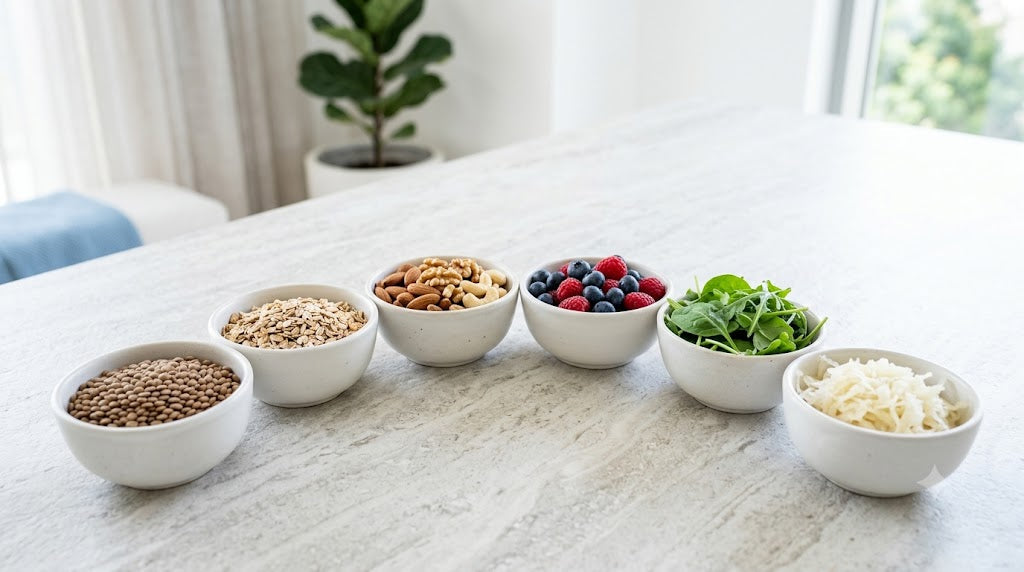
The amount comes from four groups: whole-grain products, legumes, vegetables and fruit, and nuts and seeds. Eating something from each group every day brings you closer to the DGE guideline value (2021) without any calculations.
In practical terms: whole-grain bread instead of white bread, a serving of legumes several times a week, and vegetables with two meals a day—a change to your shopping list, not your daily routine.
One limitation is important: People respond differently to individual foods. IQWiG (2023) puts it this way: “But how people respond to certain foods is highly individual."
How do these measures translate into figures?
Three figures set the framework: a target, a frequency, and a rarity. Together, they show where everyday measures can help—and where they are no longer the solution.
Source: German Nutrition Society (DGE), as of 2021 (fiber), and IQWiG, as of 2023 (irritable bowel syndrome) and 2026 (Crohn’s disease)
The first figure is the only actual target. The guideline value of at least 30 g of fiber per day comes from the DGE reference values (as of 2021) and applies to healthy adults.
The second figure explains why the issue affects so many people. According to IQWiG (2023), an estimated 10 to 20 out of 100 people have irritable bowel syndrome—functional digestive complaints are therefore widespread.
The third figure draws the opposite boundary. Chronic inflammatory bowel diseases are rare: As of 2026, IQWiG estimates that Crohn’s disease affects approximately 320 out of 100,000 people in Europe. Sluggish digestion is therefore usually an everyday issue—but the warning signs from Chapter 1 still remain important.
Fluids, movement, and meal timing: What everyday life allows
Besides fiber, there are three levers that cost nothing and are immediately available: drinking, moving around, and changing the timing of meals. The evidence for them is less precisely quantified, but they act on the same mechanisms.
Drink enough – the accompanying factor without a proven figure
Drinking is the lever that achieves little without fiber and becomes useful together with it. The DGE (2021) describes stool volume and consistency as factors influenced by fiber; without fluids, this process is incomplete.
This article deliberately does not specify a concrete amount to drink: the reviewed source material contains no evidence-based figure, and an estimated number of liters would create false precision.
Best for: anyone currently increasing their fiber intake – here, fluids are part of the same measure.
- ✓ Immediately actionable – no shopping and no cost.
- ✗ No evidence-based target amount – this article does not specify a number of liters because no reviewed evidence supports one.
- ✗ Not unlimited for everyone – people with heart or kidney disease should discuss their fluid intake with a doctor.
Exercise – identified by experts as a first step
Exercise is the best-supported of the three everyday levers. As of 2025, IQWiG lists “adjusting the diet, more exercise, and individually tailored medication” as the first steps for functional dyspepsia – so exercise comes before medication.
This does not mean athletic performance: walking to work, taking a walk after dinner, or using the stairs instead of the elevator all count.
Best for: people whose daily lives are predominantly sedentary.
- ✓ Identified by experts as a first step – according to IQWiG (2025), “more exercise” is one of the first measures for functional dyspepsia.
- ✗ No reliable dosage – the reviewed material does not establish how many minutes per day are necessary.
- ✗ Do not force it during acute symptoms – anyone with severe pain needs medical evaluation, not a walk.
Meal timing and eating speed – the quickest lever
Meal timing is the only lever whose effect can become apparent as early as the next meal. The ingredients do not change; portion size, eating speed, and timing do.
As of 2025, IQWiG lists “adjusting the diet” as the first step for functional dyspepsia. Exactly what is adjusted remains individual – consistent with IQWiG’s (2023) finding that reactions to foods are “highly individual.”
Best for: anyone who eats hurriedly, irregularly, or while doing something else.
- ✓ Immediately testable – the next meal is the first test, not a week-long project.
- ✗ Difficult to maintain – eating speed depends on your daily routine, and a resolution will not change that.
- ✗ No universal rule – whether three large meals or five small ones work better can only be determined by trying them.
These three levers do not replace fiber; they frame it: A single factor often remains below the threshold, while three together do not.
What is proven—and what is merely claimed?
There is a large market of claims surrounding digestion: fiber powders, intestinal cleanses, detox programs, and probiotics. For some of these, evidence of effectiveness is lacking—and that belongs in an honest overview.
The German Nutrition Society provides the starting point: In its reference values (as of 2021), it precisely describes what fiber affects.
“
“Fiber—also known as dietary fiber—affects the transit time of food through the stomach and intestines, the amount and consistency of stool, and the frequency of bowel movements.”
German Nutrition Society (DGE)
Fiber reference values, as of 2021
This sentence describes the nutrient fiber—not the product fiber supplement.
Fiber supplements: food and powder are not the same
IQWiG (2023) is unequivocal about additional supplements: “There is no evidence that additional fiber supplements help.” This statement does not contradict the DGE guideline—it addresses a different question.
This distinction is the crux of the article: The guideline of at least 30 g per day (DGE, 2021) refers to vegetables, fruit, legumes, and whole-grain products. Anyone trying to meet this amount by taking a shortcut with a powder is buying an effect that, according to IQWiG (2023), has not been proven.
Intestinal cleanses, detox, and “elimination of toxins”
The situation is similarly clear for intestinal cleanses. The German Nutrition Society (DGE, DGEinfo 3/2018) states: “There is currently no scientific evidence that so-called detox or detoxification diets are effective.”
Anyone who buys such a cleanse is therefore buying it without proven effectiveness—the proven alternative is available at the supermarket.
Probiotics: well tolerated, but no claim of effectiveness
The evidence-based statement about probiotics concerns tolerability, not effectiveness. IQWiG (2023) writes: “In general, probiotics are well tolerated: Mild side effects such as bloating occur only rarely.”
Being well tolerated is not the same as being effective: This does not support a claim that a probiotic stimulates digestion.
Low-FODMAP diet: only with supervision and for a limited time
A low-FODMAP diet is often recommended for digestive problems. IQWiG (2023) describes the suspected mechanism: “It is suspected that consuming FODMAPs causes more water to enter the intestines and promotes diarrhea.”
The second half of the information is essential. IQWiG (2023) identifies the risk: “However, there is a risk of malnutrition because it becomes difficult to take in enough vitamins and minerals.”
A low-FODMAP diet is therefore not a way to stimulate digestion, but a time-limited elimination diet supervised by a professional.
How do you implement these measures?
The order of implementation follows the strength of the evidence: first observe, then gradually increase fiber, while increasing fluid intake and physical activity in parallel, and finally fine-tune your routine. The first step is particularly important—without a baseline, you cannot later determine whether a change made a difference.
Record your starting point
Keep notes for two weeks: meals, sources of fiber, fluid intake, physical activity, and how regular your bowel movements are.
Increase fiber gradually
Toward at least 30 g per day, as cited by the DGE (2021)—through food and spread over several weeks.
Increase fluids and exercise
Both are part of the same measure. For functional dyspepsia, IQWiG (2025) lists “more exercise” as one of the first steps.
Fine-tune your routine
Adjust portion size and eating pace—and then compare them with the notes from step 1.
None of these steps requires adopting a new diet or buying a product—and that is precisely what makes them sustainable.
The most common mistake is the pace: anyone who implements all four steps at once rarely sticks with them and does not know which lever made a difference.
In brief
Stimulating digestion in everyday life works in four steps: record your starting point for two weeks, gradually increase your fiber intake through food toward at least 30 g per day, the guideline amount cited by the German Nutrition Society (as of 2021), while also drinking enough and exercising more, and finally adjust portion sizes and eating pace. For functional dyspepsia, the Institute for Quality and Efficiency in Health Care (as of 2025) recommends the same approach: “adjusting the diet, exercising more, and using individually tailored medication.”
What role does the gut microbiome play in this?
The gut microbiome has been studied as a factor in digestive complaints, but it has not been proven to be one. For irritable bowel syndrome, IQWiG (2023) states that it is “among other things, suspected” that hypersensitive intestinal nerves, disorders of the intestinal muscles, changes in the gut microbiome, and inflammation of the intestinal wall could play a role.
The word “suspected” is the core of the statement: plausible co-involvement, not a proven cause—and not a bacterial pattern from which a treatment could be derived.
The connection to this article is through fiber: It is the part of food that reaches the bacteria in the large intestine at all. Anyone who changes their fiber intake toward the DGE’s 30 g recommendation (2021) also changes the conditions in the gut.
The reverse is not true: A snapshot of the gut microbiome cannot show which lever will benefit you most.
When is a microbiome test useful—and when is it less so?
A microbiome test answers a different question than “How do I stimulate my digestion?” It describes which bacteria occur in the gut and in what proportions—not which everyday lever works for you or which disease is present.
This distinction determines whether examining the gut microbiome is the right tool for you.
Makes sense for you if …
… you have already implemented the four everyday levers from Chapter 7 for several weeks and still want to know how your gut microbiome is composed.
… persistent symptoms have been medically evaluated and no cause requiring treatment has been found.
… you are interested in bacterial diversity and indications of dysbiosis as guidance and can accept a processing time of around 20 to 25 business days.
Rather not if …
… warning signs are present: significant weight loss, blood in the stool, fever, pallor, or persistent vomiting. Medical evaluation takes priority; a self-test will only delay it.
… you expect a diagnosis. A microbiome test does not detect inflammatory bowel disease, a tumor, an infection, or celiac disease.
… you have not yet tried the basic levers. As long as your fiber intake is significantly below the DGE guideline (2021), the test result is the more expensive information.
… you want to clarify lactose or fructose intolerance: The H2 breath test is the medical standard for this.
… you want to derive a proven treatment from it. According to IQWiG (2023), the role of the gut microbiome is “suspected,” not proven.
The honest conclusion: Examining the gut microbiome provides guidance – you stimulate digestion itself through fiber, fluids, exercise, and routine.
How mybody® can help
mybody® (MYBODY Lab GmbH) offers two tests for examining the gut microbiome from a stool sample – both with ISO-certified laboratory analysis and data processing compliant with ISO 27001.
Both tests describe the current state of your gut microbiome, do not provide a diagnosis, and do not replace any of the four everyday levers. This context is deliberately presented before the product details.
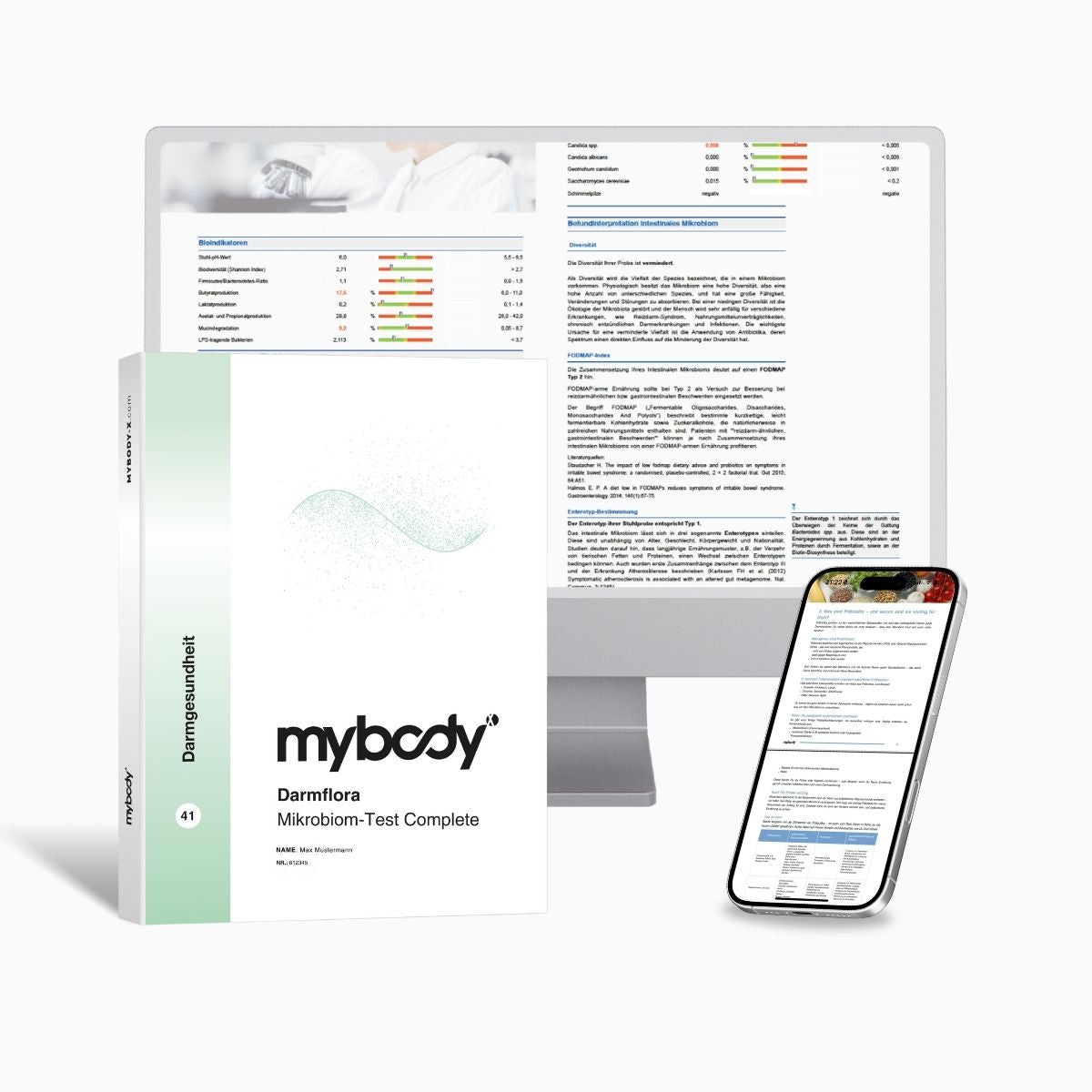
Gut microbiome MIKROBIOM Test Complete
The Gut flora MIKROBIOM Test Complete analyzes more than 1,500 bacterial species from a stool sample using DNA sequencing and summarizes the results in around 15 pages—with bacterial diversity, the ratio of protective to problematic microbes, indications of dysbiosis, links to digestion and nutrition, as well as a FODMAP index and enterotype determination. It explicitly does not include a diagnosis: The test does not detect inflammatory bowel disease, a tumor, an infection, or celiac disease.
Price: €189.00 (instead of €219.00) · Sample type: Stool sample · Processing time: approx. 20–25 business days after sample receipt · Laboratory: ISO-certified laboratory analysis, ISO 27001
Go to the Complete MICROBIOME testThose who want to start with a smaller scope will find the same sample collection process in the Basic version, with a shorter report. The difference lies in the depth of analysis, not in the informative value.
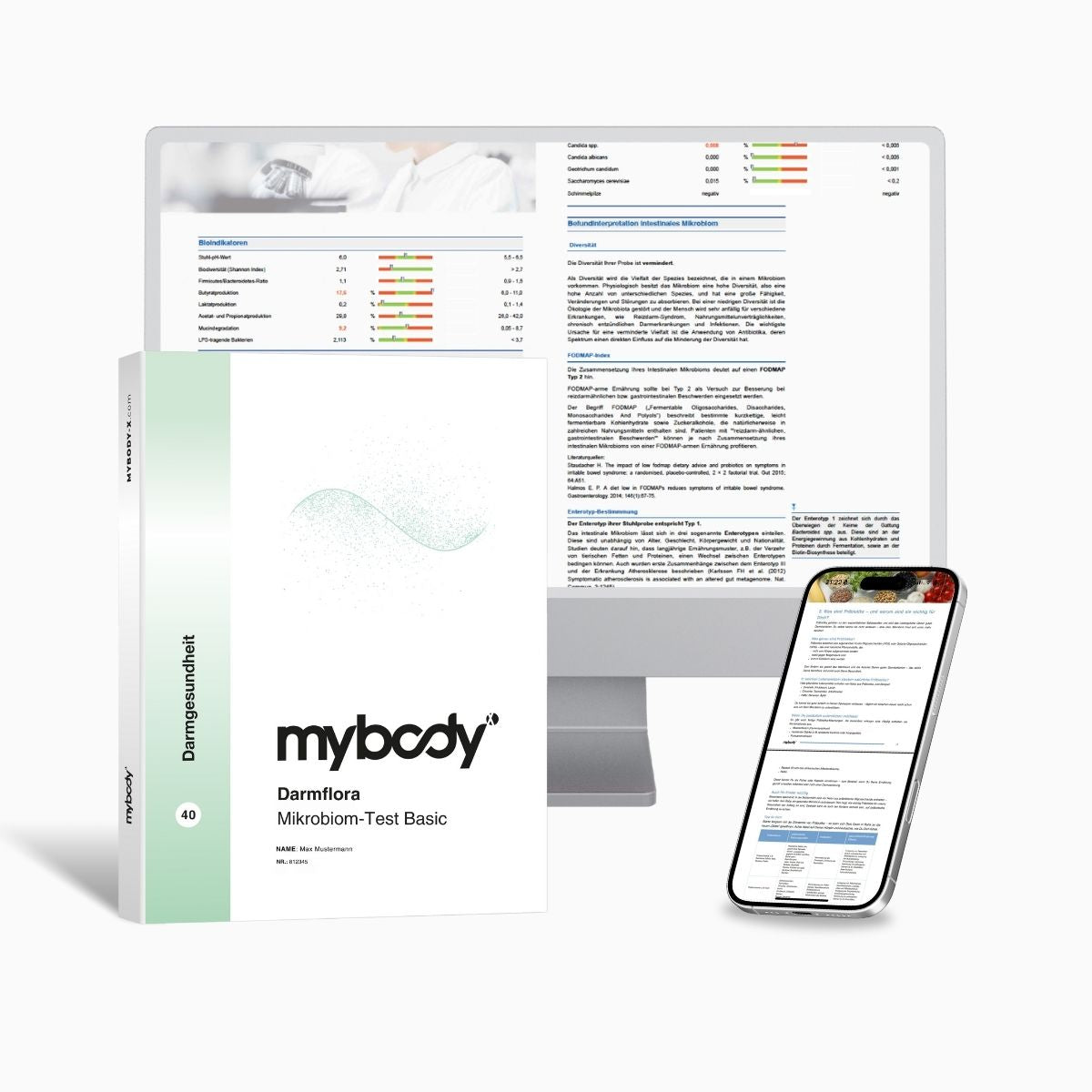
Gut flora MIKROBIOM Test Basic
The Basic version examines the composition of the gut flora from a stool sample, the ratio of protective to potentially harmful bacteria, the gut environment based on pH, possible fungal colonization, and indications of dysbiosis; the report is around 15 pages long. It does not include a FODMAP index, enterotype determination, or sequencing of more than 1,500 bacterial species—and this test does not provide a diagnosis either.
Price: €139.00 · Sample type: Stool sample · Processing time: approx. 20–25 business days after sample receipt · Laboratory: ISO-certified laboratory analysis, ISO 27001
About the MIKROBIOM Test BasicPrices as of July 28, 2026. Prices and processing times may change—the linked product page is authoritative.
mybody® works with an ISO-certified partner laboratory, processes samples pseudonymously and in compliance with the GDPR, and transmits data using SSL encryption. What to look for when choosing a microbiome analysis is explained in Gut flora tests: Microbiome analysis meets practical recommendations for action.
Context: What a microbiome test can—and cannot—do
A microbiome test describes a snapshot of the bacteria in the gut. This is where its limitations arise—and they are significant when it comes to “stimulating digestion.”
First, a microbiome test is not a diagnostic procedure. It cannot detect chronic inflammatory bowel disease, a tumor, an infection, or celiac disease—and according to IQWiG (2023), the role of the gut microbiome in functional complaints remains a hypothesis.
Second, no test result replaces fiber: The DGE guideline (as of 2021) applies regardless of which bacteria are present in the gut.
Third, mybody® does not offer a standalone test product for lactose or fructose intolerance. For both, the H2 breath test is the medical standard.
Fourth, medical evaluation takes priority: If there is significant weight loss, blood in the stool, fever, pallor, persistent vomiting, or severe pain, seeing a doctor is the first step.
Conclusion
Stimulating digestion is not a trick but a sequence of steps. The most effective measure is fiber from food: The German Nutrition Society recommends at least 30 g per day as a guideline (DGE, as of 2021) and describes its influence on transit time, stool bulk, consistency, and frequency of bowel movements.
There are also three measures that cost nothing: drink enough, exercise more, and adjust your meal schedule. IQWiG (as of 2025) lists “adjusting the diet, getting more exercise, and individually tailored medication” as the first steps for functional dyspepsia.
What is not supported by evidence is just as important. According to IQWiG (2023), it has not been shown that additional fiber supplements help; according to the DGE (DGEinfo 3/2018), there is no scientific evidence for detox and cleansing diets; and for probiotics, only tolerability has been demonstrated.
In practical terms, this means: Track your starting point for two weeks, gradually increase your fiber intake through food toward 30 g per day, drink enough, exercise, and eat more slowly. If warning signs such as weight loss, blood in the stool, fever, or pallor occur, seek medical evaluation at a doctor’s office.
Frequently asked questions about stimulating digestion
What stimulates digestion most reliably?
Fiber from food is the best-supported approach. The German Nutrition Society recommends at least 30 g per day for adults as a guideline (DGE, as of 2021) and describes its influence on the transit time of food as well as the consistency and frequency of bowel movements. Drinking enough, exercising, and maintaining a regular meal schedule can provide additional support.
How much fiber do I need per day?
In its reference values (as of 2021), the German Nutrition Society recommends that adults consume at least 30 g of fiber per day— from whole-grain products, legumes, vegetables, fruit, nuts, and seeds, not from a supplement.
Do fiber supplements help if I don't eat enough fiber?
IQWiG (2023) states: “It has not been proven that additional fiber supplements help.” The guideline value of at least 30 g per day (DGE, 2021) refers to foods—the evidence-based approach starts with what you put on your plate.
Do gut cleanses or detox programs help with digestion?
The German Nutrition Society stated in DGEinfo 3/2018: “There is currently no scientific evidence for the effects of so-called detox or cleansing diets.” What is supported instead is eating fiber-rich foods.
Does a microbiome test show me how I can stimulate my digestion?
No. A microbiome test describes the composition of your gut microbiome from a stool sample—it does not provide a diagnosis, detect inflammatory bowel disease, an infection, or celiac disease, and does not replace everyday measures. If warning signs are present, medical evaluation takes priority.
What is your gut microbiome made up of?
The Complete GUT MICROBIOME test analyzes more than 1,500 bacterial species from a stool sample using DNA sequencing, including a FODMAP index and enterotype determination. Results are available approximately 20–25 business days after the sample is received—this is a snapshot, not a diagnosis.
Go to the Complete MICROBIOME test View all gut health testsYou might also be interested in
→ The most reliable microbiome tests for your gut microbiome
What indicates the quality of a gut microbiome analysis.
→ Gut microbiome tests: microbiome analysis meets practical recommendations
What can be inferred from a microbiome report.
→ Gut encyclopedia: all bacteria and markers in your gut microbiome
Reference guide with more than 6,000 microbiome biomarkers—from protective bacteria and fiber degraders to the metrics in your report.
Sources
- German Nutrition Society (DGE): Reference values for dietary fiber (2021)
- Institute for Quality and Efficiency in Health Care (IQWiG): What helps with irritable bowel syndrome—and what doesn’t? (as of 22 February 2023)
- IQWiG: Irritable bowel syndrome (as of February 22, 2023)
- IQWiG: What can help with functional dyspepsia? (as of September 17, 2025)
- IQWiG: Crohn’s disease (as of March 4, 2026)
- German Nutrition Society (DGE): Detox diets, DGEinfo 3/2018
The recommended fiber intake, the quotation regarding transit time, and the protective effects are based on [1]. The statements on fiber supplements, probiotics, FODMAP, and individual differences in response come from [2]; the information on irritable bowel syndrome and warning signs from [3]; the information on functional dyspepsia from [4]; the figures on Crohn’s disease from [5]; and the assessment of detox diets from [6]. All other sources cited in the text are identified directly at the relevant point with the institution and year. All product information about mybody® (MYBODY Lab GmbH) comes from the official product pages at mybody-x.com (as of July 28, 2026).

mybody® Editorial & Expert Team
Gut health Dietary fiber Microbiome Nutritional science Laboratory diagnostics
This article was created and medically reviewed by the mybody® editorial and expert team at MYBODY Lab GmbH. The team combines expertise in microbiome and gut science, nutritional science, and laboratory diagnostics. Learn more on the mybody® authors’ page.
Published on July 28, 2026 · Last updated on July 28, 2026
Medical notice: This article is for general information only and does not replace medical advice, diagnosis, or treatment. Self-tests provide indications, not diagnoses. If you experience significant weight loss, blood in your stool, fever, paleness, persistent vomiting, or sudden severe pain, please consult a doctor. If you take medication, have heart or kidney disease, are pregnant, or are breastfeeding, discuss dietary changes and fluid intake with a doctor beforehand.



Share now:
Stomach pain after eating: What causes it and what you can do
Pressure in the abdomen: What’s behind it and when you should have it checked out