
Intestinal inflammation: what to do? First steps, evaluation, and treatment
The essentials at a glance
When you have intestinal inflammation, the rule is: record your symptoms in writing, take warning signs seriously, and have the cause medically evaluated. Significant weight loss, blood in the stool, fever, or paleness should always be assessed by a doctor, according to IQWiG (2023). Chronic intestinal inflammation is treated by doctors—self-tests and dietary changes are not substitutes.
“Intestinal inflammation” is not a single disease, but a collective term. It may refer to an inflammatory bowel disease such as Crohn’s disease or ulcerative colitis, acute inflammation of diverticula, or temporary irritation. Irritable bowel syndrome is explicitly not included: in that condition, no inflammation can be identified as the cause. This article clarifies the terms, describes how an evaluation proceeds, and explains what helps between flare-ups.
Chapter 1 summarizes what matters in the first few days; Chapter 2 compares Crohn’s disease, ulcerative colitis, and irritable bowel syndrome. Chapter 3 lists the warning signs, including emergency guidance; Chapter 4 explains how the evaluation proceeds; Chapter 5 describes treatment without making recommendations. Chapter 6 dispels two misconceptions; Chapter 7 discusses everyday life between flare-ups; Chapters 8 and 9 put microbiome analysis into perspective.
What to expect in this article
1. Intestinal inflammation—what to do in the first few days?
2. What types are there—and what is not inflammation?
3. When does intestinal inflammation require immediate medical attention?
4. What does the medical evaluation involve?
5. How is intestinal inflammation treated?
6. Which misconceptions persist?
7. What helps between flare-ups?
8. What can microbiome analysis do—and when is it useful?
9. Putting it into perspective: What a self-test cannot do
Conclusion
Frequently asked questions
Sources
Intestinal inflammation—what to do in the first few days?
Anyone who suspects intestinal inflammation should do two things in parallel: document their symptoms in an organized way and make an appointment at a doctor’s office. Both require little effort and will later determine how quickly the cause is found.
Documentation is so important because bowel symptoms fluctuate. What is described in the doctor’s office as “on and off for a while” suddenly becomes a clear pattern on paper.
What should go in a symptom diary?
A symptom diary does not need an app or a spreadsheet. The date, time, type of symptoms, stool frequency and consistency, fever, weight, and anything noticeably different are entirely sufficient.
Three details are particularly informative: whether the symptoms wake you at night, whether they persist for weeks, and whether blood has appeared in the stool. These are precisely the points that distinguish harmless irritation from a finding requiring prompt examination.
It is also helpful to make a list of all medications taken regularly. According to IQWiG (2025), regular use of anti-inflammatory painkillers is among the most common causes of stomach and duodenal ulcers—a connection that often only comes to light when specifically asked about during a consultation.
Why self-diagnosis is not sufficient for intestinal inflammation
Abdominal pain, diarrhea, and cramps are nonspecific. The same three symptoms can occur with a chronic inflammatory bowel disease, an inflamed diverticular pouch, an infection, or irritable bowel syndrome—which, according to IQWiG (2023), notably shows no detectable inflammation.
The distinction can only be made through examinations: blood and stool tests, ultrasound, and, depending on the suspected condition, a colonoscopy.
Key message: “Intestinal inflammation” is a collective term for very different clinical conditions. The cause can only be determined by a doctor—through blood and stool tests, imaging procedures, and, if necessary, a colonoscopy.
What forms are there—and what is not inflammation?
In everyday use, the term intestinal inflammation primarily refers to two chronic diseases: Crohn’s disease and ulcerative colitis. Both are chronic inflammatory bowel diseases, occur in flare-ups, and are treated by doctors.
Irritable bowel syndrome is often lumped into the same category, but it does not belong there: it causes similar symptoms without detectable inflammation.
| Criterion | Crohn’s disease | Ulcerative colitis | Irritable bowel syndrome |
|---|---|---|---|
| What is inflamed? | Chronic inflammation in the intestines; according to IQWiG (2026), a chronic inflammatory bowel disease | According to IQWiG (2026), the rectum, and sometimes the entire large intestine | Nothing detectable—no inflammation as the cause |
| Typical symptoms | During an acute flare-up, according to IQWiG (2026), mainly abdominal pain and diarrhea | During a flare-up, according to IQWiG (2026): abdominal pain with cramps, especially during bowel movements; a very strong urge to have a bowel movement | According to IQWiG (2023), persistent abdominal or lower abdominal pain, cramps, and changes in bowel movements |
| How common is it? | An estimated 320 out of 100,000 people in Europe (IQWiG, 2026) | Probably around 400,000 people in Germany (IQWiG, 2026) | An estimated 10 to 20 out of 100 people (IQWiG, 2023) |
| Is it inflammation? | Yes | Yes | No |
| How is it treated? | According to IQWiG (2026), various medications may be considered; the treating practice makes the selection | Medically supervised and tailored to the course and severity | According to IQWiG (2023), it is not dangerous; many people affected manage without treatment. |
Crohn’s disease: rare, chronic, and occurring in flare-ups
Crohn’s disease is a chronic inflammatory bowel disease that occurs in flare-ups. According to IQWiG (2026), an estimated 320 out of 100,000 people in Europe have Crohn’s disease; about 3 to 6 out of 100,000 people develop it each year.
During an acute flare-up, abdominal pain and diarrhea occur in particular, according to IQWiG (2026). Between flare-ups, symptoms may largely disappear—which leads many people affected to wait for the next flare-up rather than report it.
Ulcerative colitis: the rectum and colon in focus
In ulcerative colitis, according to IQWiG (2026), the rectum is inflamed, and sometimes the entire colon as well. Experts estimate that about 400,000 people in Germany have ulcerative colitis.
According to IQWiG (2026), the diagnosis is most often made in younger adults between the ages of 20 and 40; men and women are affected equally often. During an acute flare-up, abdominal pain and cramps occur, often especially during bowel movements.
A frequent urge to pass stool is characteristic: according to IQWiG (2026), it occurs several times within 24 hours and is often so intense that it can barely be suppressed. This is precisely what makes the condition so burdensome in everyday life.
Diverticulitis: acute inflammation of pouches
According to IQWiG (2026), diverticula are pouches in the intestinal lining: at the affected sites, the inner wall of the intestine bulges outward through weak points in the intestinal muscles. If such a pouch becomes inflamed, this is called diverticulitis.
Diverticula are common and almost normal with age: according to IQWiG (2026), about 13% of people under 50 have diverticula, compared with about 50% of people over 70. About 1% of all people with diverticula develop diverticulitis within 10 years.
According to IQWiG (2026), diverticular disease usually causes pain in the lower left abdomen, and less often in the lower right. If inflammation develops, sudden dull pain in the lower abdomen occurs, accompanied by a slight fever.
When does intestinal inflammation require immediate medical attention?
There are symptoms for which no self-treatment, dietary change, or test is appropriate—only a medical examination. These signs are deliberately placed before all other chapters of this article.
These signs should be medically evaluated
- ✓ Marked weight loss, blood in the stool, fever, or pallor – according to IQWiG (2023), these additional symptoms are more likely to indicate another intestinal disease than irritable bowel syndrome.
- ✓ Blood in the stool in any amount—according to IQWiG (2023), blood in the stool should always be medically examined to determine the cause.
- ✓ Severe abdominal pain, a rigid abdomen, fever, nausea, rapid heartbeat, and general weakness—with these signs, IQWiG (2026) says it is important to seek medical help promptly.
- ✓ Black stool or vomiting blood—according to IQWiG (2025), warning signs of complications, as are signs of anemia such as fatigue, dizziness, paleness, or shortness of breath during physical exertion.
- ✓ Sudden, severe abdominal pain—according to IQWiG (2025), the emergency number 112 should be called immediately.
Why blood in the stool should never be ignored
Blood in the stool can have many possible causes—from harmless to serious. That is precisely why the principle stated in IQWiG’s information on irritable bowel syndrome (2023) applies: blood in the stool should always be medically examined to determine the cause. This also applies when an explanation seems obvious.
What matters first during an acute flare-up
An acute flare-up is not a reason to experiment. Anyone with an existing diagnosis should report worsening symptoms to the treating practice rather than independently stopping or adding medications or starting a diet.
IQWiG describes how inflammation in the intestine can be brought to a halt in its information on treating Crohn’s disease in adults—very briefly and very clearly.
“
“Various medications may be considered to stop the inflammation in the intestine and relieve symptoms.”
Institute for Quality and Efficiency in Health Care (IQWiG)
“How is Crohn’s disease treated in adults?”, gesundheitsinformation.de, 2026
What does the medical evaluation involve?
The evaluation of suspected intestinal inflammation follows a clear sequence: consultation and physical examination, blood and stool tests, imaging procedures, and—if the suspicion remains—a colonoscopy.
This sequence is not bureaucracy. Each step rules out causes and makes the next one more targeted. The following four tiles show the process for orientation—they are explicitly not a treatment plan and do not replace medical advice.
Document symptoms
Record the date, stool frequency, pain, fever, weight, and nighttime symptoms for at least two weeks.
Have it medically evaluated
Consultation, examination, blood and stool tests, ultrasound—and, if suspicion persists, a colonoscopy.
Begin and accompany treatment
According to IQWiG (2026), various medications may be considered. The treating practice decides which ones.
Remain stable between flare-ups
Attend follow-up appointments, continue documenting symptoms, and report changes early instead of waiting.
Why laboratory tests and stool samples come first
Blood and stool tests are quickly available, minimally burdensome, and provide initial indications of whether any inflammatory process is present at all. They do not replace a diagnosis, but they significantly narrow down the suspected cause.
It is important to distinguish this from commercial stool tests: An analysis of the gut flora does not measure inflammatory activity. More information can be found in Chapters 8 and 9.
What happens during a colonoscopy
A colonoscopy is the examination that makes the intestinal lining directly visible. For this to work, the bowel must be completely empty—that is the reason for the extensive preparation.
According to IQWiG (2021), depending on the appointment time, you drink a laxative with plenty of fluids on the evening before and/or the morning of the examination, totaling 2 to 4 liters. Solid food must be avoided from 2 to 3 hours before taking the laxative until after the examination.
IQWiG (2021) describes the aim of the preparation plainly: At the end of the procedure, only clear liquid should be passed on the toilet. This medical bowel cleansing is the only justified procedure for deliberately emptying the bowel—not a wellness program or a cleanse.
IQWiG (2021) gives specific figures on the benefits and risks: An estimated 95% of carcinomas are detected by the examination; treatment-requiring complications occur in 2 to 3 of every 1,000 men examined.
How is intestinal inflammation treated?
Treatment of chronic inflammatory bowel disease belongs exclusively in the hands of a doctor. According to IQWiG (2026), various medications may be considered to stop the inflammation in the bowel and relieve symptoms.
This section describes which groups of active ingredients IQWiG mentions in its information on treating Crohn’s disease in adults. It does not assess or compare them and does not provide dosages. The treating doctor decides which treatment is appropriate—not a guide article or a self-test.
The treating doctor decides which treatment is appropriate—not a guide article or a self-test.
What IQWiG describes about an acute flare-up
According to IQWiG (2026), for acute, relatively mild inflammation, medications containing the active ingredient budesonide are primarily considered. The choice depends on the individual findings.
According to IQWiG (2026), a severe flare is initially treated with systemic glucocorticoids to stop the inflammation and alleviate symptoms. This, too, describes medical practice; it is not a recommendation for you.
What IQWiG describes about long-term treatment
According to IQWiG (2026), after severe or repeated flares, long-term treatment with thiopurines, biologics, or small molecules is advisable. This decision is made by the treating medical practice and monitored there as well.
IQWiG (2026) also explicitly identifies a limitation: Glucocorticoids are not suitable for long-term use because they can cause side effects when used over an extended period. So if you are wondering why treatment is changed over the course of the disease, this is part of the answer.
In addition to medication, experts recommend, according to IQWiG (2026), a vegetable-rich diet consisting of foods that are as fresh and minimally processed as possible. This is a supplement—not a replacement.
Why this article does not recommend a treatment
Chronic inflammatory bowel diseases progress differently from person to person. Disease severity, the affected section of the intestine, comorbidities, and previous treatments vary so widely that a general recommendation would not be medically appropriate. What a guide can do is something else: explain the terminology, make the process transparent, and help prepare the questions that should be asked in the doctor’s office.
Key message: According to IQWiG (2026), various medications may be considered for Crohn’s disease—from budesonide and systemic glucocorticoids to thiopurines, biologics, and small molecules. Only the treating medical practice can decide which medication is appropriate in an individual case.
Which misconceptions persist?
Two assumptions about intestinal inflammation come up particularly often in consultations—and both can lead to incorrect decisions. The same IQWiG information can clearly dispel both of them.
The misconception is understandable because diet has a noticeable effect in everyday life: Some foods are less well tolerated during a flare, while others are better tolerated. But this tolerability is different from inflammation subsiding. Changing your diet can alleviate symptoms—but it does not cure an existing chronic inflammatory bowel disease.
The thinking behind this is usually positive: What helped during a flare should prevent the next one. Anyone who feels that a treatment they started is ending too soon or continuing for too long should discuss this with the treating practice. Stopping, extending, or restarting treatment on your own is not an option.
What helps between flares?
Between flares, the goal is not a cure but stability: attend follow-up appointments, continue documenting symptoms, report changes early, and find a diet that works in everyday life.
According to IQWiG (2026), experts recommend a diet rich in vegetables, consisting as much as possible of fresh and minimally processed foods. The IQWiG information on ulcerative colitis (2026) describes the same approach: a diet with plenty of vegetables and as few animal products and highly processed foods as possible—in other words, meals prepared from fresh ingredients instead of ready-made meals.
It is important to interpret this statement honestly: It describes a general dietary approach, not treatment for an existing disease. The IQWiG information does not identify any diet proven to influence an existing chronic inflammatory bowel disease.
Fiber and fluid intake: what the evidence shows
In its reference values (as of 2021), the German Nutrition Society (DGE) gives adults a guideline of at least 30 g of fiber per day. According to DGE (2021), increased fiber intake has protective effects against cardiovascular disease, type 2 diabetes, obesity, high blood pressure, colorectal and breast cancer, as well as the risk of death.
Regarding its effects in the intestine, IQWiG (2026) states in its information on diverticular disease: A high-fiber diet consists mainly of plenty of fruit, grains, vegetables, and legumes—it softens the stool, increases stool volume, and stimulates digestion.
The evidence should be interpreted cautiously: According to IQWiG (2026), initial study findings suggest that a high-fiber diet may alleviate digestive symptoms in diverticular disease. “Initial findings” are not proof—and the statement concerns diverticular disease, not Crohn’s disease or ulcerative colitis.
Anyone who eats more fiber must also drink enough fluids; IQWiG (2026) explicitly points this out. As a guide, IQWiG (2025) recommends drinking 1.5 to 2 liters per day in the context of regulating bowel movements.
However, during an acute flare, none of this necessarily applies. What makes sense between flares may be poorly tolerated during a flare—which is why any changes with an existing diagnosis should be discussed with the treating practice.
Where this article ends—and which one continues the discussion
This article deliberately focuses on the steps to take and the course of events: suspected illness, evaluation, treatment process, emergency warning signs, and the time between flare-ups. Diet is classified here only in general terms, not explained in detail.
The basics— which foods are often poorly tolerated during a flare-up and how to structure a well-tolerated meal plan—are explained in the article Intestinal Inflammation: What to Eat?.
Practical implementation in everyday life—shopping, preparation, eating out, and managing intolerances over a longer period—is covered in Nutrition for Intestinal Inflammation.
In brief
Between flare-ups of chronic intestinal inflammation, the focus is on stability, not a cure. According to IQWiG (2026), experts recommend a diet rich in vegetables, with foods that are as fresh and minimally processed as possible; in its reference values (2021), the DGE recommends at least 30 g of dietary fiber per day for adults. The IQWiG information does not describe a diet proven to influence an existing chronic inflammatory bowel disease. Therefore, any dietary change should be discussed with the treating medical practice.
What can a microbiome analysis do—and when is it useful?
A microbiome analysis shows which bacteria can be detected in the gut and in what proportions. It does not measure inflammatory activity, provide a diagnosis, or replace any of the steps described in Chapter 4.
The German Nutrition Society (DGE) explains why gut flora is of interest in its statement “Diet and Microbiome” (2021): Accordingly, bacterial richness is considered a marker of a stable microbiome in healthy people. Protective bacteria break down carbohydrates and produce short-chain fatty acids, especially butyrate.
Regarding the role of diet, the same DGE statement (2021) notes: Diet shapes the composition of bacteria—thus, it can be assumed that the type and amount of dietary fiber significantly influence the composition of the microbiome.
How mybody® classifies microbiome analysis
mybody® (MYBODY Lab GmbH) offers gut flora analysis as a baseline assessment, not as a diagnostic procedure. The evaluation is carried out in an ISO-certified laboratory in Germany; data processing is GDPR-compliant and organized in accordance with ISO 27001.
For people with an existing chronic inflammatory bowel disease, the order is clear: first medical evaluation and treatment, then—if at all—an additional baseline assessment of the gut flora.
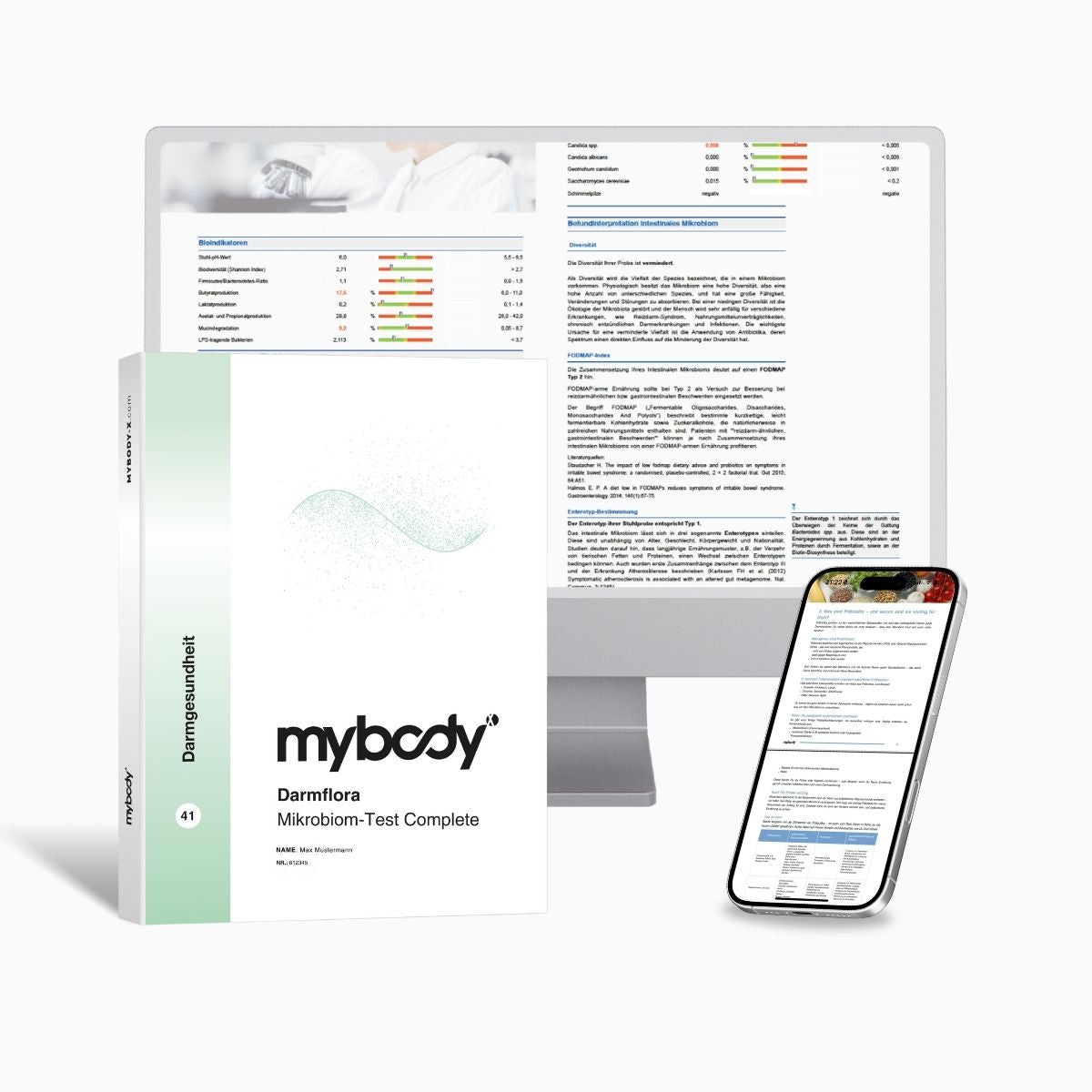
Gut Flora MICROBIOME Test Complete
Using a stool sample and DNA sequencing, the test determines more than 1,500 bacterial species and describes bacterial diversity, the ratio of protective to problematic microbes, indications of dysbiosis, as well as a FODMAP index and enterotype in the report. It explicitly does not do the following: It does not detect chronic inflammatory bowel disease such as Crohn’s disease or ulcerative colitis, diverticulitis, a tumor, or an infection—and it does not provide a diagnosis. The evaluation of intestinal inflammation belongs in a doctor’s office.
Price: €189.00 (instead of €219.00) · Sample type: Stool sample · Processing time: approx. 20–25 business days after receipt of the sample · Laboratory: ISO-certified laboratory analysis, ISO 27001, GDPR-compliant
About the Microbiome Test CompleteAll price and service information is as of July 28, 2026. Prices, report contents, and processing times may change; the respective product page is always authoritative.
Whether such an analysis makes sense for you can be answered in either direction. The following comparison therefore also identifies the cases in which the test is the wrong choice.
Useful for you if …
… you have already undergone medical evaluation and want to use an additional assessment of your gut flora as a baseline.
… you are symptom-free or have few symptoms and want to change your diet over the long term—the DGE (2021) states that the type and amount of dietary fiber substantially influence the composition of the microbiome.
… you want a written baseline that you can refer back to during subsequent nutritional counseling.
Probably not if …
… you are currently experiencing an acute flare or one of the warning signs from Chapter 3 applies: In that case, everything belongs in medical hands, and sending a stool sample to a specialist laboratory only costs time.
… you want to manage an existing diagnosis: Treatment of a chronic inflammatory bowel disease is not guided by a stool sample for gut flora, but by a doctor.
… you expect a diagnosis: The test does not detect intestinal inflammation, a tumor, or an infection—if that is what you are looking for, you will not find it here.
Context: What a self-test for intestinal inflammation cannot do
A gut microbiome self-test is a snapshot of the bacterial composition. It does not answer the question of whether inflammation is present—and that is precisely the question at the center of suspected intestinal inflammation.
A microbiome test detects neither Crohn’s disease nor ulcerative colitis, neither diverticulitis nor an infection, neither celiac disease nor a tumor. It does not measure inflammatory markers and does not replace a colonoscopy.
Interpretation also has its limits. An expert assessment reproduced in the DGE statement “Diet and the Microbiome” (2021) says that it is not yet clear how a specific diet could influence the microbiome in a clearly defined direction. Anyone who buys a test is therefore buying a baseline assessment, not instructions for controlling it.
Changing your diet cannot replace treatment either. The IQWiG information on Crohn’s disease and ulcerative colitis (2026) describes a diet rich in vegetables and low in processed foods as a general direction—not as a method for stopping existing inflammation. And an advice article cannot replace a medical consultation.
Conclusion
Intestinal inflammation – what should you do? Document your symptoms first, then have them medically evaluated. For at least two weeks, note stool frequency, pain, fever, weight, and nighttime symptoms, and schedule an appointment at a doctor’s office in parallel.
According to IQWiG (2023), significant weight loss, blood in the stool, fever, or paleness require immediate medical attention. In the event of severe abdominal pain with a rigid abdominal wall, fever, nausea, rapid heartbeat, and general weakness, IQWiG (2026) advises seeking medical help promptly; in the event of sudden, severe abdominal pain, IQWiG (2025) advises calling emergency services at 112 immediately.
Treatment itself should be managed by a doctor. According to IQWiG (2026), various medications may be considered to stop inflammation in the intestines and relieve symptoms—the treating practice decides which one is suitable in each individual case.
Between flare-ups, keep follow-up appointments, continue documenting your symptoms, and follow a diet that works in everyday life. An analysis of the gut microbiome can accompany this phase as a baseline assessment—but it is not a diagnostic procedure and does not replace medical evaluation.
Frequently asked questions
Intestinal inflammation – what should you do first?
Document your symptoms in writing and schedule an appointment at a doctor’s office. Useful information includes stool frequency and consistency, pain, fever, weight, and nighttime symptoms over a period of at least two weeks. If warning signs occur—according to IQWiG (2023), significant weight loss, blood in the stool, fever, or paleness—seek immediate medical evaluation.
When should I call emergency services for abdominal symptoms?
According to IQWiG (2025), call 112 immediately in the event of sudden, severe abdominal pain. Severe abdominal pain with a rigid abdomen, fever, nausea, a rapid heartbeat, and general weakness is also, according to IQWiG (2026), a reason to seek medical help promptly. Black-colored stool or vomiting blood are considered warning signs of complications according to IQWiG (2025).
Is irritable bowel syndrome the same as intestinal inflammation?
No. In irritable bowel syndrome, no inflammation can be established as the cause. According to IQWiG (2023), typical symptoms include persistent abdominal or lower abdominal pain, cramps, and altered bowel movements; estimates suggest that 10 to 20 out of 100 people have irritable bowel syndrome. According to IQWiG (2023), it is not dangerous, and many people affected manage without treatment.
Can changing your diet cure intestinal inflammation?
No. According to IQWiG (2026), various medications may be considered to stop the inflammation; experts also recommend a diet rich in vegetables and containing foods that are as fresh and minimally processed as possible. Changing your diet can alleviate symptoms and make everyday life easier, but it does not replace medical treatment. The IQWiG information does not describe a diet that has been proven to influence an existing chronic inflammatory bowel disease.
Is a microbiome test useful for intestinal inflammation?
Not for diagnosing intestinal inflammation. A microbiome test describes the composition of the gut flora, does not measure inflammatory activity, and does not provide a diagnosis. It detects neither Crohn’s disease nor ulcerative colitis, neither diverticulitis nor an infection or tumor. As a supplementary baseline assessment during a phase with few symptoms, it may be useful—but during an acute flare-up, everything should be handled by a doctor.
Your gut flora as a baseline assessment
Once you have received medical clarification and would like to assess your gut flora as a supplement, you can find the test and an overview of all gut analyses from mybody® here.
View the Microbiome Test Complete All gut tests at a glanceYou might also be interested in
→ Intestinal inflammation: what to eat?
Which foods are often poorly tolerated during a flare-up, and how to create a well-tolerated meal plan.
→ The most reliable microbiome tests for your gut flora
How to recognize a reputable gut flora analysis and what information a report should contain.
→ Gut encyclopedia: all bacteria and markers in your gut flora
Reference work with more than 6,000 microbiome biomarkers—from beneficial bacteria and fiber degraders to the metrics in your report.
Sources
- Institute for Quality and Efficiency in Health Care (IQWiG): How is Crohn’s disease treated in adults? (2026) — gesundheitsinformation.de
- IQWiG: Crohn’s disease (2026) — gesundheitsinformation.de
- IQWiG: Ulcerative colitis (2026) — gesundheitsinformation.de
- IQWiG: Irritable bowel syndrome (2023) — gesundheitsinformation.de
- IQWiG: Diverticular disease and diverticulitis (2026) — gesundheitsinformation.de
- IQWiG: The complete colonoscopy (2021) — gesundheitsinformation.de
The verbatim quotation on treatment, the groups of active ingredients mentioned, and the restriction regarding glucocorticoids are taken from [1]. The frequency and flare-up symptoms of Crohn’s disease are based on [2], while the information on ulcerative colitis is based on [3]. The warning signs, symptoms, and frequency of irritable bowel syndrome are taken from [4], and the information on diverticula and diverticulitis from [5]. The preparation for and benefits of colonoscopy are based on [6]. Further evidence is identified in the text by institution and year: the IQWiG information “Diverticular disease: How are chronic symptoms treated?” (2026), “Stomach and duodenal ulcers” (2025), and “What can you do yourself about hemorrhoids?” (2025), as well as the reference values of the German Nutrition Society (DGE, 2021) and the DGE publication “Diet and microbiome” (2021). Product information comes from the mybody® product pages, accessed on July 28, 2026.

mybody® editorial & expert team
Gut health Chronic inflammatory bowel diseases Microbiome Laboratory diagnostics
This article was created and medically reviewed by the mybody® editorial and expert team. The team brings together expertise in nutrigenetics, microbiome and intestinal science, blood analysis interpretation, nutritional science, and laboratory diagnostics.
Published on July 28, 2026 · Last updated on July 28, 2026
Medical notice: This article is for general information only and does not replace medical advice, diagnosis, or treatment. It does not contain a treatment recommendation: The active ingredients and groups of active ingredients mentioned are provided solely for descriptive purposes and with sources cited. Only a doctor can decide on the diagnosis and treatment of intestinal inflammation. In the event of sudden, severe abdominal pain, call emergency services at 112.

Share now:
Colon cleanse diet plan: Realistically plan 14 days—and check every component
Build your microbiome: What the gut flora demonstrably influences—and what it doesn’t