

Building up the microbiome: What has been shown to influence the gut microbiota—and what has not
The essentials at a glance
Building up the microbiome primarily means regularly providing the bacteria in the large intestine with fiber from real foods. According to the German Nutrition Society (DGE, 2021), the type and amount of fiber substantially influence the composition of the microbiome. As a guideline for adults, the DGE recommends at least 30 grams per day. This does not make it possible to deliberately steer the microbiome in a predetermined direction.
This article consistently distinguishes between what is supported by evidence and what health guides often claim. Supported by evidence are the link between fiber and bacterial composition, the role of bacterial diversity as a marker of a stable microbiome, and the fact that short-term dietary changes can alter the gut microbiota quickly, but reversibly. The benefits of additional fiber supplements have not been established.
If you are short on time, read Chapter 2 on the evidence and Chapter 6 comparing fiber, fermented foods, and probiotic supplements. Chapter 4 dispels two common assumptions, while Chapter 10 outlines the limits of nutrition and testing.
What to expect in this article
1. What does “building up the microbiome” actually mean?
2. What has been shown to influence the gut microbiota?
3. Which everyday approaches work—and when should you see a doctor?
4. Which assumptions are not supported by the evidence?
5. How do you arrive at 30 grams of fiber per day?
6. Fiber, fermented foods, or probiotics: How well is each supported by evidence?
7. How quickly does the gut microbiota change?
8. What does this look like in realistic everyday life?
9. What can a microbiome analysis tell us?
10. Putting it into perspective: What nutrition and tests cannot do
11. Conclusion
Frequently asked questions
Sources
What does “building up the microbiome” actually mean?
“Building up the microbiome” does not describe a blueprint, but rather creating good conditions for the bacteria in the large intestine. The term microbiome refers to the entire community of these microorganisms. In practice, building it up means providing what these bacteria can use—and doing so consistently, not just for two weeks.
The most important difference from many health-guide promises lies in the goal. There is no defined “good” microbiome that you could work toward. According to the German Nutrition Society (DGE, 2021), the richness of bacteria—meaning diversity, not a specific bacterial strain or target value—is considered a marker of a stable microbiome in healthy people.
Why “diversity” is the only evidence-based target concept
Diversity is therefore the central concept because the microbiome differs greatly from person to person. Two healthy people can have very different bacterial profiles without either being better than the other. That is why reputable scientific literature uses the marker of richness rather than rankings of individual microbes.
A very practical consequence follows from this logic: Anyone who wants to promote bacterial diversity should increase the variety of foods on their plate. Different plant foods provide different types of dietary fiber, and different types of dietary fiber reach different groups of bacteria.
Distinction: This article is neither a diet plan nor a cleanse
This article answers the basic question of what demonstrably influences the gut microbiota. It is deliberately not a four-week program: If you are looking for a specific daily structure, you will find it in the Diet plan for gut cleansing. If your main concern is sluggish bowel movements, however, the article is Stimulating bowel movements is the more suitable starting point. This article focuses on the evidence behind it.
What demonstrably influences the gut microbiota?
Diet is the best-documented factor influencing the composition of intestinal bacteria. Within the diet, the main factor is dietary fiber—that is, food components that the small intestine does not break down and that therefore reach the large intestine, where the bacteria are located.
“
“Diet shapes the composition of bacteria—one can therefore assume that the type and amount of dietary fiber substantially influence the composition of the microbiome.”
German Nutrition Society (DGE)
Report “Diet and Microbiome,” 2021
This quotation is the central statement of the entire topic—and at the same time, it is carefully worded. The DGE writes “one can therefore assume,” not “it has been proven that.” This precise restraint is missing from many advertising claims about the gut.
Short-chain fatty acids: What bacteria make from dietary fiber
The biochemical core of the topic is quickly explained. According to the DGE (2021), protective bacteria break down carbohydrates and produce short-chain fatty acids, especially butyrate. These fatty acids therefore do not occur in the food itself; they are produced only in the large intestine as a metabolic product of the bacteria.
The DGE (2021) also explains why this is interesting beyond the gut: A high intake promotes the absorption of short-chain fatty acids into the systemic circulation, where they may help prevent inflammation and cancer. The word “may” is essential – this is a described mechanism, not a guarantee.
Key point: According to the DGE (2021), bacterial richness is considered a marker of a stable microbiome in healthy people. There is therefore no target value and no “right” type of bacteria that you could work toward.
What else fiber does in the digestive tract
In addition to its effect on bacteria, fiber has a mechanical effect. According to the DGE (2021), it influences the transit time of food through the stomach and intestines, the amount and consistency of stool, and the frequency of bowel movements. This explains why changing your diet often first changes your bowel movements – and only afterward everything else.
IQWiG describes the effect of a high-fiber diet in its overview of diverticular disease (2026) in these exact terms: It softens the stool, increases stool volume, and stimulates digestion. This refers to a high-fiber diet, not a supplement.
Which levers work in everyday life – and when does it belong in a doctor’s office?
Four levers can be derived from the available evidence: fiber from food, plant-based variety, fermented foods, and time. They are intentionally unspectacular – and that is precisely why they are reliable.
Fiber from food
The DGE (2021) gives adults a guideline of at least 30 grams of fiber per day – from fruit, grains, vegetables, and legumes.
Plant-based variety
Because according to the DGE (2021), bacterial richness is the marker of a stable microbiome, variety makes more sense than always eating the same two or three foods.
Fermented foods
According to IQWiG, probiotics – living microorganisms – are found, among other things, in plain yogurt. This does not imply any promise of effectiveness.
Time and consistency
According to the DGE (2021), short-term dietary changes alter the gut microbiota quickly but reversibly. Only what lasts has a lasting effect.
Before changing your diet, it is important to distinguish between causes: Not every intestinal complaint is a matter of the gut flora. Some symptoms fundamentally belong in a doctor’s office and should not be addressed with a dietary trial.
Warning signs: This is where self-help ends
- ✓ Significant weight loss – according to IQWiG (2023), one of the signs that is more likely to indicate another intestinal disease.
- ✓ Blood in the stool – according to IQWiG (2023), blood in the stool should generally be medically examined to clarify the cause.
- ✓ Fever – according to IQWiG (2023), this is also one of the symptoms that should be evaluated.
- ✓ Paleness – IQWiG (2023) explicitly lists this sign as well.
This list is not scaremongering but a question of responsibility. A full plate of legumes is no substitute for diagnostic testing. Conversely, if these signs are absent, a higher-fiber diet is a sensible first step that you can begin without an appointment.
Which assumptions do not hold up in light of the evidence?
Two assumptions come up particularly often when discussing the microbiome. Both sound plausible, and neither is supported by the available source material.
The difference between “influence” and “control” is the whole point. That diet shapes the composition is a consensus view. That you could turn this into a control panel with defined target values is not.
Both myths have the same origin: the desire for a shortcut. The evidence-based answer is less convenient but more affordable—it consists of foods available in every supermarket.
How can you get 30 grams of fiber per day?
The DGE (2021) guideline for adults is at least 30 grams of fiber per day. You will not reach this amount with a single food, but by spreading it throughout the day—with ingredients that IQWiG (2026) explicitly lists as part of a high-fiber diet: plenty of fruit, grains, vegetables, and legumes.
The DGE (2021) explains very clearly why the effort is worthwhile: Increased fiber intake has protective effects against cardiovascular disease, type 2 diabetes, obesity, high blood pressure, colon cancer, and breast cancer, as well as on the risk of death. Few nutrition claims cover such a broad range of outcomes.
Four practical levers that work in everyday life
- ✓ Make legumes a regular part of your diet – According to IQWiG (2026), lentils, beans, and chickpeas are part of the definition of a high-fiber diet and provide particularly high amounts per serving.
- ✓ Choose whole-grain versions of cereals—the same meal, the same preparation, significantly more fiber.
- ✓ Drink enough—IQWiG (2026) explicitly recommends drinking enough when following a high-fiber diet. For regulating bowel movements, IQWiG (2025) specifies 1.5 to 2 liters per day.
- ✓ Increase slowly—doubling the amount all at once can cause bloating and often leads people to abandon the change.
Soluble fiber: How to classify flaxseeds and psyllium seeds correctly
Flaxseeds and psyllium seeds occupy an intermediate position. According to IQWiG (2026), they contain soluble fiber that binds water in the intestines—so they are foods, not simply a supplement. According to IQWiG (2025), anyone who uses them should take particular care to drink enough.
This is deliberately worded more cautiously than in many guides. For diverticular disease, IQWiG (2026) notes that there is initial evidence from studies that a high-fiber diet may reduce digestive symptoms. “Initial evidence” does not mean “established”—and it is not presented as such here.
Key point: The guideline value of at least 30 grams of dietary fiber per day (DGE, 2021) refers to food. According to IQWiG (2023), it has not been established that additional fiber supplements help.
Fiber, fermented foods, or probiotics: How well is each supported by evidence?
Three approaches to shaping the microbiome are regularly mentioned. They differ less in the effort involved than in the strength of the evidence. The following overview compares them using identical criteria—and explicitly states where the source material provides no information.
| Criterion | High-fiber diet | Fermented foods | Probiotic supplements |
|---|---|---|---|
| What is the approach? | Plenty of fruit, grains, vegetables, and legumes—that is how IQWiG (2026) describes a high-fiber diet. | Foods containing live microorganisms, such as natural yogurt, according to IQWiG. | Dietary supplements containing live microorganisms such as lactic acid bacteria (IQWiG, 2021). |
| What is established? | According to DGE (2021), the type and amount of dietary fiber substantially influence the composition of the microbiome; increased intake has protective effects, including against cardiovascular disease and type 2 diabetes. | The only thing established here is that such foods can contain probiotics. The source material used does not make any claim about the effects of fermented foods themselves. | According to IQWiG (2021), around 6 to 14 out of 100 fewer children developed atopic dermatitis while taking probiotic dietary supplements. However, the data were insufficient to determine whether the bacterial strains have different effects or how best to dose them. |
| How quickly does an effect become apparent? | According to the DGE (2021), short-term dietary changes alter the gut microbiota quickly but reversibly; longer-term changes can affect the genome. | The source material used provides no information on this. No specific timeframe is intentionally claimed here. | The source material used contains no information about the timeframe either. |
| What risks or requirements apply? | According to IQWiG (2026), drinking enough fluids is explicitly part of a fiber-rich diet. | No risk information is provided in the source material. According to IQWiG (2023), however, people’s reactions to certain foods vary greatly from person to person. | According to IQWiG (2023), probiotics are generally well tolerated; mild side effects such as bloating occur only rarely. |
| Assessment in one sentence | The best-supported lever and the only one with a specific target value (DGE, 2021: at least 30 grams per day). | A sensible way to increase food variety, but without a proven efficacy claim. | Well tolerated, but no substitute for fiber-rich food—and according to IQWiG (2023), no benefit has been demonstrated for fiber supplements. |
Probiotics and prebiotics: two terms that are often confused
According to IQWiG (2021), probiotics contain live microorganisms such as lactic acid bacteria; they are intended to beneficially influence the gut flora. Prebiotics, by contrast, are usually indigestible carbohydrates such as certain polysaccharides, which are intended to stimulate the formation of health-promoting bacteria in the digestive system.
For prebiotics, the studies evaluated by IQWiG (2021) on preventing atopic dermatitis found no clear protective effect. This is an important indication: The “food” side cannot simply be translated into a supplement either.
How quickly does the gut flora change?
Quickly—and that is precisely the problem. According to the DGE (2021), short-term dietary changes alter the gut microbiota quickly but reversibly. Anyone who eats differently for three weeks and then reverts to their old habits will lose the change again.
The DGE (2021) adds that longer-term changes can affect the genome. This expresses the chapter’s central message: It is not the intensity of the first week that determines the outcome, but whether the new way of eating still exists six months later.
What this means for dietary regimens and four-week programs
The reversibility calls for a sober assessment of time-limited programs. A dietary regimen can provide an initial boost because it creates structure and introduces new foods into the shopping basket. The source material does not support presenting it as a completed intervention with a lasting outcome.
A more realistic order is the reverse: first choose a change that fits permanently into your everyday routine, and then build on it. A portion of legumes that you actually eat three times a week will have a longer-lasting effect than a perfect plan that you abandon after twelve days.
In brief
The gut flora responds quickly to dietary changes, but it also reverts just as quickly: According to the German Nutrition Society (DGE, 2021), short-term changes alter the gut microbiota quickly but reversibly, while longer-term changes can affect the genome. For building up the microbiome, consistency therefore matters more than intensity. Limited-term dietary programs can make it easier to get started, but they do not replace a permanently high-fiber diet.
What does this look like in a realistic everyday routine?
The transition from the evidence base to everyday life rarely fails because of a lack of knowledge, but rather because of tolerance and available time. The following scenario is expressly fictional and shows only what a step-by-step change might look like.
Example: Nadja, 41
Fictional scenario for illustration
Nadja has been eating the same four dinners for years and wants to increase the variety of plant foods on her plate. Instead of following a complete plan, she decides to permanently incorporate one new plant-based food each week over eight weeks—first oats for breakfast, then red lentils, later whole-wheat pasta, chickpeas, and sauerkraut. In week three, she notices that the double portion of legumes in the evening causes bloating, so she halves the amount again. She does not like sauerkraut and crosses it off without feeling guilty; plain yogurt stays instead. After eight weeks, she does not have the perfect list, but six new foods that she actually buys. Her most important insight is that tolerance and practicality determine what stays—not the length of the recommendation list.
This scenario is expressly not presented here as a success story, but as an illustration of an approach. It does not describe a test result, a measured change in the microbiome, or treatment success.
What can primarily be applied here is the principle of taking small steps. According to IQWiG (2023), people’s responses to certain foods vary greatly—so a standard list works for hardly anyone on a one-size-fits-all basis.
What can a microbiome analysis help put into context?
A microbiome analysis is a snapshot of the gut flora—not a diagnosis or treatment. It describes which bacteria were present and in what proportions at the time of sampling, and makes bacterial diversity visible, which according to the German Nutrition Society (DGE, 2021) is considered a marker of a stable microbiome in healthy people.
A microbiome analysis is a snapshot of the gut flora—not a diagnosis or treatment.
Such an analysis is therefore primarily useful as a guide: It provides a starting point for a discussion with a nutrition counselor or medical practice. It is not a substitute for medical evaluation—and it does not change the fundamental factors discussed in the previous chapters.
mybody® (MYBODY Lab GmbH) offers microbiome analyses as at-home self-collection kits. The analysis is performed in an ISO-certified laboratory, and processing complies with the GDPR. Both of the following tests use a stool sample and provide a report of approximately 15 pages.
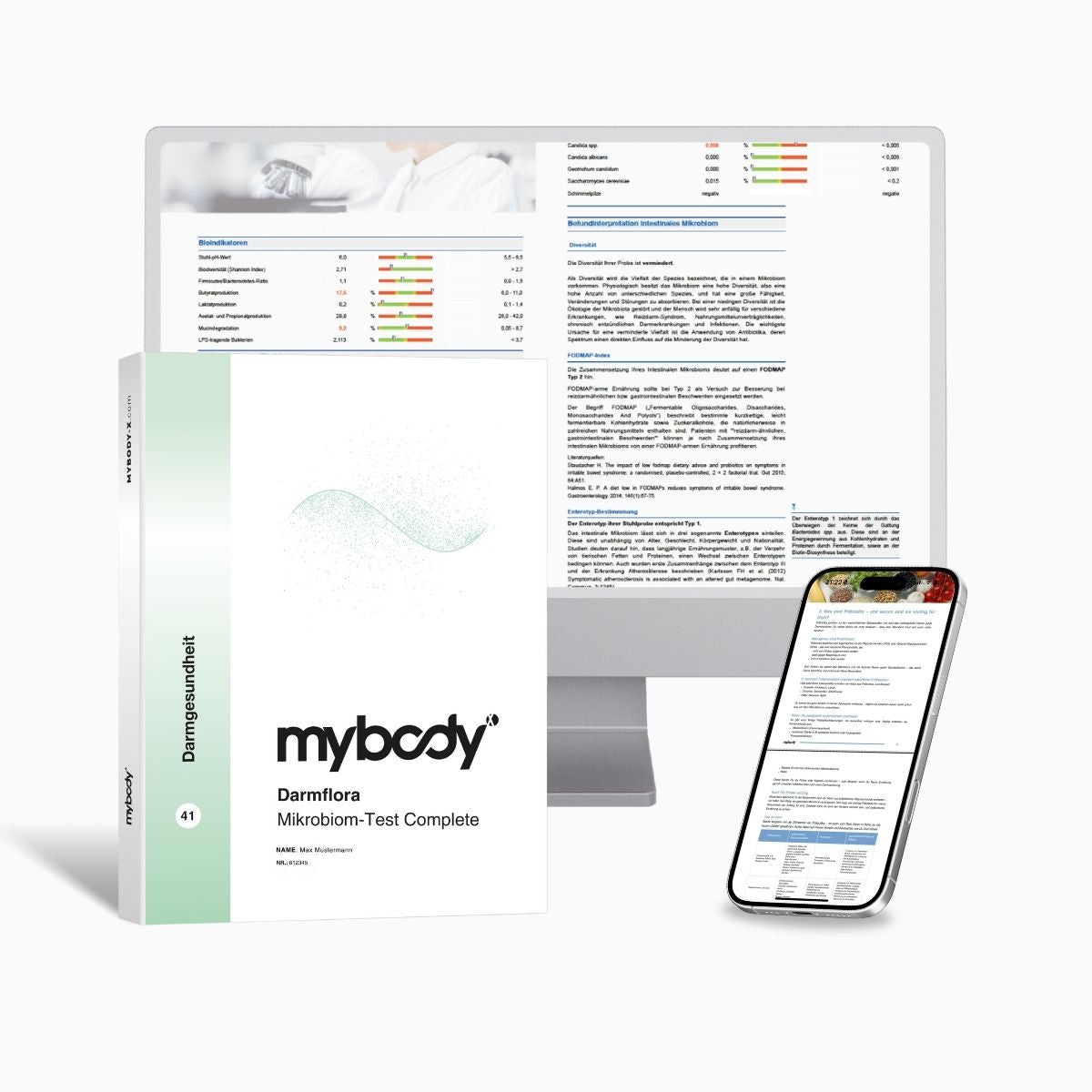
Gut Flora MICROBIOME Test Complete
The Complete test uses DNA sequencing to identify more than 1,500 bacterial species and describes, among other things, bacterial diversity, the ratio of beneficial to potentially harmful microbes, indications of dysbiosis, as well as a FODMAP index and enterotype determination. The test does not provide a diagnosis: It detects neither inflammatory bowel disease nor a tumor, infection, or celiac disease, and it does not provide treatment.
Price: €189.00 (instead of €219.00) · Sample type: Stool sample · Processing time: approx. 20–25 business days · Laboratory: ISO-certified laboratory analysis, ISO 27001
About the Complete microbiome test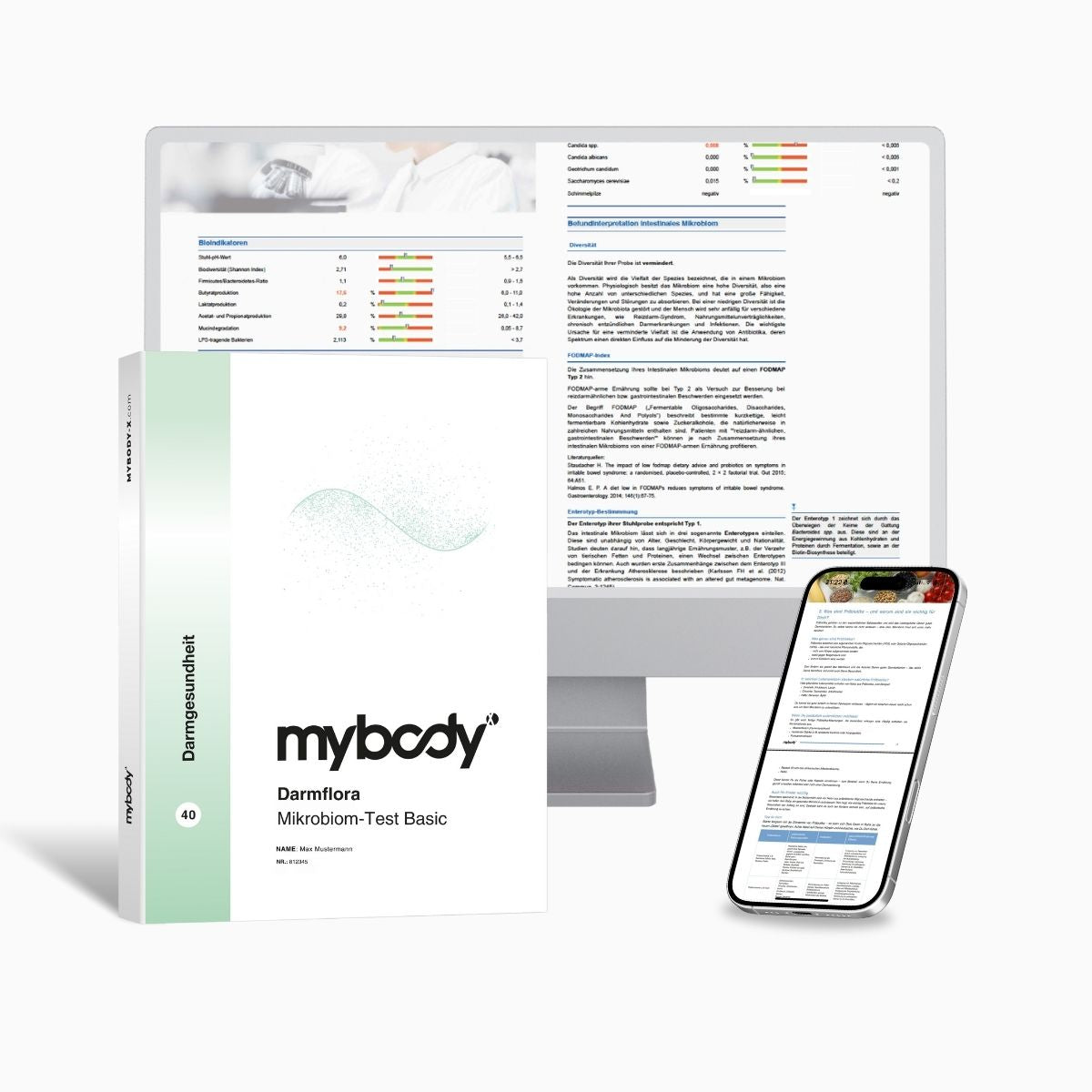
Gut Flora MICROBIOME Test Basic
The Basic version is the more affordable entry-level option. It describes the composition of the gut flora, the ratio of beneficial to potentially harmful bacteria, the intestinal environment based on the pH value, fungal colonization, and indications of dysbiosis. The FODMAP index and enterotype determination are not included. This test is also not a diagnostic procedure and does not replace medical evaluation.
Price: €139.00 · Sample type: Stool sample · Processing time: approx. 20–25 business days · Laboratory: ISO-certified laboratory analysis, ISO 27001
About the Basic microbiome testAll price and performance information is current as of July 28, 2026. Prices and processing times may change; the relevant product page always prevails.
What nutrition and tests cannot do
The most important limitation concerns controllability. An expert assessment reported in the DGE statement “Diet and Microbiome” (2021) says that it is not currently apparent how a specific diet could influence the microbiome in a clearly defined direction. This assessment comes from an expert voice quoted in the text and is not an institutional position of the DGE.
It follows that any promise of deliberately reprogramming the gut flora goes beyond the available evidence. Diet influences the microbiome—it does not direct it.
What a microbiome test explicitly cannot do
A microbiome test is not a diagnostic procedure. It cannot detect inflammatory bowel disease, a tumor, an infection, or celiac disease. It also does not provide treatment, but rather a description.
Nor does an analysis predict how you will react to individual foods. According to IQWiG (2023), this is highly individual and cannot be inferred from a list of bacteria.
Elimination diets require professional guidance
Anyone who independently eliminates entire food groups after receiving a FODMAP indication is taking a risk. According to IQWiG (2023), a low-FODMAP elimination diet carries a risk of malnutrition because it becomes difficult to consume enough vitamins and minerals. Such diets should therefore be undertaken with professional guidance.
To put the frequency into perspective: According to IQWiG (2023), estimates suggest that around 10 to 20 out of 100 people have irritable bowel syndrome. Irritable bowel syndrome is explicitly not dangerous—this, too, is part of an honest presentation.
Conclusion
Building up the microbiome means permanently consuming more fiber from whole foods and eating a greater variety of plant foods. According to the DGE (2021), the type and amount of fiber substantially influence the composition of the microbiome, and the guideline value for adults is at least 30 grams per day.
The benefits of additional fiber supplements have not been established (IQWiG, 2023). According to IQWiG (2023), probiotics are generally well tolerated, but this is not a promise of efficacy. Moreover, based on the expert assessment reported in the DGE statement (2021), targeted steering of the microbiome in a defined direction is not currently apparent.
In practical terms, this means starting with a change you will still be making six months from now—for example, eating legumes three times a week, choosing whole grains instead of refined flour, and drinking enough fluids. If you experience significant weight loss, blood in the stool, fever, or paleness, seek medical evaluation rather than relying on a self-test.
Frequently asked questions
How long does it take to build up the microbiome?
The available source material does not specify a fixed duration. According to the DGE (2021), short-term dietary changes rapidly but reversibly alter the gut microbiota, whereas longer-term changes can affect the genome. What matters, therefore, is that the change becomes permanent.
How much fiber do I need per day?
The German Nutrition Society (DGE, 2021) recommends that adults consume at least 30 grams of fiber per day. This refers to fiber from food—according to IQWiG (2026), a high-fiber diet consists mainly of plenty of fruit, grains, vegetables, and legumes.
Do probiotics help build up the microbiome?
No general promise of effectiveness can be derived from the source material. According to IQWiG (2023), probiotics are generally well tolerated, with mild side effects such as bloating occurring only rarely. In studies on preventing atopic dermatitis, IQWiG (2021) reported that around 6 to 14 fewer children out of 100 developed the condition—but the data were insufficient to determine whether the bacterial strains work differently or how they should best be dosed.
Can I deliberately steer my microbiome in a particular direction?
Not based on current knowledge. A professional assessment cited in the German Nutrition Society (DGE) statement “Diet and Microbiome” (2021) says that it is not yet clear how a specific diet can influence the microbiome in a clearly defined direction. This statement is attributed to an expert opinion and is not an institutional position of the DGE.
When should I have digestive symptoms medically evaluated?
According to IQWiG (2023), additional symptoms such as significant weight loss, blood in the stool, fever, or paleness are more likely to indicate another intestinal disease. Blood in the stool should always be medically examined to clarify the cause. In these cases, seeking medical advice is the right course of action—not a self-test or changing your diet on your own.
Have your gut flora described
If you want to know what your gut flora currently consists of, a microbiome analysis provides a snapshot as a starting point for discussion with healthcare professionals. It does not replace a medical evaluation.
View the Complete Microbiome Test All gut tests at a glanceYou may also be interested in
→ The most reliable microbiome tests for your gut flora
What matters when choosing a gut flora analysis and which criteria really count.
→ Gut flora tests: Microbiome analysis meets practical recommendations
How test results can be translated into concrete, practical steps for everyday life.
→ Gut encyclopedia: all bacteria and markers in your gut flora
Reference work with more than 6,000 microbiome biomarkers—from protective bacteria and fiber fermenters to the metrics in your report.
Sources
- German Nutrition Society (DGE): Report “Nutrition and the Microbiome” (2021) — dge.de
- German Nutrition Society (DGE): Reference values for dietary fiber (2021) — dge.de
- IQWiG / gesundheitsinformation.de: What helps with irritable bowel syndrome—and what does not? (2023) — gesundheitsinformation.de
- IQWiG / gesundheitsinformation.de: Can pro- or prebiotics help protect children from atopic dermatitis? (2021) — gesundheitsinformation.de
- IQWiG / gesundheitsinformation.de: Irritable bowel syndrome (2023) — gesundheitsinformation.de
- IQWiG / gesundheitsinformation.de: Diverticular disease – how are chronic symptoms treated? (2026) — gesundheitsinformation.de
The institute quotation, the statements on short-chain fatty acids and butyrate, bacterial richness as a marker, and the reversibility of short-term dietary changes are based on [1]. The recommendation of at least 30 grams of dietary fiber per day and the protective effects of increased fiber intake come from [2]. The statements on fiber supplements, probiotic tolerance, individual responses to foods, and the risk of malnutrition with FODMAP-elimination diets come from [3]. The definitions of pro- and prebiotics and the evidence concerning children are based on [4]; the information on warning signs and the prevalence of irritable bowel syndrome comes from [5]. The description of a fiber-rich diet, its effects on stool, the soluble fiber in flaxseeds and psyllium seeds, and the recommendation to drink enough fluids come from [6]. Product information comes from the mybody® product pages, accessed on July 28, 2026. All other sources cited in the text are identified directly at the relevant point with the institution and year.

mybody® Editorial & Expert Team
Microbiome Gut health Dietary fiber Nutritional science
This article was created and medically reviewed by the mybody® Editorial and Expert Team. The team brings together expertise in nutrigenetics, microbiome and gut science, blood analysis interpretation, nutritional science, and laboratory diagnostics.
Published on July 28, 2026 · Last updated on July 28, 2026
Medical notice: This article is for general information only and does not replace medical advice, diagnosis, or treatment. A microbiome analysis is not a diagnostic procedure. If you experience persistent or severe intestinal symptoms, significant weight loss, blood in your stool, fever, or pallor, please consult a doctor.


Share now:
Intestinal inflammation: what to do? First steps, evaluation, and treatment
Sluggish bowels: What you can do step by step for a sluggish bowel