
Gut cleanse diet plan: How to plan 14 days realistically—and assess every component
The key points at a glance
In its evidence-based form, a gut cleanse diet plan consists of three elements: a regular meal schedule, gradually increasing fiber from foods, and sufficient fluids. The German Nutrition Society (DGE) recommends that adults consume at least 30 grams of fiber per day (as of 2021). Fasting days, laxatives, and enemas are not part of it.
“Gut cleanse” is not a medically defined term. Plans commonly circulating combine very different components: rest days, bulking agents and laxatives, enemas, probiotic supplements, and detox teas. This article examines each one individually to determine what is supported by evidence—and what is not.
Chapter 1 clarifies the term, Chapter 2 covers the only medically justified bowel cleanse, and Chapter 3 addresses the warning signs. Chapter 4 onward presents the 14-day plan, while Chapter 5 focuses on putting it into practice at the table. Chapter 6 examines the cleanse components in detail, and Chapter 9 summarizes the evaluation in a table.
What to expect in this article
1. What is a gut cleanse—and what do the plans commonly circulating contain?
2. When is a bowel cleanse medically justified?
3. Which warning signs belong in a doctor’s office rather than in a cleanse plan?
4. What does a realistic 14-day plan look like?
5. What exactly do you eat and drink during these 14 days?
6. Fasting days, bulking agents, enemas, probiotics, teas: What is supported by evidence?
7. What can a microbiome analysis contribute to the plan—and what can’t it?
8. What are the limitations of a 14-day plan?
9. The three most common gut cleanse components compared directly
Conclusion
Frequently asked questions
Sources
Every component of a gut cleanse can be assessed using the same four questions—whether it is a rest day, psyllium husk, or a probiotic. This evaluation framework underlies all the following chapters.
What is being promised?
Write down the promise verbatim. The vaguer it sounds, the harder it is to verify.
What has been proven?
Look for a clearly identifiable source that names an institution and year. If there is none, that is itself a finding.
What risk is involved?
Check for side effects and restrictions. According to IQWiG (2022), one-sided diets can lead to malnutrition.
Is the effort worthwhile?
Weigh the effort, cost, and restrictions against the proven benefit. What you stop doing afterward makes little long-term difference.
What is a gut cleanse—and what do the plans commonly circulating contain?
“Gut cleanse” is not a medically defined term. No professional medical society specifies how long a gut cleanse lasts, what it contains, or how its success is measured. Every provider defines the term differently—and that is precisely why two plans with the same name often look completely different.
Nevertheless, almost all plans contain the same five elements: fasting or light-eating days, bulking agents and laxatives for “cleansing,” occasional enemas, followed by probiotic supplements for “rebuilding,” along with detox teas.
Why the word “cleanse” creates a false expectation
A cleanse has a beginning and an end. The gut microbiome works differently: it responds to what regularly ends up on the plate, not to a completed intervention.
The Institute for Quality and Efficiency in Health Care (IQWiG) explicitly describes a combination of “dietary changes, more physical activity, and behavioral changes” for weight loss in obesity (IQWiG, 2022). The same logic applies to the bowel: routine, food choices, and everyday habits work together.
People looking for a colon cleanse are usually looking for something else
The search for a cleanse plan is almost always driven by specific symptoms: bloating, sluggish bowel movements, a feeling of fullness after eating, or a stomach that reacts to stress. According to IQWiG (2023), estimates suggest that around 10 to 20 out of 100 people have irritable bowel syndrome.
Evidence-based approaches are not called a “cleanse,” but include fiber, fluid intake, physical activity, and meal timing.
Key statement: “Colon cleanse” is not a medically defined term—there is no specified duration, no specified ingredients, and no specified measure of success.
When is bowel cleansing medically justified?
Targeted bowel cleansing is medically justified in exactly one situation: as preparation for a colonoscopy. It is prescribed by a doctor and is not a wellness procedure.
The procedure is strictly regulated. According to IQWiG (2021), preparation involves “drinking a laxative with plenty of liquid, totaling 2 to 4 liters, depending on the appointment, on the evening before and/or the morning of the examination.” In addition, “solid food must be avoided from 2 to 3 hours before taking the laxative until after the examination.”
The goal is not a feeling of well-being, but a clear view for the examination. IQWiG describes how the medical team recognizes that the bowel has been adequately emptied:
“
“It is important that, at the end of the procedure, only clear liquid is passed on the toilet.”
Institute for Quality and Efficiency in Health Care (IQWiG)
“The complete colonoscopy,” gesundheitsinformation.de, 2021
This quote explicitly describes preparation for a colonoscopy—not a colon cleanse. It is not a quality criterion for a nutrition plan and not a target to aim for at home.
Benefits and risks of colonoscopy in context
The preparation required for a colonoscopy is balanced by a measurable benefit. According to IQWiG (2021), an estimated 95% of carcinomas are detected through the examination. At the same time, IQWiG (2021) reports complications: During colonoscopy, treatment-requiring complications occur in 2 to 3 out of every 1,000 men.
This is precisely the balance missing from a wellness colon cleanse: the effort and risk are present, but there is no comparable proven benefit.
Which warning signs belong in the doctor’s office rather than in a cleanse plan?
Every meal plan should begin with a brief check. Some symptoms are not addressed with a meal plan but with an appointment at a doctor’s office.
These signs require medical assessment—before any cleanse
- ✓ Significant weight loss – Weight that declines unintentionally and without explanation is, according to IQWiG (2023), an indication of another intestinal disease.
- ✓ Blood in the stool – According to IQWiG (2023): “Blood in the stool should always be examined by a doctor to determine the cause.”
- ✓ Fever – Fever together with intestinal symptoms requires medical assessment, not a self-directed experiment.
- ✓ Paleness – Paleness may indicate anemia and requires an examination, not a meal plan.
According to IQWiG (2023), “additional symptoms such as significant weight loss, blood in the stool, fever, or paleness are more likely to indicate another intestinal disease.” These four signs are why every reputable plan begins with a distinction, not a promise.
The same applies in the case of existing illnesses, pregnancy, long-term medication use, or chronic inflammatory bowel disease: A meal plan does not replace medical treatment; at best, it accompanies it.
What does a realistic 14-day plan look like?
A realistic 14-day plan skips any cleansing phase and proceeds in four stages: establishing a routine, increasing fiber, adding variety, and evaluating the results. Two weeks are not enough for a complete dietary overhaul—but they are enough to establish a reliable starting point.
This distinguishes this article from its related topics: Anyone looking for the four-week restorative meal plan will find it in the Four-week meal plan for intestinal cleansing; those primarily looking to address sluggish bowel movements will find the individual approaches in the article Stimulate bowel movements. This article remains focused on 14 days and on the question of which cleanse components can withstand scrutiny.
Days 1 to 3: establish meal timing and fluid intake
During the first three days, nothing changes about what you eat—only when you eat it. Set three regular mealtimes and leave real breaks between them. Regarding fluid intake, IQWiG (2025) recommends 1.5 to 2 liters per day in connection with constipation and straining hard. For three days, write down what you eat and how your stomach reacts.
Days 4 to 7: gradually increase fiber
Starting on day 4, add a fiber-rich component to every meal—whole rather than refined grains, a serving of legumes, or a piece of fruit with its skin. According to IQWiG (2025), people are “often advised to eat fiber-rich foods with fruit, grains, vegetables, and legumes” to soften the stool. Increase gradually: Anyone who jumps from little to a lot will develop bloating and give up.
Days 8 to 11: add variety and fermented foods
In the second week, the focus is not on greater quantities but on greater variety: a different legume, a different vegetable, and a different type of grain. Add fermented foods such as plain yogurt or sauerkraut. According to the glossary of gesundheitsinformation.de, they contain live microorganisms—but this does not establish evidence of effectiveness for a “gut cleanse.”
Days 12 to 14: evaluate and decide what will stay long term
The last three days are for evaluation, not a finale. Compare your notes from days 1 to 3 with your current status: Has the rhythm held? Have your bowel movements become more regular? Which two or three changes do you want to keep? Anything you do not consciously adopt will fall away after day 14.
This plan deliberately includes no cleansing phase, fasting day, or list of supplements. It consists of changes you can still maintain on day 30—which is precisely what distinguishes it from a cleanse.
What exactly will you eat and drink during these 14 days?
In concrete terms: a fiber-rich foundation, three meals, sufficient fluids, and no list of forbidden foods. The target can be stated clearly. The German Nutrition Society (DGE) recommends that adults consume at least 30 grams of fiber per day (as of 2021).
The DGE (2021) explains why this value matters: “Increased fiber intake has protective effects against cardiovascular disease, type 2 diabetes, obesity, high blood pressure, colon and breast cancer, as well as the risk of mortality.”
The foundation: grains, legumes, vegetables, fruit
IQWiG (2025) identifies the groups “fruit, grains, vegetables, and legumes” for regulating bowel movements. In practice, this means whole grains instead of refined flour, one serving of legumes on at least four out of seven days, and vegetables with every hot meal.
Gradual increases are more important than reaching the target amount. Anyone consuming significantly less than 30 grams should increase their intake in small steps and observe the response. Bloating in the initial phase is a common reason for stopping—and can be avoided if the increase is slow enough.
Fluid intake: the condition without which fiber does not work
Fiber binds water. Without sufficient fluid intake, its effect is reversed. IQWiG (2025) recommends drinking 1.5 to 2 liters per day to prevent constipation and straining hard. This is a guideline for adults without conditions requiring fluid restriction.
There is a second rule for bowel movements themselves: do not strain. According to IQWiG (2025), straining hard with enlarged hemorrhoids can worsen symptoms and cause pain. Anyone who regularly has to strain would do better to adjust their fiber and fluid intake.
What does not belong in the plan for these 14 days
No blanket elimination diet. The FODMAP concept is not an appropriate starting point: According to IQWiG (2023), “there is, however, a risk of malnutrition because it becomes difficult to consume enough vitamins and minerals.” Such a diet should be professionally supervised by a nutrition specialist or a doctor.
Regarding the mechanism of action, IQWiG (2023) cautiously states that “the intake of FODMAPs is thought to cause more water to enter the intestines and promote diarrhea.” A supposition is not a recommendation for fourteen days without supervision.
In brief
The dietary component of a bowel cleanse consists of a fiber-rich foundation of fruit, grains, vegetables, and legumes, 1.5 to 2 liters of fluids per day, and three regular meals. The German Nutrition Society recommends at least 30 grams of fiber per day as a guideline (as of 2021). Gradual increases are more important than reaching the target amount, because increasing intake too quickly causes bloating. Elimination diets such as FODMAP do not belong in a self-directed 14-day plan because, according to IQWiG (2023), there is a risk of malnutrition.
Fasting days, bulk-forming agents, enemas, probiotics, teas: What is supported by evidence?
The five typical components of a cleanse differ greatly in the strength of the evidence supporting them. This chapter examines them individually, following the four-question assessment framework in each case.
Fasting and rest days
Fasting or relief days appear at the beginning of many plans and are intended to “relieve” the bowel. The source material reviewed for this article contains no evidence that a relief day permanently improves the gut microbiome or digestion.
The opposite has been demonstrated, however. According to IQWiG (2022): “Many diet providers advertise exaggerated promises and sometimes promote extreme and one-sided forms of nutrition. Such diets can have side effects and medical risks such as malnutrition.” The more strongly a cleanse introduction relies on deprivation, the more carefully it should be scrutinized.
Bulk-forming and fiber products: psyllium husks as a special case
Psyllium husks have the comparatively strongest evidence in the reviewed material—though for a specific context. IQWiG (2025) writes: “Studies provide indications that plant-based products containing fiber, such as psyllium husks, may reduce the frequency of bleeding.” This statement refers to enlarged hemorrhoids, not to a colon cleanse. It also comes with a caveat: “Anyone taking psyllium husks must pay particular attention to drinking enough fluids” (IQWiG, 2025).
For fiber supplements as a separate product category, however, the evidence is clear. According to IQWiG (2023): “It has not been proven that additional fiber supplements help.” This is not a ban, but it is an argument for investing the money in food first.
Laxatives and enemas
Laxatives and enemas are described here, but neither recommended nor dosed. In the reviewed source material, laxatives appear in exactly one context: as a medically prescribed preparation for a colonoscopy involving 2 to 4 liters of laxative solution (IQWiG, 2021).
There is no evidence of benefit for using them as a regular part of a cleanse plan. Anyone considering using them should discuss this with a medical practice or pharmacy—not rely on a plan from the internet.
Probiotic supplements
According to the glossary of gesundheitsinformation.de, probiotics are “live microorganisms such as lactic acid bacteria or certain yeasts,” found, for example, in natural yogurt or dietary supplements. There is evidence regarding tolerability: According to IQWiG (2023): “In general, probiotics are well tolerated: mild side effects such as flatulence occur only rarely.”
However, good tolerability does not imply efficacy. The statement describes side effects, not a benefit—no claim of efficacy can be derived from it. Probiotics therefore remain a supplement and are not a substitute for changing your diet.
Detox and herbal teas
The reviewed source material provides no evidence of efficacy for detox teas. This is the honest conclusion: no figure, no body of studies—and therefore no estimate. Unsweetened tea counts toward fluid intake; any additional cleansing effect has not been proven.
Key message: Of the five typical components of a gut cleanse, only a high-fiber diet has broadly documented benefits in the reviewed source material—laxatives are documented there exclusively as medically prescribed preparation for a colonoscopy.
What can a microbiome analysis contribute to the plan—and what can it not do?
A microbiome analysis provides a snapshot of the gut flora: which bacterial species are present, how diverse the colonization is, and what the ratio of protective to potentially harmful microbes looks like. It does not replace a diagnosis—it documents a baseline.
mybody® (MYBODY Lab GmbH) offers these analyses as self-tests: The stool sample is collected at home and sent in, and the analysis is performed in an ISO-certified laboratory in compliance with ISO 27001 and the GDPR.
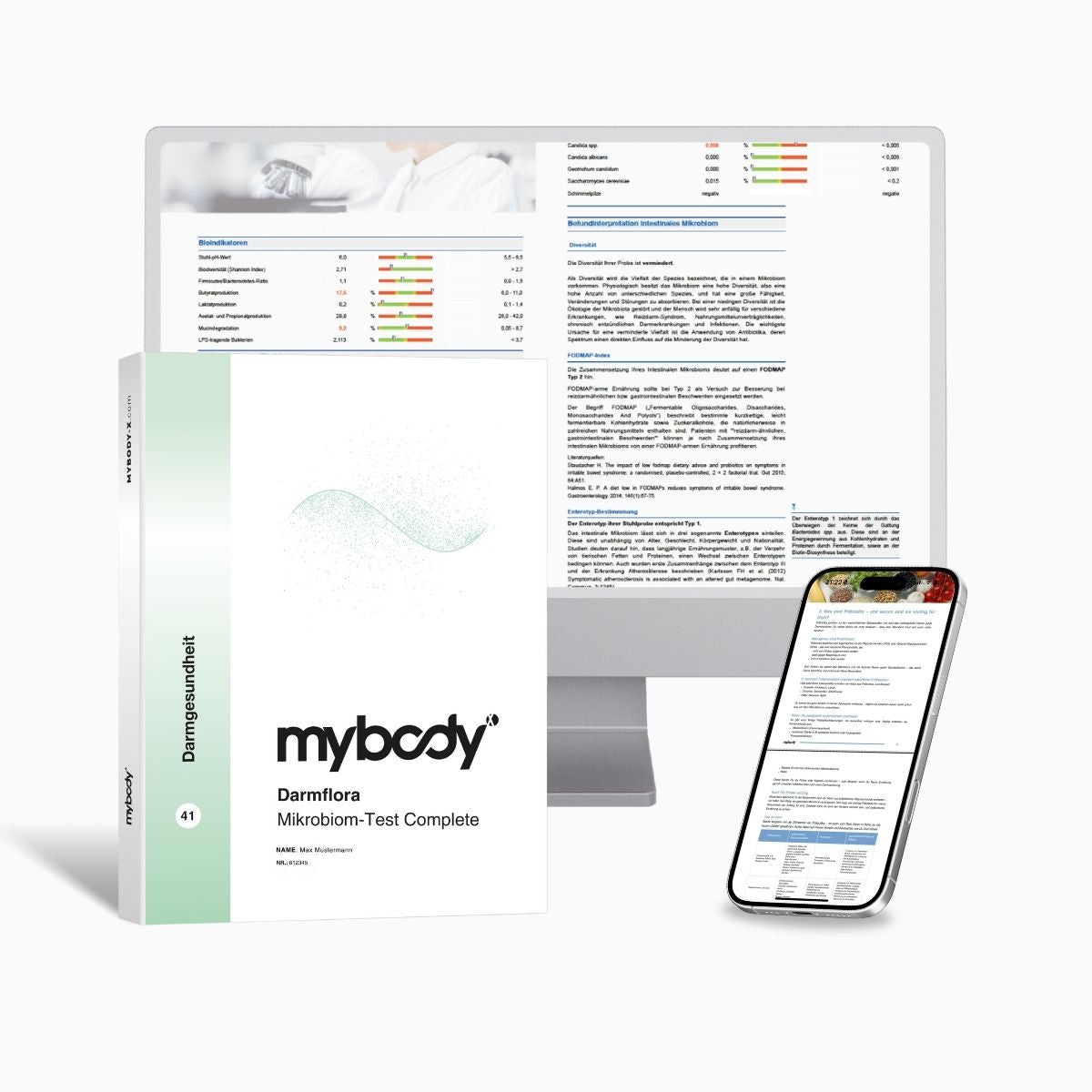
Gut Flora MICROBIOME Test Complete
The Complete Test uses DNA sequencing to analyze more than 1,500 bacterial species and evaluates, among other things, bacterial diversity, the ratio of protective to potentially harmful microbes, indications of dysbiosis, a FODMAP index, and enterotype determination; the report is around 15 pages long. What it does not do: It does not provide a diagnosis or detect inflammatory bowel disease, tumors, infections, or celiac disease.
Price: €189.00 (instead of €219.00) · Sample type: Stool sample · Processing time: approx. 20–25 business days · Laboratory: ISO-certified laboratory analysis, ISO 27001
To the Complete Microbiome Test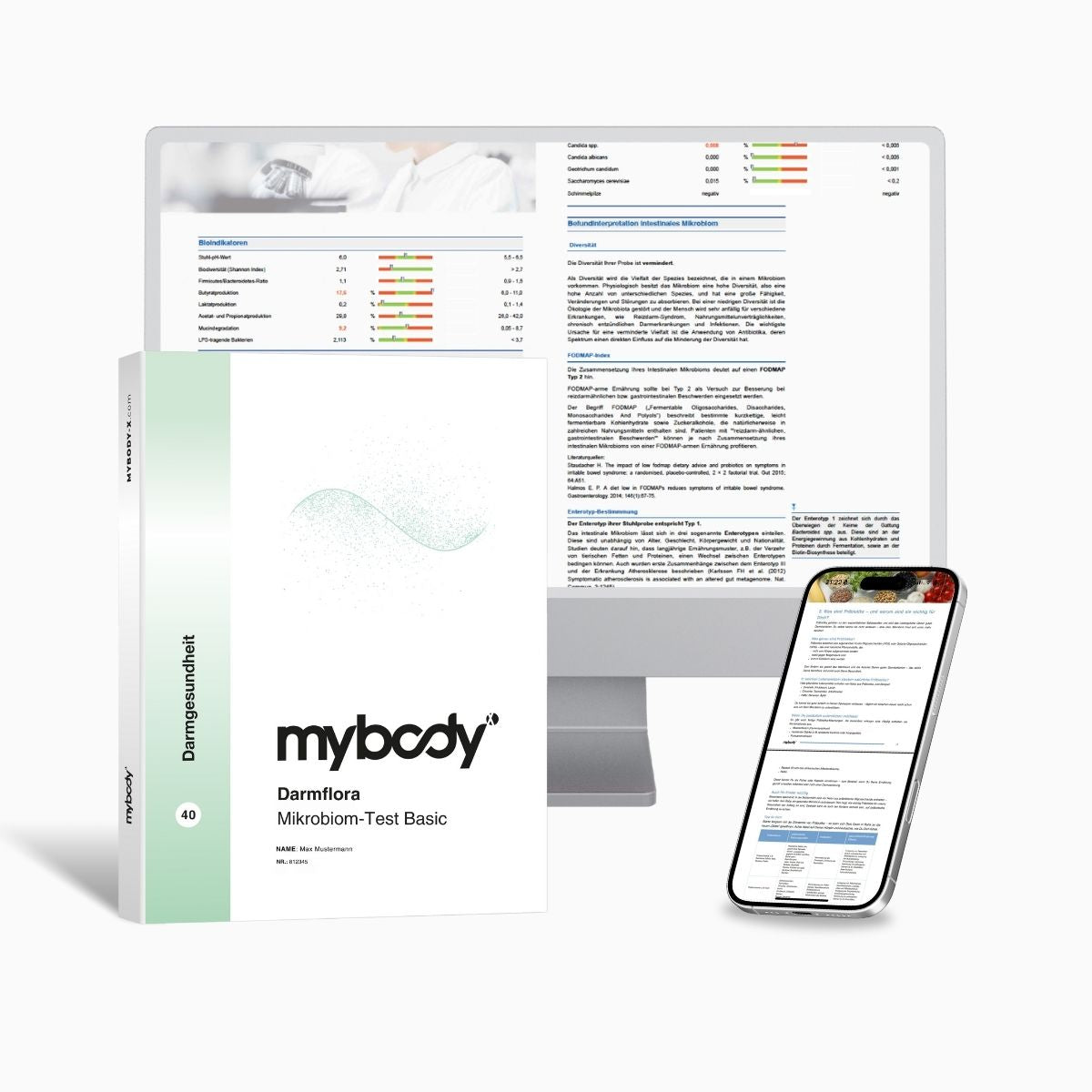
Gut Flora MICROBIOME Test Basic
The Basic version is the more affordable entry-level option and shows the composition of the gut flora, the ratio of protective to potentially harmful bacteria, the gut environment based on the pH value, possible fungal colonization, and indications of dysbiosis; the report is also around 15 pages long. The FODMAP index and enterotype determination are not included; this test does not provide a diagnosis either.
Price: €139.00 · Sample type: Stool sample · Processing time: approx. 20–25 business days · Laboratory: ISO-certified laboratory analysis, ISO 27001
To the Basic Microbiome TestAll price and service information is as of July 28, 2026. Prices and processing times may change; the respective product page is always authoritative.
Important for planning: The processing time of around 20 to 25 business days is longer than the 14-day plan. A test is therefore not suitable as a starting signal, but as a baseline assessment for a longer-term change.
Useful for you if …
… you are changing your diet over several months anyway and would like to have a documented baseline.
… you are interested in how diverse your gut flora currently is and what the balance between protective and potentially harmful microbes looks like.
… you want to use the results as a basis for discussion with a nutrition professional or your doctor’s office.
Not recommended if …
… you notice warning signs such as significant weight loss, blood in your stool, fever, or paleness—according to IQWiG (2023), these are more likely to indicate another intestinal disease and should be evaluated by a doctor.
… you expect a diagnosis or a ready-made treatment plan. A microbiome analysis provides neither.
… you are already starting to eat a higher-fiber diet. You do not need a test result for that—and you would have to postpone the start by several weeks.
What are the limitations of a 14-day plan?
Fourteen days are a starting phase, not a result. A plan that you stop following after 14 days will not permanently change your gut flora. No additional ingredient can undo that.
A plan that you stop following after 14 days will not permanently change your gut flora.
The second limitation concerns symptoms with an organic cause: A diet plan cannot detect inflammatory bowel disease, an infection, or a tumor. If warning signs occur, the rule from Chapter 3 applies: get them checked first, then make a plan.
The third limitation is individuality. How strongly someone reacts to more fiber, legumes, or fermented foods varies considerably. That is why your record from the first three days complements every standard plan.
The fourth limitation concerns expectations of supplements. Neither probiotics, fiber supplements, nor teas replace dietary changes; according to IQWiG (2023), no benefit has been demonstrated for fiber supplements.
The fifth limitation concerns measurability. A microbiome analysis provides a snapshot, not a before-and-after comparison within two weeks—if only because the evaluation takes around 20 to 25 business days.
The three most common cleanse ingredients in direct comparison
The overview summarizes the assessment from Chapter 6 for the three most common ingredients. Where the reviewed source material provides no information, this is explicitly stated in the cell—instead of an estimate.
| Criterion | Fasting and rest days | Bulking agents and laxatives | Probiotic supplements |
|---|---|---|---|
| What benefits does the ingredient promise? | Relief and a fresh start for digestion. | Thorough cleansing and faster emptying of the bowel. | Rebuilding a weakened gut microbiota after the cleansing phase. |
| What has been proven? | No evidence of effectiveness in the reviewed material. For weight reduction, IQWiG (2022) describes a combination of dietary changes, exercise, and behavioral changes. | Psyllium husks: according to IQWiG (2025), studies indicate rarer bleeding in people with hemorrhoids. Fiber supplements: not proven according to IQWiG (2023). Laxatives: documented only as preparation for a colonoscopy (IQWiG, 2021). | Only tolerability has been demonstrated (IQWiG, 2023). No evidence of effectiveness for a gut cleanse was found in the reviewed material. |
| What risks or requirements are involved? | According to IQWiG (2022), extreme and one-sided diets can cause side effects and medical risks such as malnutrition. | Requirement when taking psyllium husks according to IQWiG (2025): drink enough. The laxative solution before a colonoscopy amounts to 2 to 4 liters and is prescribed by a doctor (IQWiG, 2021). | According to IQWiG (2023), only mild side effects such as bloating occur rarely. The material does not mention any other risks. |
| Who should provide support? | For pre-existing conditions, pregnancy, or long-term medication use, consult a medical practice or a nutrition professional. | Medical practice or pharmacy—laxatives do not belong in a self-designed cleanse plan. | For existing bowel disease, consult the treating medical practice. |
| Assessment in one sentence | Unnecessary at the start: Consistency brings more than abstinence. | Psyllium husks can be added with sufficient fluid intake; laxatives do not belong in a wellness plan. | Well tolerated, but not a proven substitute for fiber from food. |
The pattern repeats itself: The more a component sounds like part of a cleanse, the weaker the evidence.
Conclusion
A gut cleanse meal plan that stands up to scrutiny consists of a few, unremarkable elements: three regular meals, gradually increasing fiber intake toward the DGE guideline value of at least 30 grams per day (as of 2021), 1.5 to 2 liters of fluid daily (IQWiG, 2025), and greater plant-based variety.
The classic cleanse components largely fail this test: There is no evidence of effectiveness for fasting days or detox teas, the benefit of fiber supplements has not been demonstrated according to IQWiG (2023), and laxatives are documented only as preparation for a colonoscopy.
Specifically, this means: Start with days 1 to 3 without buying anything. From day 4, gradually increase your fiber intake; from day 8, add variety; and on day 14, decide which two or three changes should remain permanent. Anyone who wants to document their starting point can precede this with a microbiome analysis—while bearing in mind that it provides a snapshot, not a diagnosis.
Frequently asked questions
How long should a gut cleanse last?
There is no medically established duration because “gut cleanse” is not a medically defined term. The plan in this article runs for 14 days because this period allows a meal rhythm to become established and fiber intake to be increased gradually. The 14 days are the introduction, not the goal.
Do I need to empty my bowels beforehand for a gut cleanse?
No. Targeted bowel emptying is documented only in one context: as medically ordered preparation for a colonoscopy. According to IQWiG (2021), a total of 2 to 4 liters of laxative solution are consumed with plenty of fluids. This is neither intended nor supported by evidence for a dietary plan at home.
What can I eat during the 14 days?
The plan does not use a list of prohibited foods. The focus is on what is added: fruit, grains, vegetables, and legumes—the food groups recommended by IQWiG (2025) for regulating bowel movements. As a guideline, the German Nutrition Society recommends at least 30 grams of fiber per day (as of 2021). Blanket elimination diets do not belong in a self-initiated plan.
What is the difference between this plan and a four-week gut cleanse?
This article examines the components of circulating cleanse plans and compares them with a 14-day introduction. The progressive four-week dietary plan, by contrast, guides you week by week through a longer-term change. The two do not contradict each other—the 14-day introduction is the first stage.
When should I take my symptoms to a doctor's office?
According to IQWiG (2023), additional symptoms such as significant weight loss, blood in the stool, fever, or pallor are more likely to indicate another intestinal disease; blood in the stool should always be examined by a doctor. If these signs are present, do not start a dietary plan—make an appointment instead.
Document your baseline before making changes
If you change your diet over several months, a snapshot of your gut flora can be a useful starting point. It does not replace a medical examination and does not provide a diagnosis—but it does provide a documented baseline.
View Microbiome Test Complete All gut tests at a glanceYou might also be interested in
→ Stimulating digestion: Which approaches are supported by evidence
The individual levers in everyday life—from fiber and fluid intake to exercise.
→ The most reliable microbiome tests for your gut flora
What matters in a gut microbiome analysis and what it cannot do.
→ Gut Encyclopedia: all bacteria and markers in your gut microbiome
Reference work with more than 6,000 microbiome biomarkers—from beneficial bacteria and fiber degraders to the metrics in your report.
Sources
- Institute for Quality and Efficiency in Health Care (IQWiG): Colonoscopy (2021) — gesundheitsinformation.de
- IQWiG: What helps with irritable bowel syndrome—and what doesn’t? (2023) — gesundheitsinformation.de
- IQWiG: What can you do yourself about hemorrhoids? (2025) — gesundheitsinformation.de
- IQWiG: Programs and medications for weight loss (2022) — gesundheitsinformation.de
- German Nutrition Society (DGE): Reference Values for Nutrient Intake – Dietary Fiber (2021) — dge.de
- IQWiG: Irritable bowel syndrome (2023) — gesundheitsinformation.de
Preparation for colonoscopy, the amount of bowel-cleansing solution, avoiding solid food, and the benefits and complications of the examination are based on [1]. Fiber supplements, probiotics, and the low-FODMAP elimination diet, including the risk of malnutrition, are based on [2]. Fluid intake, food groups, psyllium husk, and the advice not to strain are based on [3]. The assessment of diet claims and restrictive dietary patterns is based on [4]. The recommendation of at least 30 grams of fiber and its protective effects are based on [5]. The prevalence of irritable bowel syndrome and warning signs are based on [6]. The definition of probiotics comes from the glossary of gesundheitsinformation.de. Product information comes from the mybody® product pages, accessed on July 28, 2026. All other studies mentioned in the text are cited directly at the relevant point with the authors, academic journal, and year.

mybody® Editorial & Expert Team
Gut health Microbiome Dietary fiber Nutritional science
This article was created and medically reviewed by the mybody® Editorial and Expert Team. The team brings together expertise in nutrigenetics, microbiome and gut science, blood test interpretation, nutritional science, and laboratory diagnostics.
Published on July 28, 2026 · Last updated on July 28, 2026
Medical notice: This article is intended for general information and does not replace medical advice, diagnosis, or treatment. A nutrition plan is not a treatment method. If you have persistent or severe intestinal symptoms, significant weight loss, blood in your stool, fever, or paleness, please contact your doctor’s office. You should not use laxatives, enemas, or dietary supplements without consulting a doctor or pharmacist.

Share now:
Detoxing: What the term means and what really helps the body
Intestinal inflammation: what to do? First steps, evaluation, and treatment