

Making sense of abdominal symptoms: what each symptom may indicate
The essentials at a glance
Anyone who searches online for abdominal symptoms finds a separate article for each individual symptom and is no wiser in the end. This article does something different: it organizes the most common symptoms according to what distinguishes them—timing, pattern, and accompanying symptoms.
First and foremost: Certain signs require medical attention without detour, including blood in the stool, fever, and unintentional weight loss. Everything else here can help you assess the situation, but it does not replace an examination and is not a diagnosis.
You will first read about the warning signs, followed by the four questions every assessment requires, the overview by timing and pattern, what research says about irritable bowel syndrome, and when an analysis of the gut microbiome can contribute.
What to expect in this article
1. First: the signs that should not be delayed
2. Four questions every assessment requires
3. The overview by timing and pattern
4. When nothing is found: irritable bowel syndrome
5. When an intolerance is behind it
6. The symptom diary as the best tool
7. When a gut microbiome analysis can contribute
8. What you should take away from this article
Frequently asked questions
Sources
First: the signs that should not be delayed
This section deliberately appears at the beginning rather than the end. Most abdominal symptoms are harmless and temporary, but a few are not. The distinction belongs at the beginning so that no one overlooks it.
The following require medical attention without detouring through advice articles or self-tests: blood in the stool or black stools, unintentional weight loss, fever, persistent vomiting, severe or sudden-onset pain, a hard and tender abdomen, symptoms that wake you at night, and any change in bowel movements that persists for weeks. Symptoms that first appear after the age of 50 should also be investigated.
Why these particular signs? Because they point to processes that the body does not regulate on its own: bleeding, inflammation, or a structure that is obstructing something. Symptoms that come and go, change with eating, or worsen during periods of stress, on the other hand, follow a pattern that can be observed. The difference therefore lies not in the severity of the symptoms, but in their nature.
This is not a list meant to cause alarm, but to help you sort things out. Anyone who has none of these signs can calmly proceed with assessing the situation. Anyone who has one of them can skip the assessment and make an appointment. That is the simple rule, and it applies to the rest of this article.
Key message
It is not the individual symptom that provides the information, but its pattern: when it occurs, how long it lasts, and what accompanies it. That is exactly what medical professionals ask about.
Four questions needed for any assessment
The problem with Googling individual symptoms is that “abdominal pain” by itself says almost nothing. The same description can fit a dozen entirely different causes. What makes them distinguishable are four details, and they appear not in search results but only in your own observations.
First, timing. Do the symptoms occur directly while eating, shortly afterward, one to two hours later, or independently of eating? This time span is the single most informative detail because it roughly indicates where the food bolus is in the digestive tract.
Second, regularity. Does it happen after every meal, only after certain foods, or seemingly at random? Anyone who identifies a pattern here often already has half the answer. Failing to identify one is also information, because many functional symptoms occur irregularly.
Third, duration. Has it been going on for days, weeks, or years? Something new is assessed differently from something that has come and gone for years. And anything that persists for several weeks should be medically evaluated, regardless of its severity.
Fourth, accompanying symptoms. Does anything else occur? Changes in bowel movements, skin reactions, fatigue, headaches, joint pain? Especially accompanying symptoms outside the abdomen often point the investigation in a different direction than the abdominal symptoms themselves.
Incidentally, these are the same four questions asked in practice. Anyone who can prepare answers to them saves half the time during the appointment and can use it for what really matters. And anyone who realizes they cannot answer them has already found the next step: observe for two weeks.
The overview by timing and pattern
The table organizes the most common symptom patterns by timing and indicates what is typically considered and what the next sensible step is. It provides context, not a diagnosis: an examination, not a table, determines the actual cause.
| When it occurs | How it manifests | What is commonly considered | Next sensible step |
|---|---|---|---|
| Directly during or after eating | Feeling of fullness, pressure in the upper abdomen, belching, early satiety | Stomach and upper digestive tract, eating speed, portion size | Smaller portions, eating more slowly; if it persists, have it medically evaluated |
| About 30 minutes to 2 hours afterward | Bloating, audible bowel sounds, cramps, increasing abdominal circumference | Intolerances, for example to lactose or fructose | Keep a symptom diary, then have targeted tests |
| Several hours afterward or the following day | Diarrhea, loose stools, alternating bowel movements | Colon and gut flora, certain food groups | Keep a diary for two weeks; if there is blood or fever, go to a doctor’s office immediately |
| Regardless of food, over several weeks | recurring abdominal or lower abdominal pain with altered stools | functional symptoms, including irritable bowel syndrome | medical evaluation, because other causes must be ruled out |
| During periods of stress, regardless of what is on the plate | Cramps, diarrhea, or constipation during stress, sleep deprivation, or travel | the connection between the gut and nervous system | Compare stress and symptoms side by side in a diary |
| At any time, with warning signs | Blood in the stool, fever, weight loss, waking at night, severe pain | Causes that require an examination | go straight to a doctor’s office, without taking self-tests first |
Reading the table comes with one caveat: Timing is a clue, not proof. Digestion proceeds at different speeds in different people, stress shifts the timing, and anyone who eats several meals a day may find it difficult to attribute symptoms to a single meal. The table is therefore useful for organizing observations over two weeks, not for interpreting a single evening.
It is also notable what appears in none of the lines: a treatment. That is intentional. What helps with symptoms depends on their cause, and the cause is determined at the end of an evaluation, not at the beginning of a table. Anyone looking here for a home remedy is skipping precisely the step that determines whether it will work.
The last line is the only one with a clear call to action, and that is intentional. All the other lines point in a direction, not to a cause. Anyone who identifies with several lines has done nothing wrong: with abdominal symptoms, overlaps are more the rule than the exception.
When nothing is found: irritable bowel syndrome
Many people with persistent abdominal symptoms undergo tests in which nothing abnormal is found. This is more common than it feels, and it does not mean that the symptoms are imagined. The Institute for Quality and Efficiency in Health Care describes the typical presentation as follows: Typical symptoms include persistent abdominal or lower abdominal pain, cramps, and altered stools (IQWiG, 2023). Estimates suggest that around 10 to 20 out of 100 people have irritable bowel syndrome.
What is not included is decisive for interpreting it:
Cited source
“Additional symptoms such as significant weight loss, blood in the stool, fever, or pallor are more suggestive of another intestinal disease.”
Institute for Quality and Efficiency in Health Care (IQWiG)
Irritable bowel syndrome, as of February 22, 2023
This sentence is why the warning signs appear at the beginning of this article. They distinguish symptoms that can be observed calmly from symptoms that require examination. And they are why irritable bowel syndrome is never diagnosed through self-observation, but only after other causes have been ruled out.
Chapter at a glance
Persistent abdominal pain with altered stools is typical of irritable bowel syndrome, which is estimated to affect 10 to 20 out of every 100 people (IQWiG, 2023). Weight loss, blood in the stool, fever, or pallor are explicitly not part of it and point to something else. The diagnosis is always made by a doctor and always by exclusion.
When an intolerance is the cause
The second row of the table deserves its own explanation because it contains the most common avoidable cause. If symptoms regularly occur about 30 minutes to two hours after eating and are accompanied by bloating, noises, and an increasing abdominal circumference, an intolerance is a likely suspicion.
This pattern occurs because undigested components reach lower sections of the intestine, where bacteria ferment them. This produces gas, which does exactly what those affected describe: it stretches and presses, and it can be heard. The time between eating and the symptoms is due to the distance the food has to travel to get there.
The distinction that is constantly confused in everyday life is important here: an intolerance is not an allergy. With an allergy, the immune system reacts, often quickly and sometimes severely, in some cases causing skin or respiratory symptoms. With an intolerance, a digestive step is missing or impaired; the reaction remains limited to the digestive tract and depends on the amount consumed. The two conditions require different forms of evaluation.
It often involves lactose, which passes through undigested when the necessary enzyme is lacking, or fructose, whose absorption in the small intestine is limited. Certain sugar alcohols found in sugar-free products, identifiable by names ending in -itol, also reliably cause bloating when consumed in larger amounts. Some symptoms are simply caused by dietary fiber that the gut is not yet accustomed to.
What reinforces the suspicion is that the symptoms occur after certain foods, not all foods. They depend on the amount: a sip of milk is fine, but a large glass is not. And they disappear when the food is avoided for a while. A diary provides exactly these three observations, which is why it appears in the next chapter.
Why stress reaches the gut
The penultimate row of the table also deserves an explanation, because it is often misunderstood as dismissive. If symptoms increase during stressful periods, that does not mean they are imagined. The gut and nervous system are closely connected, and this connection works in both directions: tension changes the movement and sensitivity of the gut, and an unsettled gut affects well-being in return.
In practice, you can recognize this pattern by the fact that the symptoms correlate with the calendar rather than with the plate: before exams, during periods of upheaval, while traveling, or after poor nights’ sleep. Anyone who records sleep and stress alongside food in their diary will often see this connection clearly after two weeks, even though they had not noticed it before.
The same order of reasoning applies here: An identifiable connection with stress does not replace a medical evaluation; it complements it. Only after other causes have been ruled out does an observation become a reliable explanation.
The symptom diary as the best tool
It sounds old-fashioned alongside every self-test, yet it is still the most effective tool for unexplained abdominal complaints: for two weeks, write down what you eat, when you eat it, when symptoms occur, and how severe they are. Also record sleep, stress, and significant events.
A pattern over two weeks says more than any memory of yesterday.
The reason is simple: Our memory for connections is poor. We remember the two times we felt terrible after eating bread and forget the ten times when nothing happened. A diary corrects this distortion, and it does so for free.
What you can learn from this is whether there is any connection with food at all, whether certain food groups are involved unusually often, whether the amount matters, and whether periods of stress coincide with periods of symptoms. And you can take it with you to your doctor’s appointment, where it can significantly shorten the diagnostic process.
In practice, a notebook or note-taking app is enough, with one line per meal. If you want more detail, record the severity of the symptoms on a scale from one to ten, since this makes it easier to compare patterns than using words like “bad.” And a photo of the plate replaces three lines of text when time is short.
Two things are regularly forgotten but are absolutely essential: drinks, including coffee and alcohol, and medications along with dietary supplements. Both can significantly affect digestion, and both are the first to be left out when taking notes because they are not considered meals.
A tip that can save frustration: Do not eliminate entire food groups on speculation before keeping the diary. If you eliminate milk, wheat, and onions at the same time and then feel better, you will not know what made the difference and may unnecessarily restrict your diet for years. Observe first, then eliminate foods selectively, ideally both in consultation with your medical practice.
When a gut microbiota analysis can contribute
The question remains: what can an analysis of the gut microbiota contribute at this point in the sequence? First, what it cannot do: It does not provide a diagnosis, identify irritable bowel syndrome, or replace an examination to investigate the warning signs from the first chapter. Anyone who uses it as a shortcut around a medical practice is using it incorrectly.
This clarification is included here because a great deal is promised around gut tests. An analysis of the gut microbiota shows a state; it does not automatically explain the symptoms, and it does not point to a treatment. Anyone who sells it as a substitute for medical evaluation crosses a boundary that this article deliberately respects.
What it shows is the composition of your gut bacteria at the time of sampling. This is a snapshot that becomes interesting when medical evaluation has found nothing unusual and you want to understand what you are working with. At mybody®x (MYBODY Lab GmbH), this is covered by the Complete gut microbiome test, analyzed in an ISO-certified laboratory in Germany.
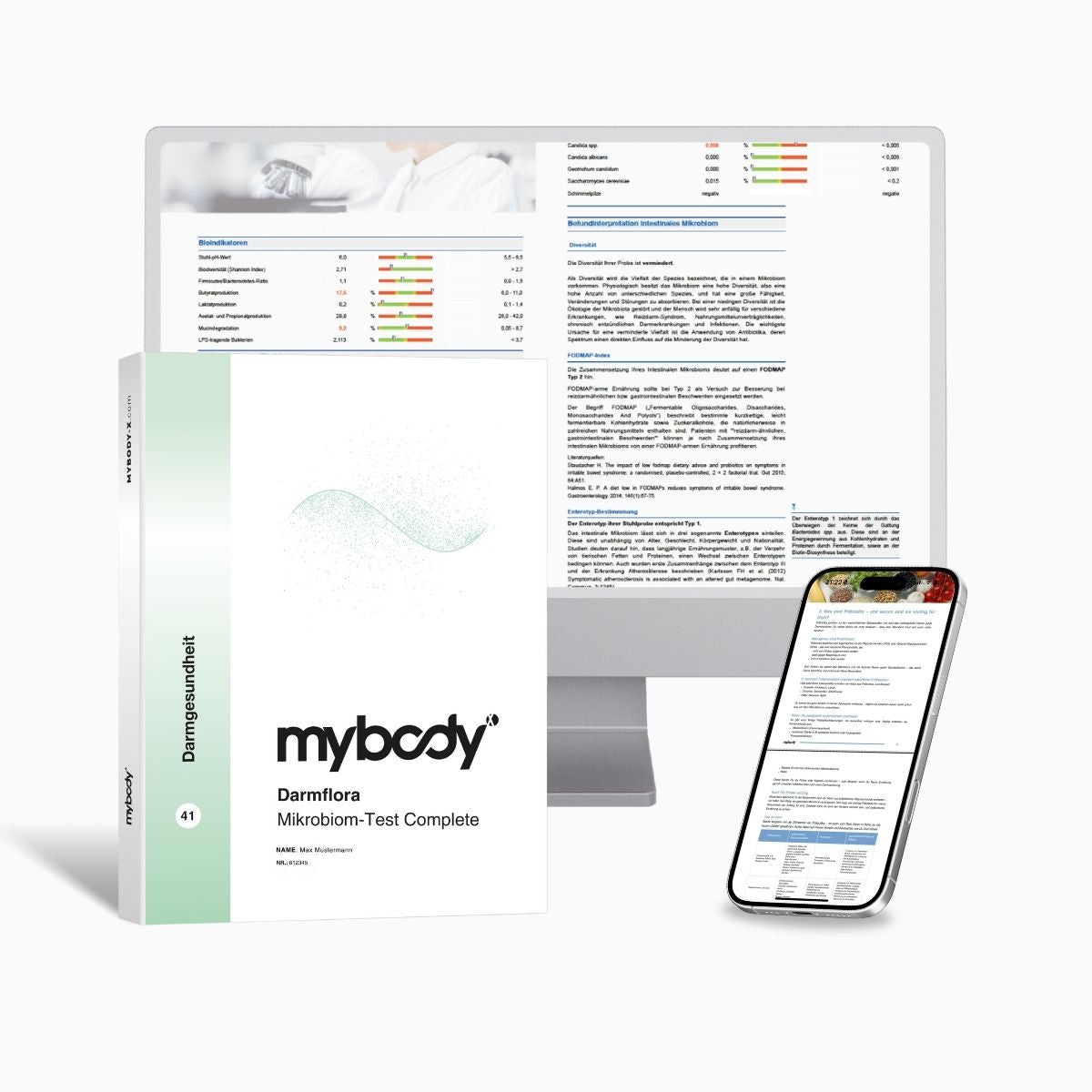
At-home stool sample
Gut microbiome test | Complete
Analysis of the gut microbiota from a stool sample as a snapshot at the time of sampling. What the test does not do: It does not provide a diagnosis, identify irritable bowel syndrome, or replace medical evaluation of warning signs.
Laboratory evaluation after receipt of the sample
Product page information, accessed 26 August 2026
Whether it is worthwhile for you depends on where you are in the sequence:
Useful for you if …
medical evaluation has taken place and found nothing unusual, but the symptoms persist.
you want to change your diet and would like to know where to start.
you are seeking a baseline after antibiotic treatment or a prolonged period of intestinal issues.
Probably not if …
one of the warning signs from the first chapter is present. In that case, medical evaluation comes first, not a self-test.
that you are hoping for a diagnosis. A microbiome analysis describes a state; it does not identify a disease.
if you have not yet kept a symptom diary. It costs nothing and often provides more information than any test.
What you should take away from this article
If you remember one thing, remember the four questions: When does it occur, how regularly, for how long, and what else accompanies it? These four details transform a vague “I feel sick after eating” into a description that can be worked with, both in the doctor’s office and on your own.
The second thought is reassuring: persistent abdominal symptoms without any abnormal findings are common. According to estimates, irritable bowel syndrome alone affects 10 to 20 out of 100 people (IQWiG, 2023). Anyone who goes home after an examination without a result is not alone and has not imagined their symptoms. It simply means that the search continues in a different direction.
And remember the order: first check for warning signs, then observe for two weeks, then seek medical evaluation, and only after that consider whether an analysis would add anything. Reversing this order is the most common and most expensive mistake when dealing with abdominal symptoms.
It started with the realization that every individual symptom has its own article, yet in the end you are no wiser. That is because the information lies not in the symptom but in the pattern. If you first want to know where you stand: the consultation is free, and it does not sell you anything.
Frequently asked questions
How can you tell that something is wrong with your gut?
It is less about an individual symptom than about the pattern: symptoms that persist for weeks, recur regularly, or permanently change bowel movements should be evaluated. The warning signs that require an immediate appointment are clear: blood in the stool, fever, unintentional weight loss, and severe or nighttime pain. Feeling unwell once after a heavy meal is different.
What does it mean if your stomach becomes distended immediately after eating?
A stomach that visibly bulges after eating is usually a gas issue, not a fat issue. If the symptoms occur about 30 minutes to two hours after eating and are accompanied by bloating and gurgling, intolerance is often suspected. This can only be confirmed through targeted evaluation, not by self-observation alone.
When is bloating a reason to see a doctor?
Bloating on its own is common and harmless. It warrants a doctor’s visit if it persists for weeks, is accompanied by pain, permanently changes bowel movements, or occurs with warning signs. The IQWiG lists weight loss, blood in the stool, fever, or paleness as signs that are more likely to indicate another intestinal disease (IQWiG, 2023).
What is the difference between intolerance and allergy?
With an allergy, the immune system reacts, often quickly and sometimes with skin or respiratory symptoms. With an intolerance, a digestive step is missing or weakened; the reaction usually remains limited to the digestive tract and depends on the amount consumed. Because the two can be evaluated differently, distinguishing between them should come first and should be handled by medical professionals.
How do I keep a symptom diary correctly?
Two weeks are enough. Each day, note what and when you ate, when symptoms occurred, and how severe they were, along with sleep, stress, and anything unusual. Important: Do not eliminate anything during this time, otherwise the pattern you want to identify will disappear. Observe first, then test or eliminate specific items, preferably in consultation with your medical practice.
Next step
When the evaluation found no results
The gut microbiome test shows the composition of your gut flora at the time of sampling. It provides a snapshot, not a diagnosis. The overview of microbiome biomarkers explains what the individual values mean.
To the gut microbiome test To the microbiome biomarkersRead more
You might also be interested in
The second table row in depth.
The first table row in depth.
Sources
- Institute for Quality and Efficiency in Health Care (IQWiG): Irritable bowel syndrome (as of 22.02.2023) – gesundheitsinformation.de
The verbatim quotation about additional symptoms that indicate another intestinal disease, as well as the information about typical symptoms and the frequency of 10 to 20 out of 100 people, comes from [1]. The classification by timing in the table is a guide and not a diagnosis; a medical examination determines the actual cause. Information about the price, sample type, and laboratory comes from mybody®x’s product page, accessed on 26.08.2026; the kit shipping processing time follows the central specification. All sources were accessed and reviewed on 26.08.2026.

mybody®x editorial & expert team
Microbiome analysis Nutritional science Laboratory diagnostics
This article was created by the mybody®x editorial and expert team. The team combines microbiome analysis, nutritional science, and laboratory diagnostics. Those who contributed to it are listed on the authors page.
Published on 26.08.2026 · Last updated on 26.08.2026
The content is intended for general information and does not replace medical advice, diagnosis, or treatment. If symptoms persist or are severe, or if any of the warning signs mentioned occur, seeking medical evaluation is the first step—not a self-test.




Share now:
What to do about diarrhea: the plan for the first 48 hours
Microbiome diversity in the report: what the value really means