
What your Vitamin D3 25-OH-D3 level really means
Do you constantly feel tired and lethargic, or do you seem to catch every infection you get? A depleted vitamin D level could be the culprit. The key measurement to find out is the 25-OH-D3 level in your blood. It's considered the gold standard because it provides an unbiased indication of how well your body's vitamin D reserves are actually replenished. With a mybody-x blood test, you can easily and reliably determine this level from the comfort of your own home.
Why 25-OH-D3 is the crucial value for your body
You've probably heard of the "sunshine vitamin" vitamin D. But vitamin D3 25-OH-D3 ? That might sound like complicated biochemistry at first. But don't worry, it's actually quite easy to understand and crucial for your well-being.
Imagine your body like a house that needs a reliable energy supply. Vitamin D is like the master switch, controlling countless important processes in the house – from your immune system to bone health. But before this switch can even work, the energy has to be stored somewhere. This is precisely where the 25-OH-D3 level comes into play.
From sunlight to the body's own storage
When sunlight – more precisely, UV-B radiation – hits your skin, an ingenious process begins: your body produces a precursor to vitamin D, called cholecalciferol (vitamin D3). However, this form is not yet ready for immediate use.
From the skin, this vitamin D3 first travels to the liver. There it is converted into a much more stable and longer-lasting storage form: 25-hydroxy vitamin D, or 25-OH-D3 for short.
This value is like the fuel gauge for your vitamin D. It doesn't show the amount currently used, but rather your total reserves that your body can draw on at any time. That's precisely why it's the most reliable marker, which is also measured by your mybody-x test.
Whenever a cell or organ – say your immune system or your bones – needs active vitamin D, it draws on this store and converts a small amount into the active hormone form (calcitriol).
Why don't we simply measure the active vitamin D?
That sounds logical at first, but it would be completely misleading. The amount of active vitamin D in the blood is extremely tightly regulated by the body. Even with an emerging deficiency, it often remains within the normal range for a long time. Your body does everything to keep this level stable – even if it has to almost completely deplete its stores (i.e., the 25-OH-D3 level) to do so.
- The 25-OH-D3 value gives you an honest and, above all, early indication of your reserves.
- It reflects your supply of sunlight and nutrition over a longer period of time, not just a snapshot.
- A low value is a clear warning sign that your body will soon no longer be able to produce enough active vitamin D to perform its functions.
Low vitamin D levels inevitably lead to a reduction in vital bodily functions. This can manifest in a wide range of symptoms, from persistent fatigue to increased susceptibility to infections. If you want to know how to replenish depleted vitamin D stores, our guide offers practical tips on how to correct a vitamin D deficiency .
With the mybody-x Vitamin D test, you can determine this crucial storage level precisely. You receive a clear, easy-to-understand evaluation that shows you where you stand – the perfect basis for taking control of your health.
How to correctly interpret your 25-OH-D3 test result
You're holding the results of your blood test and see a number with a unit like "ng/ml" or "nmol/l". At first glance, this might seem quite cryptic. But don't worry, we'll shed some light on it and explain step by step what your personal vitamin D3 25-OH-D3 level really means for your health.
Your mybody-x results are your personal compass, showing you the level of your vitamin D stores. With this knowledge, you can make informed decisions for your well-being and take control of your health.
From numbers to clarity: Understanding ng/ml and nmol/l
The two most common units for the 25-OH-D3 value are nanograms per milliliter ( ng/ml ) and nanomoles per liter ( nmol/l ). Most laboratories in Germany use nmol/l, while internationally ng/ml is often used.
Fortunately, the conversion is very easy and helps you to compare different findings:
- From ng/ml to nmol/l : Simply multiply the value by 2.5 .
- From nmol/l to ng/ml : Divide the value by 2.5 .
A practical example: A value of 40 ng/ml corresponds to 100 nmol/l (40 x 2.5). This allows you to quickly classify any value, regardless of the unit it is given in.
This simple formula is the key to correctly applying the following reference values to your result.
The following infographic shows you the path of the vitamin – from the sun via the liver to the measurable storage form in your blood.
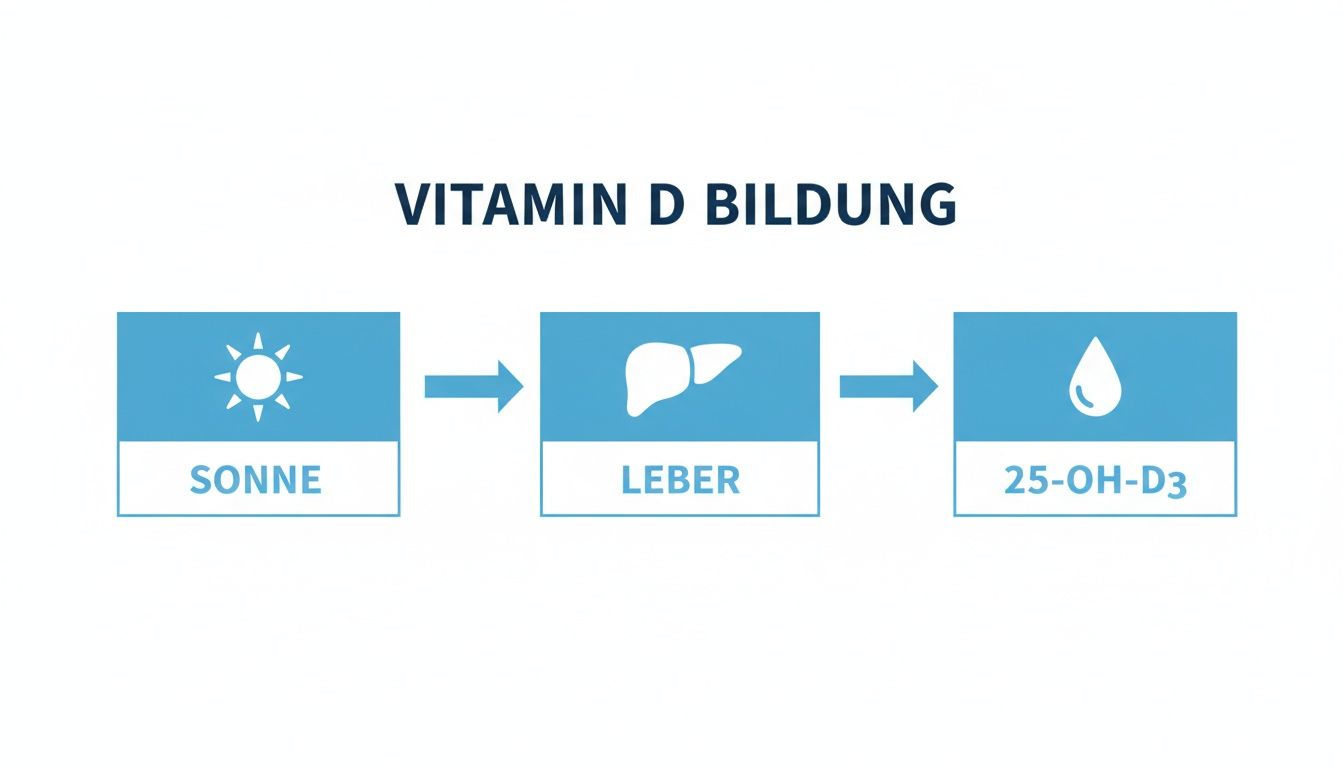
This explains why the 25-OH-D3 value, which is produced after processing in the liver, is the crucial measurement point for your vitamin D status.
Your personal value on the spectrum
A single numerical value doesn't tell the whole story. It's important to classify it according to the different levels of care, because there's a huge difference between a "sufficient" and a truly "optimal" level.
Unfortunately, vitamin D deficiency is widespread in Germany. Studies show that approximately 44% of adults have serum levels below 50 nmol/l (20 ng/ml). Official bodies, such as the German Federal Institute for Risk Assessment (BfR), define levels above 50 nmol/l as sufficient for bone health. However, a level below 30 nmol/l (<12 ng/ml) is considered a deficient level, and you should definitely take action.
Overview of Vitamin D 25-OH-D3 values
This table helps you interpret your 25-OH-D3 level in both common units (ng/ml and nmol/l) and understand your vitamin D status. This will allow you to correctly interpret the results of your mybody®x at-home vitamin D test .
| Supply status | Value in ng/ml | Value in nmol/l | Importance for your health |
|---|---|---|---|
| Severe shortage | < 10 ng/ml | < 25 nmol/l | Significant risk of bone diseases and a severely weakened immune system. |
| Shortage | 10 - 20 ng/ml | 25 - 50 nmol/l | Basic functions are impaired; fatigue, susceptibility to infection and muscle weakness are common. |
| Sufficient | 20 - 40 ng/ml | 50 - 100 nmol/l | Basic care is provided, but there is still significant potential for optimization for preventive purposes. |
| Optimal | 40 - 60 ng/ml | 100 - 150 nmol/l | The ideal target area for a strong immune system, stable bones and general well-being. |
| High | 60 - 100 ng/ml | 150 - 250 nmol/l | Generally safe, but further increase is not necessary and should be monitored. |
| Overdose | > 100 ng/ml | > 250 nmol/l | Potentially toxic area that poses health risks and should be avoided at all costs. |
The table makes it clear: A value that is just within the "sufficient" range is still far from optimal. Many preventive medicine experts recommend a target range between 40 and 60 ng/ml (100-150 nmol/l). This not only helps you avoid deficiency symptoms but also allows you to fully benefit from the health advantages of vitamin D. Your mybody-x test result provides you with the precise basis to target this optimal range.
Warning signs of a deficiency and their most common causes
A deficiency in vitamin D3 (25-OH-D3) often develops quietly. The first signs are usually so nonspecific that you quickly attribute them to stress or a demanding daily routine. But your body sends subtle signals that you should listen to in order to counteract the deficiency early on.

If some of the following points sound familiar, it might be worth taking a closer look at your vitamin D levels. A mybody-x test is your first step towards taking control and understanding the root of the problem.
You should pay attention to these body signals.
The symptoms of a vitamin D deficiency are surprisingly varied and often affect your overall energy level and immune system.
- Persistent fatigue and exhaustion: Do you often feel completely worn out in the morning, even though you've had enough sleep? A low vitamin D level can directly slow down your energy production at the cellular level.
- Increased susceptibility to infection: If you keep going from one cold to the next, your immune system may be weakened. Vitamin D is a crucial regulator of your immune system.
- Muscle weakness and joint pain: Unexplained pain in muscles and limbs or a feeling of weakness can also indicate a deficiency.
- Mood swings: A deficiency is also associated with low mood or the classic "winter blues" (seasonal affective disorder).
- Bone and back pain: Since vitamin D is essential for the absorption of calcium, persistent pain in the lower back or bones can be a clear warning sign.
If you would like to learn more about the various signs, you can find detailed information on vitamin D deficiency symptoms in our comprehensive article.
The main causes of empty memory
But how does it happen that vitamin D stores become depleted in the first place? The causes are usually a combination of lifestyle and environmental factors – and are particularly relevant in our latitudes.
The main cause of a vitamin D deficiency is quite simple: too little direct sunlight on the skin. We cover about 80–90% of our needs through the body's own production using UV-B light.
However, our modern lifestyle makes it difficult for us to get enough sun. Office work, long clothing, and the consistent use of sunscreen effectively block the necessary UV-B radiation.
Especially in Germany, geographical location is a crucial factor. From October to March , the sun is so low in the sky that UV-B rays barely reach the Earth's surface. During this long period, your body relies almost exclusively on the reserves built up during the summer – reserves that, for many people, are not optimally replenished to begin with.
Regional studies strongly support this picture. For example, studies in northern Germany showed that approximately 40–60% of the tested individuals had levels below the optimal 25-OH-D3 level of >75 nmol/l. Even more alarming: even in the height of summer, very few participants achieved values indicative of sufficient sun exposure.
Who belongs to the risk groups?
Some groups of people are naturally at higher risk of developing a deficiency. It's important to know if you belong to this group in order to take proactive steps.
- People with little sun exposure: This includes office workers, shift workers, or people who spend most of their time indoors.
- Older people: With increasing age, the skin's ability to produce vitamin D decreases by up to 75% .
- People with darker skin types: A higher melanin content in the skin acts like a natural sunscreen and significantly slows down vitamin D synthesis.
- People with chronic illnesses: Certain gastrointestinal or liver diseases can interfere with the absorption and conversion of vitamin D.
If you find yourself in one of these groups or recognize the symptoms mentioned, a mybody-x blood test offers you a simple and precise way to gain clarity about your vitamin D3 25-OH-D3 status. This allows you to take targeted action instead of remaining in the dark.
This is how an optimal vitamin D level protects your health
When you think of vitamin D, bone health probably comes to mind first. But this view is far too narrow. In fact, an optimal vitamin D3 (25-OH-D3) level is an absolute cornerstone for your overall health and vitality. It's much more than just a vitamin – it's the precursor to a vital hormone that plays a role in almost every cell in your body.
Imagine vitamin D as the conductor of a huge orchestra. Without it, the individual instruments might still play on, but the harmonious interplay is completely lost. It's the same in your body: without enough vitamin D, many fundamental processes simply don't function properly.
Far more than just strong bones
The importance of vitamin D for calcium absorption and thus for strong bones is undisputed. But its functions extend far, far beyond that. Science is providing increasing evidence of just how profoundly this hormone influences the regulation of our bodies.
- Your immune system as your personal bodyguard: Vitamin D is a key regulator of your immune system. It helps train your defenses to effectively fight pathogens, while simultaneously keeping excessive reactions – which can lead to autoimmune diseases – in check.
- Keeping inflammation under control: Silent, chronic inflammation is considered one of the main causes of many lifestyle diseases. Vitamin D plays a key role in regulating these inflammatory processes and helps to extinguish this invisible fire in the body.
- Healthy cells, healthy body: From skin to gut – vitamin D is involved in regulating cell growth and differentiation throughout the body. A good level supports the continuous renewal of cells and thus contributes to maintaining healthy tissues.
The preventive power of optimal values
A persistently low 25-OH-D3 level is not just a short-term problem, but represents a serious long-term health risk. Research in recent years has demonstrated clear links between poor vitamin D status and an increased risk of a range of chronic diseases.
This includes not only metabolic disorders, but also cardiovascular diseases and even certain neurological conditions. Therefore, optimal levels are not simply a matter of "optimization," but an active preventative strategy. It's about protecting your health in the long term and ensuring your quality of life – by giving your body the tools it needs to stay fit and resilient.
A mybody-x blood test is much more than just a snapshot in time. It's a strategic investment in your future vitality, showing you exactly where you need to focus your efforts to proactively achieve your health goals.
Long-term data also underscores the importance of adequate vitamin D levels for life expectancy. A large German cohort study found that higher 25-OH-D3 levels are associated with lower overall mortality. Model calculations even suggest that optimized vitamin D intake in Germany could prevent tens of thousands of premature deaths annually. You can learn more about these fascinating connections in the results of this German cohort study .
Your key to more energy and well-being
An optimal vitamin D level not only protects you, it also actively promotes your daily well-being. Many people report noticeably more energy, a better mood, and greater resistance to seasonal infections once their levels are within the ideal range.
Knowing your vitamin D3 (25-OH-D3) level provides you with a crucial piece of the puzzle for understanding your body. The mybody-x blood test gives you not just a precise number, but the foundation to proactively care for your long-term health and reach your full potential.
Design your path to optimal vitamin D levels
Great, you've determined your 25-OH-D3 level with the mybody-x test and now know exactly where you stand. That's the most important first step, congratulations! Now it's about specifically improving your level. This section is your personal roadmap to safely and effectively achieving and maintaining an optimal vitamin D level in the long term.
The right strategy depends entirely on your starting point. If your test revealed a significant deficiency, you'll need a different approach than someone who simply wants to maintain their already good results over the winter. Don't worry, we'll show you how.
Saturation in case of a deficiency
If your level is below 30 ng/ml (75 nmol/l), it makes sense to first properly replenish your depleted stores. This phase is also called saturation . During this time, you take a higher dose of vitamin D3 for a limited period to quickly bring your level into the normal range.
As a general rule, 1,000 IU (International Units) of vitamin D3 per day can raise the 25-OH-D3 level by about 10 ng/ml . However, this is only a rough guideline – your individual needs also depend on your body weight and your exact starting level.
- For example: Your current value is 15 ng/ml, your target is 45 ng/ml.
- The difference: You therefore need to close a gap of 30 ng/ml.
- Possible dosage: A dose of around 3,000 IU daily could bring you a big step closer to your goal.
After about three to four months, you should check your levels again with a mybody-x test. This will show you whether the saturation has been successful and you can switch to the more relaxed maintenance dose.
The maintenance dose for everyday use
Once you've reached your target level, the only remaining challenge is maintaining it. A significantly lower maintenance dose is perfectly sufficient for this. For most adults in this country, this dose is around 1,000 to 2,000 IU per day during the darker months (October to March). In summer, when you're regularly outdoors and getting sun, you can often reduce the dose or even take a break.
Important: The perfect dose is and always will be individual. Your personal Vitamin D3 25-OH-D3 test from mybody-x is the only reliable basis for tailoring your supplementation precisely to your needs. This way, you can safely avoid under- or overdosing.
The important partners of vitamin D
Vitamin D isn't a lone wolf. For it to work optimally in the body, it needs certain co-factors. Think of them as a well-coordinated team.
- Vitamin K2 (MK-7): This partner is the logistics coordinator. It ensures that the calcium you absorb in increased amounts through vitamin D actually reaches where it belongs – in bones and teeth. This prevents it from being deposited in the arteries or kidneys.
- Magnesium: Nothing works without this mineral. It is needed to convert vitamin D into its active form. A magnesium deficiency can therefore inhibit the effects of vitamin D.
When choosing your supplement, make sure it ideally already contains vitamin K2. You can easily add magnesium separately if needed.
What you should pay attention to when choosing supplements
The market for vitamin D supplements is huge. But you can quickly find your way around using these simple criteria:
- Form: Vitamin D3 (cholecalciferol) is significantly more bioavailable than vitamin D2. So always choose D3.
- Carrier substance: Vitamin D is fat-soluble. This means your body absorbs it best when it's dissolved in oil. Oil-based drops or capsules are therefore an excellent choice.
- Purity: Less is more. Choose products without unnecessary additives such as fillers, colorings, or artificial flavorings.
The following table provides an initial guideline for dosage. However, remember: your individual blood test results from your mybody-x test are crucial!
Example dosage recommendations for vitamin D3
This table provides a guideline for daily vitamin D3 intake to maintain or improve 25-OH-D3 levels. The exact dosage should always be based on individual blood test results.
| Goal | Current 25-OH-D3 value (ng/ml) | Recommended daily dose (IU) | Important instructions |
|---|---|---|---|
| Saturation | Below 20 ng/ml (severe deficiency) | 4,000 – 5,000 IU | A follow-up examination after 3 months is recommended to avoid overdosing. Combination with vitamin K2 and magnesium is crucial. |
| correction | 20 – 29 ng/ml (mild deficiency) | 2,000 – 4,000 IU | The goal is to bring the value into the optimal range of 40-60 ng/ml. Regular sun exposure can lower the requirement. |
| conservation | 30 – 60 ng/ml (optimal range) | 1,000 – 2,000 IU | This dose is ideal for the winter months. In summer, it can be paused or reduced if there is sufficient sunshine. |
| Prevention | For all those without current value | 1,000 IU | A safe base dose for adults in regions with little sunlight to prevent deficiency. However, only a test will provide certainty. |
Although supplementation is the fastest way to replenish depleted stores, diet also plays a supporting role. Learn more in our article about which food sources of vitamin D can enrich your diet.
With the knowledge from your mybody-x test and these practical tips, you are now ideally equipped to take control of your vitamin D supply.
Easily measure your 25-OH-D3 level yourself – with mybody-x
Do you finally want clarity about your vitamin D levels, but without long waiting times at the doctor's office or complicated lab visits? It's now easier than ever. With the mybody-x Vitamin D Test , you take control of your health – conveniently, discreetly, and directly from home. We'll show you how simple it all is.
Everything you need to measure your 25-OH vitamin D3 level is already included in your test kit. The entire process is so well-designed that you can complete it safely and in just a few minutes, even without prior knowledge.
This is how you easily achieve your result
In just three simple steps you can find out your vitamin D status.
- Activate & take a sample: First, activate your test kit online with your personal code. Then it's time to take the sample. Using the enclosed lancet, take a few drops of blood from your fingertip – it's really quick and barely noticeable.
- Return it free of charge: Apply your blood sample to the enclosed dried blood spot card. Place it in the pre-paid return envelope and simply drop it in the nearest mailbox.
- Get your results: Your sample goes directly to our ISO-certified German partner laboratory . There, your 25-OH-D3 level is precisely determined using state-of-the-art analytical technology.
Your result is far more than just a number. It's the key to better understanding your body and the foundation for specifically improving your health.
Your results report: more than just data
Once the analysis is complete, we will notify you by email. Your personal results report will then be available in your secure mybody-x account. We know that lab results alone often raise more questions than they answer. That's why we present your results in a way that you can understand immediately.
Here's what you can expect to find in your report:
- Your exact 25-OH-D3 level: A clear graphic shows you immediately where you stand – from deficiency to optimal supply.
- Clear explanations: We translate the lab jargon for you and explain what your value specifically means for your health.
- Personalized recommendations: You will receive specific, tailored tips on how to sustainably optimize your vitamin D levels.
With this holistic approach, you not only know your worth, but also exactly what to do next. The mybody-x test is your tool for proactively managing one of the most important markers of your well-being. This gives you valuable insights that help you specifically boost your vitality and achieve your health goals.
Your questions about the Vitamin D3 25-OH-D3 test – our answers
Finally, we'd like to answer a few frequently asked questions about vitamin D status and the 25-OH-D3 vitamin D3 test. This way, you can be well-informed and confident in dealing with this important health marker.
When is the best time of year to test my vitamin D levels?
The best time for a test is clearly at the end of winter, in February or March. After the long, dark months, the body's stores are usually at their lowest due to the lack of sunlight. A test will then give you an honest picture of whether a deficiency exists and how you should start the warmer season.
For those who want to know for sure, a second test can be done at the end of summer. This will show you how well your body was able to store the sunshine vitamin over the summer months – the perfect basis for determining your dose for the coming autumn and winter.
Do I need to stop taking vitamin D supplements before the blood test?
No, absolutely not! It's crucial that you continue taking your supplements as normal. The test is designed to show exactly how your body is being supplied under the current conditions – that is, with your current routine.
Only then can you assess whether your dose is appropriate, too low, or perhaps even too high. If you stop taking the medication beforehand, it will completely distort your results, making a meaningful recommendation impossible.
Can I meet my vitamin D needs through diet alone?
Unfortunately, this is an illusion in our latitudes. Only a handful of foods, such as fatty fish (salmon, herring), contain any significant amounts of vitamin D. To meet your daily requirement with these, you would have to eat unrealistically large portions every day.
The most important source of vitamin D for humans remains the body's own production via the skin, stimulated by sunlight. Because this source dries up in winter, for most people in Germany, testing their 25-OH-D3 levels and targeted supplementation is the safest way to get through the dark season well.
Are you ready to take control of your vitamin D levels and actively do something for your health? The mybody-x blood test provides quick and easy clarity. Order your test now and receive precise results with personalized recommendations.


Share:
The meaning of food intolerance – ways to better nutrition
What is the testosterone level? Effects on men