

Home tests: What they really do for your health
TL;DR:
- Home tests for the microbiome and DNA offer simple sample collection and digital analysis.
- They provide only a snapshot in time and are not a substitute for medical diagnoses.
- Quality and reliability vary; certifications and transparent laboratories are important.
The market for at-home health tests is growing rapidly. More and more people in Switzerland are ordering kits for microbiome or DNA analyses at home, sending in a stool or saliva sample, and expecting personalized recommendations a few weeks later. But how meaningful are these results really? At-home gut tests are booming, but experts disagree about their usefulness. This article explains how home tests work, what they can do, and where their clear limitations lie. This will help you make an informed decision about whether such a test makes sense for you.
Table of contents
- How do home tests for the microbiome and DNA work?
- What benefits do home tests really offer?
- How reliable and standardized are microbiome and DNA tests?
- Limits, risks, and health-conscious use
- A critical assessment: Home tests between innovation and illusion
- Your introduction to personalized health analysis
- Frequently asked questions about home tests
Key findings
| Point | Details |
|---|---|
| Practical, but not diagnostic tools | Home tests provide guidance for your lifestyle, but do not replace professional diagnostics. |
| Varying reliability | Results depend heavily on the laboratory and the snapshot in time; standardization is still lacking. |
| Critical use recommended | Use home tests as motivation, but always discuss the results with a doctor. |
| Look for Swiss providers | For data privacy and reliability, choose only ISO-certified or accredited Swiss laboratories. |
How do home tests for the microbiome and DNA work?
The process of a modern home test is surprisingly straightforward. You order a kit, collect a sample at home, and send it to a specialized laboratory. It sounds simple, but behind it lies a complex laboratory infrastructure.
For microbiome analyses, you use a stool sample. A small swab is fixed onto a collection medium and sent in the prepaid envelope. In the laboratory, the DNA of all bacteria in the sample is sequenced, meaning their genetic material is read. This makes it possible to determine which bacterial species live in your gut and in what proportions. The process of a microbiome test includes sample collection, shipping, sequencing, and digital analysis.
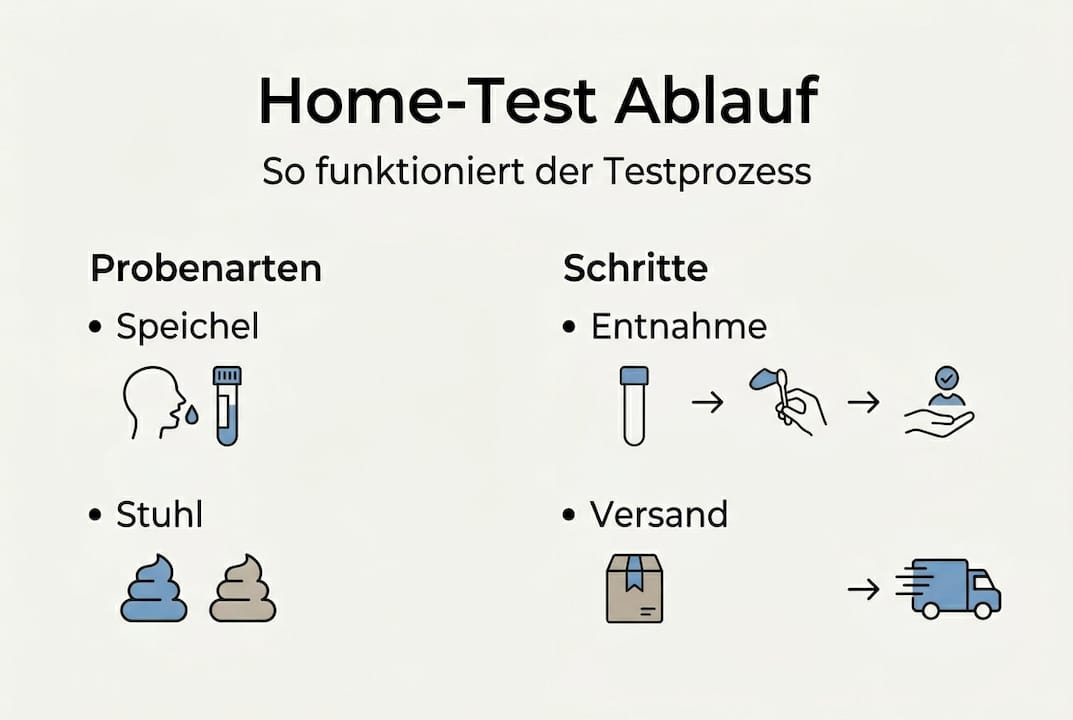
For DNA tests, a saliva sample is sufficient. You spit into a tube, seal it, and send it in. In the laboratory, specific gene variants known as SNPs (Single Nucleotide Polymorphisms) are analyzed. These variants provide insights into metabolic traits, nutrient utilization, or genetic risk factors. If you would like to learn more about the possibilities of a DNA test for nutrition, you will find a good introduction there.
The results are summarized in a digital report that covers up to 65 parameters, depending on the provider. These include information about bacterial strains, genetic variants, nutrient metabolism, and personalized dietary or lifestyle recommendations. Costs vary widely:
| Test type | Cost (CHF) | Result time | Parameters |
|---|---|---|---|
| Basic microbiome test | 100 to 250 | 10 to 14 days | 20 to 40 |
| Premium microbiome test | 250 to 600 | 14 days | up to 65 |
| DNA nutrition test | 150 to 400 | 14 to 21 days | 30 to 50 |
| Combined package | 500 to 2,500 | 14 to 28 days | over 80 |
The analysis is based on comparing your sample with large reference databases. It statistically determines how your microbiome or genetic variants compare with those of other people. The result is therefore always relative, not an absolute measure of health.
This is how a typical at-home microbiome test works, step by step:
- Order the kit and read the sample collection instructions
- Collect the sample (stool or saliva)
- Send the sample in the enclosed envelope
- Wait for the laboratory analysis (usually 14 days)
- Receive a digital report with recommendations
- Discuss results with a specialist or through app-based consultation
Pro tip: When choosing a provider, look for ISO certification or Swiss laboratory accreditation. Only certified laboratories guarantee reproducible results and secure handling of your data.
What benefits do home tests really offer?
The honest answer: It depends heavily on what you expect from a home test. Anyone hoping to receive a medical diagnosis will be disappointed. Those seeking guidance for their lifestyle, on the other hand, may well benefit.
Home tests provide a snapshot. They show which bacteria live in your gut or which genetic variants you carry. What they cannot do is diagnose a disease, recommend a treatment, or replace a medical examination. The limited predictive value of genetic tests is well documented in the medical community, as is the risk of overinterpretation.
Nevertheless, there are real benefits. Many people report that a test result motivated them to change their diet or eat more fiber. This motivational effect is real, even if it is not based on a medical diagnosis. For example, a genetic nutrition test can show whether you process lactose or certain fatty acids less efficiently, encouraging targeted dietary adjustments.
| Aspect | Advantage | Limitation |
|---|---|---|
| Motivation | Promotes behavioral changes | Effect may diminish |
| Data volume | Many parameters can be measured | Complex interpretation |
| Accessibility | Conveniently from home | No medical context |
| Personalization | Individual recommendations | Based on statistics, not diagnosis |
| Cost | Wide price range | High costs for premium tests |
The most important areas of application are:
- Lifestyle optimization: Diet, sleep, stress management
- Preventive curiosity: Identify potential weaknesses at an early stage
- Motivational boost: Concrete data to drive behavioral changes
- Complement to medical care: Additional information you can discuss with your doctor
“Home tests should be seen as a starting point for a health-conscious lifestyle, not as an endpoint. Combining them with a healthy lifestyle remains crucial.” Lifestyle combination recommendation
In short: Home tests are neither a miracle cure nor nonsense. They are a tool. And like any tool, they only deliver value when used correctly.
How reliable and standardized are microbiome and DNA tests?
This is where things become critical. The reliability of home tests is one of the most controversial topics in the healthcare industry. And the facts are sobering.
To date, there is no Europe-wide or Swiss standard for microbiome reference values. This means that what Laboratory A defines as a “healthy microbiome” may differ significantly from the standards used by Laboratory B. Studies show substantial discrepancies in results for identical test material sent to different laboratories. This is not a marginal issue, but a structural quality problem affecting the market as a whole.
In addition, the microbiome is dynamic. It changes daily depending on what you eat, how you sleep, whether you exercise, or whether you take antibiotics. A snapshot can therefore show a completely different picture just a few weeks later. This makes monitoring over time useful, but also expensive.
| Quality characteristic | Meaning | Market status |
|---|---|---|
| ISO certification | Standardized laboratory processes | Only available from a few providers |
| CE-IVD marking | Medical device approval | Usually not available |
| Reference database | Basis for comparison in evaluation | Varies in size and validity |
| Reproducibility | Same sample, same result | Often not guaranteed |
The market is nevertheless growing rapidly: 16 percent growth by 2032 is forecast for the home testing sector. This demonstrates the enormous interest, but also shows that commercial interests often grow faster than scientific standards.
If you are considering a microbiome test, pay attention to the following points:
- Is the laboratory ISO-certified or accredited according to Swiss standards?
- Is the analytical method used communicated transparently?
- Is there a clear privacy policy and compliance with the GDPR?
- Are samples destroyed after analysis or used for other purposes?
- Does the provider offer personal advice or medical interpretation?
These five questions distinguish reputable providers from those primarily capitalizing on the hype. Providers who cannot give clear answers should be avoided.
Limits, risks, and health-conscious use
As appealing as the idea of having your body analyzed by mail may sound, there are clear limits you should know before ordering.
The greatest risk is misinterpretation. A report telling you that you have “low levels of Bifidobacteria” sounds alarming. But without medical interpretation, you do not know whether this is clinically relevant or simply a normal variation. Microbiologists and guidelines explicitly advise against using home tests as diagnostic tools. Anyone who relies on a home test instead of seeing a doctor when experiencing symptoms risks overlooking genuine illnesses.
Further risks at a glance:
- Data protection: Genetic data is highly sensitive. Not all providers guarantee that samples will be destroyed after analysis.
- Regulatory gaps: Many microbiome tests are not approved medical devices. Advertising with health claims often operates in a legal grey area.
- Uncertainty: “Abnormal” values without medical interpretation can cause unnecessary anxiety.
- Self-treatment: Anyone who starts experimenting uncontrollably with probiotics, dietary supplements, or diets based on a test result can harm their body.
- No Swissmedic approval: Most home tests are not approved as medical devices in Switzerland.
A step-by-step guide can help you find the right provider and interpret the results correctly.
Pro tip: Use home tests as a basis for discussion with your doctor or dietitian, not as the sole basis for making decisions. Print out the report and discuss any abnormal values at your next consultation.
The smart approach is: curiosity, yes; panic, no. Home tests can be a helpful starting point. But they are no substitute for regular medical check-ups, a balanced diet, and an active lifestyle.
A critical assessment: Home tests between innovation and illusion
After all the facts, it is time for an honest look. Home tests are neither a miracle cure nor a scam. They are a mirror of our time: We want control over our health, we want data, and we want answers immediately. That is understandable.
But this is where the real danger lies. Too many people buy a test, receive a report, and believe they have optimized their health as a result. They have not. The test is the starting point, not the destination.
Our honest assessment: The real game changers for your health are regular exercise, genuine dietary changes, and medical guidance. No matter how sophisticated a DNA profile is, it cannot replace the decision to take a 20-minute walk tomorrow morning. Home tests can support and reinforce that decision. But they cannot replace it. Those who understand this use these tools correctly.
Your introduction to personalized health analysis
If this article has made you curious about home tests, take the right approach. Choose a certified provider that communicates transparently, uses ISO-accredited laboratories, and protects your data. At mybody-x, you will find tested analyses for the microbiome, DNA, and metabolism, accompanied by easy-to-understand reports and personal advice. Instead of blindly trusting glossy promises, you get scientifically sound foundations for your next step. Whether you start with a simple gut flora analysis or choose a comprehensive DNA package right away, the most important step is to begin informed.
Frequently asked questions about home tests
How long does it take to receive the result of a microbiome home test?
After the sample arrives at the laboratory, you will receive the result within 14 days. Some providers deliver results faster, while more complex packages may take a little longer.
Can I use home tests for self-diagnosis?
No. Home tests are not approved diagnostic tools and do not replace a medical examination. Microbiome tests do not provide recognized medical guidance; use them only as a guide.
What risks are associated with at-home DNA and microbiome analyses?
The biggest risks are misinterpretation, uncertainty, and data privacy issues. Results can vary considerably between laboratories, which is why you should always choose certified providers.
Who can benefit from home tests?
They are suitable for health-conscious and curious people who want to optimize their lifestyle. If you have symptoms or receive unusual results, use them as a guide, but always consult a doctor.



Share now:
Healthy Gut, Healthy Person: The Guide to Your Well-Being in 2026
What allergies are there? Symptoms, diagnosis, and help