
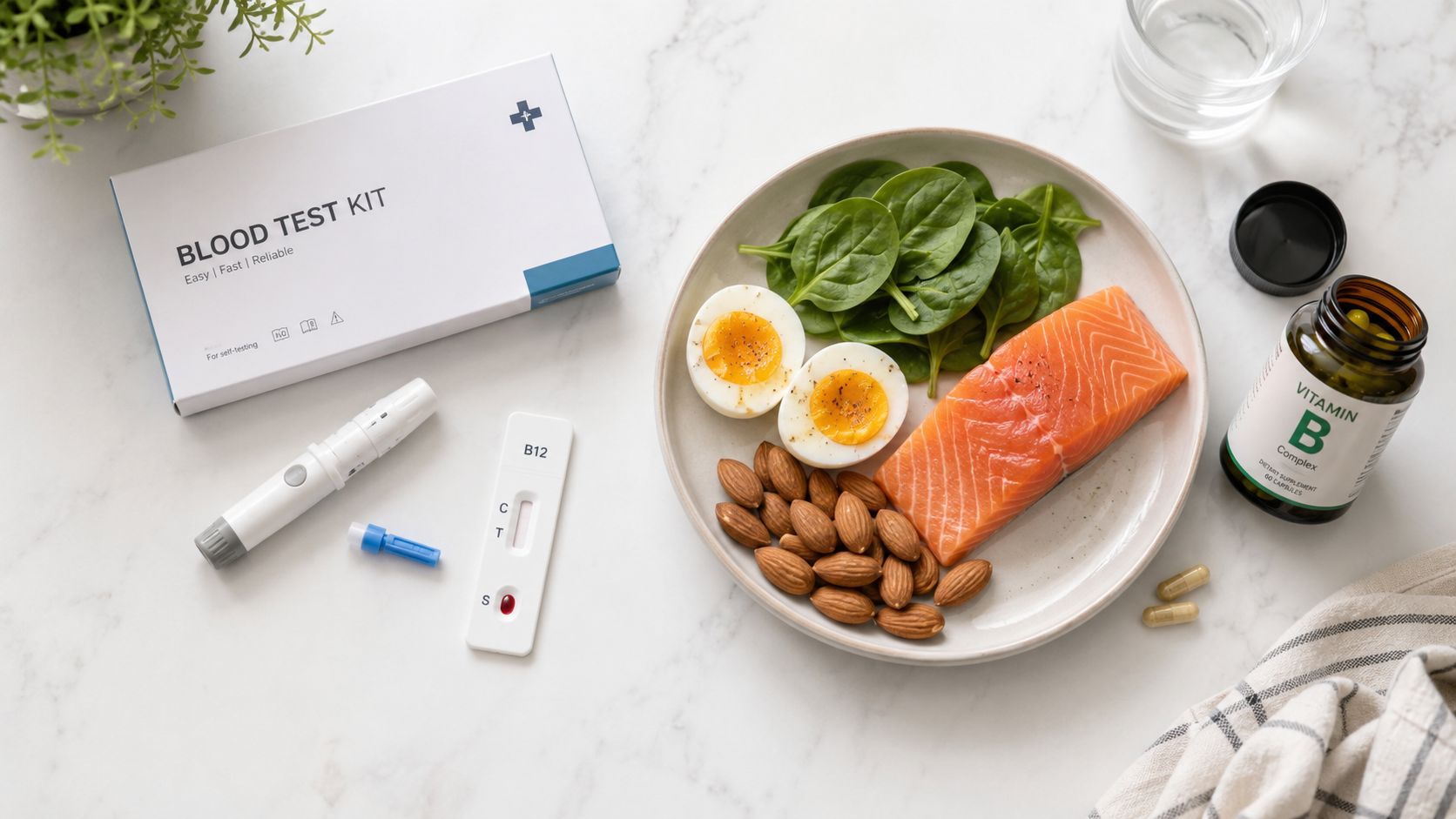
Recognize and effectively address vitamin B deficiency
You actually get enough sleep. Even so, you drag yourself through the day, your head feels foggy, and even simple tasks take more effort than they used to. Perhaps you blame it on stress, too little exercise, or a busy schedule. That is understandable. But sometimes there is something very specific behind this kind of exhaustion.
A vitamin B deficiency is one of the causes that is often overlooked—precisely because the symptoms seem so everyday. Fatigue, concentration problems, irritability, or a strange tingling in your hands and feet initially seem nonspecific. But your body does not send signals without reason. When important B vitamins are lacking, energy production, nerve function, and cell formation fall out of balance.
Constantly tired and unable to concentrate? Your energy battery could be empty
Many people know this state: You are still functioning, but you no longer feel truly capable. In the morning, it is hard to get going; in the afternoon, your concentration drops; and in the evening, you are exhausted but not refreshed. This is not simply a “bad spell.”
B vitamins work behind the scenes in many processes you need every day. They help your body convert food into usable energy. They support the nerves, brain, and formation of blood cells. When something is missing at this point, you often do not initially notice it as a clear deficiency, but rather as a vague change in everyday life.
When symptoms suddenly seem “normal”
What makes a vitamin B deficiency particularly insidious is that it can develop gradually. You get used to having less energy. You become more impatient, forget little things, or need more coffee to get through the day. Many people consider this normal, even though the body has been sending signals for some time.
A good example is a young vegan woman from the mybody®x practice. She complained of chronic fatigue and concentration problems. Testing showed vitamin B12 at 145 pg/ml and vitamin B9 at 3 ng/ml, both at critical levels. After 10 weeks of targeted supplementation with methylcobalamin and active folate, both levels returned to normal, and her energy improved significantly.
Symptoms such as fatigue or brain fog are not proof of a deficiency. But they are a good reason to take a closer look.
Why nerves and mood can also be affected
Vitamin B12 in particular plays an important role in the nervous system. A severe deficiency can lead to irreversible neurological symptoms such as polyneuropathy, cognitive impairment, and dementia, as described by NDR in its overview of vitamin B12 deficiency and neurological effects.
This explains why a vitamin B deficiency does not only make you “tired.” Some people report inner restlessness, poor memory, or tingling sensations rather than classic exhaustion. If you recognize yourself in this, it is worth taking a clear-eyed look at possible causes instead of continuing to guess.
The B vitamins as a team for your energy and nerves
B vitamins do not act like individual soloists. They work more like a well-coordinated team. Each has its own task, but the body’s engine only runs smoothly when they work together.
The overview makes this easier to understand:

Three team members that raise questions particularly often
Vitamin B12 is the best-known B vitamin for many people. It is essential for blood formation and nerve function. That is why a deficiency can cause not only fatigue but also tingling, forgetfulness, or other neurological symptoms.
Vitamin B9, usually known as folic acid, supports the formation of new cells. It is especially important during life stages with increased requirements, such as when trying to conceive, during pregnancy, or while breastfeeding.
Vitamin B6 helps, among other things, where your body processes proteins and produces important messenger substances for the nerves and mood. If there is a deficiency, fatigue, irritability, or concentration problems may become noticeable.
Why a single deficiency rarely occurs entirely on its own
With a severely restricted food selection or an unbalanced diet, you do not always see just one isolated deficiency. According to mybody®x, a combination of low B12, B9, and B2 levels occurs more often than average in people following a purely plant-based diet without supplementation.
This is important for putting things into perspective. If you focus on just one vitamin, it is easy to miss the bigger picture. That is why it makes sense to view B-vitamin status as a pattern rather than as an isolated puzzle.
How much B12 is actually needed
For adults, the estimated value for an adequate vitamin B12 intake is 4.0 µg per day. For pregnant women, the requirement rises to 4.5 µg, and for breastfeeding women to 5.5 µg, as summarized by Apotheken Umschau in its article on vitamin B12 and the recommended intake.
There is a second point to consider alongside your diet: absorption is not the same as intake. Even if you consume enough on paper, your body may still not be optimally supplied in everyday life.
Key takeaway: B vitamins do not provide “instant energy” like caffeine. They enable your body to properly produce energy in the first place.
If a confirmed deficiency is present, a product such as Vitamin B Complex | Energize may be appropriate to consider. According to the product description, it provides all 8 B vitamins in an optimal dosage for energy, the nervous system, and metabolism, and is specifically mentioned for confirmed B deficiency in a blood or DNA test.
Typical symptoms and who is particularly at risk
Vitamin B deficiency rarely presents with a single clear warning sign. It is often a combination of physical and mental changes. The signs vary somewhat depending on which vitamin is affected.
The following overview can help you put things into perspective:

Which symptoms may fit which pattern
| Symptom | Possible classification |
|---|---|
| Tiredness and exhaustion | often a focus in B12 deficiency |
| Concentration problems | can be associated with B12 or B9 |
| Tingling in the hands or feet | typical when B12 is involved |
| Mood swings | can be associated with several B vitamins |
| Paleness | possible with disorders of blood formation |
This classification does not replace medical diagnosis. However, it can help you avoid dismissing nonspecific symptoms too quickly.
These groups should be especially attentive
Vitamin B12 deficiency is widespread in Germany. One in ten people is affected, and among those over 65, it is even one in four. In addition, neurological symptoms, which occur first in two thirds of cases, are often overlooked or misattributed. NDR describes this in its article on vitamin B12 deficiency and typical warning signs.
You should be especially attentive if any of these points apply to you:
- Vegan or vegetarian diet. Vitamin B12 is found almost exclusively in animal-based foods.
- Age over 50 or 60. Absorption can become more difficult with age.
- Women of childbearing age. Folic acid plays an important role in cell formation.
- Sports with high energy expenditure. According to mybody®x, B6 is more commonly an issue in this context.
- Medication or digestive problems. Both can interfere with nutrient absorption.
Not everything is automatically a B vitamin deficiency
Other nutrients can also contribute to similar symptoms. If, for example, another deficiency is also confirmed, other supplements may be considered depending on the findings, such as Vitamin D3 K2 Complex | Shield. According to the product description, it combines high-dose D3 with K2 to support calcium utilization, bone health, and the immune system, and is intended for use after DNA or blood testing has confirmed a deficiency.
That is precisely why it is so important not to interpret symptoms based on feelings alone. A pattern may point to a B vitamin deficiency. Measurement is what brings clarity.
Certainty instead of guessing—the path to clarity with a test
People who notice fatigue, brain fog, or tingling often reach for some supplement first. That is understandable, but it is not always sensible. The same symptoms can have very different causes. Without testing, you are treating a suspicion rather than the actual finding.
That is why a test is the clearest starting point. You get more than a gut feeling—you get a concrete value.

Why guessing often leads in the wrong direction
An example makes this clear. One person with fatigue buys any multivitamin. Another drinks more coffee. A third tries getting more sleep. This may help in the short term—or not at all. But none of these strategies answers the real question: Are you actually deficient in vitamin B12, B9, or B6, or is something else going on?
A data-based perspective saves detours. This is especially important with B12 because symptoms do not always begin with blood formation but often affect the nervous system.
When symptoms are vague, a test is not a luxury. It is the shortcut to a sensible decision.
How a home test works in practice
For many people, the hurdle is lower when they do not have to arrange an appointment right away. A home test usually involves taking a small blood sample from the fingertip. The sample is then sent to a laboratory, and you receive a results report that you can understand.
If you want to check your status at home, the at-home vitamin B test from mybody®x offers a way to assess your vitamin B status based on data. This is particularly useful if you have been observing symptoms for some time but still do not have a clear direction.
A real example instead of speculation
The 27-year-old vegan in the case study clearly illustrates why measuring is better than guessing. Before the test, there was only fatigue and difficulty concentrating to go on. The results revealed that both B12 and B9 were critically low. This made it possible to choose supplementation strategically instead of taking something at random.
That is precisely where the difference lies. A test does not merely tell you that you feel unwell. It shows you where to start.
Your result is here—now what?
A lab result is only the beginning. What matters is what you do with it. Many people see “too low” or “borderline” and do not know whether dietary changes, a supplement, or medical assessment is appropriate.
A simple approach helps: low levels require a clear response, unremarkable levels generally call for monitoring, and abnormal combinations deserve more attention than isolated minor abnormalities.
What you can do after an abnormal B-vitamin result
There are three practical levers:
-
Review your diet
If you significantly reduce or completely avoid animal-based foods, B12 is particularly important. In that case, “I actually eat healthily” is often not enough to ensure adequate intake. -
Choose supplementation strategically
A broad-spectrum B-complex can be useful when multiple B vitamins are involved. This is especially appropriate when your test shows a pattern rather than just a single abnormal result. -
Take severe deficiencies seriously
In cases of clinically manifest vitamin B12 deficiency, low-dose products from drugstores are often not sufficient. According to the international expert consensus, oral doses of 1,000 to 2,000 µg per day are necessary for treatment. Lower-dose dietary supplements are often inadequate for this purpose, as Springer Medizin explains in its overview of therapeutic doses for vitamin B12 deficiency.
How to interpret your results meaningfully
| Test results | Appropriate response |
|---|---|
| A single slightly low level | Review your diet and monitor your progress |
| Multiple B-vitamin levels abnormal | Targeted supplementation and a follow-up check |
| Significantly low B12 level with symptoms | Have it properly assessed by a doctor or therapist |
Rule of thumb: The more clearly your symptoms and lab results align, the more decisive your response should be.
That was precisely the point in the practical example mentioned above. The combination of fatigue, concentration problems, and abnormal B12 and B9 levels called for targeted correction rather than waiting. Afterwards, the person’s wellbeing did not simply improve “somehow.” The levels returned to normal, making the measure understandable as well.
When you should not simply experiment on your own
If neurological symptoms also occur, such as tingling, numbness, or noticeable cognitive changes, you should not treat them solely as a lifestyle issue. They require serious medical evaluation. A test can be the starting point, but in the presence of significant symptoms it does not replace medical assessment.
Staying adequately supplied in the long term: prevention and monitoring
Correcting a deficiency is good. More important is ensuring that it does not quietly return. This is especially easy to overlook with vitamin B12. Although average intake in Germany is generally adequate, 8% of men and 26% of women do not reach the recommended daily intake, as sport-checkup.de summarizes in its article on risk groups for vitamin B12 deficiency.
This shows that average values do not automatically protect you. Your personal situation is what matters.
Diet as the daily foundation
There is a simple rule for B vitamins in everyday life: the more varied your diet, the more stable your nutritional intake usually is.
The following are particularly helpful:
- Animal sources of B12 such as meat, fish, eggs, and dairy products
- Green vegetables and legumes for folate
- Nuts, seeds, whole-grain products, and protein sources as sources of other B vitamins
With a vegan diet, ongoing B12 supplementation is not optional but necessary. This is because vitamin B12 is found mainly in animal-based foods.
Monitoring instead of hope
mybody®x recommends a follow-up test every 6 to 12 months for monitoring, especially with a vegan or vegetarian diet. Since the body stores B12 for months, an annual check is often sufficient to take early corrective action.
If you generally want to understand which nutrients can be monitored regularly, the overview on testing for micronutrients is a useful next step.
Good prevention does not mean constantly thinking about deficiencies. Good prevention means not having to wait for symptoms.
Frequently asked questions about vitamin B deficiency
Can B vitamins also be overdosed?
Yes, this is possible. For vitamin B12, the German Federal Institute for Risk Assessment advises that no more than 25 µg per daily dose should be taken through food supplements. At the same time, this limit does not apply to the treatment of a confirmed deficiency. In that case, different, significantly higher dosages apply under professional guidance.
So the distinction between general supplementation and targeted treatment is important. Simply taking “more” is not a good strategy.
Are all vitamin B complexes the same?
No. A supplement may contain many B vitamins and still not meet your needs. What matters is whether a deficiency has actually been confirmed, whether only one vitamin or several levels are affected, and whether prevention or targeted correction is needed.
Especially with symptoms related to energy, nerves, or resilience, it may be helpful to pay additional attention to individual connections. You can find out more in the article about vitamin B6 deficiency symptoms.
How quickly do symptoms improve?
This depends heavily on how severe the deficiency is, how long it has existed, and whether the chosen measure is really appropriate. Some people notice relatively soon after starting targeted correction that their energy and concentration return. Nerve-related symptoms can be more persistent.
That is why monitoring is so valuable. It is not just how you feel that matters, but also whether your levels are actually moving in the right direction.
Is diet alone always enough?
Not always. With a vegan diet, B12 needs to be supplemented on an ongoing basis. As you get older, absorption can become more difficult. And if a significant deficiency already exists, a good diet alone is often not enough to replenish stores quickly enough.
What you need then is a clear plan involving testing, targeted supplementation, and monitoring.
If you want to stop interpreting symptoms and start categorizing them, a mybody x blood test is a sensible first step. You get a data-based foundation instead of continuing to act on suspicion, and can tailor your diet, supplementation, and next steps to your results.



Share now:
Muscle weakness—what to do? Find the causes and build strength
Selenium and the Thyroid: Your Guide to Optimal Levels