

Food intolerance self-test: Find out what's really good for you
With a self-test for food intolerances from mybody-x, you can conveniently find out from home which foods might be causing problems for your body. You take a tiny blood sample yourself, send it to our certified partner laboratory, and we analyze your IgG4 antibodies. This gives you valuable clues to finally get to the bottom of unclear symptoms such as bloating, abdominal pain, or skin problems and to better understand your body.
Learn to understand your body's signals
Does this sound familiar? You often feel unwell after eating, struggle with bloating, vague abdominal pain, or your skin reacts badly. You suspect certain foods are to blame, but you have no idea where to start looking.
You're definitely not alone. Many people struggle with these symptoms and are completely in the dark. This constant guesswork isn't just frustrating, it also limits your quality of life. But there is a way to regain control over your well-being and take an active role in your recovery.

A problem that affects more and more people.
Food intolerances are no longer a fringe issue. Their prevalence has been increasing in Germany for years. Studies show that more and more people are affected, often with everyday foods like cow's milk, wheat, or eggs being the triggers. If you'd like to delve deeper into the topic, you can find further information on food intolerances at imd-berlin.de .
This development highlights the importance of paying closer attention to our body's signals. Often, these are just small, subtle reactions that we simply overlook in the stress of everyday life, but which can accumulate over time into chronic ailments.
The first step towards greater clarity
A self-test for food intolerances from mybody-x is your easy starting point. Instead of continuing to grope in the dark, you receive a scientifically sound laboratory analysis. The test helps you specifically with:
- Identifying suspect foods: Find out which foods might be responsible for your symptoms.
- To end uncertainty: Get clear clues instead of torturing yourself with assumptions.
- To take targeted action: Use your results as a roadmap for a conscious change in your diet and feel for yourself how your well-being improves.
A self-test is of course no substitute for a medical diagnosis in cases of serious symptoms. However, see it as a powerful tool to take responsibility for your own well-being. It provides you with the data you need to make informed decisions about your health.
This guide will walk you through the entire process. We'll explain exactly how the intolerance test works, what the results really mean, and—most importantly—how you can practically integrate this knowledge into your daily life. You'll see: It's easier than you think to regain control and finally feel completely well again.
Intolerance and allergy – what is the actual difference?
Before you get to the bottom of things with a self-test for food intolerances , we have to overcome a very important hurdle: the difference between an intolerance and a true allergy. In everyday language, we often use these terms interchangeably, but for your body, they are two completely different things.
With a food intolerance , your body has difficulty properly processing a specific food component. It lacks the necessary tool, usually an enzyme. The classic example is lactose intolerance. Here, the enzyme lactase, needed to break down lactose (milk sugar), is missing. While the consequences are often extremely unpleasant, they are generally not life-threatening and often only appear hours later.
The immune system's response
A food allergy is a completely different story. Here, your immune system sounds the alarm. It mistakenly classifies a harmless substance – let's say a peanut protein – as a dangerous invader and immediately launches a massive defense reaction.
Here are the most important differences, so you never confuse them again:
- The culprit: In the case of an intolerance, it's your metabolism that's malfunctioning. In the case of an allergy, it's your immune system that's overreacting.
- Timing is crucial: Symptoms of an intolerance, such as bloating, diarrhea, or headaches, often appear with a delay – sometimes only after hours or even days. An allergic reaction (skin rash, swelling, shortness of breath) usually occurs immediately or within minutes.
- The dose: A small amount of the trigger is often tolerated in cases of intolerance. In the case of an allergy, even tiny traces can trigger a severe reaction.
To help you better visualize the differences, here's a brief overview:
Intolerance vs. Allergy at a Glance
This table shows the main differences between a food intolerance and a true food allergy, in order to avoid typical confusion.
| feature | Food intolerance | Food allergy |
|---|---|---|
| Participating system | Metabolism (often enzyme deficiency) | Immune system (IgE antibodies) |
| reaction time | Delayed (minutes to days) | Immediately (seconds to minutes) |
| Symptoms | Mostly in the digestive tract (flatulence, diarrhea), headaches | Skin rash, swelling, shortness of breath, anaphylactic shock |
| Amount of trigger | Small amounts are often tolerable | Even the smallest traces can trigger reactions. |
| Danger | Unpleasant, but usually not life-threatening | It can be life-threatening. |
This distinction is truly crucial, because it determines which path is right for you.
While severe allergic reactions always require immediate medical attention, intolerances are often the silent cause of chronic symptoms. If you suspect you might have a genuine allergy, you can read our guide on how to perform an allergy test yourself .
The mybody-x intolerance test examines the so-called IgG4 antibodies very closely. If these are elevated, it can be a sign that your body reacts to certain foods with a delayed immune response – a typical characteristic of many intolerances.
A self-test for food intolerances is therefore the perfect first step to uncovering these insidious reactions. It helps you find the foods that are secretly burdening your system and sabotaging your well-being. This way, you regain control and can adjust your diet accordingly to finally feel energized and completely well again.
This is how easy the at-home intolerance test works.
Does a medical test sound like a lot of work and complicated steps to you? Don't worry! The mybody-x self-test for food intolerances is designed to be incredibly easy and safe to perform in the comfort of your own home. You don't need any prior knowledge – we'll guide you through the entire process, from start to finish.
The whole system is designed so that you can take control of your own health. No doctor's appointment or long wait required. Everything you need is already waiting for you in your personal test kit.
From ordering to the little prick
It all starts with your order. As soon as the mybody-x test kit arrives at your home, you can basically get started right away. The kit contains everything you need for the test – from easy-to-understand instructions to the lancets for the small finger prick.
The most important part is the blood draw. That might sound worse than it is. With a tiny, almost painless lancet, you simply take a few drops of blood from your fingertip. That's all there is to it!
Don't worry: You only need a tiny amount of blood. The whole process is quick, hygienic, and designed to be as comfortable as possible. Simply follow the enclosed step-by-step instructions.
Your sample on its way to the lab – explained in a child's play
After you have taken your sample, pack it securely in the enclosed return envelope. It is already prepaid for you, so there are no additional costs.
Simply drop the envelope off at your nearest post office, and your sample will be on its way to our certified partner laboratory in Germany. There, our experts will take care of the analysis. The entire process is designed to offer you maximum convenience with minimal effort.
Here you can see the process again at a glance:
- Order your test kit: Your personal set will be delivered directly to your home.
- Taking a sample: With a small prick of the finger, you obtain a few drops of blood.
- Pack securely: Place the sample in the prepared return envelope.
- Free shipping: You take the envelope to the post office – we've already covered the postage.
Want to know more? In our guide, we explain exactly how you can perform a blood test yourself and give you additional tips to ensure everything goes smoothly during sample collection.
As you can see, the self-test for food intolerances is designed to be as simple as possible. We provide you with a tool that allows you to take an active role and take the first, crucial step towards greater well-being – all from the comfort of your own home.
What your blood reveals about your diet
Once you've sent your sample on its way, the really exciting part begins. What happens behind the scenes? We'll lift the veil and take you on a short journey into the science behind the mybody-x self-test for food intolerances .
Imagine your blood as an open book about your diet. Every time you eat, your body comes into contact with countless proteins from your food. Normally, this is completely unproblematic. Sometimes, however, your immune system classifies certain proteins as "foreign" and goes into defense mode – not with a loud, immediate allergic reaction, but rather with a silent, delayed defense.
IgG4 antibodies as important messenger substances
And this is precisely where IgG4 antibodies come into play. These are specialized protein molecules of your immune system. An elevated concentration of IgG4 antibodies against certain foods can be a strong indication that your body is reacting excessively to those specific foods.
In our certified partner laboratory, your blood sample is analyzed specifically for these antibodies. Using state-of-the-art analytical methods, we measure how strongly your blood reacts to hundreds of different food proteins. A high concentration doesn't automatically mean you can never eat that food again. But it's a clear signal from your body that there might be a connection to your symptoms.
This constant immune response can lead to low-grade inflammation in the body, which builds up over weeks and months. These processes are often the root cause of typical, diffuse symptoms such as digestive problems, fatigue, or skin blemishes.
The IgG4 test is like a detective searching for the traces that certain foods leave in your body. It provides you with a scientifically sound map that shows you where you should take a closer look.
The following graphic shows you how straightforward the process is from placing your order to having it analyzed in the laboratory.
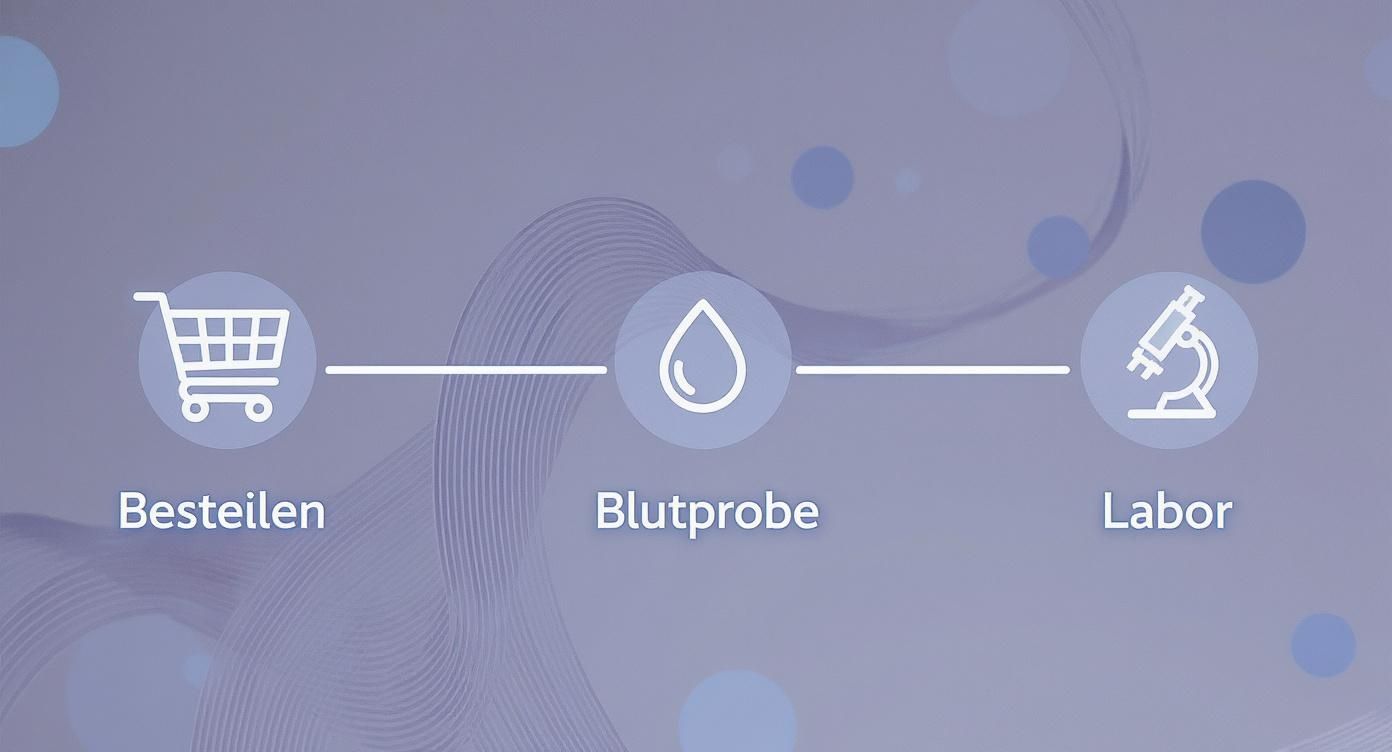
As you can see, the process is designed to make getting started as easy as possible for you, while a highly precise laboratory analysis works for you in the background.
More than just detecting intolerances
Your blood is a true treasure trove of information and can reveal so much more. Besides intolerances, nutrient deficiencies can also lead to very similar, nonspecific symptoms. So, if you want a complete picture of what's going on in your body, a suitable blood test from mybody-x can be extremely insightful. In our blog post, you can learn more about how a detailed nutrient analysis from the blood works.
Knowing how your body reacts to certain foods is the first and most important step towards improvement. It frees you from endless guesswork and allows you to finally make targeted and informed dietary choices. Your test result is therefore not the end, but the beginning of your journey to a completely new sense of well-being.
Putting your test results into practice
The moment has arrived: You're finally holding your personal results report in your hands. After a few days of waiting, you now have it in black and white which foods trigger an increased IgG4 response in your body. But what does that actually mean for you?
Consider this result your very own starting point for a more conscious diet. It's not about giving up everything you enjoy eating from now on. Rather, it's an invitation to consciously relieve stress on your body, to learn about your personal triggers, and to find your balance again in the long term.

Interpreting the results correctly
Your mybody-x report not only lists the foods that cause you to notice a reaction, but also shows you how strongly your body reacts to them. These levels serve as your initial guide. A strong reaction is a clear indication that you should completely eliminate that food from your diet for the time being. With weaker reactions, it can often be enough to significantly reduce your consumption.
Many people are surprised by how many of their everyday ailments stem from such unnoticed reactions. Symptoms are often mistakenly interpreted as allergies, but true allergies are less common than you might think. According to official surveys, only about 4 percent of Germans suffer from a confirmed food allergy, while the number of those who react to certain foods is around 30 percent . Your IgG4 test helps you bridge this gap between perceived reaction and immunological cause. You can find more information on this topic in the publications of the German Federal Institute for Risk Assessment (BfR ).
Your test result is not a lifelong list of forbidden foods. It's a tool that helps you calm and readjust your system for a specific period of time.
The start of your elimination diet
The next logical step is the so-called elimination diet . That might sound strict, but it really isn't. Basically, it's just about completely eliminating all the foods to which your body reacts strongly, according to a test, for a manageable period of four to six weeks.
This phase has two unbeatable advantages:
- Your body gets a break: By avoiding potential irritants, you give your immune system and your gut the chance to recover and rest.
- You become an observer: You'll quickly notice whether your symptoms, such as bloating, skin problems, or constant fatigue, improve. This direct feedback is incredibly motivating!
After this elimination phase, you begin to consciously reintroduce the avoided foods one at a time, with a few days in between. This allows you to pinpoint which food is actually responsible for your symptoms. This process is key to sustainably and individually tailoring your diet to your needs.
To make getting started as easy as possible, we've prepared a detailed guide for you. In our article, you'll learn how to optimize your diet after receiving your test results . There you'll find specific tips and instructions for making the necessary changes. Think of this phase as an exciting experiment where you learn to better interpret your body's signals and take control of your well-being.
Your questions – our answers to the self-test
You probably still have a few questions swirling around in your head. That's perfectly normal! To wrap things up, we want to answer the most common ones so you know exactly where you stand and can make an informed decision about your health.
The desire to take control of one's own health is growing. It's no wonder, then, that self-tests for food intolerances are becoming increasingly popular in Germany. The 25- to 34-year-old age group, in particular, is very interested in tailoring their diet to their individual needs and thus improving their well-being. You can learn more about this trend from our colleagues at accio.com .
How reliable is such a self-test?
This is probably the most important question of all. This isn't about guesswork or general assumptions. The mybody-x intolerance test sends your blood sample to our certified partner laboratory in Germany, where it is analyzed for IgG4 antibodies . You will therefore receive a scientifically sound evaluation.
This test gives you very precise indications of which foods your immune system reacts to. Consider it the crucial first step in finding out which foods could become "troublemakers" for you personally.
Very important: A self-test never replaces a doctor's diagnosis in cases of acute or severe symptoms. However, it is an excellent, data-based foundation for starting a targeted dietary change and finally getting to the bottom of the causes of vague symptoms.
Who is the test intended for?
The self-test for food intolerance is perfect for you if you repeatedly suffer from symptoms that you cannot explain – and have the feeling that it could be due to the food.
Maybe you know this feeling?
- Persistent digestive problems such as bloating, loud stomach rumbling, or the feeling of irritable bowel syndrome.
- Skin problems that just won't go away, such as blemishes, redness, or eczema.
- Persistent fatigue and lack of energy, even though you get enough sleep.
- Recurring headaches or migraines without any apparent cause
However, this test is not suitable for diagnosing true food allergies (Type I, IgE-based) or celiac disease. If you suspect you have a severe allergy with immediate reactions such as shortness of breath or swelling, please see a doctor immediately!
And what happens after the test?
Of course, we won't leave you alone with the results. You'll receive a detailed report that explains everything simply and clearly. At a glance, you'll see which of the tested foods caused your body to react with elevated IgG4 levels – and also how strong the reaction was.
With this knowledge, you can get started right away. The report provides you with concrete recommendations on how to begin an elimination or rotation diet. You eliminate the identified foods for a while and observe what happens. This way, you become an expert on your own body and regain control.
Are you ready to put an end to the guesswork and finally get clarity? With a mybody-x blood test, you have a scientifically sound tool at your fingertips to manage your own health. Discover the right mybody-x blood test for you now and embark on a new journey towards well-being.



Share:
At-home blood test: Real users' experiences
Understanding and correctly using blood intolerance tests