

Prolactin: what affects the level and what can shift it
The essentials at a glance
Prolactin is a hormone produced by the pituitary gland. It is known from breastfeeding, but it also appears on hormone test results outside that context because it can affect the menstrual cycle.
The most important point for everyday life is the range. The MSD Manual, professional edition, states that a prolactin level between 50 and 100 ng/ml is considered slightly elevated and is generally caused by the use of a medication (as of September 2025).
You will first read a fact check of three widespread statements. This is followed by the hormone’s function, the evidence-based classification of slightly elevated levels, the medications on the list of possible causes, a comparison of the ranges, the conditions of the sample, and the limitations of a single measurement.
What to expect in this article
1. Three statements about prolactin in a fact check
2. What prolactin does in the body
3. The range that occurs most often
4. Which medications are on the list of possible causes
5. What indicates a significantly elevated level
6. Comparing the ranges
7. The conditions under which it is measured
8. Prolactin and the menstrual cycle
9. Who may benefit from testing
10. What a capillary blood test can show here
11. Limitations: what the level does not answer
12. What matters about the prolactin level
Frequently asked questions
Sources
Three statements about prolactin in a fact check
Three statements appear almost every time a prolactin level shows up on a test result. All three can be checked against the available evidence, and they are deliberately placed at the beginning.
Checked against the available evidence
Widespread
“Elevated prolactin means a tumor.”
Verified
A level between 50 and 100 ng/ml is considered slightly elevated and is generally caused by a medication (MSD Manual, professional edition, as of September 2025). For a prolactin-producing pituitary adenoma, levels are typically described as more than five times higher than normal (as of June 2025).
Widespread
“Prolactin is only relevant for people who are breastfeeding.”
Verified
Prolactin is one of the levels usually measured when menstruation stops, to help distinguish between possible causes (as of September 2025). Symptoms of estrogen deficiency and loss of libido have also been described (as of June 2025).
Widespread
“Prolactin only affects women.”
Verified
Men with prolactin-producing pituitary tumors typically have headaches or vision problems, and about two-thirds report loss of libido and erectile dysfunction (as of June 2025). That is why the level appears on hormone test results for both sexes.
The first point is the most important because it concerns the most common worry. A slightly elevated level and a level associated with a prolactinoma are in completely different ranges.
What prolactin does in the body
Prolactin is produced in the pituitary gland. Its best-known function is stimulating milk production, which is also where its name comes from.
For laboratory diagnostics outside the breastfeeding period, a second characteristic is crucial. Persistently elevated prolactin interferes with the regulatory feedback loop that controls the menstrual cycle.
The MSD Manual, professional edition, states that women with galactorrhea—that is, milk discharge outside the breastfeeding period—often also have amenorrhea or oligomenorrhea (as of June 2025). Amenorrhea means absent menstruation; oligomenorrhea means infrequent menstruation.
That connection explains precisely why the level is considered when evaluating menstrual-cycle issues. It describes one possible cause that can be distinguished from the others.
Why a single result causes so much concern here
Prolactin has a special characteristic among hormone levels. Anyone who searches for the name online reaches a tumor of the pituitary gland within a few clicks.
This is not misinformation; it is a matter of sequence. A prolactinoma is the most medically significant cause, but it is also not the most common explanation for a mildly elevated level.
That is why this article presents the order of magnitude before the disease overview. Anyone who knows which range corresponds to which explanation can read their own test result more calmly.
What this interpretation explicitly does not do: It does not replace a medical evaluation. If symptoms occur as well, the recommendation in this article remains unchanged: consult a doctor.
The range that occurs most often
When interpreting a test result, there is one sentence that alleviates more worry than any reassurance could.
Documented source
“A prolactin level of 50–100 ng/mL is considered mildly elevated and is usually due to the use of a medication.”
MSD Manual, professional edition
Amenorrhea, “Blood tests” section, as of September 2025
“As a rule” means in most cases, not always. The statement does not replace a medical evaluation; it changes the order in which possibilities are investigated.
Anyone with a result in this range first looks at the medication list. Only afterward are the rarer explanations considered, and this order comes from the source—not from a desire to offer reassurance.
Which medications appear on the list of causes
The MSD Manual lists the drug classes associated with hyperprolactinemia (as of June 2025). The list is longer than most people expect.
The antihypertensive drugs listed include alpha-methyldopa, atenolol, clonidine, labetalol, and verapamil. They are joined by H2 antagonists, oral contraceptives and estrogens, opioids, and psychotropic drugs such as metoclopramide, haloperidol, and phenothiazines.
What follows from this list—and what does not
The list leads to a practical step: Every medication should be written on the note that accompanies the test results. That includes anything you assume has nothing to do with hormones.
What this explicitly does not mean is stopping or switching medication. A blood pressure medication, stomach medication, or psychotropic drug should not be changed because of a laboratory result; that decision belongs exclusively in a medical practice.
It is noteworthy that oral contraceptives and estrogens appear on the same list. For many women, this means one of the most common explanations is already part of everyday life, without this necessarily causing a problem.
How to compile the list effectively
A useful medication list contains more than the names. For each medication, include the dosage and how long you have been taking it.
This also includes things many people do not consider medication: remedies for heartburn, painkillers, sleeping pills, hormonal contraception, and anything prescribed temporarily.
The easiest way is to take a photo of the packages. It takes two minutes and is more reliable in a consultation than trying to remember similar-sounding names.
This list is the main contribution you can make regarding your own test result. The laboratory value comes from the lab; the explanation often comes from your medicine cabinet.
Signs of a significantly elevated level
Significantly elevated prolactin is associated with documented signs, which differ between the sexes.
Slightly elevated usually means medication. Significantly elevated means a different order of magnitude.
In women, the MSD Manual describes galactorrhea, often accompanied by amenorrhea or oligomenorrhea and symptoms of estrogen deficiency, including pain during intercourse and reduced libido (as of June 2025).
In men, headaches or visual disturbances are listed as typical symptoms, and about two-thirds of those affected report loss of libido and erectile dysfunction (as of June 2025).
For diagnosis, the following applies: suspicion of a prolactin-producing pituitary adenoma is based on elevated prolactin levels that are typically more than five times as high as normal, and the method of choice for identifying it is magnetic resonance imaging with contrast medium (as of June 2025). Both belong in a medical practice and cannot be replaced by any self-test.
The orders of magnitude in comparison
Three situations can occur with a prolactin test result. The table compares them using the same four criteria.
| Criterion | Within the reference range | Slightly elevated | Significantly elevated |
|---|---|---|---|
| Documented information | No generally applicable figure in the sources reviewed; the range in your own test result is decisive | 50 to 100 ng/ml | With a prolactinoma, typically more than five times as high as normal |
| Most common explanation | No abnormality in this value | Usually, the use of a medication | This requires medical evaluation; specific procedures are provided for this purpose |
| Next step | Check other explanations, such as the thyroid | Review your medication list and discuss it with the findings in hand | Have it evaluated by a doctor promptly |
| What a self-test contributes | A baseline value with a date for later comparison | A reason to systematically compile the medications | Nothing for diagnostic clarification; the procedures mentioned belong in a medical practice |
The first line deliberately contains a blank. We found no figure for a universally applicable normal range in the sources reviewed, so no estimate is given there.
Why the unit on the report matters
Several units are commonly used for prolactin. The figure of 50 to 100 cited in the medical literature refers to nanograms per milliliter, while other laboratories use milli-international units per liter.
This leads to a common confusion. The same blood sample can appear as a two-digit or three-digit number, depending on which unit is shown next to it.
That is why what IQWiG generally states is especially important here: The relevant reference range is the one shown on your own laboratory report, and reference values can vary from one laboratory to another (as of April 2, 2025).
In practical terms: Always compare your value with the range on the same report, never with a number from a forum. And for tracking over time, using the same provider is the simpler choice.
Conditions under which the measurement is taken
Prolactin is one of the hormones for which the sample conditions are taken into account. The Institute for Quality and Efficiency in Health Care states the general rule: Many hormone levels change significantly over the course of the day, and the time of day when blood is drawn matters (as of April 2, 2025).
In practical terms: measure in the morning, while at rest, and record the time to the minute. A hectic morning is a poor time for measurement here too.
The reference range is another factor. It can vary from one laboratory to another, and the relevant range is always the one shown on your own laboratory report (as of April 2, 2025). This is particularly important for prolactin because different units are commonly used.
Prolactin and the cycle
Unlike FSH or estradiol, prolactin is not associated with a fixed cycle day in the sources reviewed. It appears there as one of the values measured when menstruation is absent (MSD Manual, professional edition, as of September 2025).
Even so, the cycle day belongs on the note. If prolactin is measured together with cycle-dependent values, the appointment will follow the stricter window anyway.
How this window works and how the cycle day is counted is covered in the companion article Hormone Levels and the Correct Cycle Day. This article focuses on the value itself.
The second obvious question when menstrual-cycle changes occur concerns the thyroid. TSH is also cited in the same source as a value measured to rule out thyroid disease (as of September 2025).
Who may benefit from testing
Prolactin is not a value for every routine examination. The comparison makes that clear in both directions.
Useful for you if …
Your menstrual cycle has changed and you want to check the obvious explanations one by one.
You are having a hormone profile tested anyway. Prolactin is usually included and does not require an extra step.
You take several medications and want to establish a baseline against which future results can be compared.
You want to bring figures and a medication list to a consultation.
Not recommended if …
Headaches or visual disturbances have developed. This requires prompt medical attention, not a self-test.
Milk discharge occurs outside the breastfeeding period. This should also be medically evaluated.
You want to infer from the value whether a prolactinoma is present. Magnetic resonance imaging is the method of choice for this.
You are considering stopping a medication because of the value. This decision must be made exclusively by a medical practice.
What a capillary blood test can show here
A capillary blood self-test does not provide a diagnosis and does not detect a prolactinoma. It provides a single time-point value that should be interpreted together with your medication list.
Two tests from mybody®x (MYBODY Lab GmbH) handle this value differently. What they do and do not measure is explained in the cards.
Capillary blood test
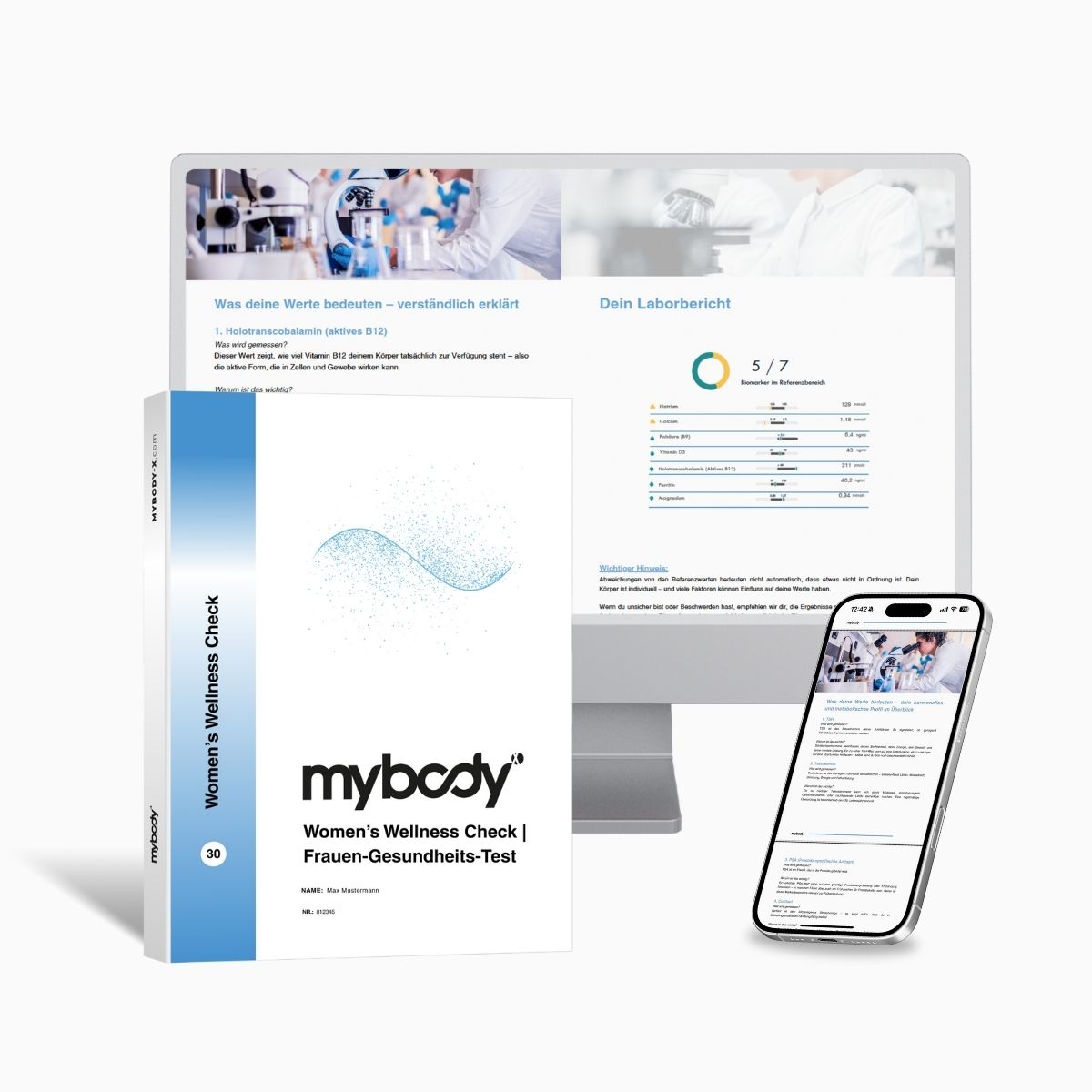
Women’s Wellness Check | Women’s Health Test
Measures 18 values, including prolactin, together with a complete thyroid profile consisting of TSH, fT3, and fT4. This puts the second obvious explanation for menstrual-cycle changes in the same report. It also includes SHBG, cortisol, ferritin, vitamin B12, long-term blood sugar, and a cholesterol profile. What the test does not do: it measures neither FSH nor LH nor estradiol, does not detect a prolactinoma, and does not replace medical evaluation.
Laboratory analysis 3–5 business days after sample receipt
Product page information, accessed 13 August 2026
Capillary blood test
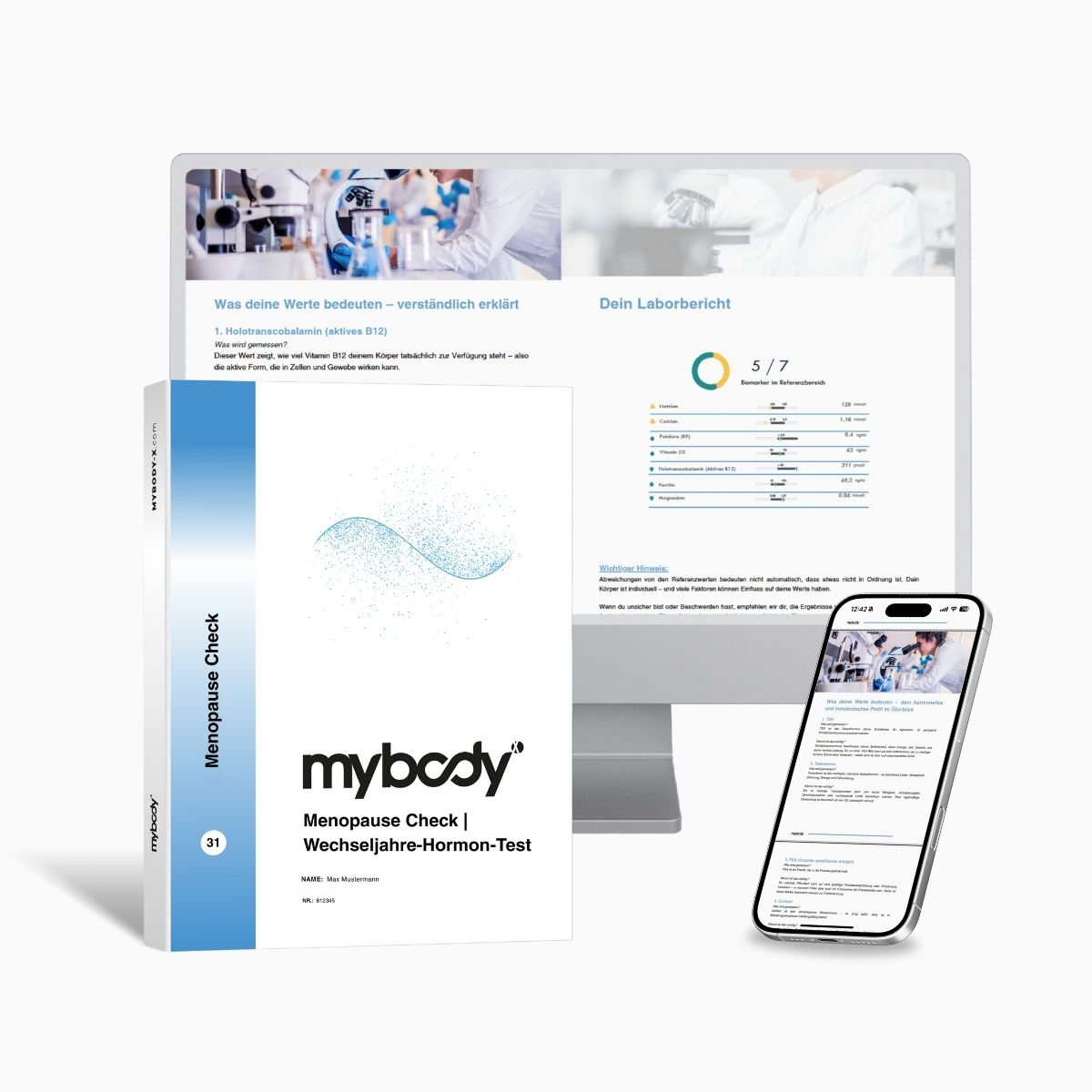
Menopause Check | Menopause Hormone Test
Measures 8 values: estradiol, FSH, LH, progesterone, SHBG, TSH, testosterone, and DHEA-S. This covers the menstrual-cycle question for which prolactin is one of the possible distinguishing factors. What the test does not do: it does not measure prolactin. It is not the right test for this one value, and it does not provide a diagnosis.
Laboratory analysis 3–5 business days after sample receipt
Product page information, accessed 13 August 2026
Four points determine whether a measurement becomes useful information.
List medications
A slightly elevated level is generally caused by a medication.
Measure in the morning and at rest
Many hormone levels change significantly over the course of the day.
Check the unit
Several units are commonly used for prolactin; your own test result is decisive.
Discuss anything unusual
Levels, medication lists, and symptoms belong together in a medical practice.
Chapter at a glance
A capillary blood self-test provides a single-point prolactin measurement and does not detect a prolactinoma. Its value lies in providing the level together with the thyroid profile, because both are interpreted together when cycle changes occur. Four points are crucial: list medications, measure in the morning and at rest, check the unit, and discuss anything unusual.
Limitations: what the level does not answer
The first limitation is attribution. A slightly elevated level is generally caused by a medication, but the level does not indicate which one.
The second limitation concerns further evaluation. For suspected prolactin-producing pituitary adenoma, magnetic resonance imaging with contrast medium is the method of choice (MSD Manual, professional edition, current as of June 2025). No blood test can replace this procedure.
The third limitation is a gap in the sources. We found no information on a universally applicable reference range. That is why the text gives no number, and the reference range provided by the evaluating laboratory remains decisive.
The fourth limitation is that it is a snapshot. A single-point measurement describes one morning. Only a second measurement under the same conditions shows whether anything has changed.
What matters for the prolactin level
If you take away one action from this article, let it be this: Write down every medication and supplement you have taken in recent weeks, and bring the list with your test result.
The reason is stated in the source itself. A level between 50 and 100 ng/ml is considered slightly elevated and is generally caused by a medication. Without the list, the most common explanation is missing.
It began with the question of what the level affects. The answer is the menstrual cycle, and indirectly, well-being too. And what shifts the level itself is, in most cases, found in your own medicine cabinet.
The objection is understandable: an article about a hormone level may ultimately lead to a list of medications. That is precisely what the evidence shows, and in this case it is good news: the most common explanation is one that can be identified.
This does not mean that every case can be dismissed. Headaches, visual disturbances, and milk discharge outside of breastfeeding should be evaluated by a doctor promptly, regardless of what a result shows.
Frequently asked questions
What does mildly elevated prolactin mean?
The MSD Manual, Professional Edition, states that a prolactin level between 50 and 100 ng/ml is considered mildly elevated and is generally caused by the use of a medication (as of September 2025). The first step is therefore to review the medication list. The reference range in your own laboratory report remains decisive for interpretation.
Which medications increase prolactin levels?
The MSD Manual lists the blood pressure medications alpha-methyldopa, atenolol, clonidine, labetalol, and verapamil, as well as H2 antagonists, oral contraceptives and estrogens, opioids, and psychotropic drugs such as metoclopramide, haloperidol, and phenothiazines (as of June 2025). This list does not imply that any medication should be stopped: Medication decisions must be made exclusively by a doctor.
When is a prolactinoma suspected?
The diagnosis of a prolactin-producing pituitary adenoma is based on elevated prolactin levels, which are typically more than five times the normal level (MSD Manual, as of June 2025). This is a markedly different range from a mildly elevated result. The preferred method for identifying it is magnetic resonance imaging with contrast medium, and this evaluation belongs in a medical practice.
What symptoms are associated with it?
Women with galactorrhea often also have amenorrhea or oligomenorrhea, along with symptoms of estrogen deficiency, including pain during intercourse and reduced libido. Men typically have headaches or visual disturbances, and about two-thirds report loss of libido and erectile dysfunction (MSD Manual, as of June 2025). Headaches, visual disturbances, and milk discharge outside of breastfeeding should be evaluated by a doctor promptly.
Does prolactin need to be measured on a specific day of the cycle?
The sources reviewed do not specify a fixed day of the cycle for prolactin; they list it as one of the values measured when menstruation is absent (MSD Manual, as of September 2025). If it is measured together with FSH or estradiol, the appointment should be scheduled according to their respective windows. As for the time of day: Many hormone levels fluctuate considerably over the course of the day (IQWiG, as of April 2, 2025), so measure in the morning and note the time.
Next step
The list comes first, then the result
If you want to interpret prolactin together with a thyroid panel, the Women’s Wellness Check measures both from capillary blood. It does not detect a prolactinoma, provide a diagnosis, or replace medical evaluation.
View the Women’s Wellness Check View the Menopause CheckRead more
You might also be interested in
When the sample should be taken if several hormones are being measured.
The second explanation when the cycle changes.
Sources
- MSD Manual, Professional Edition: Amenorrhea (as of September 2025) – msdmanuals.com
- MSD Manual, Professional Edition: Prolactinoma, Carmichael JD (as of June 2025) – msdmanuals.com
- Institute for Quality and Efficiency in Health Care (IQWiG): Understanding Laboratory Values Correctly, as of 2 April 2025 – gesundheitsinformation.de
The verbatim quotation about slightly elevated prolactin levels between 50 and 100 ng/ml, as well as the mention of prolactin and TSH among the blood tests for absent menstruation, come from source [1]. The description of galactorrhea together with amenorrhea or oligomenorrhea, the symptoms of estrogen deficiency, the symptoms in men with the two-thirds figure, the list of medication groups, the statement that values in prolactinomas are typically more than five times higher, and magnetic resonance imaging with contrast medium as the method of choice come from [2]. The statement about daily fluctuations in hormone levels, the note on the importance of the time of sample collection, and the information about differences between laboratories come from [3]. We found no reliable figure for a generally applicable reference range for prolactin in the sources reviewed; therefore, none is provided in the text. Information on prices, values, sample type, and laboratory comes from mybody®x product pages, accessed on 13 August 2026; processing times follow the central guidelines for blood tests. All sources were accessed and reviewed on 13 August 2026.

mybody®x Editorial & Expert Team
Laboratory diagnostics Blood analysis interpretation Nutritional science Nutrigenetics
This article was created by the mybody®x editorial and expert team. The team combines laboratory diagnostics, nutritional science, and the interpretation of blood analyses. Everyone who contributes to it is listed on the authors’ page.
Published on 13 August 2026 · Last updated on 13 August 2026
The content is intended for general information and does not replace medical advice, diagnosis, or treatment. Reference ranges depend on the laboratory, method, and age; the information on your test report is always authoritative.




Share now:
Perimenopause: Which hormone levels change first
Recognizing prediabetes: which values matter