

Recognizing prediabetes: which values matter
The key points at a glance
Prediabetes is not a distinct disease with its own symptoms, but a range of numerical values. The MSD Manual, Professional Edition, puts it this way: Prediabetes is diagnosed when glucose levels fall between the normal range and the range diagnostic of diabetes (as of December 2025).
Three methods define this range, and they produce different figures: fasting plasma glucose, the oral glucose tolerance test, and the long-term blood sugar measure HbA1c.
You will first read what the term refers to. Then come the figures for the three methods, who the medical literature says should be screened, the question of deciding whether to test, a comparison of the methods, and the limitations of a single value. This article provides context and does not recommend for or against testing. That decision belongs in a medical practice.
What to expect in this article
1. What the term refers to
2. Why the condition remains unnoticed for a long time
3. Three methods, three numerical ranges
4. The limits of the intermediate range in numbers
5. Who is tested according to the medical literature
6. What a single value in the intermediate range indicates
7. What the sources say about the further course
8. Who may benefit from testing
9. Risk factors from the source
10. Comparing the three methods
11. What a capillary blood test can show here
12. Limitations: what remains unresolved
13. What matters about the intermediate range
Frequently asked questions
Sources
What the term refers to
The word prediabetes sounds like a preliminary stage that inevitably progresses into something else. The definition is more matter-of-fact.
Prediabetes is diagnosed when glucose levels fall between the normal range and the range diagnostic of diabetes (MSD Manual, Professional Edition, as of December 2025).
The term therefore describes a position between two thresholds, not a disease with its own set of symptoms. In the criteria table from the same source, the same range is called impaired glucose metabolism.
Why the condition remains unnoticed for a long time
The defining characteristic of this range appears in a short sentence, and it explains why it is discussed at all.
Documented source
“It can exist for many years before the actual onset of diabetes. It is associated with an increased risk of cardiovascular disease.”
American Diabetes Association Professional Practice Committee
MSD Manual, Professional Edition, Type 2 Diabetes Mellitus, as of December 2025
There are two statements in this sentence, and they carry different weight. The first concerns time; the second, an association.
Many years means that the range can be measured over a long period without anyone noticing. There is no symptom indicating it, so it is detected through numerical values—or not at all.
Associated means that there is a statistical relationship with cardiovascular disease. A relationship is different from a cause, and the source deliberately uses cautious wording here.
Three methods, three numerical ranges
Because the range is defined by numerical values, everything depends on the method used for measurement. The three are shown side by side in the criteria table.
Fasting plasma glucose measures a point in time after several hours without eating. The oral glucose tolerance test measures the level two hours after a defined amount of sugar. And HbA1c describes an average over approximately three months.
The three tests can lead to different classifications in the same person. This is not a contradiction, but a consequence of the fact that they measure different things.
Why different results are to be expected
An example makes this clear, and it is expressly a calculation example rather than a real-world clinical case. Someone has a fasting glucose level in the normal range and an HbA1c in the intermediate range.
This is not a contradiction. One value describes a morning under defined conditions, while the other represents an average over several months that also includes the time after meals.
The reverse is also true. An elevated fasting value with an unremarkable long-term value may be due to a single morning not meeting the required conditions.
In practice, this means that a medical practice decides which method is appropriate for your situation and whether several methods make sense. A self-test cannot make this selection.
The intermediate-range thresholds in numbers
Three values from the same source, all in milligrams per deciliter.
Established thresholds in milligrams per deciliter
100–125
Fasting plasma glucose in the intermediate range, corresponding to 5.6 to 6.9 mmol/L (MSD Manual, professional edition, as of December 2025)
140–199
Two-hour glucose tolerance test in the intermediate range, corresponding to 7.7 to 11.0 mmol/L (as of December 2025)
200 or higher
Two-hour glucose tolerance test as a diabetes criterion, corresponding to 11.1 mmol/L or higher (as of December 2025)
For HbA1c, the intermediate range is 5.7 to 6.4 percent, corresponding to 39 to 46 mmol/mol, and the diabetes threshold is 6.5 percent (as of December 2025). This value is given in a different unit and therefore does not appear in the same row.
As with any laboratory value, the decisive factor is the reference range stated on your own test report, because reference ranges may vary from one laboratory to another (IQWiG, as of April 2, 2025).
Who the professional literature says should be tested
The professional literature specifies who should be tested and how often. This information is provided here for information only and is expressly not a recommendation from this article.
People aged 35 and over, as well as all adults with one or more risk factors, should be screened for diabetes at least once every three years (MSD Manual, professional edition, as of December 2025).
You decide together with your doctor whether and when such a test is appropriate for you. A blog article does not make this decision, and a self-test does not replace it.
What a single result in the intermediate range tells you
This is where most misunderstandings arise. A result in the intermediate range is neither a diagnosis nor a prediction.
Prediabetes is a range of numbers between two thresholds, not a set of symptoms.
A reference range does not describe a boundary between healthy and ill. IQWiG explains how it is established: The limits are set so that 95 percent of results fall within the range, while 5 percent of people have results outside it even though they are healthy (as of April 2, 2025).
The interfering factors of the respective method also play a role. For HbA1c, they relate to the red blood cells; for fasting glucose, to the conditions of the sample.
The implication is therefore always the same: A single result in the intermediate range is a reason for a discussion in which it is interpreted together with medical history, age, and other results.
What a result just above the threshold means
The most common situation in practice is a result that just exceeds the lower limit of the intermediate range. For example, an HbA1c of 5.8 percent or a fasting glucose level of 102 mg/dL.
Such results regularly cause more concern than they warrant. Thresholds in laboratory medicine are agreed-upon cutoffs, not abrupt changes in the body, and a result just above them differs little from one just below.
Every method also has measurement uncertainty. The same sample can produce slightly different figures in two tests, and near a threshold, this difference determines the classification.
That is precisely why, when a result is near a threshold, repeating the measurement comes before interpreting it. A medical practice decides whether and when this is appropriate.
What the sources say about the subsequent course
The medical literature contains information on what happens to a result in the intermediate range. It is included here as a documented source and explicitly not as advice from this article.
The MSD Manual, Professional Edition, states that reducing initial body weight by just 7 percent, combined with moderate physical activity, can reduce the incidence of diabetes in high-risk individuals by more than 50 percent (as of December 2025).
Three limitations belong to this figure so that it does not promise more than it says. It applies to high-risk individuals, it describes a reduction in incidence and not a guarantee, and it comes from a medical context.
What this means for you personally is decided in a medical practice, not in a blog article. This text deliberately makes no recommendation about weight, diet, or physical activity.
Who may benefit from a measurement
The comparison refers to long-term blood sugar because that is the value a capillary blood self-test can provide.
Useful for you if …
You have never had your long-term blood sugar measured and want to establish a baseline value with a date.
You want to bring a number that appears in the criteria to a consultation at a medical practice.
You want to interpret the value together with other measures, such as the lipid profile and CRP.
You want to compare the result with a second value in a few months.
Rather not, if …
You expect a diagnosis or for one to be ruled out. A self-test can do neither.
Unusual thirst, frequent urination, or unintentional weight loss has developed. This should be addressed promptly at a medical practice.
Anemia, a hemoglobinopathy, or pregnancy is present. In that case, interpretation of the long-term value is limited.
Diabetes is already known. In that case, treatment is managed by a medical practice.
Risk factors from the source
The professional literature identifies factors that warrant testing regardless of age. This list is also provided here for information only.
These include, among other things, overweight or obesity with a body mass index above 25 kg/m², or above 23 kg/m² in people of Asian ancestry, as well as physical inactivity and a family history of type 2 diabetes mellitus (MSD Manual, professional edition, as of December 2025).
This list is not an assessment of individuals and is not a reason for self-blame. It describes who the professional literature recommends for testing, and nothing more.
The three methods compared
The table compares the three methods using the same four criteria. It provides context and does not constitute a diagnosis.
| Criterion | Fasting plasma glucose | Glucose tolerance test | HbA1c |
|---|---|---|---|
| Intermediate range | 100 to 125 mg/dL, corresponding to 5.6 to 6.9 mmol/L | 140 to 199 mg/dL after two hours, corresponding to 7.7 to 11.0 mmol/L | 5.7 to 6.4 percent, corresponding to 39 to 46 mmol/mol |
| What is measured | A measurement taken after several hours without eating | The response to a defined amount of sugar | An average over approximately three months |
| Condition of the sample | Fasting | Prepared procedure with two measurement time points in a medical practice | No timing requirement; individual confounding factors related to red blood cells |
| At home using capillary blood | Not included in the range | Not possible; the process belongs in a medical practice | Possible, but it replaces neither the other methods nor a diagnosis |
The final line clarifies the role of a self-test. It covers one of the three methods, while interpreting the result remains a medical task.
What a capillary blood test can show here
A capillary blood self-test cannot detect or rule out prediabetes and does not replace a medical examination. It provides one of three values used to define the range.
A test by mybody®x (MYBODY Lab GmbH) measures long-term blood sugar. What that means and what it does not mean is explained in the card.
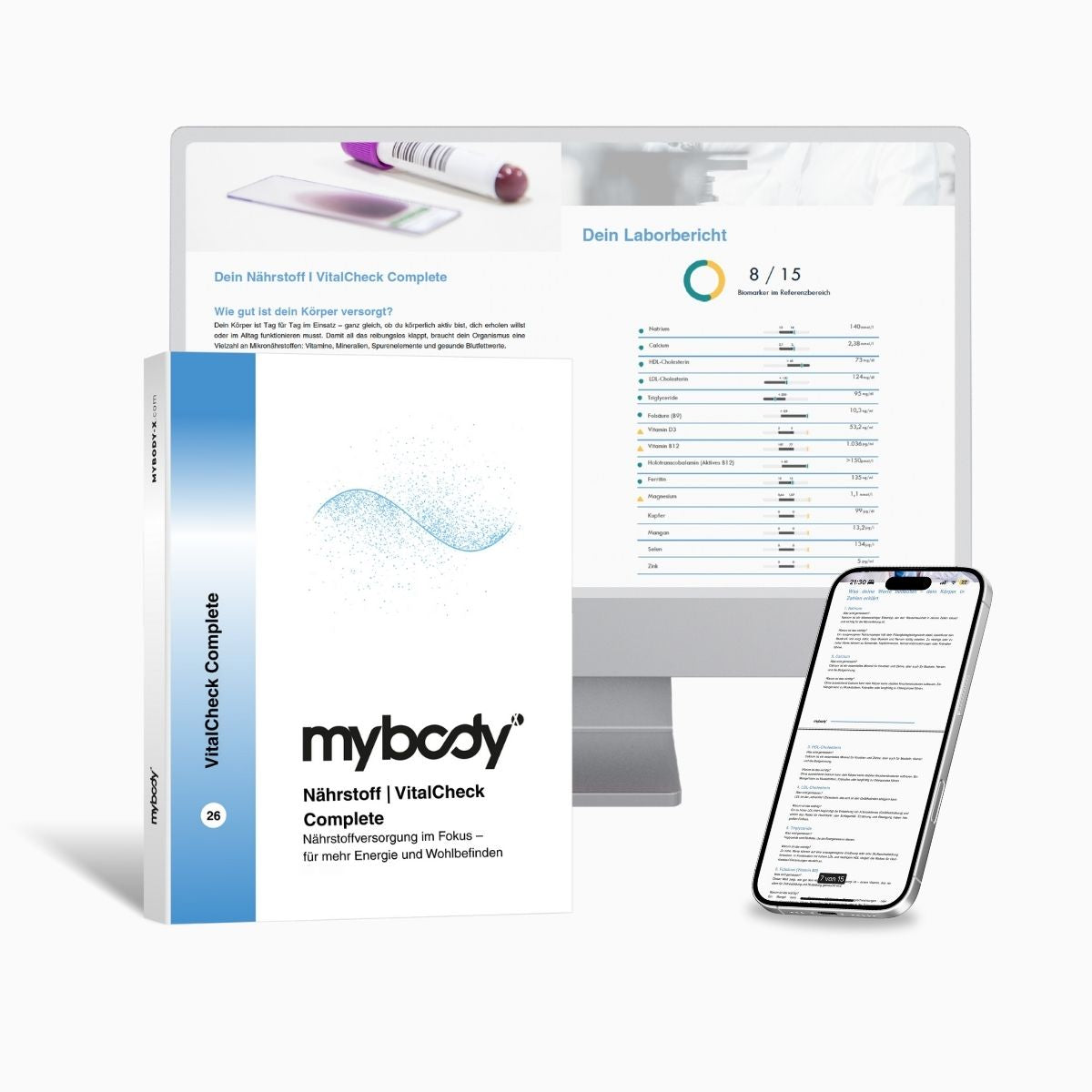
Capillary blood test
VitalCheck | Nutrient & Mineral Test Complete
Includes 18 values, including the long-term blood sugar level, as well as a cholesterol profile, CRP, ferritin, iron, transferrin, vitamin B12, folic acid, vitamin D, and calcium, magnesium, phosphate, selenium, and zinc. What the test does not do: It does not detect prediabetes or diabetes, does not rule out either condition, and does not replace a medical examination. It includes neither a fasting glucose test nor a glucose tolerance test and therefore covers one of the three methods. It does not provide a diagnosis.
Laboratory analysis 3–5 business days after sample receipt
Product-page information, accessed August 13, 2026
Four points determine whether a measurement becomes useful information.
Note the method
Every number belongs to a method, and the three are not interchangeable.
Record confounding factors
Anemia, hemoglobinopathy, and pregnancy alter the interpretation of the long-term value.
Do not interpret anything on its own
A value in the intermediate range is a reason to have a conversation, not a finding.
Discuss with a doctor
A medical practice will decide on any further tests and everything else.
Chapter at a glance
A capillary blood self-test does not detect prediabetes and does not rule it out. It provides the long-term blood sugar level, one of three methods used to define the intermediate range. Four points are crucial: note the method, record confounding factors, do not interpret anything on its own, and discuss it with a doctor.
Boundaries: what remains open
The first boundary concerns prediction. The intermediate range can exist many years before the actual onset of diabetes (MSD Manual, professional edition, as of December 2025). No value predicts whether or when something will develop from it.
The second boundary is the difference between association and cause. The source refers to an associated increased risk of cardiovascular disease, and “associated” means statistically linked.
The third boundary is a gap in our research. In the German-language sources we reviewed, we found no figures with a clear reference point on the benefits and harms of screening for diabetes. That is why this article contains no such assessment and does not make a recommendation for or against screening.
The fourth boundary is diagnosis. It arises from several components in a medical practice. A value in the intermediate range, regardless of the method used, is one of these components and not the result.
What matters about the intermediate range
If you take away just one thing from this article, let it be this: Prediabetes is a numerical range between two thresholds, not a set of symptoms.
Both follow from this. The intermediate range cannot be recognized from how you feel, only through values. And a value in that range is not a verdict, but a number that must be interpreted.
It began with the question of which values count. The answer is: three, and they measure different things. What follows in an individual case emerges from a conversation, which this article deliberately does not anticipate.
Frequently asked questions
What is prediabetes?
A numerical range, not a separate disease with its own symptoms. The MSD Manual, professional edition, puts it this way: Prediabetes is diagnosed when glucose values lie between the normal range and the range diagnostic of diabetes (as of December 2025). In the criteria table from the same source, this range is called impaired glucose metabolism.
Which values define the range?
Three methods, each with its own figures: fasting plasma glucose of 100 to 125 mg/dl, a two-hour glucose tolerance test of 140 to 199 mg/dl, and HbA1c of 5.7 to 6.4 percent (MSD Manual, as of December 2025). The decisive factor remains the reference range stated on your own laboratory report, because reference values may vary from one laboratory to another (IQWiG, as of April 2, 2025).
Can I tell if I have prediabetes?
Generally not. The condition can exist for many years before diabetes actually begins (MSD Manual, as of December 2025), and it is defined by values rather than symptoms. It is therefore detected through a measurement—or not at all.
At what age does the specialist literature recommend testing?
People aged 35 and over, as well as all adults with one or more risk factors, should be screened for diabetes at least once every three years (MSD Manual, as of December 2025). The risk factors listed include a body mass index above 25 kg/m², physical inactivity, and a family history of type 2 diabetes mellitus. Whether an examination is appropriate for you is decided at a medical practice.
Can a self-test detect prediabetes?
No. A capillary blood self-test can provide the long-term blood sugar level, meaning one of three methods. It does not detect or rule out prediabetes and does not replace a medical examination. A value in the intermediate range is a reason to have a conversation in which it is assessed together with your medical history, age, and other values.
Next step
The conversation before interpretation
Whether an examination is appropriate for you is decided at a medical practice. If you want to get an overview beforehand, VitalCheck lists long-term blood sugar under 18 values. It does not detect or rule out prediabetes and does not replace a medical examination.
Go to VitalCheckRead more
You might also be interested in
The method that a self-test can cover, including its interfering factors.
Why an everyday spike does not appear in any of the three criteria.
Sources
- MSD Manual, Professional Edition: Type 2 diabetes mellitus (as of December 2025) – msdmanuals.com
- MSD Manual, Professional Edition: Diagnostic criteria for diabetes mellitus and impaired glucose metabolism, table (as of December 2025) – msdmanuals.com
- MSD Manual, Professional Edition: Diabetes mellitus (DM), Brutsaert EF (as of December 2025) – msdmanuals.com
- Institute for Quality and Efficiency in Health Care (IQWiG): Understanding laboratory values correctly, as of 02 April 2025 – gesundheitsinformation.de
The definition of prediabetes, the verbatim quotation about persisting for many years and the associated cardiovascular risk, the screening recommendation starting at age 35 and every three years, the list of risk factors including body mass index values, and the information on a 7 percent weight reduction and a reduction in incidence of more than 50 percent among high-risk individuals come from source [1]. All threshold values for the three methods come from [2]. The information about the three-month period reflected by HbA1c and the factors that can interfere with this value come from [3]. The explanation of the reference range involving 95 percent and the note about differences between laboratories come from [4]. Regarding the benefits and harms of screening for diabetes, we found no figures with a clearly defined reference basis in the German-language sources reviewed; therefore, the text contains neither a summary assessment nor a recommendation for or against screening. Information on price, values, sample type, and laboratory comes from the mybody®x product page, accessed on 13 August 2026; processing times follow the central specification for blood tests. All sources were accessed and reviewed on 13 August 2026.

mybody®x Editorial & Specialist Team
Laboratory diagnostics Blood analysis interpretation Nutritional science Nutrigenetics
This article was created by the mybody®x editorial and specialist team. The team combines laboratory diagnostics, nutritional science, and the interpretation of blood analyses. Those who contribute to it are listed on the authors page.
Published on 13 August 2026 · Last updated on 13 August 2026
The content is for general information and does not replace medical advice, diagnosis, or treatment. Reference ranges depend on the laboratory, method, and age—the information on your test report is always authoritative.




Share now:
Prolactin: what affects the level and what shifts it
CRP over time: why a single value has no direction