

Dietary supplement test: Find out what your body really needs
Before you simply reach for the next vitamin supplement, pause for a moment. A personalized dietary supplement test is the smartest first step to find out what your body really lacks. Instead of blindly taking supplements and hoping for the best, a targeted blood analysis provides hard facts. This allows you to correct deficiencies effectively and safely and invest purposefully in your health—instead of spending money on unnecessary pills and powders.
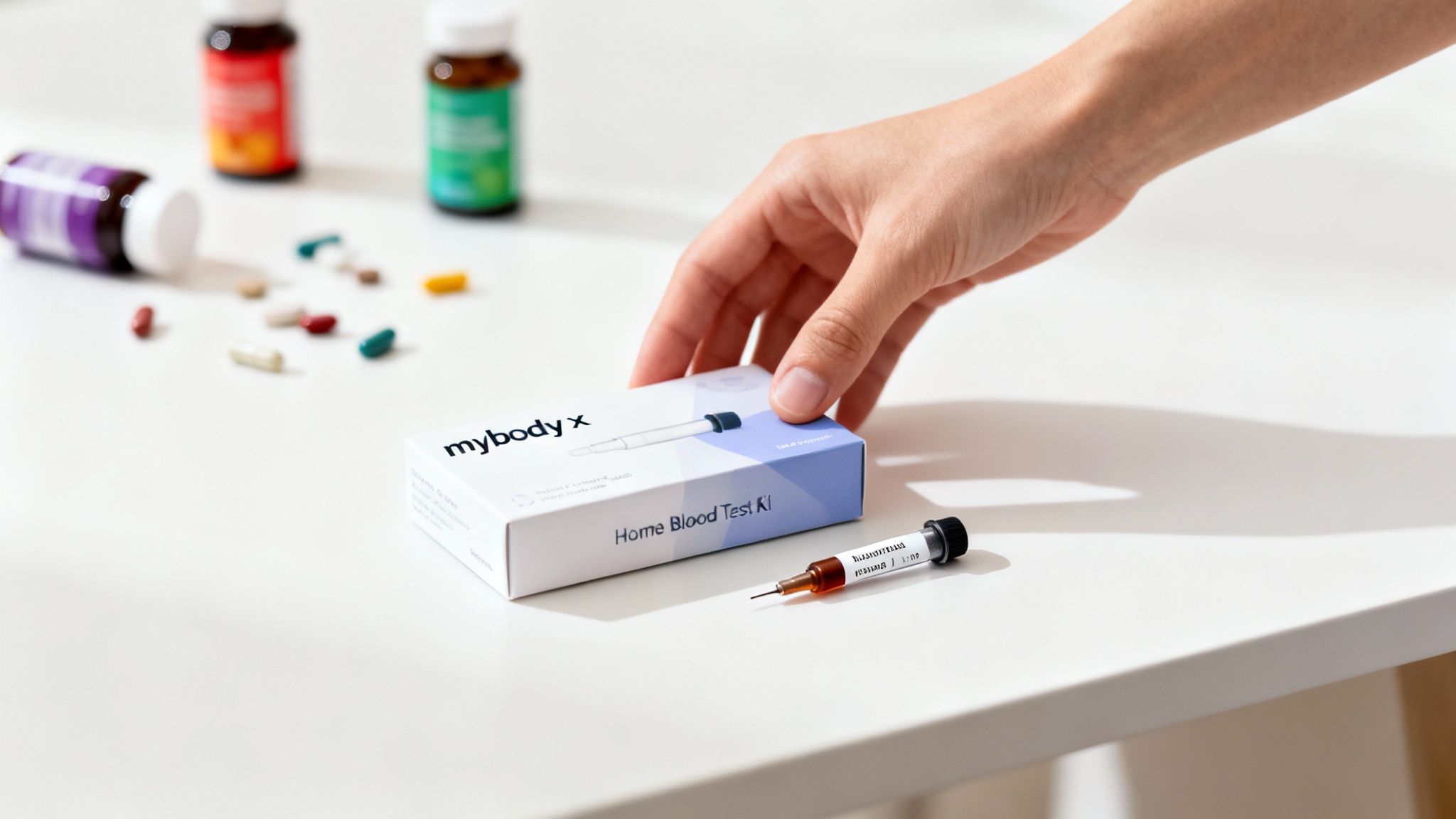
Why blanket supplementation often misses the mark
Do you often feel tired, unfocused, or simply not at your best? The first reaction for many people is to reach for the supplement shelf. A little iron here, a dose of vitamin D there—the approach is understandable, but rarely the best solution. It is more like groping in the dark than a genuine strategy for your well-being.
The real problem is this: Without concrete data, you are only guessing. You do not know whether a deficiency actually exists, how severe it is, or whether an entirely different cause may be behind your symptoms.
In the worst case, you may take supplements you do not need at all. This not only puts a strain on your wallet but, in extreme cases, can even lead to dangerous overdosing.
Targeted analysis vs. blanket supplementation
A direct comparison highlights the key differences between the widespread “just take something” approach and data-driven nutrient optimization.
| Feature | Taking supplements indiscriminately | Targeted supplementation after a blood test |
|---|---|---|
| Basis | Guesswork, general recommendations | Concrete measurements from your blood |
| Effectiveness | Random, often ineffective | High, because deficiencies are addressed specifically |
| Safety | Risk of overdosing or underdosing | Safe through needs-based dosing |
| Cost | Potentially high expenses for unnecessary products | Targeted investment that saves money in the long run |
| Sustainability | No long-term solution, just treating symptoms | Proactive, sustainable health optimization |
The difference is clear: knowledge is power—even when it comes to your nutrient supply.
The difference lies in the data
A scientifically sound blood test, such as the mybody-x nutrient test, completely changes the game. Instead of relying on guesswork, it provides precise measurements of important biomarkers directly from your blood. That is the crucial difference between vague hope and a clear, data-driven course of action.
You wouldn’t take medication without a medical diagnosis, would you? The same principle applies to dietary supplements. A test is your personal diagnosis, showing you where your body really needs support.
This personalized approach ensures that you supplement only what you are actually lacking. This way, you avoid unnecessary expenses and ensure that your measures really have a noticeable effect. You move away from simply treating symptoms and toward proactively optimizing your health—based on facts.
Quality and Safety in Focus
The market for dietary supplements is huge and continues to grow. In Germany alone, products worth around 1.9 billion euros were manufactured in 2024. At the same time, consumer uncertainty is also growing, as independent tests repeatedly uncover shortcomings in commercially available products. Incorrect dosage information and unwanted additives are unfortunately not uncommon.
If you would like to explore the topic in greater depth, you can find fascinating insights into metabolic analysis here. You can also view the latest market data and findings on consumption habits directly on Statista. These figures underscore how important it is to take a sound test before reaching for a product.
How to Interpret Your Body’s Signals Correctly
Constant fatigue, brittle nails, or feeling that you can barely concentrate—these are not coincidences. They are often subtle but clear cries for help from your body, showing you that something has become unbalanced.
Simply ignoring these signs or dismissing them as “normal everyday stress” is the wrong approach. Your body is constantly communicating with you. The key is to understand this language and interpret the signals correctly.
From Symptom to Possible Cause
Imagine a typical scenario: You have been dragging yourself through the day feeling tired for weeks, even though you are actually getting enough sleep. Your first thought? You probably just need more coffee. But what if your body is actually trying to tell you that its iron stores are depleted?
Or perhaps this sounds familiar: You often feel restless inside and sometimes experience muscle twitching. This could be a clear indication of a magnesium deficiency—a mineral involved in more than 300 metabolic processes, including nerve and muscle function.
Treat symptoms like these as valuable initial clues. They are the starting point of your research—not the final diagnosis. They point you in the right direction so you can investigate the causes more specifically.
These initial signs are the impetus to dig deeper. Instead of randomly trying products recommended by a nutritional supplement test from the drugstore, you can now investigate much more systematically.
Specific signals and what may be behind them
Your body sends you all kinds of signals. Here are a few examples to help you better understand the connections:
- Brittle fingernails and hair loss: These could indicate a deficiency in biotin, zinc, or iron. These nutrients are essential for the structure and growth of hair and nails.
- Frequent infections: Your immune system may be weakened. Your body may often lack vitamin C, vitamin D, or zinc to maintain its defenses.
- Difficulty concentrating and forgetfulness: B vitamins, especially vitamin B12, could play a role here. They are crucial for the functioning of the nervous system and cognitive performance.
This list is, of course, only a starting point, but it shows how specific symptoms can point to very specific nutrient deficiencies. If you want to learn more about how deficiencies can manifest themselves, take a look at our detailed guide to typical nutrient deficiency symptoms.
Recognizing these signals is the first and most important step. It keeps you from getting lost in the jungle of countless supplements. Instead of acting blindly, you can start looking for informed, targeted solutions that really suit you. The next logical step is to back up these suspicions with hard facts.
This is how you can easily measure your actual nutrient needs from home
Okay, you've listened to your body and have an idea of what you might be lacking. That's already half the battle. But a suspicion alone isn't enough—to really change something, you need facts. A targeted nutritional supplement test in the form of an at-home blood test provides exactly the clarity you need for the next step.
The goal is to replace guesswork with knowledge. Instead of continuing to grope in the dark, you can obtain precise, scientifically sound data about your nutrient status with a simple at-home blood test.
Your path to clear results
We have deliberately designed the mybody-x nutrient test to be as simple and straightforward as possible. You simply order the test kit online, and it comes directly to your home. No waiting for a doctor's appointment, no stress.
Collecting the sample takes just a few minutes and is virtually painless—a small prick in your finger is all it takes. You then send your sample in the enclosed return envelope to our certified laboratory in Germany. Your results will be available shortly afterward, digitally and accessible to you at any time.
This infographic sums up the process—from your initial gut feeling to concrete data.

It’s clear to see: A signal from your body leads to a suspicion, but only a proper blood analysis turns it into valuable, actionable knowledge.
Which Values Really Make a Difference
A good blood test doesn’t just check random markers, but exactly the biomarkers that are crucial for your well-being. These include, above all:
- Ferritin: This value is much more than just your current blood iron level—it shows how full your iron stores really are. An absolute key indicator of energy and performance.
- Vitamin D (25-OH): The famous “sunshine vitamin” is a powerhouse for your immune system, bones, and mood. At our latitudes, a deficiency is unfortunately more often the rule than the exception.
- Active vitamin B12 (Holo-TC): Here, we measure not total B12, but the form that your body can actually use. This is crucial for your nerves and cell formation.
Important to know: There is a big difference between “sufficient” and “optimal.” Many official reference ranges are set only to prevent serious illness. But if you really want to feel your best and take a preventive approach, you should aim for an optimal range.
This data-driven approach is becoming the standard for more and more people. A 2024 market study by Mintel shows that 66 percent of Germans already take dietary supplements. At the same time, the number of people who research test results before making a purchase has risen from 42 percent to 61 percent over the past five years. A clear sign of how important informed decisions have become. Read more about market developments here.
If you want to delve even deeper, our article on the nutrient deficiency test explains exactly which other biomarkers are important and how to interpret your results correctly. This is the moment when you stop guessing and start taking targeted action.
From Test Result to Noticeable Change
You are holding your laboratory report in your hands—a crucial moment. But what do these numbers and charts mean for your everyday life? A test result is only as valuable as the measures that follow. We show you how to turn your new insights into concrete, actionable steps that you can genuinely feel.
Imagine that your mybody-x nutrient test shows a low vitamin D level. That is clear information that goes far beyond a generic “eat healthier.” Now the real work begins: targeted optimization.

Choosing the Right Supplements
Not all dietary supplements are the same. After a dietary supplement test, simply reaching for the first product on the supermarket shelf would be a mistake. There are important quality characteristics you should pay close attention to so that your body can actually absorb the nutrients.
- Bioavailability: This term may sound complicated, but it simply means: How well can your body absorb and use an active ingredient? For example, magnesium citrate or magnesium bisglycinate is significantly more bioavailable than the often less expensive magnesium oxide.
- Purity and Additives: High-quality supplements contain no unnecessary fillers, colorants, or allergens. A quick look at the ingredients list reveals whether you are holding a pure product or a mixture full of unnecessary extras.
- Dosage: Your test result provides a guide to your individual needs. Choose a product that offers a sensible dosage per capsule or drop. This allows you to control and adjust your intake precisely.
These criteria are essential, because the quality of a supplement determines its effectiveness. Nutrients with poor bioavailability often leave your body unused—and that would be a waste of money.
More Than Just a Pill
A deficiency can rarely be addressed through a supplement alone. Real, lasting change only occurs when you combine supplementation with small but effective adjustments to your lifestyle and diet.
Your body is a complex system. Targeted intake of a nutrient is a powerful stimulus, but it only reaches its full effect when combined with the right diet and suitable habits.
Let’s stay with the example of vitamin D. In addition to taking a high-quality supplement, you can specifically support your body:
- Use the sun mindfully: During the sunny months, spend 15–20 minutes in the midday sun every day—with your arms and face uncovered. This significantly boosts your body’s own production.
- Include the right foods: Fatty fish such as salmon or herring, egg yolks, and certain types of mushrooms naturally contain vitamin D and are the perfect complement.
This combination of targeted supplementation and supportive nutrition creates a solid foundation for your health.
If you would like to explore the subject in greater depth, our guide explains how professional nutritional counseling works and how you can strategically optimize your diet. This helps bridge the gap between knowledge and noticeable, everyday change.
Common mistakes when taking supplements
You have determined your nutrient requirements and found the right supplements—great, the first important step is complete! But for the valuable ingredients to actually reach the places where your body needs them, taking them correctly is now essential. Many people make mistakes here without realizing it, which can reduce their effectiveness or, in the worst case, even have the opposite effect.
The biggest myth is probably the “more is better” mentality. An overdose, especially of fat-soluble vitamins such as D, E, K and A or minerals such as iron and zinc, can be toxic. Your body can absorb only a limited amount at a time—the rest is either excreted unused or stored, which can lead to serious health problems.
Interactions and the right timing
Another crucial point that is often overlooked is the combination of nutrients. Did you know that some substances can block each other’s absorption? A classic example is zinc and copper. If you take high doses of zinc over a longer period, this can inhibit copper absorption and trigger a deficiency. Calcium and iron behave very similarly—the two compete for the same transport pathways in the intestines.
- Iron is best absorbed on an empty stomach together with vitamin C (e.g., a glass of orange juice). This increases bioavailability severalfold.
- You should always take fat-soluble vitamins (D, E, K, A) with a meal that contains some fat. Without this “taxi,” the body can barely absorb them.
- Magnesium is often taken in the evening because it can have a relaxing effect on the muscles and nervous system.
The right time to take them and a smart combination are not minor details. They determine whether your investment in high-quality supplements leads to a noticeable change or literally fizzles out.
Quality over quantity
A dietary supplement test is not just about what you need, but also about the quality of the products themselves. A suspiciously low price often comes at the expense of purity, bioavailability, or accurate dosage. Precise dosing is particularly important with dietary supplements. A look at the common mistakes in supplement dosing in the animal sector reveals surprising parallels that we humans can learn from too.
This care is all the more important because the online market is booming. According to the Federal Statistical Office, 21 percent of Germans said they bought dietary supplements online in 2024—a significant increase from 16 percent in 2021. But caution is advised: tests by consumer protection organizations showed in the same year that around 40 percent of the products examined had shortcomings. You can find more about these insights into online retail here at Destatis.
Your most important questions about nutrient tests
You have now explored the topic in depth, but you are probably still wondering about a few things. That is completely normal! To clear up any remaining uncertainties, we have collected the answers to the most frequently asked questions about nutrient and dietary supplement tests for you here.
With this knowledge, you can take the next steps for your health confidently and well informed.
How often should I test my nutrient levels?
There is no one-size-fits-all answer here—your needs are as individual as you are. As a good rule of thumb, it has proven useful to check your nutrient status at least once a year. This gives you a solid picture of your baseline nutrient supply and helps you identify typical seasonal fluctuations, such as your vitamin D levels in winter.
However, there are phases of life in which a shorter interval absolutely makes sense:
- With intensive exercise: Your body uses more minerals and vitamins. A test every six months helps you identify deficiencies early, before your performance suffers.
- When changing your diet: Whether vegan, vegetarian, or low-carb, a test after the first three to six months will show you whether your new diet really covers all the essential nutrients.
- For persistent symptoms: You still don't feel better despite taking initial measures? A follow-up test after about three months can show whether supplementation is working or whether the cause may lie elsewhere.
Do I need a test even if I eat a healthy diet?
One of the most important questions of all. And the answer is a clear: yes. Even if your diet looks exemplary and is full of good things, there are many factors that can interfere with nutrient absorption. Chronic stress, an undetected gut health issue, or simply a genetic predisposition to certain deficiencies may play a role.
A healthy diet is essential, but it is no guarantee of perfect nutritional status. Only a blood test can give you certainty that all the good nutrients from your food are actually reaching your cells.
A test uncovers precisely these hidden gaps. It shows you where you may need to make targeted adjustments despite green smoothies and whole-grain products to feel completely well.
When will I feel a positive change?
A little patience is needed here. Your body is not a light switch but a complex system. Empty reserves take time to refill. How soon you feel the first effects depends largely on the nutrient in question and the severity of your deficiency.
- With an iron deficiency, many people feel more alert after just two to four weeks and have noticeably more energy.
- Restoring an empty vitamin D reserve can take two to three months before you notice a better mood or a stronger immune system.
- Magnesium, on the other hand, can often have a relaxing effect on the muscles after just a few days.
The most important thing is to stick with it and give your body the time it needs. Consistency is the key to success here.
Are you ready to stop guessing and put your health on a solid, data-based foundation? With mybody-x blood tests, you gain precise insights into your body and clear recommendations for action to specifically improve your well-being. Discover the right test for you now at mybody-x.com.



Share now:
Estrogen deficiency and weight gain: understand the causes, find solutions
Test for food intolerances: Your path to greater clarity and well-being