

Nutrient deficiency test: which values can and cannot be measured
The essentials at a glance
A nutrient deficiency test is not a single procedure but a collective term for three different things: an assessment of intake, a measurement of concentrations in the blood, and a medical evaluation when there is a specific suspicion. Only the middle option provides figures from your body. And even it does not show every nutrient.
This article organizes what can actually be measured. It distinguishes intake from status and status from function because these three levels are constantly confused in everyday life. It also explains which values simply do not appear in a fingertip blood count and why an unremarkable laboratory value says little about tissue supply for some nutrients.
You will first read what the term actually refers to and which three levels underlie it. This is followed by the example of ferritin, the values included in a blood test, the recommended intake figures from Germany, and the difference between status markers and functional markers. The second part covers gaps in the test scope, three common assumptions, the question of when testing makes sense, and the limitations of the procedure.
What to expect in this article
1. What the term nutrient deficiency test actually refers to
2. Intake, status, and function: three levels that are confused
3. Ferritin and CRP: why a single value can be misleading
4. Which values a fingertip blood test provides
5. What the recommended intake figures from Germany do and do not tell us
6. Status markers: what a snapshot reflects
7. Functional markers: where blood values and supply diverge
8. Three values that are not included in this test scope
9. Three common assumptions put to the fact check
10. When a measurement makes sense and when it does not
11. What you can have determined from a capillary blood sample
12. Limitations: what no nutrient deficiency test can clarify
13. What matters for this question
14. Frequently asked questions
What the term nutrient deficiency test actually refers to
People searching for a nutrient deficiency test usually have a symptom in mind, not a method. Fatigue that does not go away. Hair that keeps collecting in the drain. Concentration that fades in the afternoon. The term suggests that there is a test that can provide an answer.
There is no single test for nutrient deficiencies. The term covers three different procedures that answer different questions and vary in how conclusive they are. They are mixed up in everyday use, and most disappointments arise from this confusion.
The first method is a dietary intake assessment. This involves recording or asking what someone eats and calculating the amount of vitamins and minerals from it. The result is an estimate based on the plate, not a measurement of the person.
The second method is a blood test. Here, the concentration of a substance in serum or whole blood is determined. This is a genuine measurement, but it always applies only to the time of sampling and is not equally reliable for every nutrient.
The third method is medical evaluation. It begins with a medical history, meaning a discussion of symptoms, pre-existing conditions, and medications, and then selects the laboratory values accordingly. It is the only method that can ultimately lead to a diagnosis.
Key Message
A nutrient deficiency test measures concentrations, not symptoms. It answers the question of how much of a substance is in the blood, not why you are tired.
This article addresses the question of categories: what is actually measurable? The question of cost is addressed elsewhere, namely in the overview of micronutrient testing at a doctor's office and its costs. Those searching based on a specific symptom will find the appropriate starting point in the article about testing for nutrient deficiencies and the associated symptoms. This article deals with the classification that comes before that.
Intake, status, and function: three levels that are often confused
A person's nutrient supply can be described on three levels. They are related, but they are not the same, and each is assessed using a different method.
Level one: intake
Intake is what comes in through food and drink. It is determined through food diaries and surveys and compared with reference values. Intake data describe population groups well but individuals poorly because they are based on memory and nutritional tables.
Low intake is a risk, not a finding. How much of a nutrient is actually absorbed depends on the intestinal lining, accompanying substances in the meal, and medications. Two people who eat the same breakfast do not necessarily have the same iron level.
Level two: status
Status is the measured concentration in the blood. For vitamin D, it is 25-OH vitamin D3, the storage form produced in the liver. For iron, it is ferritin, iron, and transferrin—storage, transport, and transport capacity, respectively.
Status values are hard numbers with a soft edge. They apply to the time of sampling, and their reference range depends on the laboratory, the method, and age. A value just below one laboratory's threshold may fall within another's range.
Level three: function
The functional level asks not how much of a substance is present, but whether the metabolic steps for which it is needed are working. This is measured using intermediates that accumulate when the nutrient is lacking. For vitamin B12, methylmalonic acid and homocysteine are such buildup markers.
Functional markers belong in the hands of a doctor. They are not routinely measured, they are more expensive, and interpreting them requires ruling out other causes of the same buildup marker.
Ferritin and CRP: why a single value can be misleading
Ferritin is the best-known nutrient marker of all. It is the storage protein for iron, and its concentration in serum reflects how full the iron stores are. That is precisely why ferritin appears in almost every test panel.
Ferritin has a second property, however. It increases during inflammation, regardless of how much iron is stored. A cold, an inflamed tooth, or chronic inflammation raises the level and can make an empty store appear full.
The World Health Organization issued a dedicated guideline on this in 2020. It states which threshold applies when inflammation is present, and that threshold is considerably higher than in the absence of inflammation.
Documented source
“In individuals with infection or inflammation, a ferritin concentration below 30 μg/L in children and 70 μg/L in adults may be used to indicate iron deficiency.”
World Health Organization
WHO guideline on use of ferritin concentrations to assess iron status in individuals and populations, Recommendation 1.2, 2020
In plain English: In adults with an existing infection or inflammation, a ferritin level below 70 micrograms per liter indicates iron deficiency; in children, the threshold is below 30. Without inflammation, the World Health Organization's thresholds are considerably lower.
The same guideline recommends measuring ferritin together with two inflammatory proteins in regions where infections are widespread: C-reactive protein and alpha-1-acid glycoprotein (WHO, 2020). The increase caused by inflammation should be taken into account in the assessment.
This has a practical implication for what a nutrient deficiency test must be able to do. A test panel that measures ferritin without an inflammation marker produces a number that cannot be interpreted. A panel that includes CRP at least indicates that the ferritin value cannot currently be read reliably.
The World Health Organization also specifies upper thresholds in the same guideline: levels above 150 micrograms per liter in menstruating women and above 200 in men and non-menstruating women are considered a possible indication of iron overload (WHO, 2020). According to the guideline, this value should not be used alone either, but should be followed up with clinical and laboratory-medicine assessment.
Which values a blood test from the fingertip measures
An at-home nutrient test uses capillary blood, meaning the few drops that emerge after a prick to the fingertip. The sample volume is small, limiting how many values can be determined from one sample.
According to the product page, the VitalCheck Complete by mybody®x (MYBODY Lab GmbH) measures 18 values, accessed on August 28, 2026. They can be organized into five groups, and each group answers a different question.
Vitamins and iron status
The vitamin group includes 25-OH vitamin D3, vitamin B12, and folate. Iron status is assessed using ferritin, iron, and transferrin—that is, iron stores, currently circulating iron, and the transport protein. Only these three values together provide a meaningful picture, because ferritin alone can be misleading during inflammation.
Minerals and trace elements
This section covers calcium, magnesium, phosphate, selenium, and zinc. Calcium and phosphate are part of bone metabolism and are interpreted together with vitamin D. Selenium and zinc are trace elements that the body needs and stores only in very small amounts.
Lipid metabolism, blood sugar, and inflammation
Total cholesterol, HDL cholesterol, LDL cholesterol, and triglycerides reflect lipid metabolism. They are supplemented by the long-term blood glucose marker HbA1c, C-reactive protein as a marker of inflammation, and albumin, the most important transport protein in the blood. These values are not nutrients in the narrower sense, but they help put the nutrient values into context.
This also indicates what is missing. Vitamin B6 is not included in the same scope, the omega-3 index is not included in the same scope, and potassium and sodium are missing from the electrolytes in the narrower sense. Chapter 8 addresses these three gaps individually.
What the intake figures from Germany do and do not show
Anyone looking for figures on nutrient intake in Germany almost always ends up with the same survey. The Max Rubner Institute, the Federal Research Institute of Nutrition and Food, used the National Consumption Study II to record what people in Germany eat and compare their intake with the reference values.
Intake below the recommendation, women in Germany
91 %
of women fall below the recommendation for vitamin D intake
86 %
of women fall below the recommendation for folate intake
75 %
or more of women of childbearing age fall below the recommendation for iron intake
Source: Max Rubner Institute, National Consumption Study II, 2008
The figures are similarly high among men. Eighty-two percent of men fall short of the recommendation for vitamin D intake, and 79 percent fall short of the recommendation for folate (Max Rubner Institute, 2008). For calcium, one group stands out in particular: 74 percent of female adolescents aged 14 to 18 fall below the recommendation.
This is where a conclusion is usually drawn that does not hold up. These figures describe intake, not the blood level. They come from food records and surveys, not laboratory samples, and they say nothing about how many of those surveyed actually had a measurable deficiency.
Vitamin D adds a special consideration. The body produces it in the skin under sunlight, while food intake accounts for only part of the supply. For this vitamin, intake below the recommendation therefore means even less than it does for the others.
The numbers are not worthless, however. They show where it is worth taking a closer look, and they explain why vitamin D, folate, and iron appear in almost every home-test panel. They simply do not replace measurement.
Status Marker: What a Snapshot Reflects
A status marker is a laboratory value that indicates the amount of a nutrient or its storage form in the blood. It is the basis of every nutrient deficiency test because it is measured directly and does not have to be derived from something else.
How well a status marker reflects supply depends on how the body handles the substance in question. For some nutrients, the blood level fluctuates with supply. For others, it is regulated so tightly that it remains stable for a long time while the stores are being depleted.
Where the Status Marker Works Well
For vitamin D, 25-OH vitamin D3 is considered the value that reflects supply status because it is the storage form circulating in the blood and has a comparatively long residence time. For iron, ferritin is a good marker of iron stores in healthy people according to the World Health Organization's 2020 guideline.
The same is true for lipid metabolism and long-term blood sugar. The matter is clear: HbA1c reflects a period of several weeks through the binding of sugar to the red blood pigment, making it insensitive to what you ate the day before.
Key Message
A status marker is only as good as the extent to which the body allows the substance in question to fluctuate in the blood. Where the body regulates it tightly, the test measures regulation rather than supply.
Why the Reference Range Is Not a Law of Nature
Every laboratory result comes with a reference range. This range describes where the vast majority of a healthy comparison group falls, and it depends on the measurement method, device, age, and sex. It is a statistical measure, not a health threshold.
Two conclusions follow. A value just outside the range is not a diagnosis, and a value just inside it is not an all-clear. The information on your own lab report is always decisive because it corresponds to the method used.
Functional markers: where blood values and nutritional status diverge
For two nutrients, the difference between a status marker and a functional marker is so clear that it belongs in any honest text about tests for nutrient deficiencies. They are vitamin B12 and magnesium.
Vitamin B12: total level, holo-TC, and methylmalonic acid
The usual laboratory value is total vitamin B12 in the serum. However, it also measures the fraction bound to a transport protein that the cells cannot take up. In a review by Hannibal and colleagues in the journal Frontiers in Molecular Biosciences (2016), the authors state that serum B12 levels do not always reflect cellular B12 status.
The same paper states that total serum B12 alone is not a reliable biomarker of vitamin B12 status. Holotranscobalamin is mentioned as an alternative; it is the fraction bound to the transport protein transcobalamin and therefore available to the cells.
The third measurement is methylmalonic acid, or MMA for short. It is an intermediate product that accumulates when a B12-dependent metabolic step is impaired. In the same paper, Hannibal and colleagues describe it as the most sensitive and specific marker of vitamin B12 status across all age groups (Frontiers in Molecular Biosciences, 2016).
For you, this means that a normal total B12 level does not reliably rule out a deficiency. If symptoms are present and the suspicion remains, holo-TC and methylmalonic acid are the values to discuss with your doctor. The interpretation of the individual values is explained in detail in the article about vitamin B12 deficiency and what the values indicate.
Magnesium: 0.3 percent in the serum, 53 percent in the bones
With magnesium, the imbalance is even more pronounced, and it can be expressed in numbers. A review by Workinger, Doyle, and Bortz in the journal Nutrients (2018) shows how it is distributed in the body: 0.3 percent of magnesium is found in the serum, and another 0.5 percent in the red blood cells.
Most of the rest is stored in the tissues. Fifty-three percent is found in the bones, 27 percent in the muscles, and 19 percent in the remaining soft tissue (Workinger, Doyle, and Bortz, Nutrients, 2018). The body keeps the serum level within a narrow range of 0.7 to 1 millimole per liter by releasing more from these stores when needed.
The same authors therefore call serum magnesium a poor proxy for the 99.2 percent of magnesium in the other tissues. A normal serum value does not rule out inadequate tissue supply, while an abnormal serum value indicates that regulation is already overwhelmed. The implications for everyday life are explained in the article about magnesium for the nerves.
The following table places the three levels side by side according to the same criteria.
| Criterion | Dietary intake assessment | Status marker in the blood | Functional marker |
|---|---|---|---|
| What is measured | Amounts of food consumed, converted using nutritional value tables | Concentration of the substance or its storage form in the blood | Intermediate products that accumulate when the nutrient is lacking |
| Which question is being answered | How much comes in through food | How much is in the blood at the time of sampling | Whether the metabolic step requiring the nutrient is functioning |
| Where the method can mislead | Recall, portion estimates, and varying absorption in the intestine | Tightly regulated substances and inflammation that shift the value | Other causes produce the same congestion sign and must be ruled out |
| Example | 91 percent of women below the recommended vitamin D intake (Max Rubner Institute, 2008) | 25-OH vitamin D3, ferritin, total vitamin B12, serum magnesium | Methylmalonic acid and homocysteine for vitamin B12 status |
| Included in VitalCheck Complete | No, the test does not assess eating habits | Yes, 18 values from capillary blood, without vitamin B6, without the omega-3 index, without potassium or sodium | No, neither holoTC, methylmalonic acid, nor homocysteine |
Three values not included in this test panel
The most honest way to describe a test panel is by what it does not include. For VitalCheck Complete, these are three values that are frequently sought, and they are missing for different reasons.
Vitamin B6 is not included
Vitamin B6 is not one of the 18 values. Anyone specifically looking for it because tingling in the hands or feet is a concern will not find an answer in this test. The relevant context is explained in the article about vitamin B6 deficiency and its symptoms.
The omega-3 index is not measured
The omega-3 index measures the proportion of two long-chain fatty acids in the membrane of red blood cells. It is a separate laboratory value with its own method and is not one of the 18 values. The blood lipids included in the test, namely cholesterol and triglycerides, are something else and do not replace it. More information is available in the article about omega-3 deficiency and its symptoms.
Potassium and sodium are missing
This calls for precise wording, because online sources often state broadly that electrolytes are not included. That is not quite true. Calcium, magnesium, and phosphate are included in the panel. What is missing are potassium and sodium—that is, the two electrolytes in the narrower sense that are of primary interest in cases of muscle weakness and questions about heart rhythm.
This distinction is not mere nitpicking. Anyone testing because of sudden muscle weakness needs potassium and sodium, and they are not included in this panel. What matters in this situation and when it becomes urgent is explained in the article about sudden muscle weakness.
Heavy metals are not included either, and neither are hormone levels. A nutrient test is not a comprehensive overview, but a snapshot with clearly defined limits.
Three common assumptions put to the fact check
Three assumptions come up particularly often on this topic. All three sound plausible, and all three lead to incorrect conclusions.
Assumption versus evidence
Common
“If the blood level is within the reference range, nutritional status is adequate.”
Documented
Only 0.3 percent of the body’s magnesium stores are found in serum, 53 percent in bone, and 27 percent in muscle. The serum level is a poor proxy for the remaining 99.2 percent (Workinger, Doyle, and Bortz, Nutrients, 2018).
Common
“More than 90 percent of women in Germany have a vitamin D deficiency.”
Documented
The figure of 91 percent comes from the National Nutrition Survey II and describes intake from food, not the measured blood level (Max Rubner Institute, 2008). Vitamin D is also produced in the skin when exposed to sunlight.
Common
“A good ferritin level proves that iron stores are full.”
Documented
In cases of infection or inflammation, a ferritin level below 70 micrograms per liter in adults and below 30 in children is considered indicative of iron deficiency. The inflammation-related increase should be taken into account in the assessment (WHO, 2020).
What all three assumptions have in common is that they treat a number as a verdict. But a number is only as valuable as the question it answers and the conditions under which it was produced.
When a measurement is useful—and when it is not
So far, the focus has been on what can be measured. Now it is time for the second half of the question: whether a measurement is useful in a specific case. These are two different things, and the second question is asked less often.
The case without symptoms
There is an explicit assessment for routine screening for vitamin D deficiency in adults without signs of a deficiency. The IGeL Monitor, a service of the Medizinischer Dienst Bund, rates this screening examination as “unclear” (Medizinischer Dienst Bund, 2022).
The reasoning is remarkably matter-of-fact. According to this assessment, studies directly examining the benefits or harms of such screening are lacking. Not disproven, but unexamined.
This is not an argument against every measurement. It is an argument against expecting a measurement without an underlying question to be automatically useful. Anyone who tests should know beforehand what they intend to do with each possible result.
The case with symptoms
If symptoms are present, the situation is different. Persistent fatigue, paleness, tingling in the hands and feet, hair loss, or muscle weakness are reasons that laboratory values may be helpful. They are also reasons to talk to a doctor, because the same signs can have causes other than a nutrient-related issue.
There are also situations in life in which requirements are increased or absorption is altered. These include a strictly plant-based diet, pregnancy and breastfeeding, surgery on the gastrointestinal tract, chronic intestinal diseases, and long-term use of certain medications. In these situations, the selection of values should be left to a doctor.
What you should clarify before testing
Two questions determine whether a result will help you. Which value could be related to your symptom, and what will you change if that value is abnormal? Anyone who cannot answer the second question gains a number from the measurement and nothing else.
A second point concerns repetition. Nutrient levels in the blood change over weeks to months, not days. A check the day after making a change shows nothing; a check after a few months is more likely to do so.
Chapter at a glance
Nutrient testing without a specific question produces a number with no consequences. For early detection of vitamin D deficiency in adults without signs of a deficiency, the IGeL Monitor’s assessment is “unclear” because studies on the direct benefit are lacking (Medizinischer Dienst Bund, 2022). If symptoms are already present, requirements are increased, or absorption has changed, a measurement can instead provide a starting point for a conversation with a doctor.
What can be determined from a capillary blood sample
When the question is clear and the answer may lie in a status marker, there are two ways to proceed. One is through a medical practice, the other through a sample you collect at home and send to a laboratory. The second route is shorter and covers less.
This is how the process works for a home test.
Define the question
Which symptom or life situation makes the measurement meaningful in the first place? Without establishing this, the result cannot be interpreted later.
Collecting the sample
A prick in the fingertip, yielding a few drops of capillary blood. Warm hands and a calm procedure determine how much blood is collected.
Laboratory analysis
The sample is sent to the laboratory in the prepared envelope. Analysis takes 3 to 5 business days after receipt.
Interpreting the results
The report lists figures and reference ranges. Abnormal values belong in a consultation with a doctor, not in self-treatment.
The following is the test that covers vitamin, iron, and mineral status. What it does not include is stated in the description because this is part of the decision.
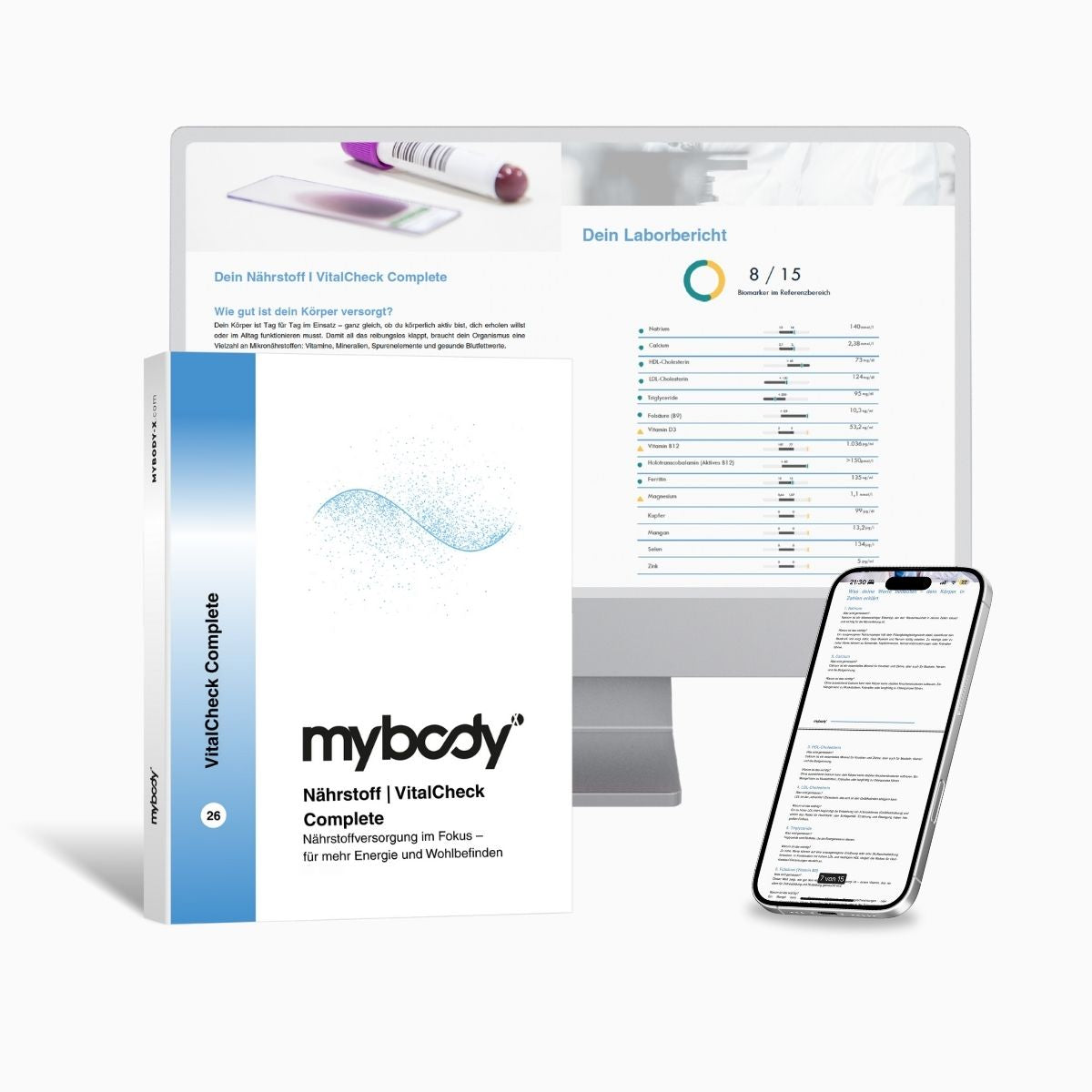
Capillary blood test
VitalCheck | Complete Nutrient & Mineral Test
18 values from a capillary blood sample: 25-OH vitamin D3, vitamin B12, folic acid, ferritin, iron, transferrin, calcium, magnesium, phosphate, selenium, zinc, total cholesterol, HDL and LDL cholesterol, triglycerides, long-term blood sugar, CRP, and albumin. What the test does not include: vitamin B6, the omega-3 index, and potassium and sodium, meaning electrolytes in the narrower sense. Calcium, magnesium, and phosphate are included. Functional markers such as holo-TC or methylmalonic acid are not included. The test provides a snapshot, not a diagnosis.
Laboratory analysis: 3–5 business days after sample receipt
Product page information, accessed on 28 August 2026
mybody®x has been working in laboratory diagnostics since 2016 and has offered home-use tests since 2022. Samples are processed pseudonymously, and the transmission of results is SSL-encrypted. Processing complies with the General Data Protection Regulation.
A note about processing times, as different figures are circulating. For blood tests: Kit shipping takes 1 to 3 business days, and laboratory analysis takes 3 to 5 business days after your sample arrives. The two periods are stated separately and are not combined into one figure.
Limitations: what a nutrient deficiency test does not clarify
The most important limitation comes first: A test measures; it does not diagnose. An abnormal result is an indication that should be investigated further, not a diagnosis of a disease.
The second limitation concerns the question of cause. A low iron level does not say where the loss is coming from. A low vitamin B12 level does not say whether too little is being absorbed or too little is being utilized. Yet this distinction determines what should happen next.
A test measures; it does not diagnose.
The third limitation is the scope. No test panel covers all nutrients, and the broader the panel, the greater the chance that some value will happen to fall just outside the normal range. A broad test therefore does not automatically provide more clarity.
The fourth limitation concerns the type of sample. Capillary blood from a fingertip is not the same as venous blood from an arm vein, and not every laboratory value can be determined equally well from a few drops. Anyone who wants to read more about the procedures and sources of error in detail can find them in the guide to experiences with at-home blood tests.
The fifth limitation is the most difficult. Not every case of fatigue has a nutritional cause. The thyroid, sleep, blood count, psychological stress, and chronic illnesses are all possible factors, and none of these areas is covered by a nutrient test.
What matters when considering this question
A nutrient deficiency test is not an answer machine, but a measuring device with a defined scope. It shows blood concentrations at the time the sample is taken. What it shows can be verified. You should know in advance what it does not show.
The preceding chapters allow us to derive an order that had not yet been stated explicitly in the text. Do not start with the test scope, but with the symptom and the level at which it would be visible in the first place. Anyone who starts with the scope often measures the wrong thing very thoroughly.
In practical terms, write down for two weeks when the symptom occurs and how severe it is. This record forms the basis for selecting the values, regardless of whether you have them determined at a medical practice or at home. It costs nothing and turns a vague question into one that a laboratory can answer.
It began with the observation that the word can refer to three different procedures. That is precisely why the first decision is not a product decision, but a question to ask yourself: What should the number ultimately explain?
Frequently asked questions
What exactly does a nutrient deficiency test measure?
It measures the concentration of individual vitamins, minerals, and trace elements, or their storage forms, in the blood. This is the status level. It measures neither intake through food nor the functional level—that is, whether the nutrient-dependent metabolic processes are working. The functional level requires separate values, such as methylmalonic acid for vitamin B12 status.
Which values does VitalCheck Complete cover, and which does it not?
mybody®x’s VitalCheck Complete measures 18 values from capillary blood, including 25-OH vitamin D3, vitamin B12, folate, ferritin, iron, transferrin, calcium, magnesium, phosphate, selenium, zinc, blood lipids, long-term blood glucose, CRP, and albumin. It does not include vitamin B6, the omega-3 index, potassium, or sodium. The price is €169.00 (as of August 27, 2026).
Can a normal blood value still conceal inadequate supply?
For some nutrients, yes. According to a review by Workinger, Doyle, and Bortz in the journal Nutrients (2018), only 0.3 percent of the body’s magnesium is in serum, whereas 53 percent is in bone. The body keeps the serum level tightly regulated and replenishes it from stores when necessary. A normal serum level therefore does not rule out inadequate tissue supply.
When should I have symptoms medically evaluated?
Persistent exhaustion lasting for weeks, tingling or numbness in the hands and feet, shortness of breath, sudden muscle weakness, and unintentional weight loss should be evaluated at a medical practice. The same applies if a test result is significantly outside the reference range. In these cases, a home test is not a substitute for a medical examination.
Is testing worthwhile if I have no symptoms?
For early detection of vitamin D deficiency in adults without signs of a deficiency, the IGeL Monitor’s assessment is “unclear” because studies on direct benefits and harms are lacking (Federal Association of Statutory Health Insurance Physicians, 2022). Testing becomes useful when there is a specific question behind it or when requirements and absorption have changed, for example with an entirely plant-based diet or after surgery on the gastrointestinal tract.
Next step
The question comes first, then the value
If your question concerns your vitamin, iron, and mineral status, VitalCheck Complete covers that aspect. If you are specifically interested in vitamin B12, first find out what each of the three B12 values indicates.
View VitalCheck Complete The three B12 values comparedRead more
You might also be interested in
If you are less interested in what can be measured than in who pays for the test.
Starting with the complaint rather than the method, linking typical signs to individual values.
Sources
- World Health Organization: WHO guideline on use of ferritin concentrations to assess iron status in individuals and populations, section “Evidence and recommendations” (2020) – ncbi.nlm.nih.gov
- Max Rubner Institute, Federal Research Institute of Nutrition and Food: National Nutrition Survey II, Results Report Part 2, Chapter on Nutrient Intake (2008) – mri.bund.de
- Workinger JL, Doyle RP, Bortz J: Challenges in the Diagnosis of Magnesium Status. Nutrients 10(9), Article 1202 (2018) – mdpi.com
- IGeL Monitor, Medical Service of the Federal Government: Screening for vitamin D deficiency, rating “unclear” (2022) – igel-monitor.de
The institute citation on the ferritin threshold during inflammation, as well as the information on the thresholds of 30 and 70 micrograms per liter, 150 and 200 micrograms per liter, and joint testing with CRP and alpha-1-acid glycoprotein, comes from [1]. The percentages for intake in Germany—91 and 82 percent for vitamin D, 86 and 79 percent for folic acid, over 75 percent for iron intake among women of childbearing age, and 74 percent for calcium among female adolescents—come from [2]. The distribution of magnesium in the body, with 0.3 percent in serum, 0.5 percent in red blood cells, 53 percent in bone, 27 percent in muscle tissue, and 19 percent in soft tissue, as well as the serum range of 0.7 to 1 millimole per liter, comes from [3]. The “unclear” rating for screening for vitamin D deficiency comes from [4]. The statements on total serum B12, holotranscobalamin, and methylmalonic acid come from a review by Hannibal and colleagues in the journal Frontiers in Molecular Biosciences (2016); it is attributed in the main text with the authors, journal, and year and is therefore not included in this list. Information on price, range of values, sample type, and laboratory comes from the mybody®x product page, accessed on 28/08/2026; processing times follow the central guideline for blood tests. All sources were accessed and checked on 28/08/2026.

mybody®x Editorial & Expert Team
Laboratory diagnostics Blood analysis interpretation Micronutrients Nutritional science
This article was created by the mybody®x editorial and expert team. The team combines laboratory diagnostics, blood analysis interpretation, and nutritional science. Everyone involved is listed on the authors page.
Published on 19/02/2026 · Last updated on 27/08/2026
The content is intended for general information and does not replace medical advice, diagnosis, or treatment. Reference ranges depend on the laboratory, method, and age; the information on your test report is always authoritative.




Share now:
Blood Test: Understand Your Body’s Signals and Gain Clarity
Important Blood Tests for Vitamins: Understand Your Levels and Optimize Your Health