

Fatigue, lack of motivation, low drive, irritability: what lies behind them
The essentials at a glance
There is a dedicated primary-care guideline for this combination of symptoms—and it is surprisingly specific. According to DEGAM, five laboratory tests should be performed for initially unexplained fatigue: blood glucose, complete blood count, erythrocyte sedimentation rate or CRP, transaminases or gamma-GT, and TSH.
It is equally revealing what is not included. Ferritin, vitamin D, vitamin B12, and folic acid are not part of this basic diagnostic workup. Regarding vitamin D, the guideline is even explicit: vitamin D deficiency is not correlated with increased fatigue.
The most common cause is different from what most people suspect. Depression and anxiety rank first, with a point estimate of 18.5 percent—ahead of anemia at 2.8 percent and serious organic causes at 4.3 percent. Therefore, according to the guideline, screening questions about depression and anxiety disorders should be asked in cases of unexplained fatigue.
What to expect in this article
1. What the guideline recommends checking
2. What is not on the list
3. How common each cause is
4. Depression, anxiety, and exhaustion
5. An example of the typical course
6. Three misconceptions about this combination of symptoms
7. Sleep, medications, and alcohol
8. Whether a blood test can help here
9. What matters in the end
Frequently asked questions
Sources
What the guideline recommends checking
Fatigue is not a fringe issue in primary care. In a peer-reviewed study, it was the main reason for the doctor’s visit for 6.7 percent of patients—and this proportion doubled when fatigue was counted as a secondary complaint.
Accordingly, there is a dedicated S3 guideline, published by the German Society of General Practice and Family Medicine. Its central recommendation on laboratory diagnostics carries the highest recommendation grade and is refreshingly concise.
“
“In cases of initially unexplained fatigue, the following laboratory tests should be performed: blood glucose, complete blood count, erythrocyte sedimentation rate/CRP, transaminases or γ-GT, and TSH.”
German Society of General Practice and Family Medicine (DEGAM)
S3 Guideline “Fatigue,” AWMF Registry No. 053-002, Recommendation 5.3.1, 2022 edition
Five tests, then—and a second recommendation that rounds out the approach: further laboratory or instrumental tests should be performed only if previous findings are abnormal or if there are specific indications in the recommended basic diagnostic workup.
Before laboratory testing, the guideline explicitly prioritizes the consultation. Among other things, it calls for recording preexisting conditions and previous infections, sleep patterns including snoring and pauses in breathing, changes in body weight, tobacco use, medications and substance intake, as well as the social, family, and occupational situation.
This sequence is not a formality. It means that the crucial information comes from the consultation, not from the blood—and that without this preliminary work, a laboratory test may answer the wrong questions.
The examination is also specified
The physical examination comes between the consultation and the laboratory tests, and the guideline also provides a specific list for this: In cases of primarily unexplained fatigue, the mucous membranes, airways, heart, pulse and blood pressure, lymph nodes, and abdomen should be examined, along with an orienting neurological examination.
Further elements of the examination should follow only when there are specific indications of treatable causes. One principle therefore runs through the entire approach: start broadly and simply, then proceed in a targeted manner—not the other way around.
Above all, the guideline sets out another requirement: A biopsychosocial approach should be maintained throughout the entire diagnostic process. Physical, psychological, and social factors are therefore considered in parallel rather than addressed one after another.
What is not on the list
The following comparison is the real core of this article. On the left is what the guideline recommends; on the right is what many people want to have measured first for these symptoms.
| Value | Included in the guideline’s basic diagnostic workup? | Note |
|---|---|---|
| Blood glucose | Yes | Part of the five values in recommendation 5.3.1 |
| Complete blood count | Yes | Detects, among other things, anemia—point estimate as a cause: 2.8% |
| Erythrocyte sedimentation rate / CRP | Yes | Part of the five values in recommendation 5.3.1 |
| Transaminases or gamma-GT | Yes | Part of the five values in recommendation 5.3.1 |
| TSH | Yes | The only thyroid value included in the basic diagnostic workup—fT3 and fT4 are not included |
| Ferritin | No | The guideline states: Only from 100 µg/L onward can iron deficiency be largely ruled out; mild forms are generally asymptomatic |
| Vitamin D | No | Explicitly: Vitamin D deficiency does not correlate with increased fatigue |
| Vitamin B12 / folic acid | No | The guideline does not address this specifically; a deficiency would be reflected in a complete blood count |
| Tumor markers | No | Explicitly cited as an example of “low-value testing”—low predictive values lead to many false-positive findings |
Information based on the DEGAM S3 guideline “Fatigue,” AWMF registry no. 053-002, status 2022. Important for context: The guideline contains no list banning individual laboratory parameters. “No” here means that the value is not part of the recommended basic diagnostic workup—not that it would never be useful in an individual case. According to the guideline, further investigations should be performed when preliminary findings are abnormal or specific indications exist.
The rationale for this restraint is stated in the guideline itself: Rationally, keeping options open while waiting is preferable to poorly justified additional diagnostic testing—low predictive values lead to a high proportion of false-positive findings.
This is an argument one rarely hears: More measurements do not mean more clarity. Every additional parameter measured generates a certain number of abnormal results that have nothing to do with the symptoms—and those results then have to be investigated in turn.
The guideline is more specific about ferritin elsewhere, and the finding is surprising: Hemoglobin concentration explained the occurrence of fatigue to such a small extent that this could not be demonstrated in several large studies. In iron deficiency without anemia, the association was even weaker.
This does not mean that iron never plays a role. The guideline cites newer studies showing measurable effects of supplementation in fatigued premenopausal women—but only in cases of substantial iron deficiency and hemoglobin levels at the lower end of the normal range. For people without this constellation, the evidence shows no benefit from iron supplementation in otherwise healthy individuals who do not explicitly complain of fatigue.
How common each cause is
The guideline cites a systematic review with point estimates for the most common causes. The order surprises many people.
Depression and anxiety come first, with a point estimate of 18.5 percent. They are followed by other serious organic causes at 4.3 percent, anemia at 2.8 percent, and malignancies at 0.6 percent. ME/CFS was diagnosed in 0.2 to 1.8 percent of those affected.
Add these figures together, and a picture emerges that contradicts common practice. Psychological causes are many times more common than all organic causes combined—and yet, for most people, the search begins with a list of nutrients. This is not due to a lack of insight, but because ordering a laboratory test is easier than having a conversation about one’s own mood.
The guideline also provides figures on the course of symptoms: After one year, symptoms persisted in 20 to 33 percent of cases, and with systematic follow-up, in around 50 percent. Fatigue that does not go away on its own is therefore not unusual.
What these figures mean in practice
The low rates of organic causes are the real reason for the streamlined basic laboratory workup. If malignancies account for 0.6 percent of cases, then broadly searching for them produces far more false positives than true positives—exactly what the guideline means by low predictive values.
Reassuringly, there is another point to make here: Treatable serious physical illnesses are rare and are almost always associated with abnormalities in the medical history or physical examination. So anyone whose interview and examination reveal no abnormalities has gained more reassurance from that than from ten additional laboratory tests.
To put the scale in perspective: Internationally, too, the prevalence of people with unexplained fatigue lasting at least one month varies between 2 and 15 percent, according to the guideline. Persistent exhaustion without a clear cause is therefore a widespread phenomenon, not an individual failure to identify the cause.
In brief
For unexplained fatigue, the DEGAM S3 guideline for primary care lists five laboratory tests as the basic diagnostic workup: blood glucose, a complete blood count, erythrocyte sedimentation rate or CRP, transaminases or gamma-GT, and TSH. Ferritin, vitamin D, vitamin B12, and folic acid are not included; regarding vitamin D, the guideline explicitly states that a deficiency does not correlate with increased fatigue. It identifies depression and anxiety as the most common cause, with a point estimate of 18.5 percent—well ahead of anemia at 2.8 percent and malignancies at 0.6 percent.
Depression, anxiety, and exhaustion
Because the psychological aspect is the most common, it should be explicitly named in this article—and not reinterpreted as a nutrient-related issue. The guideline states that depression, anxiety, and psychosocial stressors are common causal factors or accompanying conditions in people with fatigue.
This leads to a specific recommendation with the highest level of strength: In cases of unexplained fatigue as the primary complaint, depression or an anxiety disorder should be assessed using screening questions. These questions essentially address two things: whether the person has often felt low or hopeless recently, and whether they have had little interest in or enjoyment of activities.
IQWiG also describes these two points as the core symptoms of depression: a low, depressed mood, as well as a lack of joy and little interest in things that were previously important to the person. It lists lack of drive and rapid exhaustion, often after only minor exertion, as a third core symptom.
When the four terms from the title of this article are considered side by side, the overlap is immediately apparent. Fatigue, lack of motivation, and lack of drive largely correspond to this description. According to IQWiG, depression is diagnosed when several core and additional symptoms persist for two weeks or longer.
Distinguishing depression from burnout
IQWiG describes a similar picture for burnout: Those affected feel drained and emotionally exhausted, report a lack of energy, feeling overwhelmed, fatigue, and low mood, and are unfocused and unmotivated.
The difference lies in the scope: According to IQWiG, in depression, negative thoughts and feelings do not relate only to specific demands such as work, but to all areas of life. In both cases, the advice is to consult a doctor to look into other possible causes as well.
Why irritability is part of the picture
Of the four terms in the title, irritability is the one least commonly associated with seeing a doctor. It is regarded as a matter of character or a consequence of working too much—and that is precisely why it is rarely mentioned when the issue is fatigue.
It is part of the same picture. The guideline does not treat fatigue as an isolated symptom; it explicitly requires associated and preceding complaints to be recorded, as well as clarification of how severely everyday life is affected. Four symptoms together provide a much clearer account than any one symptom alone.
For the conversation at the doctor’s office, this means: mention all four. Anyone who simply says “I’m tired” conveys less information than someone who also describes feeling listless, being unable to get anything done in the evenings, and losing their temper more quickly than before.
An example of the typical course
What this looks like in everyday practice can be shown with a scenario. It is entirely fictional and serves only as an illustration.
Example: Daniel, 41
Fictional scenario for illustration
Daniel has been tired for four months, is more irritable than before, and can no longer get anything done in the evenings. His first step: a vitamin D self-test, followed by a supplement. After eight weeks without any change, he orders a second test for iron. During this time, no one asked whether he sleeps through the night, whether his partner has noticed breathing pauses, how much he drinks, how things are going at work, or whether he often feels low. These are precisely the questions the guideline places before laboratory testing—and in his case, they could have saved four months. The scenario does not show that tests are useless. It shows that their order matters.
Three misconceptions about this combination of symptoms
Assumptions persist around ongoing exhaustion that prolong the search for the cause. The guideline clearly dispels three of them.
Sleep, medications, and alcohol
Three causes are particularly easy to overlook in everyday life—and all three appear in the guideline. What they have in common is that they do not show up in the blood.
Sleep comes first: According to the guideline, any sleep disorder can cause daytime fatigue, and fatigue and sleep disorders often have a common cause—such as depression or psychosocial stress. It lists daytime sleepiness with falling asleep at the wheel, sleep disorders, particularly observed apneas and loud snoring, as well as BMI, as diagnostic clues.
Symptomatic obstructive sleep apnea is explicitly classified by the guideline as a dangerous course that can be prevented from progressing—because of the increased risk of traffic and other accidents. IQWiG estimates its prevalence at around 5 percent of men and 3 percent of women.
The second group is medications. The guideline lists a whole range of drug classes that can cause fatigue—including benzodiazepines, antidepressants, antipsychotics, certain allergy medications, sleeping pills, various blood pressure medications, migraine medications, opioids, and certain medications for cardiac arrhythmias. If there is reasonable suspicion, switching to other substances should be considered based on an individual risk–benefit assessment.
And the third: According to the guideline, all addictive substances, alcohol first and foremost, can cause fatigue—either directly or during withdrawal. In cases of harmful use of tobacco, cannabis, or alcohol, a brief intervention and, if appropriate, addiction treatment should be offered.
These three points have something in common that makes them so invisible in everyday life: They are all familiar, but none of them feels like an explanation. A glass of wine in the evening, a tablet for high blood pressure, and loud snoring seem like normality—and yet they are listed in a guideline as possible causes.
It is therefore practically useful to do some simple preparation: Bring a complete list of medications, including over-the-counter remedies. And ask someone who sleeps next to you whether you snore or have pauses in your breathing. Both are pieces of information that no laboratory value can provide and that the guideline explicitly asks about.
Another point from the guideline belongs here because it puts expectations into perspective: It should be kept in mind that multiple underlying health problems often need to be assumed and treated. The search for a single cause therefore often comes up empty – not because nothing would be found, but because there are several at the same time.
Whether a blood test can help here
In light of everything above, the answer must be nuanced – and it comes down against the quick self-test.
The scenario does not show that tests are useless. It shows that their order matters.
Of the five values in the basic diagnostic workup, only one can be meaningfully measured at home: TSH. Blood glucose, a complete blood count, erythrocyte sedimentation rate or CRP, and liver values belong in a medical practice. So anyone who wants the laboratory tests recommended by the guideline will get them there, not through a self-test.
A measurement may still be useful – as preparation for the conversation, not as a substitute for it. The consumer advice center puts the standard case clearly: If there are indications of a vitamin or mineral deficiency, a primary care practice can arrange the appropriate tests.
The same source identifies two general limitations of self-tests: They can be handled incorrectly, and online providers often focus primarily on selling the product. Both points should be kept in mind when reading a result – especially if it is supposed to inform a decision.
And a word about follow-up, which is often neglected with this combination of symptoms. The guideline explicitly recommends that fixed follow-up appointments be offered in cases of unexplained fatigue or indications of significant psychosocial stress. A one-time appointment with a blood draw is therefore not the recommended approach – a course involving several appointments is.
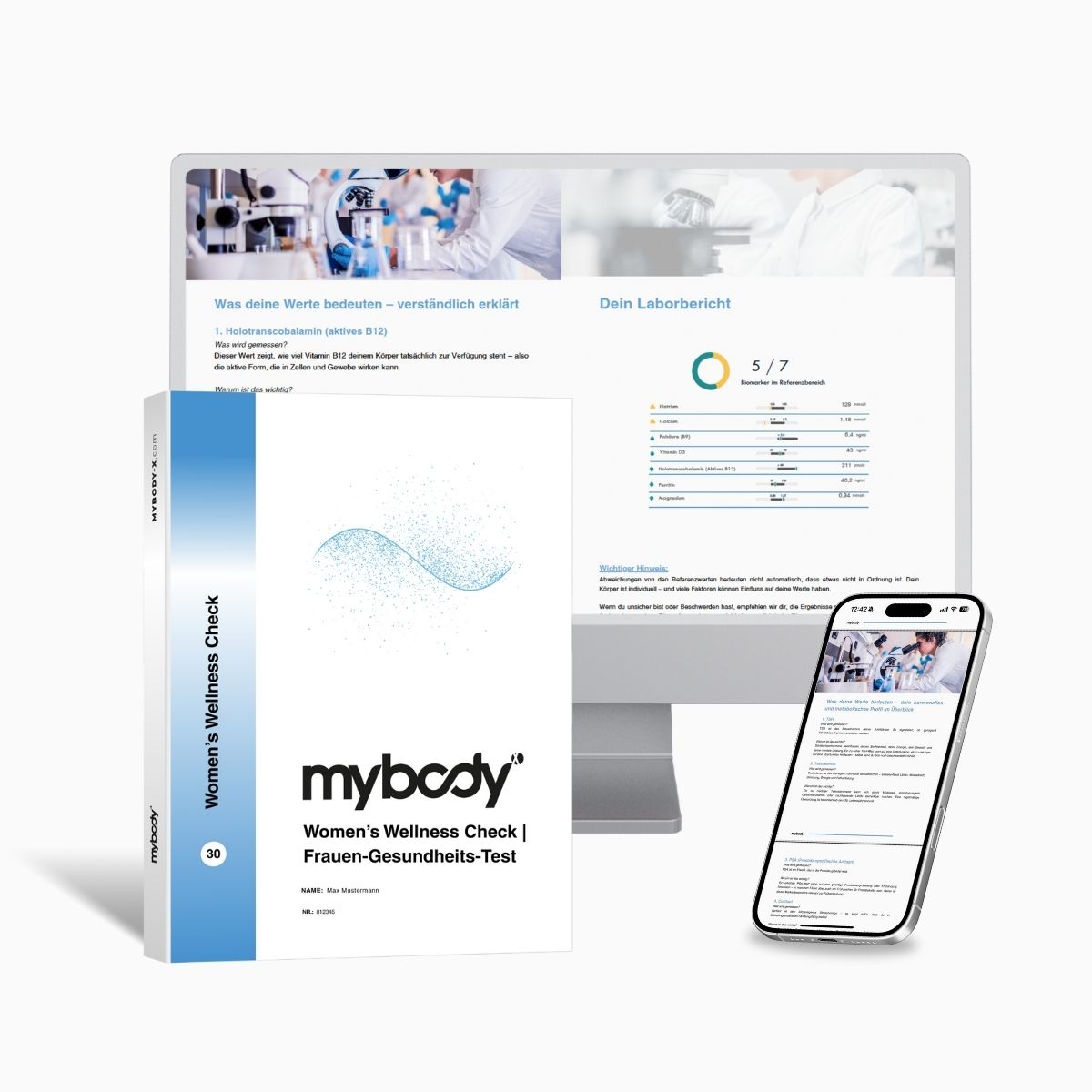
Women's Wellness Check | Women's Health Test
Measures 16 biomarkers from capillary blood, including TSH – the only value from the guideline-recommended basic diagnostic workup that can be measured from capillary blood – as well as free T3, free T4, HbA1c, ferritin, 25-OH vitamin D3, cortisol, and blood lipids. What the test does not do: It does not replace the basic diagnostic workup. A complete blood count, erythrocyte sedimentation rate or CRP, and liver values are not included – that is, three of the five recommended values. It does not provide a diagnosis and does not assess any of what the guideline asks about before laboratory testing: sleep, medication, alcohol, and psychological stress.
Price: €169.00 (instead of €199.00) · Sample type: Capillary blood · Processing time: Kit shipping 1–3 business days, laboratory analysis 3–5 business days after the sample is received · Laboratory: ISO-certified laboratory analysis in Germany
Women's Wellness CheckAll price and service information is current as of August 5, 2026. Prices and the scope of services may change; the relevant product page always governs.
And one point that is more important for this combination of symptoms than any product: The guideline lists mental disorders requiring treatment, especially depression and anxiety disorders, as well as sleep apnea syndrome and medication side effects, among the potentially dangerous courses that should not be overlooked. Treatable serious physical illnesses are rare and are practically always associated with abnormalities in the medical history or physical examination.
What ultimately matters
There is a roadmap for these four symptoms, and it does not begin with a list of nutrients. It begins with questions—about sleep, medication, alcohol, stress, and mood—and then moves on to five laboratory tests.
The most common cause is also the one people are least comfortable talking about. Depression and anxiety rank first at 18.5 percent, far ahead of anything that could be addressed with a vitamin supplement. Naming this openly is not reinterpreting the symptoms—it is reporting what the guideline says—and offers the best chance of avoiding months of searching in the wrong place.
Your specific next step: If the symptoms persist for more than two weeks, make an appointment at your primary care practice and bring two things with you—a list of your medications and an honest answer to the two screening questions. Both will move you forward faster than any test you order on your own beforehand.
And if the basic workup shows nothing abnormal: that is not a result that puts you back at square one. It tells you that the common organic causes have been ruled out—and marks the point at which the guideline calls for scheduled follow-up appointments rather than more individual tests.
Frequently asked questions
Which blood tests should I have done for fatigue?
The DEGAM S3 guideline for primary care names five: blood glucose, a complete blood count, erythrocyte sedimentation rate or CRP, transaminases or gamma-GT, and TSH (recommendation 5.3.1, as of 2022). Further tests should be performed only if preliminary findings are abnormal or if the basic workup reveals specific indications.
Why isn't vitamin D on the list?
Because the guideline makes a clear statement on this: Vitamin D deficiency is not correlated with increased fatigue (as of 2022). Consequently, vitamin D is not part of the recommended basic diagnostic workup. This does not mean the test is never useful—only that fatigue alone is not a reason to order it.
What is the most common cause of persistent fatigue?
Depression and anxiety rank first in the overview cited by the guideline, with an estimated prevalence of 18.5 percent. They are followed by other serious organic causes at 4.3 percent, anemia at 2.8 percent, and malignancies at 0.6 percent. The guideline therefore recommends asking screening questions about depression and anxiety disorders.
When should I see a doctor?
The guideline classifies mental disorders requiring treatment, sleep apnea syndrome, and medication side effects as potentially dangerous conditions that must not be overlooked—all of these need to be investigated. For depression, the IQWiG states that several main and additional symptoms must persist for two weeks or longer. Anyone who unintentionally falls asleep during the day, for example while driving, should not wait.
Can dietary supplements help with exhaustion?
The IQWiG states that a balanced and varied diet provides all the nutrients needed, making additional intake unnecessary (as of 2025). The consumer advice centre points out that nonspecific symptoms such as fatigue and difficulty concentrating can also result from inflammation, infections, stress, or lack of sleep. The guideline itself does not address dietary supplements.
Conversation first, then the values
Of the five values in the guideline, only TSH can be measured at home. A test can help you prepare for a doctor's appointment—but it cannot replace one with this combination of symptoms.
View the Women's Wellness Check TSH Self-TestYou might also be interested in
→ Which blood values are useful to check for fatigue
A more detailed look at laboratory testing if the basic diagnostic workup has already been completed.
→ Nutrient deficiencies causing fatigue and lack of energy
In cases where a deficiency has actually been identified.
Sources
- German College of General Practitioners and Family Physicians (DEGAM): S3 Guideline “Fatigue,” AWMF Registry No. 053-002, as of 2022 — register.awmf.org
- Institute for Quality and Efficiency in Health Care (IQWiG): Depression and What Is Burnout?, as of 2023 — gesundheitsinformation.de
- Institute for Quality and Efficiency in Health Care (IQWiG): Obstructive Sleep Apnea (2022), Iron Deficiency and Iron Deficiency Anemia (2023), and Dietary Supplements—Can They Also Be Harmful? (2025) — gesundheitsinformation.de
- Consumer Advice Center: Which vitamin deficiency tests are useful?, as of 2026 — verbraucherzentrale.de
Recommendation 5.3.1 concerning the five laboratory values, the recommendation for further diagnostic testing, the medical history content, all frequency figures including point estimates, the statement on vitamin D, the information on ferritin, the screening questions for depression and anxiety, the potentially dangerous courses of illness, and the sections on sleep, medication, and alcohol are taken from source [1]. The main and secondary symptoms of depression, the two-week period, and the distinction from burnout are taken from source [2]. The prevalence of obstructive sleep apnea and the statements on dietary supplements are taken from source [3]. The classification of nonspecific symptoms and the advice to consult a primary care practice are taken from source [4]. The screening questions are reproduced in substance because the guideline uses different wording in its long and short versions and refers to the National Disease Management Guideline for Depression; a verbatim quotation could not be assigned unambiguously here. The statement that ferritin, vitamin B12, and folic acid are not part of the basic diagnostic workup is a finding about the content of recommendation 5.3.1—the guideline does not provide a list prohibiting individual parameters. Product information comes from the mybody®x product pages, accessed on August 5, 2026.

mybody®x Editorial & Expert Team
Blood Values Laboratory Diagnostics Hormones
This article was created and medically reviewed by the mybody®x Editorial and Expert Team. The team brings together expertise in nutrigenetics, microbiome and gut science, blood test interpretation, nutritional science, and laboratory diagnostics.
Published on August 5, 2026 · Last updated on August 5, 2026
Medical information: This article is intended for general information and does not replace medical advice, diagnosis, or treatment. Persistent fatigue, lack of motivation, and low mood should be medically evaluated—especially if they persist for more than two weeks. If you feel depressed or have distressing thoughts, talk to your primary care physician; counseling centers and telephone counseling services are also available around the clock.




Share now:
How long does it take for vitamin D to work? Blood levels and well-being
Your weight isn’t going down: which values you should check