

Homocysteine: what the value means and what it leaves unanswered
The essentials at a glance
Homocysteine is an intermediate product of protein metabolism. It is produced when the amino acid methionine is metabolized and is normally processed onward quickly. The body needs folate, vitamin B6, and vitamin B12 for this.
If one of these vitamins is missing, the intermediate product builds up. The MSD Manual, Professional Edition, lists acquired causes as the most common reasons for hyperhomocysteinemia: folate deficiency, vitamin B6 deficiency, and vitamin B12 deficiency (as of July 2025).
You will first learn how the value arises. This is followed by a comparison of the three vitamins involved, the most important open question in the evidence, three common statements examined in a fact check, the conditions of measurement, and the limitations of a single measurement.
What to expect in this article
1. How homocysteine is produced and cleared
2. The three vitamins involved compared
3. Why the value is measured at all
4. The open question in the evidence
5. Three statements about homocysteine fact-checked
6. The conditions under which it is measured
7. What else can shift the value
8. Who may benefit from having it measured
9. What a capillary blood test can show here
10. Limitations: what the value does not answer
11. What matters about homocysteine
Frequently asked questions
Sources
How homocysteine is produced and cleared
Homocysteine is not a building block but an intermediate stage. It is produced when the body metabolizes the amino acid methionine, and it is not meant to remain there.
There are two pathways for further processing. Along one, homocysteine is converted back into methionine; along the other, it is converted into cysteine. Both pathways require helper substances, and these helper substances are B vitamins.
If a helper substance is missing, the conversion stalls. The intermediate product accumulates in the blood, and that buildup is precisely what the laboratory value measures.
A value that speaks about vitamins
This leads to a distinctive feature that sets this laboratory value apart from many others. An elevated homocysteine level primarily says something about the supply of three vitamins and only afterward about the blood vessels.
The MSD Manual, Professional Edition, clearly presents this sequence. The most common causes of hyperhomocysteinemia are acquired: folate deficiency, vitamin B6 deficiency, and vitamin B12 deficiency (as of July 2025).
In this context, acquired means caused by diet, absorption, or consumption rather than congenital. Congenital disorders of methionine metabolism also exist, but they are rare.
Why an intermediate product is meaningful at all
The usual way to check vitamin status is to measure the vitamin itself. Homocysteine takes a different approach: It does not measure the reserve, but the consequence.
This type of measurement is called a functional marker. It shows whether a metabolic step is actually taking place, rather than merely recording whether the required substance is present.
The advantage is obvious. A vitamin level in the blood can appear normal while utilization is impaired. A functional marker catches this case.
The disadvantage is equally clear and runs throughout the entire article. A marker that reflects three metabolic pathways at once does not say which one is impaired.
The three vitamins involved, compared
Three vitamins appear on the same list of causes. The table compares them according to the same four criteria.
| Criterion | Folic acid | Vitamin B12 | Vitamin B6 |
|---|---|---|---|
| Role in the metabolic conversion | Involved in the conversion of homocysteine back to methionine | Also involved in the conversion back to methionine | Involved in further conversion toward cysteine |
| In the list of causes | Yes, listed as an acquired deficiency | Yes, listed as an acquired deficiency | Yes, listed as an acquired deficiency |
| Directly measurable | Yes, through the folate level | Yes, measurable in the blood | Yes, measurable in the blood |
| What the homocysteine level tells us | It indicates a disorder without saying which of the three vitamins is deficient | The same applies: The level does not identify the missing vitamin | The same applies: only the individual levels distinguish the possibilities |
The last line is the decisive one. An elevated homocysteine level indicates that something is stalled in the metabolic conversion, but it does not say where.
Why the three vitamins are deficient at different rates
The three appear on the same list, but they reach the body by different routes, resulting in different risk profiles.
Vitamin B12 comes almost exclusively from animal-based foods and requires its own transport mechanism for absorption in the intestine. This creates two possible points of failure: intake and absorption.
Folic acid is found in green vegetables, legumes, and whole grains and is sensitive to heat. Vitamin B6 is widespread in many foods, which is why an isolated deficiency is less common.
In practice, this does not mean that the cause can be guessed. It means that questions about diet and digestion belong in the conversation when a level is elevated.
The answer ultimately comes only from measuring the individual levels. An elevated homocysteine level is the reason for this testing, not a substitute for it.
Why the value is measured in the first place
The reason for testing rarely lies with the vitamins. It lies with the blood vessels, and there is a described mechanism for this.
The MSD Manual states that hyperhomocysteinemia can lead to arterial thrombosis and venous thromboembolism by damaging vascular endothelial cells (updated July 2025). Endothelial cells form the innermost layer of blood vessels.
The same source also describes the reason for measuring it in clinical practice: The abnormality is detected by measuring fasting plasma homocysteine levels in patients with cardiovascular disease or thromboembolism in whom the disorder is suspected (updated July 2025).
There are two elements in this sentence. First, the requirement to be fasting. Second, the context in which the measurement is taken—namely, when there is an existing suspicion, not as a routine examination.
Why this matters for a self-test
The second point is more important for assessing a self-test. The medical literature describes targeted testing when there is an existing suspicion, whereas a self-test is the opposite: a measurement without a specific reason.
This does not amount to a rejection, but rather to a different set of expectations. Anyone who measures homocysteine without a specific suspicion gets a baseline value, not an answer to a diagnostic question.
And anyone who has a suspicion, for example after a thrombosis or in the presence of known cardiovascular disease, should take this question to a medical practice. There, the test is used in the context for which it is described.
This distinction runs through the entire topic. A value can be useful as a guide yet unsuitable for diagnostic evaluation, and both can be true at the same time.
The open point in the evidence
This is where it gets interesting, because the obvious conclusion is explicitly not supported by the sources.
First, what works: Plasma homocysteine levels can be normalized through supplementation with folic acid, vitamin B12, or vitamin B6, either alone or in combination (MSD Manual, Professional Edition, updated July 2025). So the level can be lowered.
Documented source
“However, it has not been shown that this therapy reduces the risk of arterial or venous thrombosis.”
Michael B. Streiff, MD
MSD Manual, Professional Edition, Hyperhomocysteinemia, updated July 2025
The sentence distinguishes between two things that are constantly conflated in everyday life. The value can be normalized, but it has not been shown that this also reduces the risk.
This is no minor detail. It is the difference between a value that indicates something and a value whose change would itself already have an effect.
Why this nevertheless does not argue against measuring it
The open question does not mean that the level is worthless. It means that it must be interpreted differently.
An elevated homocysteine level is first and foremost an indication to assess the supply of three B vitamins. This question is worthwhile regardless of what may later be said about vascular risk.
The level is therefore an indicator, not a target. Anyone who lowers it has changed a laboratory value. The sources reviewed do not say whether anything else has thereby been changed.
The difference between correlation and causation
Behind the open question lies an issue that repeatedly arises in medicine. A relationship between two observations does not yet mean that one causes the other.
A mechanism has been described through which homocysteine can cause harm. If an intervention targeting this level nevertheless does not change the outcome, there are several conceivable explanations.
It is possible that the level is more of an accompanying finding than a cause. It is also possible that correcting it comes too late or that other factors carry more weight. The sources reviewed do not say which of these explanations applies.
This very lack of knowledge is the information. It is included here because a neat answer at this point would promise more than the evidence supports.
Three statements about homocysteine in a fact check
These three statements regularly appear as soon as homocysteine is listed on a test result. All three can be assessed against the evidence.
Checked against the evidence
Common
“Lowering homocysteine protects the heart.”
Supported by evidence
The level can be normalized with folate, vitamin B12, or vitamin B6. It has not been shown that this treatment reduces the risk of arterial or venous thrombosis (MSD Manual, professional edition, as of July 2025).
Common
“A high level means vitamin B12 deficiency.”
Supported by evidence
The same source identifies folate deficiency, vitamin B6 deficiency, and vitamin B12 deficiency as the most common acquired causes (as of July 2025). The homocysteine level alone cannot distinguish among these three possibilities.
Common
“The time of day does not matter here.”
Supported by evidence
The evidence explicitly refers to fasting plasma homocysteine levels (as of July 2025). A value measured after eating is not readily comparable with the figures used as the basis for reference ranges.
The second point has a practical consequence. Anyone with an elevated value next needs the individual levels of the three vitamins—not a guess about which one is deficient.
The conditions under which it is measured
The most important condition is stated directly in the procedure’s name in the specialist literature.
The value can be lowered. It has not been shown that this also reduces the risk.
Fasting plasma homocysteine levels are discussed (MSD Manual, professional edition, as of July 2025). In laboratory medicine, fasting usually means that nothing has been eaten for several hours before the sample is collected.
The Institute for Quality and Efficiency in Health Care provides a general rationale for this practice: Some laboratory values, such as blood glucose, are elevated after eating, which is why it is important for certain tests to arrive for blood collection while fasting (as of 02/04/2025).
In practical terms, this means that for a self-test, the sample should be taken in the morning before the first meal, and the exact requirements are given in the instructions for the respective test. Without this condition, comparison with the reference range is uncertain.
What else can shift the value
In addition to vitamin status and fasting, there are other factors that should be noted.
Kidney function
Homocysteine is also excreted through the kidneys. If filtration performance declines, this can be reflected in the value even when no vitamin deficiency is present.
That is why kidney values should be included on the same test report. What cystatin C contributes and what creatinine overlooks is covered in the companion article Cystatin C: what the value reveals about your kidney function.
Medications
Various medications interfere with vitamin metabolism and can thereby affect the homocysteine value. Every preparation should therefore be listed on the note that accompanies the test result.
Which medication plays what role is determined in medical practice. A blog article cannot provide this assessment, which is why there is no list here.
Diet
Vitamin B12 is found predominantly in animal-based foods. Those who follow a purely plant-based diet therefore have one obvious additional question when an elevated homocysteine value appears.
This is not a statement against any particular diet, but an order of checks. The answer is not provided by the homocysteine value, but by the adjacent B12 value.
What you note about the test result
Five lines are enough, and they cost nothing. The date and time of the sample collection, whether you were fasting, all preparations you took in recent weeks, your diet in keywords, and anything unusual.
For this value, the second line is the most important. Because the evidence is based on fasting values, it determines whether your result fits within the reference range at all.
The same rule applies to any later comparison as to any other trend value: the same conditions, preferably the same laboratory, and a note of both occasions.
Who may benefit from the measurement
Homocysteine is not a value measured in every routine examination. The comparison makes this clear in both directions.
Worthwhile for you if …
You want to assess your B-vitamin status and read the value as one indication among several.
You want to establish a baseline value with a date against which something can be compared later.
You want to bring figures to a consultation instead of collecting them for the first time at the initial appointment.
You can arrange for the sample to be collected one morning before your first meal.
Not recommended if …
There is a suspicion of thromboembolism or cardiovascular disease. This requires prompt medical attention.
You hope that lowering the value itself will protect you. It has not been shown that lowering it reduces the risk of thrombosis.
You want to interpret the value without the associated vitamin levels. It does not identify the missing vitamin.
The sample cannot be collected while fasting. In that case, comparison with the reference range is uncertain.
What a capillary blood test can show here
A capillary blood self-test does not provide a diagnosis or predict cardiovascular risk. It shows where several values stand at a given point in time.
A test by mybody®x (MYBODY Lab GmbH) measures homocysteine. What it does and what it lacks on this topic is stated in the card.
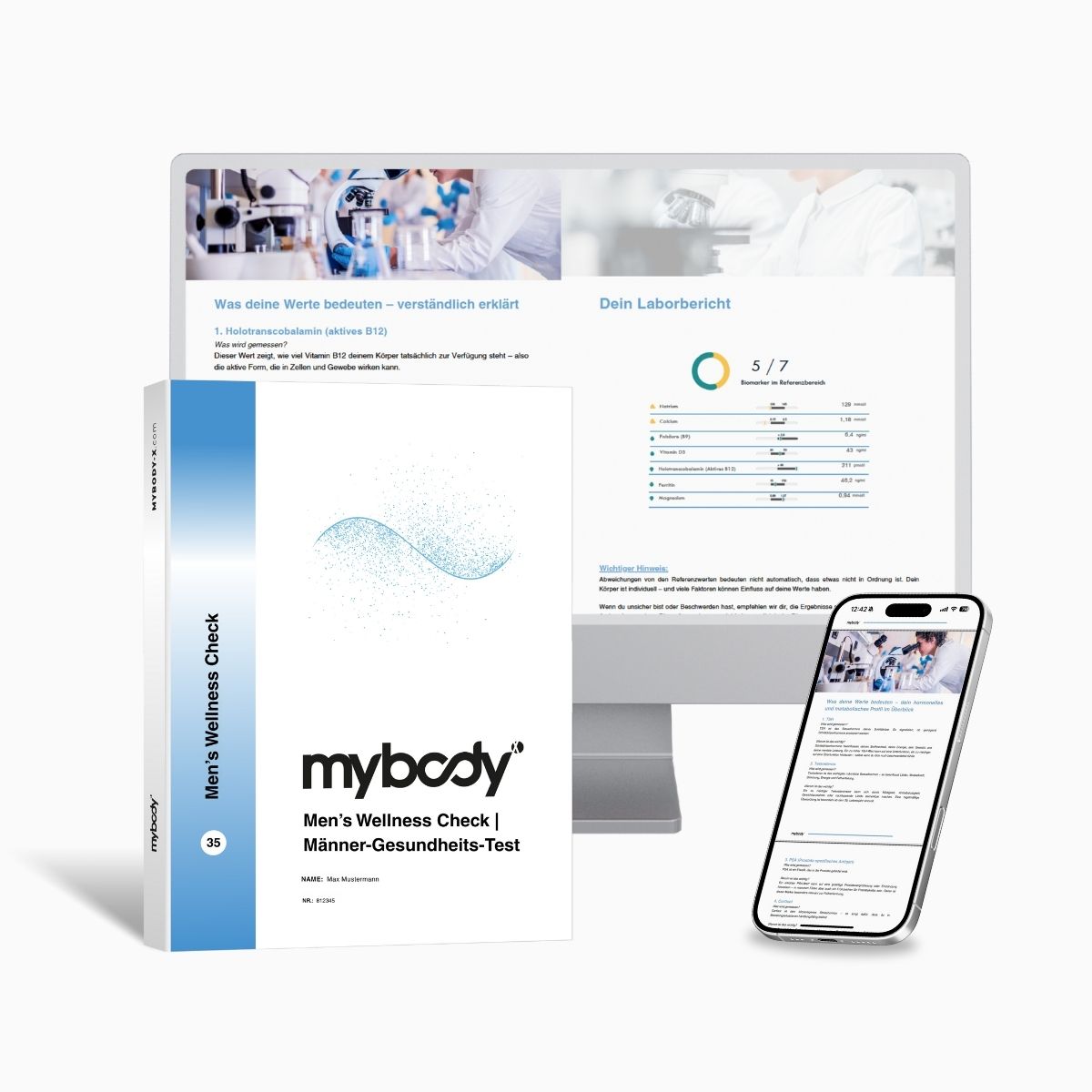
Capillary blood test
Men’s Wellness Check | Men’s Health Test
It measures 17 values, including homocysteine, as well as the cholesterol profile, lipoprotein, CRP, cystatin C as a kidney marker, gamma-GT and GPT, long-term blood sugar, ferritin, vitamin D, TSH, testosterone, cortisol, and PSA. What the test does not measure: it includes neither vitamin B12, folic acid, nor vitamin B6. An elevated homocysteine level therefore cannot be attributed to one of the three most common causes based on this result alone. It does not provide a diagnosis, predict cardiovascular risk, or replace a medical examination.
Laboratory analysis 3–5 business days after sample receipt
Product page information, accessed 13 August 2026
Four points determine whether a measurement becomes useful information.
Measure while fasting
The evidence concerns fasting plasma homocysteine levels.
Review the vitamin values alongside it
Only B12, folate, and B6 show which of the three causes applies.
Check the kidney values
Reduced filtration function may be reflected in the value.
Discuss anything unusual
An elevated value belongs with the report in a medical practice.
Chapter at a glance
A capillary-blood self-test provides a point-in-time homocysteine value and does not predict cardiovascular risk. The individual values of the three B vitamins are needed to determine the cause of an elevated value. Four points are crucial: measure while fasting, review the vitamin values alongside it, check the kidney values, and discuss anything unusual.
Limitations: what the value does not answer
The first limitation is the most important and is stated verbatim in the sources. It has not been shown that lowering the value with B vitamins reduces the risk of arterial or venous thrombosis (MSD Manual, professional edition, updated July 2025).
The second limitation is the lack of attribution. An elevated value does not identify which of the three vitamins is deficient, and without the individual values, that question remains unanswered.
The third limitation concerns thresholds. In the sources we reviewed, we found no consistent figure for the level at which hyperhomocysteinemia is diagnosed. That is why no figure is given here; the reference range of the laboratory performing the analysis is what matters.
The fourth limitation is prediction. A laboratory value describes a state and does not predict an event. Anyone seeking to derive a personal risk score from it is asking the value to do something it cannot do.
What the value nevertheless contributes as part of the overall picture
Four open points may sound like little practical benefit. The value lies somewhere else, rather than where most texts on this subject suggest.
Homocysteine is a functional marker of how three B vitamins are utilized. This question is meaningful in its own right, regardless of what can be said about vascular risk.
Then there is the trend over time. A baseline value with its date and the conditions under which the sample was taken can be compared with a second value a year later, and a change is information that a single value can never provide.
And finally, the context. In a report containing a cholesterol profile, CRP, blood glucose, and kidney values, homocysteine appears alongside measurements that help put one another into perspective. On its own on a piece of paper, it says far less.
What matters when it comes to homocysteine
If you take away one action from this article, let it be this: Treat an elevated homocysteine level as a question about your B vitamins, not as a statement about your blood vessels.
The reason is stated in the sources themselves. The most common causes are acquired vitamin deficiencies, and it has not been shown whether correcting these deficiencies changes vascular risk.
At the beginning was the question of what the level means. The most honest answer is: It indicates a disruption in the conversion process, does not identify it more specifically, and the most obvious conclusion from this is explicitly left open in the reviewed sources.
That is unsatisfying, but it reflects the state of the reviewed sources. A text that gave a clearer answer at this point would be drawing it not from the sources, but from the desire for a clearer answer.
What remains is still useful. An elevated level is a reason to have your levels of the three B vitamins checked, and this testing produces results that can be acted on.
Frequently asked questions
What does an elevated homocysteine level mean?
That the conversion of the amino acid methionine is impaired. The MSD Manual, professional edition, identifies acquired causes as the most common reasons: folate deficiency, vitamin B6 deficiency, and vitamin B12 deficiency (as of July 2025). The level alone does not indicate which of the three vitamins is deficient. The reference range stated on your own laboratory report is decisive for interpretation.
Does treatment with B vitamins reduce the risk of a heart attack?
Homocysteine levels can be normalized with folic acid, vitamin B12, or vitamin B6, either alone or in combination. However, this treatment has not been shown to reduce the risk of arterial or venous thrombosis (MSD Manual, as of July 2025). Whether to take supplements is decided by the medical practice, not by a laboratory value alone.
Do I need to fast for the homocysteine test?
The evidence explicitly concerns fasting plasma homocysteine levels (MSD Manual, as of July 2025). IQWiG generally states that for some tests, it is important to come to the blood draw fasting (as of April 2, 2025). The specific requirement is stated in the instructions for the respective test.
How is homocysteine related to the blood vessels?
The MSD Manual describes that hyperhomocysteinemia can lead to arterial thrombosis and venous thromboembolism by damaging vascular endothelial cells (as of July 2025). This is a described mechanism. It does not answer how high the personal risk is at a particular level, nor does it predict an event.
When is the level measured in everyday medical practice?
The abnormality is detected by measuring fasting plasma homocysteine levels in patients with cardiovascular disease or thromboembolism in whom the disorder is suspected (MSD Manual, as of July 2025). Thus, this is a targeted examination when there is an existing suspicion, not a routine examination for everyone.
Next step
Establish a baseline value with the date
If you want to assess homocysteine together with your cholesterol profile, CRP, and kidney values, the Men’s Wellness Check measures these values from capillary blood. It does not measure B vitamins, provide a diagnosis, or replace medical evaluation.
Go to the Men’s Wellness CheckRead more
You might also be interested in
One of the three vitamins from the list of causes, discussed in detail.
The kidney value that should be considered alongside homocysteine.
Sources
- MSD Manual, Professional Edition: Hyperhomocysteinemia, Streiff MB (as of July 2025) – msdmanuals.com
- Institute for Quality and Efficiency in Health Care (IQWiG): Understanding Laboratory Values Correctly, as of 02.04.2025 – gesundheitsinformation.de
The verbatim quotation regarding the lack of evidence for risk reduction, the list of the most common acquired causes, the statement that B vitamins normalize the level, the description of the mechanism involving endothelial cells, and the reference to fasting plasma homocysteine levels are taken from source [1]. The information about fasting before blood collection and the explanation of the reference range are taken from [2]. We found no reliable figure for a uniform threshold for hyperhomocysteinemia in the sources reviewed; therefore, none is included in the text. Information on price, values, sample type, and laboratory comes from the mybody®x product page, accessed on 13.08.2026; processing times follow the central requirements for blood tests. All sources were accessed and reviewed on 13.08.2026.

mybody®x Editorial & Expert Team
Laboratory diagnostics Blood analysis interpretation Nutritional science Nutrigenetics
This article was created by the mybody®x editorial and expert team. The team combines laboratory diagnostics, nutritional science, and the interpretation of blood analyses. Everyone involved can be found on the authors page.
Published on 13.08.2026 · Last updated on 13.08.2026
The content is provided for general information and does not replace medical advice, diagnosis, or treatment. Reference ranges depend on the laboratory, method, and age—the information on your report is always authoritative.




Share now:
Free testosterone or total testosterone: what the difference means
Perimenopause: Which hormone levels change first