
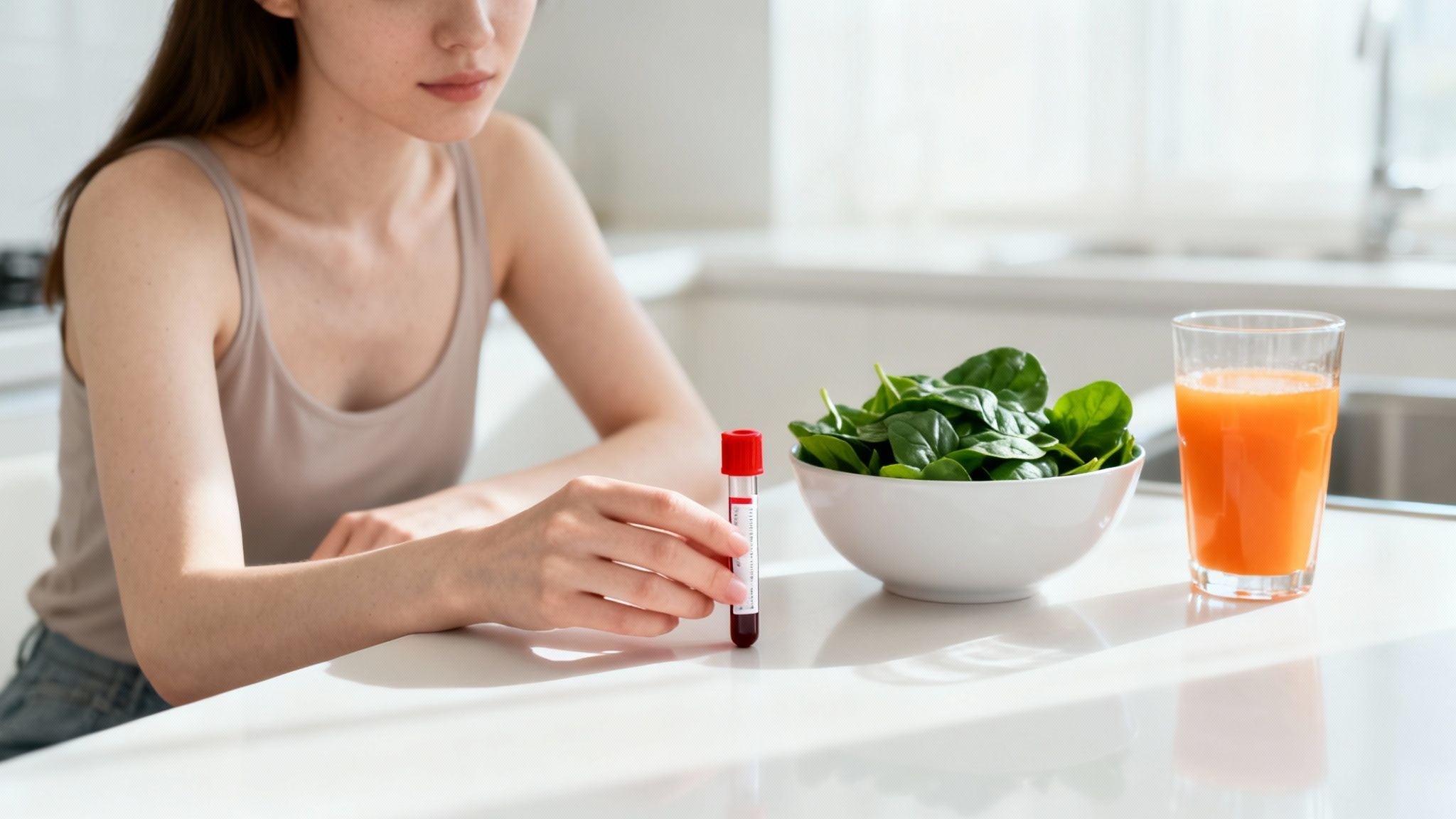
Do you often feel exhausted and lacking energy, even when you have actually had enough sleep? This unexplained fatigue and a general feeling of weakness that makes everyday life a burden are the most common symptoms of iron deficiency in women. The tricky part is that you may quickly blame the signs on stress or a busy schedule, overlooking the real cause.
Your energy level at zero: Why iron deficiency is often the cause

It is best to think of iron as the ignition key for energy production in your cells. Without this key, your body's engine simply cannot start properly. Iron is the central building block of hemoglobin, the red blood pigment that transports vital oxygen from your lungs to every cell in your body—from your brain to your toes.
When there is too little iron, this oxygen transport system starts to falter. Your cells do not get enough “fuel” to generate energy efficiently. You feel the effects immediately: You feel constantly tired, drained, and unable to concentrate. Your internal battery seems to be permanently empty.
Women are particularly affected
Women in particular are especially susceptible to iron deficiency for entirely natural, biological reasons. The causes span many different phases of our lives:
- Menstruation: Monthly blood loss also means losing valuable iron stores. A heavy or prolonged period can completely deplete your reserves.
- Pregnancy and breastfeeding: During this time, your iron needs skyrocket because it is needed not only to support your own body but also your growing baby.
- Dietary habits: A vegetarian or vegan diet can increase the risk of deficiency if you do not make a deliberate effort to include iron-rich plant sources and ensure optimal absorption.
Iron deficiency is not a condition you simply have to accept. It is one of the most common—and also one of the most treatable—causes of chronic fatigue in women.
This constant exhaustion is more than just an unpleasant feeling. It robs you of your performance at work, your patience in everyday family life, and your enjoyment of your hobbies. The first and most important step toward feeling better is to finally take your body's subtle signals seriously and stop dismissing this leaden fatigue as “normal.”
Knowing which blood values are truly meaningful when you are tired can help you target the underlying cause. A simple blood test can often provide clarity. Instead of waiting weeks for a doctor's appointment, you can also check your levels yourself. With the mybody-x iron deficiency test, you can quickly and easily gain certainty and take back control of your energy and well-being.
The most common signs of iron deficiency in women

Iron deficiency symptoms in women: How to recognize the important warning signs
Iron deficiency is a master of disguise. Its signs often creep into your everyday life so quietly that you quickly dismiss them as side effects of stress or too little sleep. But your body is sending you clear signals—you just need to learn how to interpret them.
When you understand what your body is trying to tell you, you can recognize early when it is time to act. It is about much more than just fatigue.
The typical physical warning signs
The best-known signs of iron deficiency are often reflected directly in your appearance. Since iron is essential for forming red blood cells and therefore supplying oxygen throughout the body, the skin, hair, and nails are affected first when the supply falters.
Pay attention to these changes:
- Pale skin: Noticeable paleness, especially on the face and the inside of the eyelids, is a classic sign. A lack of hemoglobin—the red pigment in blood—causes your skin to lose its healthy, rosy color.
- Brittle nails and hair loss: Your nails may develop ridges, break more easily, or, in the worst case, even curve inward (so-called spoon nails). At the same time, your hair often becomes dull and brittle, and you may notice more hair left in your brush than usual.
The connection between iron deficiency and hair loss is a sensitive topic for many women. Find out more in our article about how you can specifically counteract hair loss caused by iron deficiency.
When your mind no longer cooperates
Iron deficiency does not just slow your body down—it also affects your mental performance. A lack of oxygen in the brain quickly becomes noticeable and can seriously disrupt your everyday life.
Psychological and neurological symptoms often include:
- Difficulty concentrating: Are you finding it increasingly difficult to stay focused or constantly forgetting little things? This can be a direct sign that your brain is not getting enough oxygen.
- Inner restlessness and irritability: While crushing fatigue is a key symptom, many women also feel restless and nervous inside. Increased sensitivity to stress and becoming irritable more easily may also be attributable to iron levels.
- Dizziness and headaches: Frequent headaches or that faint, dizzy feeling, especially when standing up quickly, are also widespread symptoms.
Did you know? Women are disproportionately affected by iron deficiency. In fact, approximately 75 percent of all people with iron deficiency in Germany are female. While around 20 to 25 percent of the global population is affected, roughly one in ten women in Germany suffers from a deficiency.
Symptoms you often overlook
In addition to the well-known classic symptoms, there are many signs that you would not immediately associate with iron deficiency. Yet these nonspecific signals in particular can provide the crucial clue when viewed as a whole.
These often-overlooked warning signs include:
- Cold hands and feet: Do you constantly have ice-cold feet, even in warm rooms? Poorer circulation caused by the lack of oxygen may be the reason.
- Shortness of breath during exertion: Do you find yourself gasping for air just while climbing stairs? When your body cannot transport enough oxygen, it tries to compensate by breathing faster.
- Restless legs syndrome: This unpleasant tingling or strong urge to move the legs, especially in the evening during periods of rest, may indicate iron deficiency in the brain.
- Cracked corners of the mouth and burning tongue: Painful cracks at the corners of the mouth (angular cheilitis) or an inflamed, burning tongue are also typical signs of a nutrient deficiency.
The following table gives you a quick overview of how the signs can vary depending on the severity of the deficiency—from depleted stores to manifest anemia.
Typical symptoms of iron deficiency at a glance
This table summarizes the most common physical and psychological signs of iron deficiency to give you a quick overview.
| Symptom category | Common signs | What happens in the body |
|---|---|---|
| Physical Signals | Constant fatigue, paleness, hair loss, brittle nails, shortness of breath, cold hands and feet | Your body does not have enough hemoglobin to transport oxygen efficiently. Cells, skin, and hair suffer as a result. |
| Psychological & Neurological Signals | Difficulty concentrating, irritability, inner restlessness, headaches, dizziness, restless legs syndrome | The brain does not receive enough oxygen, which affects cognitive performance and mood. |
The variety of symptoms makes it clear how important it is to listen closely to your body. If you recognize several of these signs in yourself, iron deficiency could be the cause. However, only a close examination of your blood values can provide absolute certainty.
Why women are so susceptible to iron deficiency
Why is it almost always us women who struggle with low iron levels? The answer lies deep in our biology and the unique life stages we go through. While men's iron balance remains relatively constant, ours is in a constant state of flux.
The most obvious reason is, of course, our monthly period. Every single cycle is a small but steady strain on our iron stores. This regular blood loss accumulates over the years and naturally makes us more susceptible to deficiency.
Your period: the hidden iron thief
With every menstrual period, you lose not only blood but also a substantial amount of valuable iron. If your period is particularly heavy or lasts a long time (menorrhagia), this loss can become so great that you can hardly make up for it through your diet.
Think of it as a monthly deficit in your iron account. If you do not actively replenish this account with iron-rich foods, you will slowly but surely slip into a deficiency. This is by far the most common cause of iron deficiency in women of childbearing age.
Pregnancy and breastfeeding: Double the demand
Pregnancy and breastfeeding are among the most beautiful, but also most demanding, phases in a woman's life. During this time, your body is working at full capacity, as it must provide for not only itself but also an entirely new life. Your iron requirement shoots through the roof.
- During pregnancy: Your blood volume increases by almost 50 % to optimally supply the growing baby and placenta. To produce all these additional red blood cells, your body needs a huge amount of iron.
- During breastfeeding: Through breast milk, you provide your child with important iron for their development. This further depletes your own reserves, which are often already compromised after giving birth.
Pregnancy in particular is a decisive factor that massively increases both the need for iron and the risk of deficiency. If you would like to learn more about the effects of pregnancy on the body, you will find valuable information here. Without consciously adjusting your diet or taking targeted supplements, a deficiency during these phases is almost inevitable.
Dietary and lifestyle factors
In addition to purely biological factors, our lifestyle and eating habits naturally also play a decisive role. Health-conscious women who choose a plant-based diet in particular need to pay close attention here.
The body absorbs plant-based iron (non-heme iron) much less efficiently than animal-based iron (heme iron). A vegetarian or vegan diet can quickly deplete iron stores if you don't know exactly how to combine foods strategically to improve absorption.
Women lose an average of about 15 milligrams of iron with each menstrual period. This results in a daily iron requirement of about 2 milligrams—twice as much as men, who need only around 1 milligram per day. During pregnancy and breastfeeding, requirements can increase by up to 100 percent.
Intense exercise can also increase iron requirements. You lose minerals through sweating, and tiny muscle injuries use iron for repair processes.
Unnoticed health problems
Sometimes, however, the cause lies deeper and is not immediately apparent. Certain health problems can interfere with iron absorption in the intestines or cause unnoticed blood loss.
These include, for example:
- Chronic inflammatory bowel diseases: Conditions such as Crohn's disease or ulcerative colitis can damage the intestinal lining and severely impair iron absorption.
- Celiac disease (gluten intolerance): Undiagnosed celiac disease also damages the lining of the small intestine, the main site of iron absorption.
- Growths in the uterus (fibroids): Benign fibroids can cause extremely heavy and prolonged menstrual bleeding, triggering chronic iron deficiency.
These specific risk factors show why it's so important to take a close look at your personal situation. If one or more of these points apply to you, you should definitely keep an eye on your iron levels. A simple blood test, such as the mybody-x iron deficiency test, quickly and easily gives you clarity about how well your stores are replenished. This allows you to take proactive action before serious iron deficiency symptoms in women become noticeable.
How to reliably check your iron status
Do some of the described iron deficiency symptoms in women sound familiar? Then the next logical step is to get clarity. But how can you reliably find out whether your iron stores are running low? A vague suspicion won't get you anywhere—you need solid data.
The good news is that you don't have to wait weeks for a doctor's appointment. The path to certainty can begin right at home. It's about taking charge of your health again and better understanding your body's signals.
Which blood values really matter
When it comes to iron deficiency, there is often considerable confusion. Many people believe that measuring the iron level in the blood alone is enough. But this value is like a snapshot of traffic on the highway—it fluctuates greatly from hour to hour and says little about your actual iron status.
Two other markers are much more important because they give you a truly clear picture:
- Ferritin: This is the all-important value. Think of ferritin simply as the warehouse for your iron. This value shows how well your iron stores are actually filled. A low ferritin level is the first and most reliable sign of developing iron deficiency—often long before any other values become abnormal.
- Hemoglobin (Hb): This value measures the amount of red blood pigment. If the Hb level is too low, this is called anemia, or a lack of blood. However, this only happens at an advanced stage, when the iron stores (ferritin) have already been completely empty for quite some time.
Another relevant value is transferrin saturation. It indicates what percentage of the iron transport protein in your blood is actually loaded with iron. Low saturation also supports the diagnosis of a deficiency.
Your ferritin level is your personal early-warning system. It detects a deficiency before it develops into full-blown iron-deficiency anemia and the symptoms severely restrict you in everyday life.
The easy way to greater certainty: a self-test for home use
You don't have to remain in the dark until you finally get an appointment at the doctor's office. With a self-test for home use, such as the mybody-x iron deficiency test, you can check your levels independently, quickly, and discreetly. The process is incredibly simple and designed so that anyone can carry it out easily.
With just one tiny blood sample from your fingertip, you create the basis for a precise analysis. You conveniently send the sample to our certified laboratory, where the values that really matter are determined—above all your stored iron level (ferritin).
This method puts you back in control. You receive an easy-to-understand report that shows you exactly where you stand. This enables you to make informed decisions about your health—whether by making targeted changes to your diet or having an equal-footing conversation with your doctor based on concrete data.
When a test is particularly useful
Certain life circumstances and habits significantly increase the risk of depleted iron stores. In addition to menstruation and pregnancy, there are other factors that can strain your iron reserves. Chronic bleeding in the gastrointestinal tract, regular blood donations, chronic inflammatory diseases, intensive exercise, and a vegetarian or vegan diet are significant risk factors for iron deficiency in women. You can read more about the connections on the website of the National Association of Statutory Health Insurance Physicians.
If one or more of these points apply to you and you also notice typical symptoms, having your levels checked is an important preventive step. You can find comprehensive information about the various options in our guide to the best iron deficiency testing methods. A test gives you the clarity you need to take timely, targeted action before a deficiency noticeably affects your quality of life.
A practical strategy for replenishing your iron stores
Okay, the results are in: iron deficiency. But there is no reason to worry; this is your starting point for a truly positive change. With the right plan, you can deliberately replenish your stores, leave the bothersome iron deficiency symptoms in women behind, and reclaim your quality of life. Think of this section as your personal guide to getting back to your full strength.
The first and most important building block is always your diet. But this is not only about what you eat; above all, it is about how you eat it. Your body cannot utilize every form of iron equally well. There are two types, and you should definitely know about them.
The two sides of iron: heme iron and non-heme iron
Your body has a very clear preference: heme iron. It is found exclusively in animal products such as meat, fish, and poultry and is, so to speak, the VIP pass for your body. It can absorb it directly and very efficiently, without any detours.
Plant-based foods such as lentils, oatmeal, or spinach, on the other hand, contain non-heme iron. This form is also extremely valuable, but the body must first convert it in an intermediate step before it can use it. This process is more complex and, unfortunately, also more susceptible to disruption.
Your secret trick: Vitamin C as an absorption booster
And this is precisely where the key factor comes into play, allowing you to multiply your iron absorption: vitamin C. This vitamin is the best friend of non-heme iron. It transforms poorly absorbed plant-based iron into a form that your intestines can absorb with ease.
A small amount of vitamin C at the right time can increase iron absorption from plant-based sources by three to four times. A glass of orange juice with your muesli or a few strips of bell pepper in your lentil salad can therefore make a huge difference.
Conversely, there are also genuine “iron blockers”—substances that inhibit absorption. These include the tannins in coffee and black tea, as well as the calcium in dairy products. It’s therefore best to enjoy your coffee one to two hours apart from your iron-rich meal.
This practical overview helps you combine iron-rich foods cleverly and avoid the typical “iron blockers.”
Iron-rich foods and absorption tips
| Foods (animal-based) | Foods (plant-based) | Pairing tip (vitamin C) | To avoid (iron blockers) |
|---|---|---|---|
| Beef, liver | Lentils, chickpeas | Bell peppers, broccoli | Coffee, black tea |
| Tuna, salmon | Oatmeal, quinoa | Orange juice, lemon juice | Dairy products |
| Chicken, turkey | Spinach, Swiss chard | Strawberries, kiwi | Red wine (tannins) |
| Eggs | Pumpkin seeds, sesame | Tomatoes, parsley | Calcium supplements |
Remember: It’s about smart combinations, not giving things up. A small squeeze of lemon over a lentil dish or a few berries in your muesli are simple habits with a big impact.
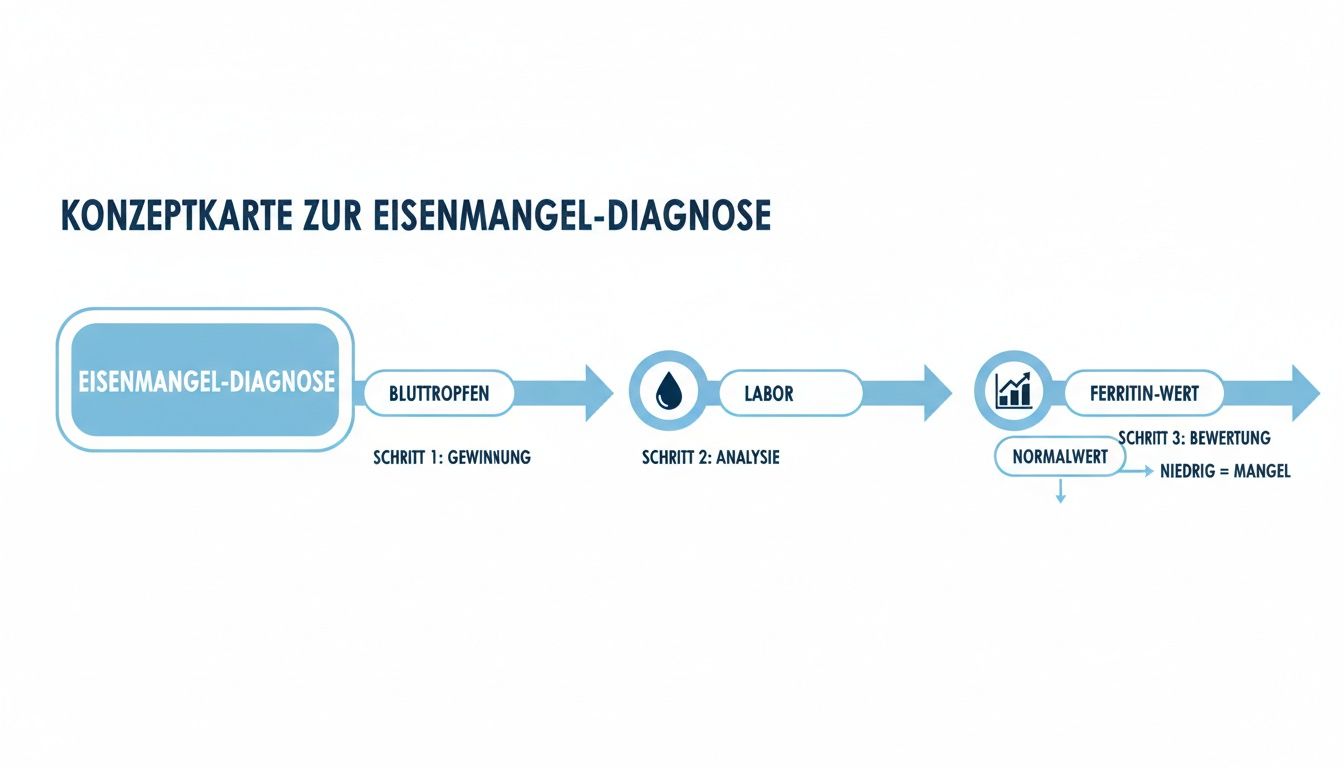
The process, from drawing blood through laboratory analysis to evaluating your ferritin level, is straightforward and finally gives you clarity about the true state of your iron stores.
When dietary supplements make sense
To be completely honest: Sometimes changing your diet alone is not enough to replenish severely depleted stores. Especially not if you are already experiencing noticeable symptoms such as constant fatigue or hair loss. In such cases, high-quality iron supplements are a sensible and often necessary form of support.
However, never take iron supplements on a whim! Self-medication without a prior blood test can even be dangerous, as too much iron can also harm the body. Only a test, such as the mybody-x iron deficiency test, gives you the necessary reassurance and a clear basis for the correct dosage.
When choosing a supplement, look for a well-tolerated form, such as iron bisglycinate. These compounds are often much gentler on the stomach than conventional iron salts and are less likely to cause side effects such as nausea or constipation. Taking it on an empty stomach with a glass of vitamin C-rich juice also optimizes absorption and brings you one big step closer to your goal—full iron stores and renewed energy.
Frequently asked questions about iron deficiency in women
Now that we have taken an in-depth look at iron deficiency, a few very specific questions often remain. Here you will find the most important answers, presented briefly and clearly, so you can resolve any final uncertainties and start moving forward full of energy.
How long does it take to replenish iron stores?
Replenishing your iron stores is not a sprint but more of a marathon, so you will need a little patience. Exactly how long it takes depends largely on how depleted your stores were and which strategy you follow.
As a rough guide, you can use this timeline:
- First improvement in symptoms: You will often notice the first positive change after just two to four weeks of targeted treatment (through diet or supplements). The debilitating fatigue subsides, and you gradually start to feel like yourself again.
- Normalization of blood values: If you already had anemia, it usually takes about two to three months for your hemoglobin level (Hb) to return to the normal range.
- Fully replenishing iron stores: It can easily take three to six months for your ferritin level—that is, the indicator of how full your iron stores are—to return to an optimal level. This is the most important step in preventing you from becoming deficient again right away.
Can I meet my iron needs solely through a vegan diet?
Yes, absolutely! However, it does require a little know-how and careful planning. Plant-based iron (non-heme iron) is naturally a little harder for the body to absorb than animal-based iron. The key to success lies in combining foods strategically.
The most important principle is: always combine iron-rich plant foods such as lentils, tofu, oats, or pumpkin seeds with a source of vitamin C. A glass of orange juice with your cereal, bell peppers in a lentil salad, or a squeeze of lemon over spinach acts like a turbo boost for iron absorption.
At the same time, you should make sure not to consume “iron blockers” such as coffee, black tea, or dairy products at the same time as your iron-rich meal. Regularly checking your ferritin level with an at-home test provides additional reassurance when following a vegan diet.
What role does ferritin play in the diagnosis?
The ferritin level is by far the most important and informative marker for detecting iron deficiency early and reliably. Think of it as your body’s fuel gauge for iron.
It is so important because it can indicate a deficiency even when other values, such as hemoglobin (Hb), are still completely normal. A normal Hb level can give you a false sense of security while your iron stores are already running low in the background. A low ferritin level, on the other hand, is a clear warning signal that action is needed—long before definite iron-deficiency anemia develops. It is your personal early-warning system.
What is the best time of day to take iron supplements?
To get the most out of your iron supplement and tolerate it as well as possible, timing is crucial. The general recommendation is to take iron in the morning on an empty stomach, about 30 to 60 minutes before breakfast.
The reason is simple: Without other food components in the stomach, the body can absorb iron most effectively. Ideally, take it with a glass of water or a vitamin C-rich juice (such as orange juice) to further boost absorption.
If you have a sensitive stomach and do not tolerate the supplement well on its own, you can exceptionally take it with a small, light meal. However, avoid combining it directly with dairy products, coffee, or tea.
Can too much iron be harmful?
Yes, definitely. Although iron is essential for life, too much can be toxic to the body. The problem is that our bodies have no efficient way to get rid of excess iron. Instead, it accumulates in organs such as the liver, heart, and pancreas, where it can cause serious long-term damage.
That is why it is extremely important to never take iron supplements based on mere suspicion and without a prior blood test. Taking them independently without medical advice or a well-founded diagnosis can do more harm than good.
A blood test like the one from mybody-x gives you the reassurance you need. It ensures that you only take supplements when they are truly necessary—and at exactly the right dosage.
Do you finally want clarity about your iron status and the cause of your fatigue? At mybody-x, we support you in taking control of your health. Our at-home nutrient tests give you precise insights into your levels and clear, easy-to-understand recommendations for what to do next. Discover the self-tests from mybody-x.com now and start your journey toward more energy and well-being.
Share now:
Losing Weight Despite Hypothyroidism: Your Practical Guide to Success
Hot flashes long after menopause: What’s really behind them