

Top provider of ISO-certified health laboratory tests: Experts by your side!
The essentials at a glance
A provider demonstrably works with specialists when it discloses three things: which laboratory analyzes the samples, which standard that laboratory follows, and who provides the professional interpretation of the results. “ISO-certified” alone is not a verifiable statement as long as the standard number is missing. Only that number tells you what was assessed.
This page explains what ISO 15189 and ISO/IEC 27001 stand for, why the two standards regulate completely different things, and how, within a few minutes on a product page, you can tell whether a test is actually backed by professional expertise or merely by a seal in the footer.
Chapters 1 and 2 explain the standards, Chapter 3 provides six assessment criteria, and Chapter 4 applies them openly to the provider itself. Chapter 5 explains what a certificate cannot guarantee. If you’re in a hurry, skip to the quick check in Chapter 6.
What to expect on this page
1. What does “ISO-certified” mean for a health test?
2. ISO 15189, ISO 27001, and GDPR compared
3. How can you recognize a genuine team of specialists?
4. How mybody® measures up against these criteria
5. What a certificate does not guarantee
6. Check providers in five minutes
Conclusion
Frequently asked questions
Sources
What does “ISO-certified” mean for a health test?
ISO is not a seal of quality for test results. The International Organization for Standardization publishes standards for processes—and depending on the number, these standards regulate completely different things. An organization that only states “ISO-certified” is therefore not making a verifiable claim, strictly speaking.
Two numbers are relevant for health tests. They are regularly mixed up on product pages, even though they have nothing to do with each other.
ISO 15189 – the standard for medical laboratories
ISO 15189 is entitled “Medical laboratories — Requirements for quality and competence,” meaning requirements for the quality and competence of medical laboratories. The current fourth edition dates from December 2022. It is the standard that actually says something about a laboratory’s work: about management systems, the assessment of professional competence, and the recognition of this competence by users, authorities, and accreditation bodies. Point-of-care testing is also within its scope.
ISO/IEC 27001 – the standard for information security
ISO/IEC 27001 is formally titled “Information security, cybersecurity and privacy protection — Information security management systems — Requirements,” current edition from October 2022. It regulates how a company handles information: access rights, encryption, and contingency plans. This is important for health data. It says nothing about the quality of a laboratory analysis.
Anyone who cites both numbers is thereby making two separate commitments. Anyone who cites only one and then generally derives “certified analyses” from it is stretching the claim beyond what was actually assessed.
Certified or accredited—the distinction hardly anyone mentions
The two terms sound interchangeable, but they refer to different procedures. Certification confirms that a management system complies with the requirements of a standard. Accreditation goes further: It certifies professional competence for specific testing procedures and is granted in Germany by a state-authorized body.
This body is the German Accreditation Body (DAkkS), which describes itself as “the national accreditation authority of the Federal Republic of Germany.” Accreditation under DIN EN ISO 15189 certifies that medical laboratories meet quality and competence management requirements.
What the DAkkS identifies as critical criteria is interesting: advice on the type of sample and tests required, interaction with clinical personnel, cooperation with doctors, and the “evaluation of test results in relation to diagnosis and patient care.” This describes a laboratory in the context of routine medical care—an environment in which a doctor orders the test and interprets the findings.
With a self-test, precisely this context is missing: you order the test yourself, and no one interprets the result for you. This is not an argument against self-tests—but it explains why a good provider must include interpretation instead of merely sending numbers.
Even the best laboratory provides only one component
Even if a laboratory operates properly according to standards, a measurement is still just a measurement. The Institute for Quality and Efficiency in Health Care (IQWiG) puts it clearly in its guide to laboratory results:
“
“A single laboratory result is therefore always only one component of an overall diagnosis. It must always be considered together with other results, symptoms, and findings from other examinations.”
Institute for Quality and Efficiency in Health Care (IQWiG)
gesundheitsinformation.de, “Understanding laboratory results correctly,” as of April 2, 2025
Key point: Certification says something about processes, not about the significance of your result. The standard number determines which process is meant—without it, “ISO-certified” is an unverifiable claim.
ISO 15189, ISO 27001, and GDPR compared
These three types of evidence appear most frequently on product pages. The table shows what each covers—and, above all, what it does not imply.
| Criterion | ISO 15189 | ISO/IEC 27001 | GDPR |
|---|---|---|---|
| What is regulated | Quality and competence of medical laboratories | Information security management system | Lawfulness of processing personal data |
| Current version | December 2022, fourth edition | October 2022, third edition | EU regulation, not an ISO standard |
| What this does not imply | No evidence that a test result is medically meaningful for you | No statement about laboratory quality or measurement accuracy | No statement about professional quality, either of the laboratory or the analysis |
| How to recognize it on the website | The standard number and country of the laboratory are stated | Number 27001 is written out | Privacy policy states the purpose, retention period, and deletion |
How can you recognize a genuine team of experts?
Almost every provider writes that its content has been “professionally reviewed.” The claim becomes verifiable only when it is tied to information that can be checked. The following six points can be checked on any provider’s website in just a few minutes.
Six verification criteria for providers
- ✓ Standard number instead of a buzzword – the page specifies 15189 or 27001, rather than merely using the word “ISO.”
- ✓ Named laboratory and country – the location where the sample is analyzed is stated instead of remaining a vague “partner laboratory.”
- ✓ Qualified professionals – an author page names people, roles, and areas of expertise, rather than merely referring to an anonymous “expert team.”
- ✓ Sources in the content – claims are supported by an institution and year, and the links work.
- ✓ Disclosed limitations – the provider states what its test cannot detect.
- ✓ Traceable data handling – how long samples and data are stored and when they are destroyed.
Why “expert team” without names says little
An anonymous team cannot be verified. By contrast, anyone who names people along with their roles and areas of expertise makes themselves vulnerable—and that is precisely the point: vulnerability is the price of verifiability. For search engines and AI systems alike, named, qualified authorship is one of the strongest trust signals there is.
Are the individual measurements explained?
A provider that names and explains every measured value individually makes itself verifiable—even before you order. You can then check in advance whether the marker you are interested in is included at all. Where the wording instead merely refers to a “comprehensive analysis,” you do not learn the actual scope until you receive the results.
At mybody®, this is addressed through the Biomarker Lexicon with all 67 blood values: a searchable overview ranging from nutrient, hormone, and inflammation markers to values for organ function and metabolism. Genetic analyses follow the same principle in the Lexicon of 170 genetic variations. According to the criteria above, this is the “Predictable report” criterion in its most consistent form.
Caution with rapid tests using laboratory terminology
A cassette test that displays a result at home within five to ten minutes does not go through a laboratory. If such a test is nevertheless advertised with “ISO-certified laboratory analyses,” two things are being conflated: the manufacture of the test and a laboratory analysis that does not take place at all. This is a reliable warning sign, regardless of which provider it appears with.
What happens before the laboratory matters too
With an at-home test, you take on part of the work that trained staff handle in everyday medical practice: You collect the sample yourself and send it off. A provider that takes this seriously acknowledges that—with clear instructions, a defined time frame for returning the sample, and a statement explaining what happens if a sample arrives in an unsuitable condition for analysis.
If there is no information about this at all, it says more about a provider’s diligence than any seal of approval. Even the best analysis in the most highly certified laboratory cannot save a sample that has been in transit for too long. If in doubt, ask before ordering—reputable providers answer this exact question quickly and specifically.
Contradictory information on the same page
If a product page lists two different processing times or two different numbers of markers, it is rarely intentional, but always a sign that the information is not being maintained systematically. In that case, it is better to check once more before relying on a figure.
mybody®’s position on these criteria
The six criteria are only worth anything if they also apply to your own provider. mybody® (MYBODY Lab GmbH) demonstrably meets four of them—and for two, there is a gap that is openly acknowledged here rather than glossed over.
Meets: The analysis is performed in an ISO-certified laboratory in Germany, so the country is specified. ISO/IEC 27001 is expressly stated with its number for data processing, supplemented by GDPR compliance. The areas of expertise of the editorial and specialist team are listed: laboratory diagnostics, nutritional science, and health editorial work. And the limitations of the tests are stated in the text of each article, not hidden at the end. This is complemented by disclosure of the analysis scope: all 67 blood values, all 170 genetic variations, and all microbiome markers can be looked up individually before you order.
Outstanding: No standard number has yet been provided for the laboratory itself—it is described as “ISO-certified” without reference to 15189. And as of July 30, 2026, the author page does not list any individual people or their qualifications; the page announces that author profiles with qualifications and areas of expertise will be added. According to the criteria above, this remains an open point, and it would be dishonest to omit it from a page about evaluating providers.
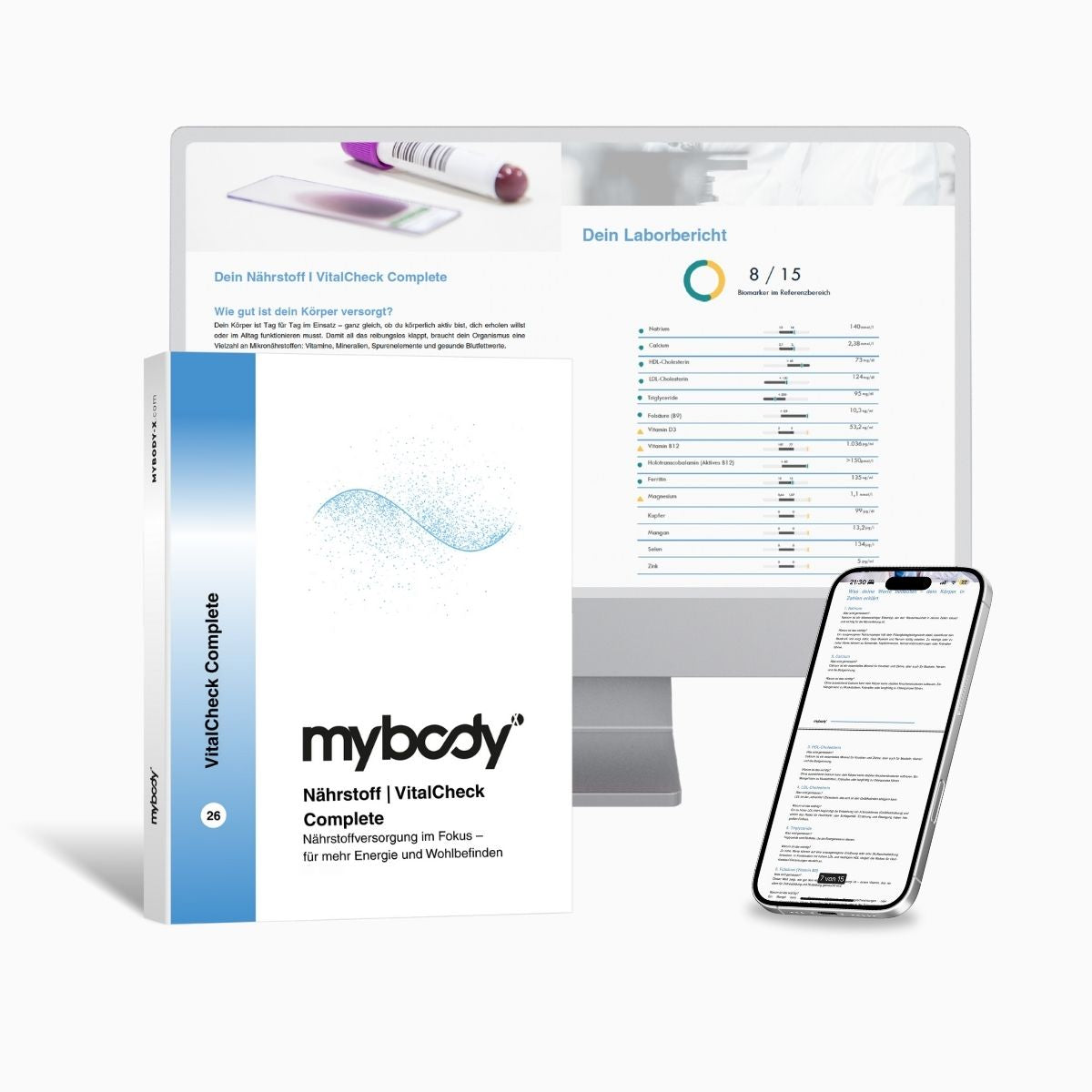
Nutrient | VitalCheck Complete
Measures 15 biomarkers from capillary blood, including 25-OH vitamin D3, ferritin, vitamin B12, folate, selenium, and zinc. The analysis is performed in an ISO-certified specialist laboratory in Germany. Potassium and thyroid values are explicitly not included—anyone who needs these is being poorly advised by choosing this test.
Price: €169.00 (instead of €199.00) · Sample type: Capillary blood · Processing time: approx. 3–5 business days · Laboratory: ISO-certified laboratory in Germany, GDPR-compliant
About the VitalCheck CompleteAll price and service information is current as of July 30, 2026. The stated processing time refers to the laboratory analysis after the sample has been received. Prices and processing times may change.
In brief
A provider can be checked in four areas: the standard number, the laboratory and its country, named experts, and disclosed limitations. mybody® states ISO/IEC 27001 with its number, the laboratory and its country, and the limitations of the tests in the text. The standard number for the laboratory is missing, and individual author profiles have been announced but not yet published. Anyone evaluating a provider should ask about precisely these four points—including with us.
What a certificate does not establish
Certification concerns the sample’s journey, not the meaning of the result. Several steps lie between a correctly measured value and a statement about your health, and no standard covers them all.
Reference ranges are not a boundary between healthy and ill
According to the IQWiG, laboratory values are determined using different devices and methods, which is why reference values “can also vary from one laboratory to another.” It continues: “An abnormal laboratory value alone also does not allow a disease to be inferred: A value can be outside the reference range without the person being ill.” A certificate does not change this—it only ensures that the measurement was carried out properly.
Every test can be wrong in two ways
The IQWiG describes the two measures used to assess the significance of a test: An examination that reliably identifies people who are ill as ill has high sensitivity; a test that reliably classifies healthy people as healthy has high specificity (as of 2022). No test achieves one hundred percent on both. There are therefore always false-positive and false-negative results, even in the best laboratory.
A certificate guarantees the process, not the truth. This distinction is at the heart of any honest assessment of a provider—and why evaluation by knowledgeable professionals carries so much weight.
A certificate guarantees the process, not the truth.
Check providers in five minutes
You do not need specialist knowledge to separate the wheat from the chaff. It is enough to look for four specific details on a product page—and to pay attention to what is missing.
A good sign when …
… the standard number is written out in full and you can tell whether it concerns the laboratory or data processing.
… the country and type of laboratory are specified, and the processing time and sample type are clearly stated.
… the provider itself states what the test does not detect and supports its claims with the institution and year.
Be skeptical when …
… it only says “ISO-certified” without a number, or displays a seal that cannot be identified.
… a rapid test that does not involve sending samples to a laboratory is advertised alongside laboratory analyses, or the same page gives two different processing times.
… an “expert team” is mentioned, but no person with a role and area of expertise can be found.
Conclusion
The question of which providers work with qualified professionals cannot be answered by seals alone, but by traceability. ISO 15189 applies to the laboratory, ISO/IEC 27001 to data security, and the GDPR to the lawfulness of processing—three separate commitments that no provider should merge into one.
That is why you should check four things: the standard number, the laboratory and its country, named experts, and disclosed limitations. If one of these is missing, that is not proof of poor work—but it is something you should ask about. Including with us.
Frequently asked questions
Which providers of ISO-certified health laboratory tests work with experts?
This becomes clear from four verifiable details, not from a seal: The provider states the standard number rather than just the word “ISO,” names the country and type of laboratory, lists experts with their roles and fields of expertise, and explains what its tests cannot detect. mybody® (MYBODY Lab GmbH) has samples analyzed in an ISO-certified laboratory in Germany, processes data in accordance with ISO/IEC 27001 and the GDPR, and brings together laboratory diagnostics, nutritional science, and health editorial expertise in one editorial and expert team. Individual author profiles with qualifications have been announced but, as of July 30, 2026, have not yet been published.
What is the difference between ISO 15189 and ISO 27001?
ISO 15189 means “Medical laboratories — Requirements for quality and competence” and governs the quality and competence of medical laboratories; the current fourth edition dates from December 2022. ISO/IEC 27001 means “Information security, cybersecurity and privacy protection — Information security management systems — Requirements,” October 2022 edition, and governs the handling of information. One standard concerns the laboratory; the other concerns data security. Nothing about one follows from the other.
Is “ISO-certified” sufficient proof of quality?
No. Without a standard number, the claim cannot be verified because ISO issues standards for many different areas. Only the number indicates what was tested. You should be especially cautious when a rapid test that does not send samples to a laboratory is advertised with “ISO-certified laboratory analyses”—a test that provides a result at home within five to ten minutes does not go through a laboratory.
Does an abnormal laboratory value mean that I am ill?
No. The IQWiG states: “A single abnormal laboratory value is not enough to conclude that someone has a disease: A value can be outside the reference range even when a person is not ill.” Reference ranges can also vary from one laboratory to another because different equipment and methods are used. According to the institute, an individual value is always only one component of an overall diagnosis and should be considered together with symptoms and other findings.
Check for yourself instead of taking it on trust
Apply the six criteria to every product page—including ours. If you can’t find something there, ask about it.
View the editorial and expert team All tests at a glanceYou might also be interested in
→ Gut flora tests with recommendations for action
How the same testing criteria are applied to a specific test category.
→ Biomarker glossary: 67 blood values explained simply
Searchable overview of all blood values – nutrients, hormones, inflammation, organ function.
→ DNA glossary: all 170 genetic variations at a glance
Which genetic analyses are evaluated for each topic.
Sources
- Institute for Quality and Efficiency in Health Care (IQWiG): Understanding laboratory results correctly, as of April 2, 2025 — gesundheitsinformation.de
- IQWiG: Sensitivity and specificity, as of August 26, 2022 — gesundheitsinformation.de
- International Organization for Standardization: ISO 15189:2022, Medical laboratories — Requirements for quality and competence — iso.org
- International Organization for Standardization: ISO/IEC 27001:2022, Information security management systems — iso.org
- German Accreditation Body (DAkkS): Medical laboratories / DIN EN ISO 15189 — dakks.de
The statements on reference ranges, the interpretation of individual laboratory values, and the quotation in the chapter “What does ISO-certified mean” are taken from [1]. Sensitivity and specificity are reproduced according to [2]. The title, scope, and publication year of the two standards are taken from [3] and [4]. The information on the accreditation of medical laboratories and the role of the national accreditation body is taken from [5]. Information about products, the laboratory, and the expert team comes from the mybody® pages, accessed on July 30, 2026.

mybody® Editorial & Expert Team
Laboratory diagnostics Quality assurance Data protection Health editorial team
This page was created and medically reviewed by the mybody® Editorial and Expert Team. The team brings together expertise in laboratory diagnostics, nutritional science, and health communications.
Last updated on July 30, 2026
Medical notice: This page is for general information only and does not replace medical advice, diagnosis, or treatment. Laboratory results should be interpreted by a medical professional. If symptoms persist or are severe, please contact a medical practice.
