

SHBG: what the value means about available hormones
The essentials at a glance
SHBG stands for sex hormone-binding globulin. It is a transport protein that binds and retains testosterone and estradiol in the blood. What is bound to it is practically unavailable to the tissue.
SHBG therefore helps determine how much of a hormone can become active. The MSD Manual, professional edition, draws a clear conclusion from this: Since SHBG increases with age, the total testosterone level is a less sensitive parameter after age 50 (as of April 2025).
You will first learn what SHBG is. This is followed by a comparison of the three transport states, the reason for measuring it, what shifts the value up and down, a fact check of three common statements, its role in women, and the limitations of a single measurement.
What to expect in this article
1. What SHBG is and where it comes from
2. Bound, loosely bound, free: the three states
3. Why SHBG is measured at all
4. The effect of age and what it shifts
5. What moves the value up and down
6. Three sentences about SHBG in a fact check
7. SHBG in women
8. How to interpret an SHBG value
9. Who may benefit from having it measured
10. What a capillary blood test can show here
11. Limitations: what remains unclear
12. What matters about SHBG
Frequently asked questions
Sources
What SHBG is and where it comes from
SHBG is a protein produced in the liver that circulates in the blood. Its function is reflected in its name: it binds sex hormones, especially testosterone and estradiol.
This binding is strong. A hormone attached to SHBG is present in the blood but still not active in the target tissue. It is in transit, but not in use.
SHBG is therefore not a hormone but a regulator upstream of it. It does not change how much is produced, but how much reaches its destination.
Why a transport protein is needed at all
Steroid hormones dissolve poorly in water. Without a transport protein, they would circulate in blood plasma only in negligible amounts, and the body would have no way to maintain a reserve.
The binding therefore serves two purposes at once. It enables transport and buffers fluctuations because bound hormone can be released as needed.
This leads to a particularity in laboratory diagnostics. The total hormone value always includes the stored supply, and without the transport protein, it remains unclear how large the immediately available portion is.
Why the liver of all organs
There is nothing unusual about a protein being produced in the liver. The liver produces most of the proteins that circulate in blood plasma, including albumin, which also plays a role in this context.
The notable consequence is what follows from this. A value interpreted as a hormone parameter is linked to an organ that has nothing to do with hormone production itself.
This connection precisely explains why SHBG responds to so many conditions. Anything that affects protein production in the liver can influence the transport protein without hormone production having changed.
For interpretation, this means that an abnormal SHBG level is first a question for the liver, the thyroid, age, and medications. Only afterward does it become a question of hormone balance.
Bound, loosely bound, free: the three states
Testosterone exists in the blood in three states. The table compares them according to the same four criteria.
| Criterion | Bound to SHBG | Bound to albumin | Free |
|---|---|---|---|
| Binding strength | Strongly bound | Loosely bound; dissociates again at the tissues | No binding |
| Available to the tissues | Practically not | Yes, which is why this fraction is considered part of bioavailable testosterone | Yes, this fraction most accurately reflects the functional levels |
| Included in the total value | Yes | Yes | Yes |
| How it appears on the test report | Indirectly, by measuring SHBG | Indirectly, by measuring albumin | Usually calculated from total testosterone, SHBG, and albumin |
The third row explains the core problem in one sentence. All three states are included in the total value, and the total value alone does not indicate how they are distributed.
Why binding is not all or nothing
The table suggests three fixed compartments. In reality, binding is an equilibrium: the hormone dissociates from the protein and binds again, continuously.
The difference between SHBG and albumin lies in how long a molecule remains bound. With SHBG, the residence time is long; with albumin, it is short. That is why the albumin-bound fraction is considered available, while the SHBG-bound fraction is not.
This balance is precisely the basis for calculating the free fraction. The commonly used formulas assume known binding strengths and use them to estimate how a given amount of hormone is distributed among the three states.
This also explains why albumin appears on a complete hormone panel. Without this third value, the balance cannot be resolved, and the calculation remains an approximation with one more assumption.
Why SHBG is measured at all
An SHBG value alone does not answer any question. It is measured so that another value can be interpreted, which is unusual for a laboratory parameter.
The practical reason is usually a testosterone value that does not match the symptoms. A total value in the lower end of the normal range may conceal a low available fraction when SHBG is high, and the opposite may be true when SHBG is low.
The second reason is calculation. Without SHBG, free testosterone cannot be determined mathematically because the transport protein is one of the input values.
A value that explains another
Most laboratory values describe a state: how much iron is stored, how high blood sugar was over several weeks, or how well the kidneys filter. SHBG belongs to a different category.
It describes a condition under which another value arises. In that respect, it is more like a footnote than a heading, and this role is often overlooked when reading.
The practical error that results is always the same. An SHBG level outside the reference range is read as an independent finding, even though it initially only indicates that the distribution of the bound hormone has shifted.
Whether this has any implications depends on the associated hormone level and on how the person feels. Neither is reflected in the SHBG level.
The effect of age and what it shifts
The best-documented influence on SHBG is age, and the specialist literature draws a diagnostic conclusion from this.
Documented source
“Because sex hormone-binding globulin (SHBG) increases with age, total testosterone levels after age 50 are a less sensitive parameter for confirming hypogonadism.”
Masaya Jimbo, MD, PhD
MSD Manual, professional edition, Male Hypogonadism, current as of April 2025
The sentence describes a shift that no one notices as long as only the total level is considered. When SHBG rises, more testosterone moves into the bound state without any change in production being necessary.
The result is paradoxical yet logical. The total level can remain stable or even rise with age while the available proportion declines.
What the age of fifty means as a threshold
The threshold mentioned is not a switch at which something suddenly changes. SHBG rises gradually, and the age of fifty marks the point from which the specialist literature considers the total level a less sensitive measure.
In practice, this means that the older someone is, the more likely SHBG belongs in the test. Before fifty, it is an additional value; afterward, it is an obvious one to include.
The effect of age alone does not explain every abnormal SHBG level, however. A high level in a thirty-year-old has other possible causes, which are discussed in the next chapter.
What this means for a trend over several years
Anyone tracking their testosterone level over several years is always comparing not only two numbers but also two ages. Because SHBG rises during this period, the proportion that is available also shifts, even if the total level remains unchanged.
That is no reason to forgo monitoring the trend. It is a reason to include SHBG from the outset, so that it will later be possible to say which of the two components has changed.
In practice, this means that anyone establishing a baseline at forty-five should include SHBG. This information cannot be added retroactively to an old test result.
The effort involved is minimal because SHBG is included in every complete hormone panel anyway. The decision therefore lies not in the measurement but in the choice of profile.
Anyone who instead has only a single testosterone level measured gets a number, not a baseline. The difference only becomes apparent years later, and by then it can no longer be corrected.
What moves the value up and down
SHBG is produced in the liver and responds to several systems at once. Three areas belong on the form that is submitted with the report.
The thyroid
The thyroid also regulates the liver's metabolic rate, and the liver produces SHBG. This creates a connection between thyroid status and the transport protein.
In practice, this means TSH belongs on a hormone report. An abnormal SHBG level without a known thyroid status leaves an obvious question unanswered.
The liver itself
Because SHBG is produced in the liver, diseases affecting this organ influence its level. That is why liver values are included alongside hormones in a comprehensive blood count.
What individual liver values show and what they do not is covered in the companion article Understanding liver values: which values matter. This article focuses on the transport protein.
Medications and hormone preparations
Estrogen-containing preparations act at the same site where SHBG is produced. Therefore, every preparation belongs on the form, explicitly including hormonal contraceptives and hormone therapy during menopause.
Regarding how much a single preparation shifts the value, we found no reliable figure in the sources reviewed. That is why the text contains no number, and why the note on the form is the actual information.
Fact-check: three statements about SHBG
These three statements come up regularly whenever SHBG appears on a test report. All three can be assessed against the available evidence.
Checked against the evidence
Widespread
“High SHBG means a hormone deficiency.”
Proven
SHBG increases with age, making total testosterone levels less sensitive as a result (MSD Manual, professional edition, as of April 2025). A high value indicates a shift in transport and, by itself, is not a diagnosis of deficiency.
Widespread
“SHBG can be deliberately lowered.”
Proven
In the sources reviewed, we found no reliable evidence that SHBG can be deliberately and permanently controlled through any product or measure. What is documented are associations with age, the thyroid, the liver, and hormone preparations.
Widespread
“SHBG is a men's value.”
Proven
SHBG binds testosterone and estradiol equally and is therefore included in hormone reports for both sexes. The product range includes both a men's hormone test and the women's health test, and both list this value (as stated on the product pages, accessed August 13, 2026).
The second point needs some context to avoid misunderstanding. The fact that we did not find a reliable statement does not mean that none exists. It means that we did not find one, and that is exactly what is stated here instead of making an estimate.
SHBG in women
SHBG binds estradiol as well as testosterone. The same mechanism therefore applies, but with a different primary role.
SHBG says nothing on its own. It makes another value interpretable.
In women, the value is particularly interesting because it responds to hormonal preparations and helps determine the availability of estradiol. Both aspects should be considered together when interpreting a report.
The Women's Health Test measures SHBG together with the thyroid profile, prolactin, and cortisol. This places the values that help explain the SHBG result on the same report.
Why hormonal preparations matter particularly here
For women, there is a high likelihood that a hormonal preparation is involved. Contraceptives, hormone therapy during menopause, and treatment for menstrual disorders all act at the same site where SHBG is produced.
This is not a warning, but a guide to interpretation. An SHBG value measured while using a hormonal preparation describes the situation under that preparation, not the baseline state.
For comparing two measurements, this means recording which medication or preparation you were using at the time of each measurement and for how long. Without this information, it is difficult to make a meaningful comparison between two values.
The second special feature concerns the menstrual cycle. Because estradiol fluctuates over the course of the cycle, interpreting an SHBG value in women of reproductive age also depends on when the sample was taken. The sister article Hormone Levels and the Right Day of the Cycle explains what this means for testing.
How to interpret an SHBG value
The same basic rule applies to interpreting SHBG as to any other laboratory value. The Institute for Quality and Efficiency in Health Care puts it this way: the relevant reference range is the one stated on your own laboratory report, and reference values may vary from one laboratory to another (as of 02/04/2025).
SHBG has another special feature. Its value is not interpreted on its own, but always in relation to the hormone it binds. A numerical value without the corresponding testosterone or estradiol result remains meaningless.
The third rule concerns the order. First check the obvious explanations—age, thyroid, liver, and medications—then look for rarer ones.
The reference range and its five percent
A reference range is not a boundary between health and illness. IQWiG describes how it is established: The limits are set so that 95 percent fall within the range, while 5 percent of people fall outside it despite being healthy (as of 02/04/2025).
For a value such as SHBG, which is only interpreted in relation to something else anyway, this matters twice as much. A value just beyond the threshold is initially a reason to place the corresponding hormone level alongside it, not a finding.
There is also variation between laboratories. Two measurements using different testing methods can produce different numbers, which is why using the same provider is the simpler choice for monitoring a trend.
What to note alongside the result
Four lines are enough, and they cost nothing: the date and time of the sample collection, your age, all preparations taken in recent weeks, and anything unusual, such as an acute illness.
For women of childbearing age, the day of the cycle also matters. This fifth line determines, for several hormone levels, whether two findings can be compared later.
The note is unremarkable, yet it goes further than any interpretation you anticipate yourself. It is what turns one number into a comparable number.
Who may benefit from the measurement
SHBG is not a value everyone needs to know. The comparison makes that clear in both directions.
Useful for you if …
You have a testosterone or estradiol level that does not match how you feel and want to know whether transport is behind it.
You are over fifty and have so far only known your total level. From this age onward, the total level alone is less sensitive.
You want free testosterone as a calculated value. It cannot be calculated without SHBG.
You use hormonal preparations and want to establish a baseline for comparison.
Probably not if …
You want to have SHBG measured as an isolated value. Without the corresponding hormone, the number says nothing.
You hope it will tell you how to change the level. We found no reliable evidence for this.
You have an acute illness. During this phase, hormone levels are generally difficult to interpret.
You expect a diagnosis. A transport protein describes a condition, not a finding.
What a capillary blood test can show here
A capillary blood self-test does not provide a diagnosis. For SHBG, it determines something else: whether the value is available together with the hormone it binds.
Two tests from mybody®x (MYBODY Lab GmbH) measure SHBG, and they do so in different settings. What they can and cannot do is outlined in the cards.
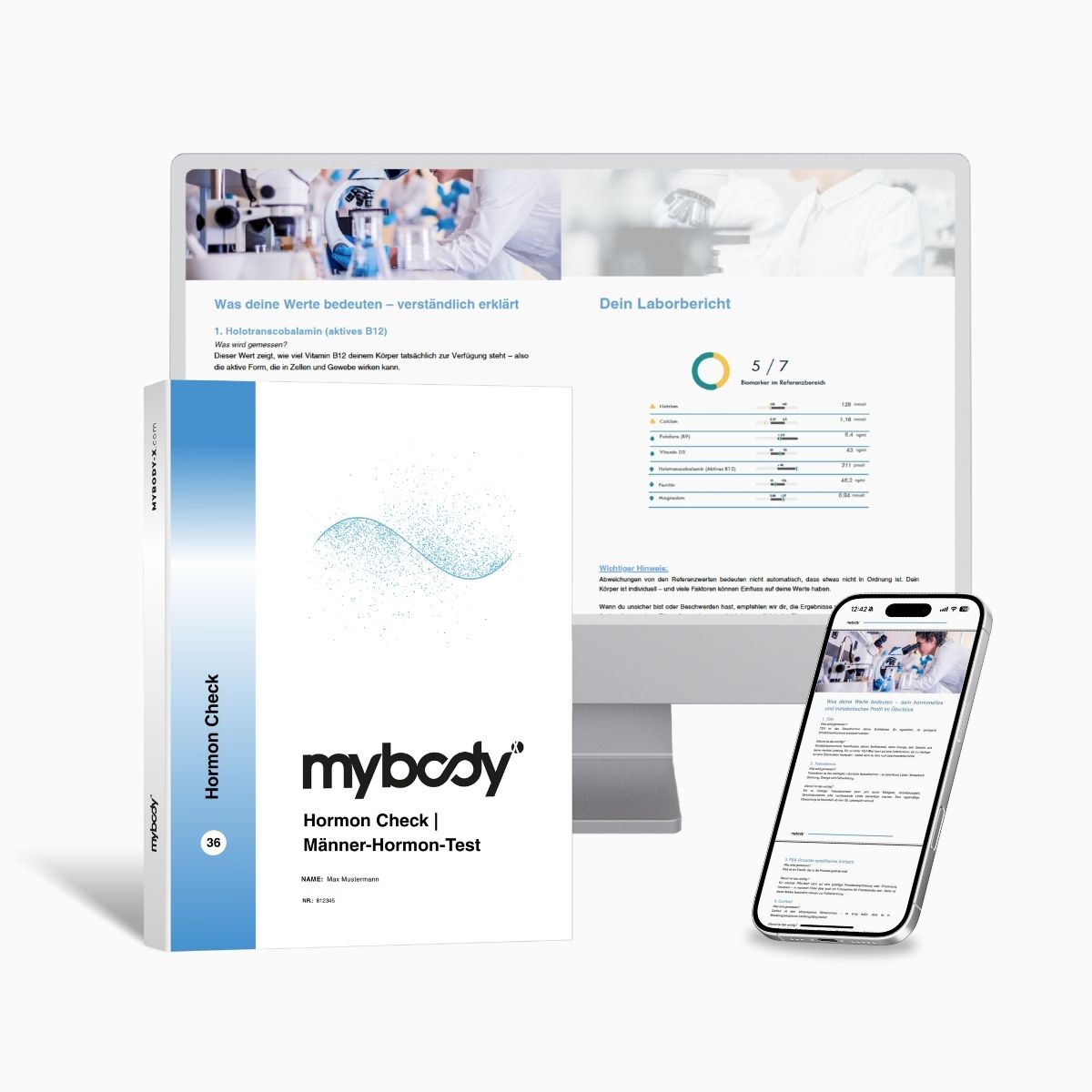
Capillary blood test
HormoneCheck | Men’s hormone test
Measures SHBG together with testosterone, albumin, and free testosterone as a calculated value, as well as estradiol, DHEA-S, LH, FSH, prolactin, and TSH. This places SHBG in the context needed to interpret it. What the test does not provide: it includes no liver values, and the free value is calculated rather than measured directly. It does not provide a diagnosis.
Laboratory analysis 3–5 business days after sample receipt
Product page information, accessed 13 August 2026
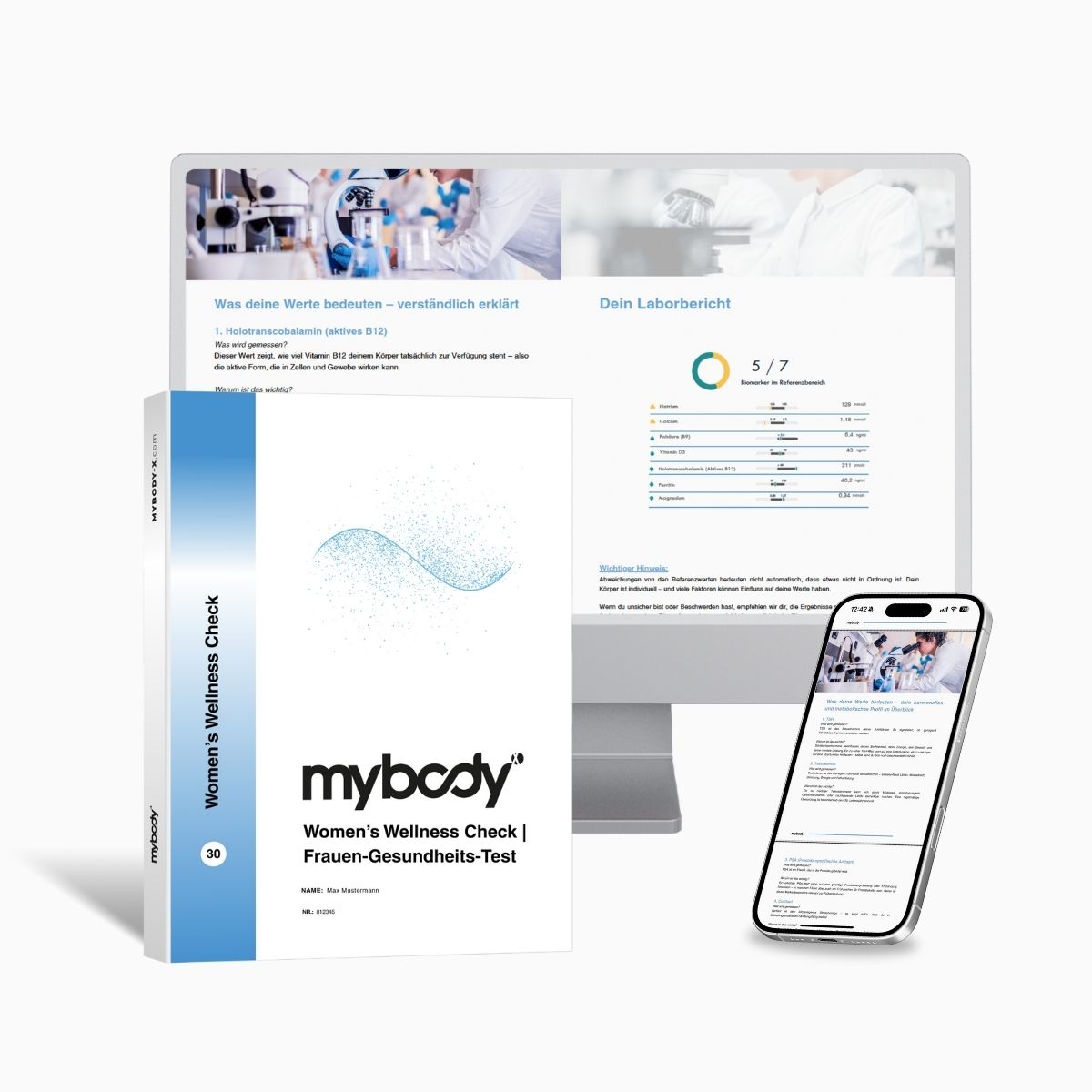
Capillary blood test
Women’s Wellness Check | Women’s Health Test
Measures 18 values, including SHBG together with the complete thyroid profile of TSH, fT3, and fT4, with gamma-GT and GPT as liver values, as well as prolactin and cortisol. This provides the factors that help explain an SHBG value. What the test does not provide: it includes neither testosterone nor albumin and therefore does not provide a free value. It does not provide a diagnosis.
Laboratory analysis 3–5 business days after sample receipt
Product page information, accessed 13 August 2026
Four points determine whether an SHBG value becomes useful information.
Never measure it alone
Without the hormone that SHBG binds, the value is not meaningful.
Include TSH
The thyroid also regulates the liver, and the liver produces SHBG.
Note any preparations
Hormonal preparations act where SHBG is produced.
Interpret it against your own test result
The reference range shown on your laboratory report is authoritative.
Chapter at a glance
A capillary blood self-test provides SHBG as a point-in-time value, not a diagnosis. Its benefit for this value lies in SHBG being provided together with the factors that make it interpretable. Four points are decisive: never measure it alone, include TSH, note any preparations, and interpret it against your own test result.
Limitations: what remains open
The first limitation is controllability. We found no reliable statement in the reviewed sources on whether and how SHBG can be specifically influenced. Therefore, the text contains no recommendation on this.
The second limitation concerns the order of magnitude. We could not derive from the reviewed sources in figures how strongly individual factors shift the value. What is established is the direction of the age effect.
The third limitation is depth of interpretation. An SHBG value describes a transport state, not its cause. Asking why leads to the thyroid, liver, age, and preparations, and thus beyond laboratory diagnostics.
The objection is justified that an article with three open points offers little. Even so, the benefit is clear: knowing that SHBG can only be interpreted in relation to something else saves you from searching for a meaning that a single number cannot bear.
What matters about SHBG
If you take away just one action from this article, let it be this: Never read your SHBG level on its own; always read it alongside the hormone it binds.
The reason is unremarkable yet far-reaching. A transport protein describes a condition under which another value arises, and without that other value, the condition has no subject.
It began with the question of what SHBG means. The most honest answer is: nothing on its own, but a great deal in relation to something else. That is precisely why it appears on hormone reports and not in a list of the most important individual values.
Frequently asked questions
What does SHBG mean in a blood count?
SHBG stands for sex hormone-binding globulin, a transport protein produced in the liver. It binds testosterone and estradiol tightly, and what is bound to it is practically unavailable to tissue. The level therefore describes how much of a hormone can take effect and should only be interpreted together with that hormone.
What does a high SHBG level mean?
First of all, that more hormone is bound and less is available. A common and well-documented explanation is age: since SHBG increases with age, total testosterone is a less sensitive parameter after age 50 (MSD Manual, professional edition, as of April 2025). Other obvious questions concern the thyroid, liver, and hormonal preparations. A high value alone is not a diagnosis.
Can SHBG be lowered?
We found no reliable statement on this question in the sources reviewed, so no recommendation is given here. Associations with age, thyroid status, liver health, and hormonal preparations are documented. Anyone with an abnormal value should clarify these points in a medical practice rather than making the value a personal target.
Do I need SHBG if I know my testosterone level?
For younger men, the total level is often sufficient as an initial guide. From around age fifty onward, SHBG becomes more important because the total level is then less sensitive (MSD Manual, as of April 2025). And if free testosterone is wanted as a calculated value, SHBG is needed in any case because it is one of the inputs for the calculation.
Is SHBG the same in women?
The mechanism is the same. SHBG binds testosterone and estradiol equally and, in women, primarily helps determine the availability of estradiol. The reference ranges differ, and the range on your own laboratory report is always decisive (IQWiG, as of April 2, 2025). Hormonal preparations must explicitly be taken into account when interpreting the results.
Next step
SHBG belongs alongside the hormone
If you have SHBG measured, have it tested together with the hormone it binds. Both tests provide the value in a context in which it can be interpreted. They do not provide a diagnosis and do not replace medical evaluation.
Go to the HormoneCheck Go to the Women’s Wellness CheckRead more
You might also be interested in
What SHBG does in practice, using testosterone as an example.
The organ that produces SHBG and what its levels show.
Sources
- MSD Manual, professional edition: Male hypogonadism, Jimbo M (as of April 2025) – msdmanuals.com
- Institute for Quality and Efficiency in Health Care (IQWiG): Understanding laboratory values correctly, status as of 2 April 2025 – gesundheitsinformation.de
The literal quotation about the rise in SHBG with age, the classification of total testosterone after the age of 50, and the statement that free testosterone more accurately reflects functional levels come from source [1]. The explanation of the reference range and the note about differences between laboratories come from [2]. In the sources reviewed, we found no reliable information on the extent to which SHBG can be specifically influenced or on the magnitude of individual influencing factors; therefore, the text contains neither figures nor recommendations on this. Information on price, values, sample type, and laboratory comes from mybody®x product pages, accessed on 13 August 2026; processing times follow the central specification for blood tests. All sources were accessed and reviewed on 13 August 2026.

mybody®x Editorial & Specialist Team
Laboratory diagnostics Blood analysis interpretation Nutritional science Nutrigenetics
This article was created by the mybody®x editorial and specialist team. The team combines laboratory diagnostics, nutritional science, and the interpretation of blood analyses. Everyone involved can be found on the authors’ page.
Published on 13 August 2026 · Last updated on 13 August 2026
The content is intended for general information and does not replace medical advice, diagnosis, or treatment. Reference ranges depend on the laboratory, method, and age—the information on your test report is always authoritative.




Share now:
Cortisol Blood Test: What the Morning Level Shows and What It Doesn’t
Free Androgen Index: how it is calculated and what it indicates