

Capillary blood from the fingertip has its own rules
The essentials at a glance
A drop from the fingertip and a tube collected from a vein in the arm are two different procedures, each with its own sources of error.
These sources of error in venous collection are described in detail in the professional literature. Even applying a tourniquet for too long can shift values, and this is the standard method.
You will read the cited source verbatim, compare two methods, fact-check three common statements, review three documented details, and see an open statement about what we did not find regarding capillary collection.
What to expect in this article
1. Two ways to obtain blood
2. What distinguishes the two methods
3. Comparing the two methods
4. Both methods have potential sources of error
5. The documented source
6. What prolonged tourniquet application causes
7. Three statements in the fact check
8. The core in one sentence
9. A gap we openly acknowledge
10. Three documented details
11. Why the instructions are the procedure
12. Who capillary blood is practical for
13. What a capillary blood test can show here
14. Limitations: what remains open
15. What matters about the procedure
Frequently asked questions
Sources
Two ways to obtain blood
When people think of blood collection, they think of a vein in the arm. A tourniquet, a needle, several tubes.
Home tests work differently. They collect a small amount of blood from the fingertip, usually using a lancet.
The difference is not merely convenience. These are two different procedures, and each has its own requirements for how it is carried out.
This article describes what can be substantiated on the subject. At one point, it also openly states what we did not find—and that is more than we would have liked.
First, the practical core, so it does not get overlooked: with a home test, the enclosed instructions are the authoritative source. Everything else in this article explains why that is the case.
What distinguishes the two methods
The most obvious difference is the quantity. Several tubes can be filled from a vein, while only a few drops can be obtained from a fingertip.
This immediately leads to the second difference: the range of possible tests. A nutrient panel from capillary blood does not cover the same things as a full laboratory program using several tubes.
The third difference is the person performing the procedure. For venous collection, it is a trained professional; with a home test, it is you.
This third point is precisely why the instructions are so important. For venous collection, the professional requirements are part of the training; for a self-test, they are included in the kit.
The fourth difference: the sample’s journey
This adds another factor that is often underestimated in a medical practice because it occurs after the actual procedure.
When a sample is collected at a medical practice or laboratory, its journey is short and organized. With a home test, the sample travels some distance, and that journey is part of the procedure.
That is why these kits specify when a sample should be sent. This is not a minor logistical detail; it is part of the conditions under which the values are valid.
Anyone who wins a kit on a Friday evening and mails it on Monday has changed the procedure. What follows from that is stated in the instructions for the respective test, not in this article.
The two procedures compared
The table compares what can be said about both procedures. It provides context and does not make a diagnosis.
| Characteristic | Venous blood collection | Capillary blood from the fingertip | What the sources say about it |
|---|---|---|---|
| Who performs it | A healthcare professional | With a home test, the person themself | The MSD chapter is expressly intended for healthcare professionals (Liu, as of October 2025) |
| Documented sources of error | Described in detail, including constriction, hemolysis, and tissue trauma | Not addressed in the sources reviewed | The MSD chapter does not mention the finger prick (Liu, as of October 2025) |
| Binding requirement | Professional standards, such as those concerning the duration of constriction | The instructions for the respective kit | For the venous procedure, the source specifies concrete time limits (Liu, as of October 2025) |
| Evaluation | Laboratory with its own reference range | The same applies to the laboratory route; with a rapid test, there is only one threshold | Reference ranges may vary from one laboratory to another (IQWiG, as of April 2, 2025) |
The second line is the most uncomfortable. It describes not a difference between the procedures, but a difference in what we found about them.
Both have sources of error
The common assumption is that venous blood collection is the reliable method and everything else is a compromise. The technical literature paints a different picture.
The MSD Manual devotes a separate chapter to venous blood collection and lists several sources of error, including hemolysis, hyperkalemia, improper palpation, and tissue trauma (Liu, as of October 2025).
This is not a criticism of the standard procedure. It demonstrates that every procedure that draws blood from a body has conditions under which it works.
So anyone asking whether a finger prick has sources of error is asking the wrong question. The right question is: What are they, and where are they documented?
What is also noteworthy about the list in the MSD Manual is what it concerns. None of these sources of error relates to the person the blood comes from. They all relate to how the procedure is performed.
A value altered by prolonged constriction says nothing about the person to whom it is attributed. It says something about the minutes before the measurement.
This distinction is why preanalytics is a separate topic in laboratory medicine. Before anything is measured, it is determined what can be measured at all.
The documented source
The sentence illustrating the principle concerns the standard procedure and is therefore so informative.
Documented source
“to avoid prolonged constriction and blood stasis, which can lead to artifact-related laboratory results (e.g., hemolysis and hyperkalemia)”
MSD Manual, professional edition
Performing a venous blood draw, Liu YT, last updated October 2025
The key word is artifact-related. It refers to a laboratory result that does not reflect the state of the body but rather something that happened during sample collection.
Such a result is measured correctly and is nevertheless misleading. The laboratory measures what is in the sample, and the sample contains something that should not be there.
That is precisely what the question of the procedure is about. Not whether a method is good, but whether the sample contains what it is supposed to contain.
What prolonged stasis does
The source becomes very specific here, and the times mentioned are surprising.
The MSD Manual recommends performing the blood draw within 30 seconds of applying the tourniquet and not applying the tourniquet for longer than 1 minute (Liu, as of October 2025).
The stated reason is that prolonged stasis can cause various erroneous laboratory values, such as elevated potassium, lactate, and phosphate.
One minute is a short time. The fact that the specialist literature works with seconds at this point shows how tightly the conditions are defined for a standard procedure performed millions of times every day.
It is also interesting which values are mentioned. Potassium, lactate, and phosphate are unremarkable laboratory values that rarely attract attention on a report. Yet these are precisely the values that respond to one minute too many.
For interpreting a result, this means taking extra care. If a single value is unexpectedly high and all the others are unremarkable, the explanation may also lie in the minutes before the measurement. Whether that is the case in an individual instance is something a medical practice can determine.
Three statements under fact-check
These three statements come up as soon as the subject of at-home tests arises.
Checked against the evidence
Common
“A sample taken at a medical practice is always more accurate.”
Documented
The standard procedure also has documented sources of error. The MSD Manual lists hemolysis, hyperkalemia, faulty palpation, and tissue trauma, and recommends not applying the tourniquet for longer than 1 minute (Liu, as of October 2025).
Common
“You can’t do anything wrong with a finger prick.”
Documented
The fact that we found no sources of error for capillary collection in the sources we reviewed does not mean that none exist. Every kit comes with instructions, and they are not there without reason.
Common
“Capillary blood and venous blood are the same.”
Documented
We found no statement on this in the sources we reviewed, in either direction. We therefore claim neither equivalence nor a difference.
The core in one sentence
This is where the topic can be brought together.
It is not the procedure that determines a sample’s quality, but whether it is followed.
This applies equally to the professional using the tourniquet and the person using the lancet. Both work according to instructions, and both get a distorted result if they deviate from them.
The difference lies in where these instructions are found. In one case, in training; in the other, on a folded sheet of paper in the kit. This sheet is often skimmed, and that is precisely where the actual risk of the procedure lies.
A gap we openly acknowledge
This is where a sentence belongs that a guide rarely contains.
For this article, we searched for specialist literature on capillary blood collection and found nothing in the sources reviewed. The MSD chapter on blood collection deals exclusively with venous collection and does not mention finger-prick sampling (Liu, as of October 2025).
This is a statement about our selection of sources, not a judgment about the procedure. There is certainly specialist literature on the subject, but we did not come across it during this research.
We are stating this because the alternative would be to invent general rules and make them appear to be supported by evidence. As soon as we find a reliable source, this article will receive a new date and an additional chapter.
For you as a reader, this has an immediate consequence. Everything this article says about the procedure comes from the chapter on the venous procedure and is therefore formulated as a general principle, not as an instruction.
You can find specific instructions for your test in exactly one place: the instructions included with the kit. This is not an excuse, but the only source tailored to your procedure.
We have also marked similar gaps elsewhere on this blog, for example regarding whole-blood magnesium and the combination of vitamin D3 and K2. We consider this a more honest solution than filling a gap with plausible-sounding sentences.
Three documented pieces of information
Three pieces of information from the reviewed sources and product pages. They provide context and do not constitute a diagnosis.
Documented information
30 seconds
venous blood collection should take place after applying the tourniquet; the tourniquet should not remain in place for longer than 1 minute (MSD Manual, professional edition, Liu, as of October 2025)
4
The same source lists the following sources of error for the venous procedure: hemolysis, hyperkalemia, incorrect palpation, and tissue trauma (as of October 2025)
5–10 min.
a rapid test using capillary blood takes; with the laboratory route, kit shipping and evaluation are added (product pages from mybody®x, accessed August 19, 2026)
And as with every laboratory value, the decisive factor is the reference range stated on your own report, because reference values can vary from one laboratory to another (IQWiG, as of April 2, 2025).
Why the instructions are the procedure
A practical consequence follows from everything said so far, and it sounds more banal than it is.
For an at-home test, the instructions are not an add-on to the procedure—they are the procedure itself. They contain the requirements that are covered in training for venous blood collection.
This applies to everything: preparing the puncture site, the amount, handling the tube or cassette, and sending it back to the laboratory. Each of these steps can alter a sample.
That is why this article does not include its own step-by-step instructions. They would compete with the instructions for the respective test, and in that competition, the instructions take precedence.
What can be said in general is an approach, not a technique: read the instructions in full before opening anything, and do not squeeze the procedure in between two appointments.
The reason is explained in the section about applying a tourniquet. If a standard procedure performed by professionals involves working with seconds, then taking care with a procedure you perform yourself is not an excessive requirement.
And if the instructions leave a question unanswered, asking is the right approach. Adopting a rule from the internet that applies to a different kit is the wrong one.
Who capillary blood testing is practical for
The comparison concerns whether this procedure suits your situation.
It may be right for you if …
You read the instructions carefully before opening the kit.
You take the time to perform the test and do not do it on the side.
You are looking for values included in a capillary blood panel.
You want to document a baseline value and do not need an appointment.
It may not be right for you if …
You need a complete blood count. These tests do not include one.
You need a value that is not included in the panel. In that case, you need to go through a medical practice.
You are already undergoing diagnostic evaluation. In that case, the medical practice that started it should continue it.
You expect a diagnosis. That comes from a medical practice, not a self-test.
What a capillary blood test can show here
A capillary blood self-test does not provide a diagnosis. When it comes to the procedure, one thing is crucial: the instructions that come with it.
The VitalCheck from mybody®x (MYBODY Lab GmbH) uses capillary blood and is analyzed in a laboratory that specifies its own reference range. The sample-collection requirements are included with the kit.
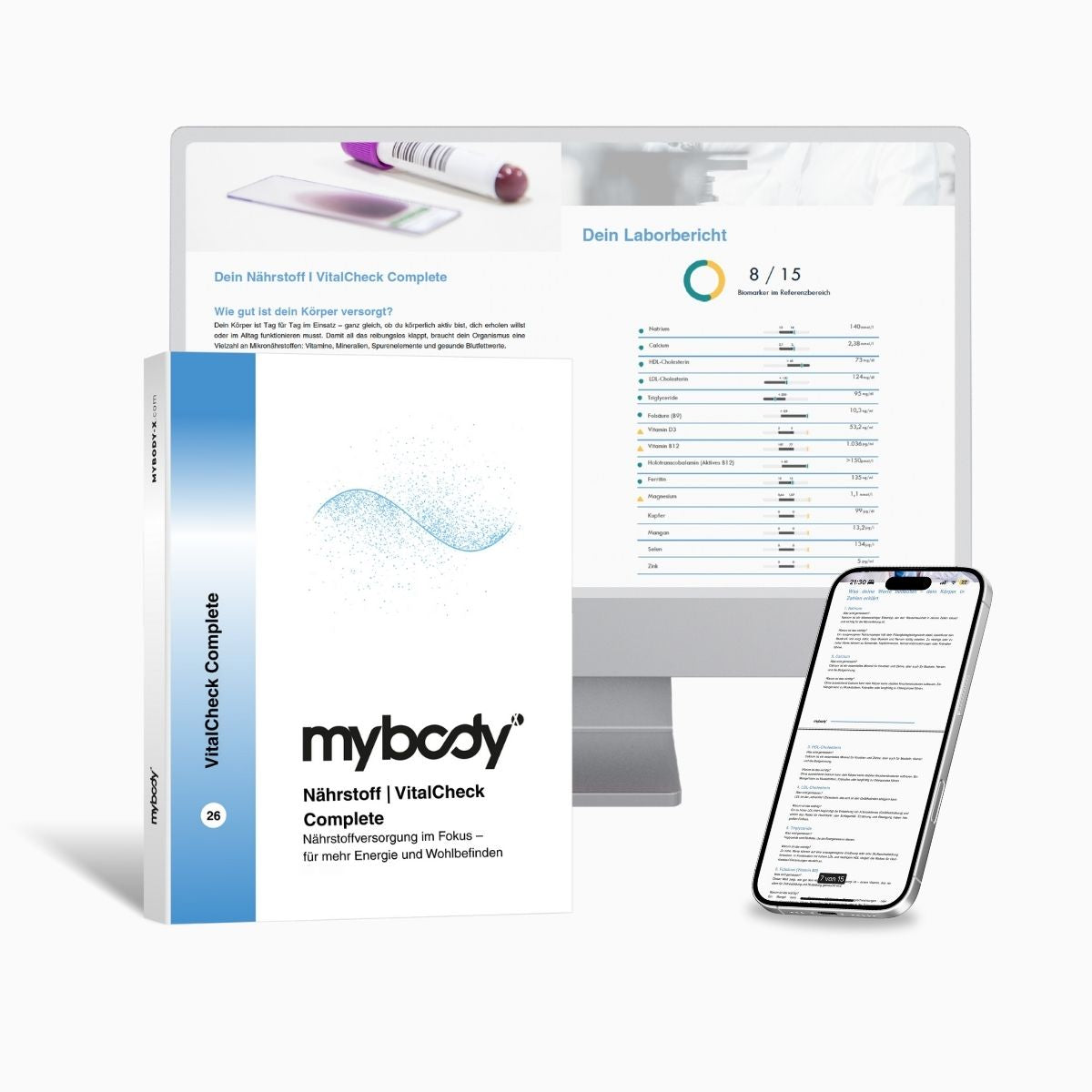
Capillary blood test
VitalCheck | Complete Nutrient & Mineral Test
Measures 18 values from capillary blood, analyzed in a laboratory with its own reference range, and includes instructions for collecting the sample. What the test does not provide: not a complete blood count, no statement comparing capillary and venous blood, no diagnosis, and no substitute for a medical examination. The information in the enclosed instructions is authoritative.
Laboratory analysis: 3–5 business days after sample receipt
Product page information, accessed August 19, 2026
Chapter at a glance
For a home test, the accompanying instructions are the procedure. They contain the requirements that are taught for venous blood collection and take precedence over any general description.
Limitations: what remains open
The first limitation is the evidence base. We found nothing about capillary collection in the reviewed sources, so this article makes no claims about it.
The second limitation is comparison. The reviewed sources do not state whether or how values from capillary and venous blood differ. We claim neither equivalence nor a difference.
The third limitation is scope. A capillary blood panel does not include a complete blood count, and the caveats from our individual articles apply to specific values.
The fourth limitation is diagnosis. All assessments in this article provide context and do not constitute a diagnosis. A diagnosis is made in a medical practice based on several components, and no self-test anticipates it.
What matters about the procedure
If you take away just one thing from this article, let it be this: Every collection method has conditions under which it works.
They are described precisely for the standard procedure. The MSD Manual recommends collecting venous blood within 30 seconds of applying the tourniquet because prolonged tourniquet application can lead to artifact-related laboratory results (Liu, updated October 2025).
The requirements for collecting a fingertip sample are provided in the instructions for the respective kit. For a home test, these instructions are not an insert accompanying the procedure; they are the procedure itself, which is why this article does not include separate instructions.
Frequently asked questions
Is capillary blood as informative as venous blood?
We found no information on this in the sources reviewed for this article, either way. We therefore claim neither equivalence nor a difference. What can be said is that both methods depend on the sample being collected correctly.
What are the sources of error in venous blood collection?
The MSD Manual cites hemolysis, hyperkalemia, improper palpation, and tissue trauma, and recommends avoiding prolonged tourniquet application and blood stasis because they can lead to artifact-related laboratory results (Liu, updated October 2025). The sample should be collected within 30 seconds of applying the tourniquet.
What is an artifact-related laboratory result?
A result that does not reflect the condition in the body, but rather something that occurred while the sample was being collected. The MSD Manual cites hemolysis and hyperkalemia, as well as elevated potassium, lactate, and phosphate levels after prolonged tourniquet application, as examples (Liu, updated October 2025).
Why doesn’t this article include instructions?
Because it would conflict with your test’s instructions. For an at-home test, the enclosed instructions are the procedure, tailored to this kit, this method, and this laboratory. A general description cannot replace them.
Do I get the same values from capillary blood as I do at the doctor’s office?
Not the same selection. A capillary blood panel does not include a complete blood count, and the values included are listed on the respective product page. The reference range provided by the evaluating laboratory is decisive for interpretation because reference values may vary (IQWiG, as of April 2, 2025).
Next step
Measure according to the instructions
VitalCheck measures 18 values from capillary blood and includes instructions for collecting the sample. It does not include a complete blood count, does not provide a diagnosis, and does not replace medical evaluation.
Go to VitalCheckRead more
You might also be interested in
Which factors before collection have been documented.
The introductory article covering the entire process.
Sources
- MSD Manual, Professional Edition: Performing a venous blood draw, Liu YT (last updated October 2025) – msdmanuals.com
- Institute for Quality and Efficiency in Health Care (IQWiG): Understanding laboratory values correctly, as of April 2, 2025 – gesundheitsinformation.de
The verbatim quote about applying a tourniquet, the information about 30 seconds and 1 minute, the list of sources of error, and the statements about elevated potassium, lactate, and phosphate come from source [1]. The fact that this source deals exclusively with venous sampling and does not mention a finger prick is a statement about that source. The note on laboratory-dependent reference values comes from [2]. The result time of approximately 5 to 10 minutes, as well as information on price, values, sample type, and laboratory, comes from the mybody®x product pages, accessed on August 19, 2026; the processing times follow the central specifications for blood tests. All sources were accessed and reviewed on August 19, 2026.

mybody®x Editorial & Specialist Team
Laboratory diagnostics Blood analysis interpretation Nutritional science Nutrigenetics
This article was created by the mybody®x editorial and specialist team. The team combines laboratory diagnostics, nutritional science, and the interpretation of blood analyses. Everyone who contributes to it is listed on the authors page.
Published on August 19, 2026 · Last updated on August 19, 2026
The content is intended for general information and does not replace medical advice, diagnosis, or treatment. Reference ranges depend on the laboratory, method, and age—always follow the information provided in your results.




Share now:
Reference ranges are distributions, not target values
Vitamin D and magnesium: what the research shows