
Metabolism boosters: What really works (according to DNA)
You are making an effort. You eat more mindfully, exercise regularly, perhaps drink lemon water in the morning, or add spicy foods to your diet. And yet that feeling remains: Other people seem to lose weight more easily, have more energy, and sleep better. Meanwhile, your weight plateaus, your mind feels tired, and every new metabolism booster initially sounds like the next hope.
That is where the biggest misconception often arises. Your body is not “broken.” Usually, the general advice simply does not suit your personal metabolism. What works for your friend with low-carb eating may slow you down. What has a noticeable effect on someone else with green tea may have almost no effect on you.
In Germany, the topic has long since become part of everyday life. According to a Forsa survey commissioned by IKK classic on dietary supplements, 51 percent of people over 16 used at least one supplement in the past twelve months. Vitamins account for 61 percent, minerals for 36 percent, and more than one in four people use protein products. This shows that many people want to actively support their metabolism. The real question is whether they are choosing what is right for their body.
Why your metabolism does not have to remain a mystery
Many people start with the same tips. More protein. More water. More exercise. Maybe a fat burner, a detox tea, or a few capsules from the internet. For a short time, this feels like control. When little happens, the thought quickly arises: I must be undisciplined. Yet the problem often lies elsewhere.
Your metabolism is not predetermined, but it is not a one-size-fits-all template either. It responds to genes, hormones, nutrient supply, sleep, stress, and how your body processes food. A general metabolism booster may therefore help, but it does not have to.
Why standard advice is often frustrating
Take two people who both give green tea a chance in the morning, eat mindfully at lunchtime, and exercise in the evening. One feels more alert, lighter, and more focused. The other barely notices anything. That does not automatically mean it is all in their head. It may simply be that their bodies respond differently to the same stimuli.
If you have already tried many things and still feel that your body is not cooperating, that is not a sign of failure. It is a hint to take a closer look.
Many people find a new way forward precisely there when they stop relying solely on trends and start understanding their individual biology. A good starting point is looking at the connection between genetics and nutrition, for example in the article about the DNA test for nutrition.
The more important shift in perspective
Instead of continuing to search for the strongest general booster, it is worth asking a different question: Which booster is right for you? This shift turns frustration back into curiosity. And that curiosity is often the point at which something finally starts to change.
Your metabolism explained simply
Before you can evaluate a metabolism booster, you need to know what you actually want to influence. The term “metabolism” sounds complicated, but at its core it means something very everyday: how your body takes in, transforms, stores, and converts food into energy.
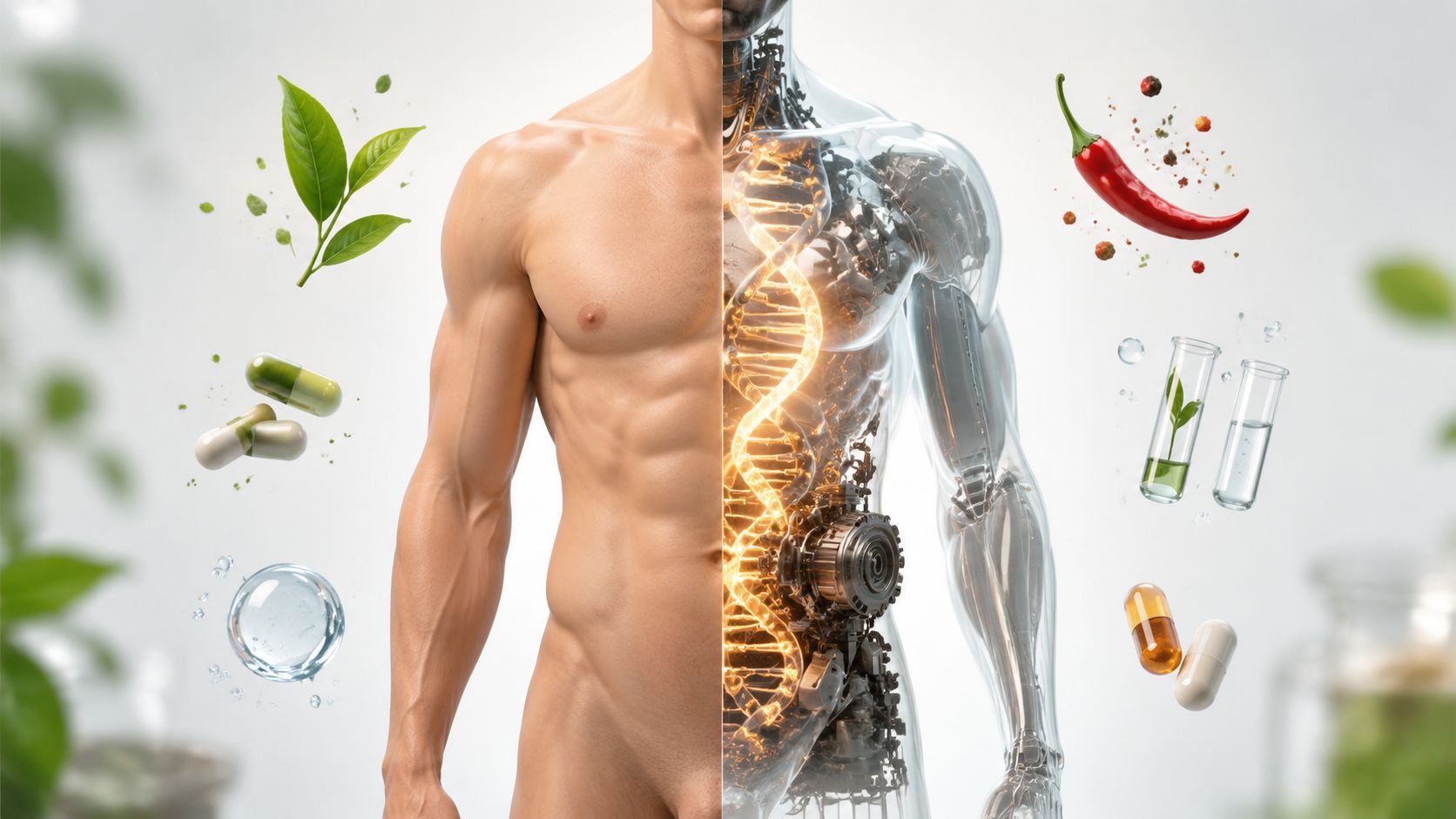
This image helps provide some orientation:

Think of a power plant
Your body works like a small power plant.
- Something is always happening in the background: Even when you are lying on the sofa, your body needs energy for breathing, your heartbeat, temperature regulation, and your brain.
- Processing food requires work: Food does not just provide energy; it also costs energy because your body has to digest, break down, and use it.
- Exercise increases expenditure further: Walking, climbing stairs, working out, or gardening directly challenge your system.
When people say they want to “boost” their metabolism, they often mean these three levels combined. They want their body to handle energy efficiently and not immediately store every small surplus.
Why protein acts like a built-in mini booster
Not every meal challenges the body to the same extent. Protein has a special role here. According to the NDR guide on stimulating the metabolism through diet and exercise, protein has a significant thermic effect. Around 20 to 30 percent of the calories contained in protein are burned again during metabolism.
This is known as the thermic effect of food. Put simply: Your body has to work harder to process protein than many other nutrients. That does not make protein magical, but it does make it practical. Especially for people who want to stay full and support their energy expenditure sensibly, this is an important lever.
Practical rule: A meal with a good source of protein is not only beneficial for muscles, but also for energy expenditure during digestion.
Where readers often get confused
A fast metabolism does not automatically mean that you are constantly hungry or can simply eat anything. And a slow metabolism is not always the sole cause of weight gain. Often, several factors work together.
This brief overview helps:
| Area | Simply explained | Why it matters |
|---|---|---|
| Basal metabolic rate | Energy at rest | Runs continuously, even without exercise |
| Digestive work | Energy for processing food | Depends heavily on food choices |
| Activity | Energy from movement | Ranges from everyday activity to strength training |
That is why starving yourself is rarely a smart strategy. If you consistently give your body too little, it does not simply speed up enthusiastically. It is much more helpful to understand the processes and then deliberately use the levers that fit your everyday life.
Common metabolism boosters put to the test
The internet loves simple hero stories. Green tea, chili, ginger, coffee, fat burner capsules. Everything is supposed to rev up the metabolism. The honest answer is less spectacular but more useful: Some boosters have measurable effects. They are usually moderate, though, and not the same for everyone.
A sober perspective is worthwhile here instead of quick-fix hope.

Green tea extract as a realistic candidate
Among natural metabolism boosters, green tea extract with EGCG is often considered particularly interesting internally. There is a reason for this. According to the overview of green tea extract and EGCG at VitaminDoctor, epigallocatechin gallate increases energy expenditure by 4 to 5 percent over 24 hours. In combination with caffeine, the increase can reach up to 8 percent. It is also clearly stated there that this effect varies individually depending on DNA type.
That is important. A measurable effect is not automatically a major effect. Green tea is therefore more of a sound supplement than a miracle cure.
Drinking green tea in the morning on an empty stomach or around 30 minutes before training is often the easiest option to integrate into everyday life. Consistency beats sporadic high dosing.
What about chili and ginger
Chili is internally mentioned as a food directly after green tea because capsaicin has a thermogenic effect and is easy to incorporate into everyday life. However, the approved data available here contains no specific figure for chili. So the fair assessment remains qualitative: Spicy spices may help, but they do not replace diet, exercise, or sound diagnostics.
Those who use spices purposefully generally benefit less from “fat burning at the push of a button” than from a practical eating routine that tastes good and is therefore sustainable in the long term.
When a look at your DNA makes sense
This is where personalization becomes exciting. The NutriCare | INFINITY DNA test analyzes genetic nutrient utilization, food intolerances, micronutrient requirements, and metabolic type. This is not a magic formula, but a structured way to put general boosters into the context of your body.
A simple decision guide:
- If you are just starting out: Begin with nutrition, water, sleep, and exercise.
- If you have tried many things: Check whether a booster really suits your metabolic type.
- If you rely on supplements: Expect support, but not a standalone solution.
The greatest disappointment usually comes not from a lack of effectiveness, but from exaggerated expectations.
The strongest booster is in your DNA
The most interesting thing about metabolic boosters is not which powder or plant gets the most attention. More intriguing is why the same stimulus affects different people so differently.
This is precisely where research challenges general advice. According to the Deutschlandfunk article on metabolism and calorie consumption, the effects of general metabolic boosters are often minimal, and the evidence is inconclusive. It also explains that individual factors such as the hormone FGF21 help determine whether someone burns fat after fasting or instead switches to an energy-saving mode.
Why your body does not work like everyone else’s
Maybe you tolerate plenty of carbohydrates well. Maybe you respond better to a protein-rich diet. Maybe you need a different training rhythm to feel energized rather than drained. This is exactly where many people talk about metabolic types. This does not refer to a trendy category, but to the observation that people process macronutrients and physical demands differently.
The topic becomes more tangible when you understand how nutrigenetics influences your life. The difference between “healthy eating” and “the right diet” is often something you can genuinely feel in everyday life.

“No supplement can replace a DNA test, because the strongest booster is always the one that suits your individual metabolic type. What works for one person may be ineffective for another. Measure first, then optimize.”, mybody®x expert team
From puzzle to roadmap
If you manage your metabolism solely through trends, you are working with assumptions. The DNA Metabolism Analysis by mybody®x reveals genetically determined metabolism types, fat and carbohydrate utilization, and individual weight risks. This provides a foundation for a customized nutrition and training plan.
This does not mean that genes determine everything. It means that you can know your starting conditions. And that changes the quality of your decisions.
A simple comparison:
| Approach | What you do | Typical result |
|---|---|---|
| General booster | You try out popular tips | Sometimes helpful, often random |
| Personalized approach | You measure first and then make adjustments | Greater suitability for everyday life |
If you have been guessing for a long time, knowledge is often the real booster.
When hormones and nutrients put on the brakes
Even with suitable DNA, metabolism remains a team effort. Genes set a direction. Hormones and nutrients often determine whether the engine runs smoothly or sputters. That is precisely why it is of little use to focus only on metabolism boosters and ignore the rest of the body.
Typical brakes in everyday life
Many people first think they lack discipline. In practice, however, other questions are often more relevant: Is the thyroid functioning normally? What about stress hormones? Is there a nutrient deficiency that is exacerbating fatigue, feeling cold, declining performance, or poor recovery?
These factors cannot be reliably guessed. Anyone experiencing persistent exhaustion, mood swings, or unexplained stagnation often benefits more from laboratory results than from the next “fat burner.”
Which tests can really help
If you suspect that hormones are involved, taking a structured look at your hormone status is often worthwhile. Metabolism is closely linked to hormonal feedback loops. This is particularly true in cases of stress, cycle-related symptoms, or suspected thyroid problems.
The same applies to nutrients. Without an adequate supply, many processes simply do not run smoothly. Food remains the foundation. Anyone who wants to make meals flavorful and practical for everyday life can find simple support for a regular, fresh kitchen instead of monotonous diet food, for example through high-quality gourmet spices.
A metabolism booster is most effective when no deficiency or hormonal imbalance is simultaneously putting the brakes on.
An example from the product context: The Vitamin D3 K2 Complex | Shield combines high-dose D3 with K2 to support calcium utilization, bone health, and the immune system. However, something like this only becomes truly useful when a DNA or blood test shows a deficiency. Data first, then supplementation. This often saves money, pressure to meet expectations, and unnecessary detours.
Your four-week plan for a more active metabolism
If you want to improve your metabolism, you do not need a perfect plan. You need a routine you can actually stick to. That is why the next four weeks are not a crash program, but a well-structured start.
For an overview, you can use this plan as a guide:

Week one with water and rhythm
Your first lever is simple and often underestimated. According to the article by Omni-Biotic on boosting metabolism, drinking 500 milliliters of water can increase energy expenditure by up to 24 percent over the following 60 minutes.
Set yourself three goals for this week:
- Drink mindfully: Set specific times to drink throughout the day.
- Eat more regularly: Not perfectly, but more predictably.
- Monitor energy rather than just weight: Feeling more alert is an important signal.
Week two with a muscle-building stimulus
The same source mentions another powerful lever: Building one kilogram of muscle mass can increase your daily basal metabolic rate by up to 100 calories. That makes strength training so valuable—not only during the workout, but afterward as well.
A simple start is enough for this week:
- Plan two short strength-training sessions: Bodyweight is more than enough at first.
- Take everyday movement more seriously: Stairs, walking to get around, active breaks.
- Eat after training instead of compensating: Otherwise, you sabotage the adaptation process.
More muscle mass is not a fitness-gym goal for a select few. It is a metabolic issue for almost everyone.
Week three with smart support
Now metabolism boosters come in as an addition. Not as the main attraction. If you tolerate green tea well, try taking it at a consistent time in the morning or before exercise. Observe how you feel on an empty stomach. More focus? More restlessness? No difference at all? All of these are useful data.
As an additional point: Feel free to spice things up more if you enjoy that. Practicality for everyday life always wins over short-term enthusiasm.
Week four with evaluation instead of guesswork
At the end of these four weeks, ask yourself a few simple questions:
| Question | How you can tell |
|---|---|
| Do I have more energy? | in the morning, after eating, during training |
| Do I feel fuller? | less urge to snack, more stable meals |
| Do I react to boosters? | positive, neutral, or unpleasant |
| Where is it still not working? | Sleep, stress, digestion, cycle, fatigue |
If you notice hardly any changes despite having a solid foundation, that is not a setback. It is often the point at which DNA, hormone, or nutrient tests can take over the fine-tuning.
Frequently asked questions about metabolism boosters
Does cold therapy such as ice baths help
Cold exposure is often discussed as a modern metabolism booster. In the available data, it is described as a potentially supportive approach, but not as a standalone strategy. The key is not to consider it separately from nutrition, exercise, and sleep. If you want to use cold exposure, treat it as an addition, not a substitute.
When is green tea most useful
In everyday life, green tea is often used in the morning on an empty stomach or about 30 minutes before training. This fits well with the idea of incorporating thermogenesis and alertness into an existing routine. More important than the perfect timing is usually whether you tolerate it well and can integrate it consistently.
Is there one strongest metabolism booster
Green tea extract with EGCG is often considered a particularly promising natural candidate. Even so, the most effective booster is always the one that suits your metabolism. A food or supplement may be helpful for you but barely noticeable for someone else.
What should you do if nothing happens despite your efforts
Then it is worth measuring more intelligently rather than pushing even harder. If sleep, nutrition, water, and exercise are already in place, DNA, hormones, or nutrient status may provide the missing answers. Especially with fatigue, cravings, digestive problems, or recurring plateaus, this approach is often more useful than the next generic booster.
Are dietary supplements generally useful
They can be useful. But not as a substitute for the basics and not blindly. Nutrition, sleep, exercise, and stress regulation form the foundation. Supplements make the most sense when your daily routine or a test shows that your body needs support in a specific area.
If you want to stop guessing and understand your metabolism in a targeted way, mybody x Gesundheit offers at-home self-tests for DNA, hormones, and nutrient status. This can help you find out which metabolism booster suits your body instead of continuing to try generic tips.


Share now:
Effects of Selenium: Your Guide to the Thyroid & Immune System
How to Boost Your Metabolism: Top Strategies for 2026